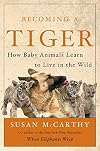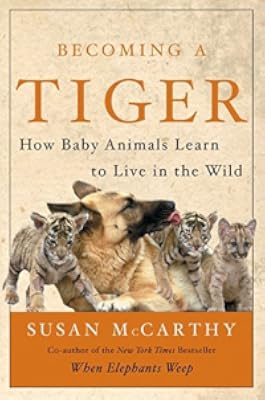
Becoming a Tiger: How Baby Animals Learn to Live in the Wild
by Susan McCarthy
On This Page
Description
Contrary to common belief, not everything is "hardwired"--or instinctual--in the animal kingdom. Many skills a wild animal needs to thrive, to grow, to be what nature intended, must be developed through play, painstaking teaching, and often treacherous trial and error. The coming-of-age processes of the myriad creatures of plain, forest, ocean, and jungle are truly fascinating natural events. In this book, McCarthy offers readers an in-depth look into the ways baby animals learn not only show more about themselves, but about their world and ours--and how to survive in both. Based on extensive scientific research done in the lab, in controlled "natural" settings, as well as in the wild, her findings provide new insights into the lives and development of Earth's nonhuman inhabitants--not only tigers, but lions, bears, bats, rats, birds, dolphins, whales, apes, elephants, and dozens of other species.--From publisher description. show lessTags
Recommendations








Member Reviews
Generally speaking I only like hard science books on animal behaviour and so I put off reading this for a while because I thought it would be fluffy stories of sweet little animals. It didn't help that the author often collaborates on books with Jeffrey Moussaieff, the master of the fluffy animal behavioural tome. However, one day, without any new book to read I thought I would give it a try. It was amazing!
The problem with the strictly-scientific animal behaviour books is that the research is generally done in laboratories where the animal lives an extremely deprived life. The problems it is expected to solve are ones that interest people, not necessarily ones that interest a bored animal. (Or person for that matter. I was recently show more reading of an experiment where the pigeons who got the answers right were rewarded with seeds to eat. They did a lot better than the test group of students who were only rewarded by a sound. Perhaps the students would have scored better given an M&M or gummy bear).
However, if an animal behaviour book is based solely on field and anectodal observation it has a tendency to be tainted with anthropomorphism. Hence my dislike for the overly-emotional Moussaieff books.
This often-amusing and very easy to read book is a mixture of hard science and scientist-gathered field observation and anecdotal reportage. Thus we learn that although gorillas when tested in a laboratory do not recognise themselves in mirrors, one gorilla who had not only a mirror but a video camera and monitor in his room could certainly recognise himself. He liked to eat his food up close to the camera and watch himself in the monitor. Further, he liked to shine a torch down his throat directly under the camera whilst looking in the monitor. Certainly this gorilla could identify himself and perhaps this means that all previous tests on gorillas have been badly-designed. Without this anecdotal information I would forever be thinking that gorillas couldn't recognise themselves.
Each section of the book moves along rapidly, each paragraph contains a gem of research or reportage, everything from the high problem solving abilities of the cannibalistic portia spider to the strange lengths humans sometimes go to in experiments. (In order for Whooping Cranes to avoid imprinting on people, the experimenters dressed up in crane suits, fed the birds with dummy cranes and when leading them on their first migration, the pilot of the plane was dressed in a crane suit too).
If you only ever read one book on animal behaviour and intelligence, make it this one, you will enjoy it. But then, this will hook you so much, it won't be your only one. Now I have to find more books by Susan McCarthy, she's got me hooked. show less
The problem with the strictly-scientific animal behaviour books is that the research is generally done in laboratories where the animal lives an extremely deprived life. The problems it is expected to solve are ones that interest people, not necessarily ones that interest a bored animal. (Or person for that matter. I was recently show more reading of an experiment where the pigeons who got the answers right were rewarded with seeds to eat. They did a lot better than the test group of students who were only rewarded by a sound. Perhaps the students would have scored better given an M&M or gummy bear).
However, if an animal behaviour book is based solely on field and anectodal observation it has a tendency to be tainted with anthropomorphism. Hence my dislike for the overly-emotional Moussaieff books.
This often-amusing and very easy to read book is a mixture of hard science and scientist-gathered field observation and anecdotal reportage. Thus we learn that although gorillas when tested in a laboratory do not recognise themselves in mirrors, one gorilla who had not only a mirror but a video camera and monitor in his room could certainly recognise himself. He liked to eat his food up close to the camera and watch himself in the monitor. Further, he liked to shine a torch down his throat directly under the camera whilst looking in the monitor. Certainly this gorilla could identify himself and perhaps this means that all previous tests on gorillas have been badly-designed. Without this anecdotal information I would forever be thinking that gorillas couldn't recognise themselves.
Each section of the book moves along rapidly, each paragraph contains a gem of research or reportage, everything from the high problem solving abilities of the cannibalistic portia spider to the strange lengths humans sometimes go to in experiments. (In order for Whooping Cranes to avoid imprinting on people, the experimenters dressed up in crane suits, fed the birds with dummy cranes and when leading them on their first migration, the pilot of the plane was dressed in a crane suit too).
If you only ever read one book on animal behaviour and intelligence, make it this one, you will enjoy it. But then, this will hook you so much, it won't be your only one. Now I have to find more books by Susan McCarthy, she's got me hooked. show less
Fascinating book filled with wonderful anecdotes that illustrate and enliven McCarthy's explanations. McCarthy's research is excellent, as shown by the detailed notes and lengthy biography, yet the book is very accessible and fun to read thanks to McCarthy's light touch and occasional humorously irreverent comment. As a popular book rather than a scholarly one it has much more breadth than depth, which makes it easy and fun to read.
Ratings
Members
- Recently Added By
Author Information

3+ Works 1,655 Members
Susan McCarthy holds degrees in biology and journalism, writes regularly for Salon.com, and has contributed to Best American Science Writing. She lives in San Francisco
Common Knowledge
- Original publication date
- 2004
- People/Characters
- Birute Galdikas; Kanzi
- Dedication
- For Mary Susan Kuhn
With love, gratitude, and respect - First words
- Introduction:
Why Learning?
Somehow a fuzzy, stumbling tiger kitten becomes a monstrously efficient killer. - Blurbers
- Prince-Hughes, Dawn; Masson, Jeffrey Moussaieff
Classifications
Statistics
- Members
- 121
- Popularity
- 270,530
- Reviews
- 2
- Rating
- (3.96)
- Languages
- English
- Media
- Paper, Ebook
- ISBNs
- 2
- ASINs
- 3