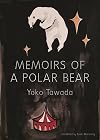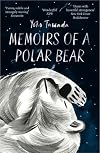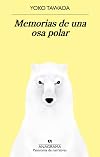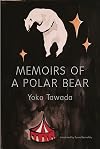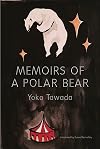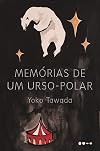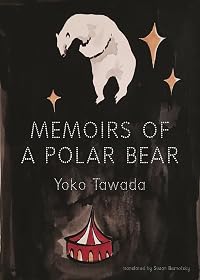
Memoirs of a Polar Bear
by Yōko Tawada
On This Page
Description
"The Memoirs of a Polar Bear is a novel that stars three generations of talented writers and performers who happen to be polar bears. The Memoirs of a Polar Bear has in spades what Rivka Galchen hailed in The New Yorker as "Yoko Tawada's magnificent strangeness"--Tawada is an author like no other. Three generations (grandmother, mother, son) of polar bears are famous, both as circus performers and writers in East Germany: they are polar bears who move in human society, stars of the ring and show more of the literary world. In Chapter One, the grandmother matriarch in the Soviet Union accidentally writes a bestselling autobiography. In Chapter Two, Tosca, her daughter (born in Canada, where her mother had emigrated) moves to the DDR and takes a job in the circus. Her son--the last of their line--is Knut, born in Chapter Three in a Leipzig zoo, but raised by a human keeper in relatively happy circumstances in the Berlin zoo, until his keeper, Matthias, is taken away... Happy or sad, each bear writes a story, enjoying both celebrity and "the intimacy of being alone with my pen.""-- show lessTags
Recommendations




Member Reviews
Etüden im Schnee is - amongst other things - a book about three (polar) bears and a little girl. But it's the magic-realist three bears novel that you might imagine Günter Grass, Angela Carter and Richard Adams getting together to write. Part one is narrated by the grandmother bear, who is writing her memoirs in between riding a tricycle in a Russian circus; part two is a joint effort by the East German mother bear Toska and her circus trainer Barbara, and part three is again a bear's-eye-view narrated by a slightly-fictionalised version of the greatest real polar-bear-celebrity of our times, Knut of the Berlin Zoo. There's also a guest appearance by a well-known US musician. Although it touches on World War II, the division and show more reunification of Germany, climate change, and other big topics, this isn't really a political novel - its real focus is on the relationship between people and animals. Tawada tries to get past the anthropomorphism and sentimentality to dig into what is really going on when people interact with animals. Interesting, beautifully written, and technically very ingenious, but I don't know if the result is really worth the effort.
The only obviously Japanese thing about this book was the use of coloured printed paper (with Arctic motifs) for dividers between the chapters, which I thought was a rather nice touch. Less successful was the idea of setting the entire text in Futura. I can't see what that was supposed to achieve - it is a typeface that really doesn't look good when it's packed together to fill a page. show less
The only obviously Japanese thing about this book was the use of coloured printed paper (with Arctic motifs) for dividers between the chapters, which I thought was a rather nice touch. Less successful was the idea of setting the entire text in Futura. I can't see what that was supposed to achieve - it is a typeface that really doesn't look good when it's packed together to fill a page. show less
I was immediately so curious when this book started showing up on recommendation lists. Described as a strange magical tale of three celebrity polar bears, in translation by a Japanese-German author - it was impossible that I could resist for long.
In the first part, an unnamed polar bear, a circus performer turned memoirist, becomes (unwillingly) a symbol for those opposed to the Soviet regime. In the second, her daughter, Tosca, is recruited from her career in the theater by an animal trainer trying to design a thrilling new circus routine. In the third, Tosca's son, Knut, becomes an international celebrity when he is born in a Berlin Zoo.
Examining home, identity, creative life in Communist countries, and even translating literature show more with a melancholic voice that often reminded me of Banana Yoshimoto. Only, you know, with polar bears and circuses. This book was a strange delight. show less
In the first part, an unnamed polar bear, a circus performer turned memoirist, becomes (unwillingly) a symbol for those opposed to the Soviet regime. In the second, her daughter, Tosca, is recruited from her career in the theater by an animal trainer trying to design a thrilling new circus routine. In the third, Tosca's son, Knut, becomes an international celebrity when he is born in a Berlin Zoo.
Examining home, identity, creative life in Communist countries, and even translating literature show more with a melancholic voice that often reminded me of Banana Yoshimoto. Only, you know, with polar bears and circuses. This book was a strange delight. show less
Three generations of a Polar bear family, each living in close proximity to humans, must try to make sense of an unnatural life. Definitely a unique plot written in marvelous prose, which frequently made me chuckle. Tawada is able to illustrate and point out many of the idiosyncrasies, inconsistencies, and absurdities of human cultures compared to life in the natural world. Ultimately, the reader sets down the book with feelings of embarrassment and shame, for good reason!
Ice, Ice, Baby
"Memoirs of a Polar Bear" is the 2016 English translation of Tawada's 2014 German language version "Etüden im Schnee" (Studies in the Snow) of her original 2011 Japanese language novel "雪の練習生 Yuki No Renshūsei" (Trainee in Snow). No details are provided here, but as Tawada writes in both Japanese and German, she probably did her own initial translation as well. The title change in English was presumably made to increase marketability.
Even though Tawada provides her polar bears with anthropomorphic (human-like) characteristics, even going so far as to letting them read and write, this is not a cutesy animal fable. It will cause you to think about the issues of animals in zoos and circuses providing so-called show more "entertainment" and even though their human-like thoughts here would be unlike animal thoughts in reality, you will still have cause to ponder what animals must be thinking.
Tawada takes this to the utmost fantasy extreme in her first generation of polar bears, where the Grandmother publishes her own autobiography and is a guest speaker at conferences. This is the most entertaining and unexpected part of the book. The middle generation of Tosca is a more conventional circus bear with the story being told from the point of view of her trainer Barbara. The 3rd generation is Knut who grows up in the Berlin Zoo after being rejected as a cub by his mother Tosca. If the cub's name sounds familiar it is because it is obviously based on the real-life Knut who grew up in the Berlin Zoo under similar circumstances(Warning: If you Google the real-life Knut, you will likely get a spoiler for how the story ends, if you don't know that already) . Human names have been changed but many elements of Knut's story are identical. You have just never read or heard it told from Knut's point of view before.
So yes it is a fantastical tale, but it is a human story as well. Even if some of the humans just happen to be polar bears. show less
"Memoirs of a Polar Bear" is the 2016 English translation of Tawada's 2014 German language version "Etüden im Schnee" (Studies in the Snow) of her original 2011 Japanese language novel "雪の練習生 Yuki No Renshūsei" (Trainee in Snow). No details are provided here, but as Tawada writes in both Japanese and German, she probably did her own initial translation as well. The title change in English was presumably made to increase marketability.
Even though Tawada provides her polar bears with anthropomorphic (human-like) characteristics, even going so far as to letting them read and write, this is not a cutesy animal fable. It will cause you to think about the issues of animals in zoos and circuses providing so-called show more "entertainment" and even though their human-like thoughts here would be unlike animal thoughts in reality, you will still have cause to ponder what animals must be thinking.
Tawada takes this to the utmost fantasy extreme in her first generation of polar bears, where the Grandmother publishes her own autobiography and is a guest speaker at conferences. This is the most entertaining and unexpected part of the book. The middle generation of Tosca is a more conventional circus bear with the story being told from the point of view of her trainer Barbara. The 3rd generation is Knut who grows up in the Berlin Zoo after being rejected as a cub by his mother Tosca. If the cub's name sounds familiar it is because it is obviously based on the real-life Knut who grew up in the Berlin Zoo under similar circumstances
So yes it is a fantastical tale, but it is a human story as well. Even if some of the humans just happen to be polar bears. show less
When would Matthias show his face again? How unendurable Knut found this question, or maybe it wasn't the question, it was just the time he spent waiting, he thought. Once time began to exist, it was impossible for it to end on its own.
Magical realism has always been a bit of a hit and miss for me. I used to devour anything [a:Haruki Murakami|3354|Haruki Murakami|https://images.gr-assets.com/authors/1470611596p2/3354.jpg] wrote a few years ago; however, I don’t think I would enjoy [b:Norwegian Wood|11297|Norwegian Wood|Haruki Murakami|https://images.gr-assets.com/books/1386924361s/11297.jpg|2956680] today as much, but I would probably appreciate the [b:The Wind-Up Bird Chronicle|11275|The Wind-Up Bird Chronicle|Haruki show more Murakami|https://images.gr-assets.com/books/1327872639s/11275.jpg|2531376] even more. Ultimately, I guess it depends on how I choose to approach it at a certain point in time. In this case, it’s safe to say that [b:Memoirs of a Polar Bear|29082575|Memoirs of a Polar Bear|Yōko Tawada|https://images.gr-assets.com/books/1463185936s/29082575.jpg|49314763] came at the right time for me.
This novel tells the story of three generations of polar bears, through which we are able to explore different issues and human-animal relationships. These three voices share a common theme, namely analyzing things through the eyes of an outsider: coming from a foreign country, speaking a different language and, of course, embodying a different species.
First off, we get to know a polar bear from the USSR who finds her true calling as a writer after retiring from the circus. She starts writing her autobiography and, upon achieving moderate success, is forced into exile. One detail that I particularly enjoyed is that, once she is settled in Germany, she decides to continue writing her work in German, rather than Russian. Her editor opposes to her decision, since he fears that writing in a language other than her mother tongue might hinder her creativity. However, the concept of having a “mother tongue” is also foreign to the polar bear, since she doesn’t think her mother is represented by any language. After researching [a:Yōko Tawada|92441|Yōko Tawada|https://images.gr-assets.com/authors/1417910366p2/92441.jpg]'s biography, it becomes clear that this is an obvious nod to her experience and career, as she herself is an exophonic writer. In fact, I was surprised to find out that Memoirs of a Polar Bear had been translated from German.
In the second part, we meet Tosca, her daughter, a successful circus performer from East Berlin. The tone shifts abruptly as the story is told from her trainer’s perspective, rather than the bear’s. By the end of this story, it becomes difficult to tell who the real narrator is. Is it the trainer telling Tosca’s story, or is it Tosca telling the story of the trainer telling Tosca’s story?
Lastly, Tosca is sold to the Berlin Zoo, where she gives birth to Knut and his brother. Knut is the only survivor who, after being rejected from his own mother, must be raised by zookeepers Matthias and Christian. Needless to say, it’s not a coincidence: Knut was a very famous polar bear born and raised in the Berlin Zoo in 2006, who unfortunately passed away at the age of four. Knut’s story brings into question issues of animal welfare, especially what it means for wild animals to be raised and kept by humans.
Overall, I would say this was a thoroughly enjoyable read-- funny, tender, but also heartbreaking at times. However, I didn't get the sudden ending or the purpose of the character introduced in the last few pages. show less
Magical realism has always been a bit of a hit and miss for me. I used to devour anything [a:Haruki Murakami|3354|Haruki Murakami|https://images.gr-assets.com/authors/1470611596p2/3354.jpg] wrote a few years ago; however, I don’t think I would enjoy [b:Norwegian Wood|11297|Norwegian Wood|Haruki Murakami|https://images.gr-assets.com/books/1386924361s/11297.jpg|2956680] today as much, but I would probably appreciate the [b:The Wind-Up Bird Chronicle|11275|The Wind-Up Bird Chronicle|Haruki show more Murakami|https://images.gr-assets.com/books/1327872639s/11275.jpg|2531376] even more. Ultimately, I guess it depends on how I choose to approach it at a certain point in time. In this case, it’s safe to say that [b:Memoirs of a Polar Bear|29082575|Memoirs of a Polar Bear|Yōko Tawada|https://images.gr-assets.com/books/1463185936s/29082575.jpg|49314763] came at the right time for me.
This novel tells the story of three generations of polar bears, through which we are able to explore different issues and human-animal relationships. These three voices share a common theme, namely analyzing things through the eyes of an outsider: coming from a foreign country, speaking a different language and, of course, embodying a different species.
First off, we get to know a polar bear from the USSR who finds her true calling as a writer after retiring from the circus. She starts writing her autobiography and, upon achieving moderate success, is forced into exile. One detail that I particularly enjoyed is that, once she is settled in Germany, she decides to continue writing her work in German, rather than Russian. Her editor opposes to her decision, since he fears that writing in a language other than her mother tongue might hinder her creativity. However, the concept of having a “mother tongue” is also foreign to the polar bear, since she doesn’t think her mother is represented by any language. After researching [a:Yōko Tawada|92441|Yōko Tawada|https://images.gr-assets.com/authors/1417910366p2/92441.jpg]'s biography, it becomes clear that this is an obvious nod to her experience and career, as she herself is an exophonic writer. In fact, I was surprised to find out that Memoirs of a Polar Bear had been translated from German.
In the second part, we meet Tosca, her daughter, a successful circus performer from East Berlin. The tone shifts abruptly as the story is told from her trainer’s perspective, rather than the bear’s. By the end of this story, it becomes difficult to tell who the real narrator is. Is it the trainer telling Tosca’s story, or is it Tosca telling the story of the trainer telling Tosca’s story?
Lastly, Tosca is sold to the Berlin Zoo, where she gives birth to Knut and his brother. Knut is the only survivor who, after being rejected from his own mother, must be raised by zookeepers Matthias and Christian. Needless to say, it’s not a coincidence: Knut was a very famous polar bear born and raised in the Berlin Zoo in 2006, who unfortunately passed away at the age of four. Knut’s story brings into question issues of animal welfare, especially what it means for wild animals to be raised and kept by humans.
Overall, I would say this was a thoroughly enjoyable read-- funny, tender, but also heartbreaking at times. However, I didn't get the sudden ending or the purpose of the character introduced in the last few pages. show less
Most definitely a very odd story, but there are many layers involved and I think it illustrates several themes quite well, despite the eccentric manner in which the author chose to tell the story (via polar bears). I would say that this book has a lot of similarities with a style I've seen very often lately in German literary fiction - another example would be BEFORE THE FEAST.
In MEMOIRS OF A POLAR BEAR, Yoko Tawada examines what it means to be human by using polar bears to narrate stories of life in circuses and zoos. The story is quite existentialist, and consequently, absolutely fascinating. Tawada also probes themes such as love versus imprisonment (we humans capture animals and force them to perform circus acts which is cruel, but show more the trainers feel real love towards these animals/captivity in zoos is cruel, but we love zoos because we love animals), human nature versus animal nature (the author boldly crosses boundaries between the two), and of course, because this is a book narrated by polar bears, there are subtle but strong references to climate change.
This book is definitely an acquired taste. show less
In MEMOIRS OF A POLAR BEAR, Yoko Tawada examines what it means to be human by using polar bears to narrate stories of life in circuses and zoos. The story is quite existentialist, and consequently, absolutely fascinating. Tawada also probes themes such as love versus imprisonment (we humans capture animals and force them to perform circus acts which is cruel, but show more the trainers feel real love towards these animals/captivity in zoos is cruel, but we love zoos because we love animals), human nature versus animal nature (the author boldly crosses boundaries between the two), and of course, because this is a book narrated by polar bears, there are subtle but strong references to climate change.
This book is definitely an acquired taste. show less
I won this as a prize for the winter readathon at my library, and it does look interesting enough to read, so ok.
Read at the most superficial level, the blurb reminds me of the picturebook stories about Larry, Irving, and Muktuk by [a:Daniel Pinkwater|20575|Daniel Pinkwater|https://images.gr-assets.com/authors/1218645652p2/20575.jpg]. The cover reminds me very superficially of The Night Circus. But of course I'll try to read it for its own merits, whenever I get around to it.
---------------
Ok done.
Ambitious... almost succeeds.
Seems original, no doubt, to some readers, but I was reminded of [b:I Am a Cat|62772|I Am a Cat|Sōseki show more Natsume|https://i.gr-assets.com/images/S/compressed.photo.goodreads.com/books/1364139690i/62772._SY75_.jpg|60969], [b:The Bear Went Over the Mountain|225691|The Bear Went Over the Mountain|William Kotzwinkle|https://i.gr-assets.com/images/S/compressed.photo.goodreads.com/books/1388378538i/225691._SY75_.jpg|1555086], and even [b:Life of Pi|4214|Life of Pi|Yann Martel|https://i.gr-assets.com/images/S/compressed.photo.goodreads.com/books/1320562005i/4214._SY75_.jpg|1392700]. And of course there's obviously a lot of 'write what you know' going on, given the author's background.
Lots of cleverness. Some beautiful poetic stylings in the beginning that some readers might roll their eyes at, but that I missed when the prose become more, erm, prosaic. Lots of metaphorical themes & commentaries, what with allusions to climate change, East & West Berlin, racism, art, celebrities (took me a minute, but I did finally realize that Michael was pop star Michael Jackson. ), etc. A *L*iterary scholar would have fun dissecting it.
But I think there's a larger message, something to unite the three stories, the generations, and I could not find it. It's definitely not a genre saga, nor is it really about polar bears (though I did learn a lot about them from a scientific pov). What it is, I just couldn't figure out. And it just plain ends, no resolution, no looking towards the future.
I can guess that it might be a sort of 'magical realism' - which I don't normally read and so am not qualified to say anything about - since the group Play Book Tag is doing m.r. this month I will report it there, maybe somebody will have a clue.
From the enchanting beginning:
"The willow trees, elegant, cunning, and overcome with ennui, kept poking their thin fingers into the water, perhaps hoping it would play with them. Pale green shoots punctuated their branches."
(Which reminds me, kudos to the translator, and kudos to the publisher for giving her more credit than is usually given.)
Later, random bits of philosophy and politics show up. A minor character spouts:
"I find it lamentable that we have to keep eating all the time so as not to just die on the spot. I detest 'gourmets.' The act as if food were an ornament that increases the aesthetic value of their lives. Which only works if they suppress all thought of how miserable it is that they have to eat at all." show less
Read at the most superficial level, the blurb reminds me of the picturebook stories about Larry, Irving, and Muktuk by [a:Daniel Pinkwater|20575|Daniel Pinkwater|https://images.gr-assets.com/authors/1218645652p2/20575.jpg]. The cover reminds me very superficially of The Night Circus. But of course I'll try to read it for its own merits, whenever I get around to it.
---------------
Ok done.
Ambitious... almost succeeds.
Seems original, no doubt, to some readers, but I was reminded of [b:I Am a Cat|62772|I Am a Cat|Sōseki show more Natsume|https://i.gr-assets.com/images/S/compressed.photo.goodreads.com/books/1364139690i/62772._SY75_.jpg|60969], [b:The Bear Went Over the Mountain|225691|The Bear Went Over the Mountain|William Kotzwinkle|https://i.gr-assets.com/images/S/compressed.photo.goodreads.com/books/1388378538i/225691._SY75_.jpg|1555086], and even [b:Life of Pi|4214|Life of Pi|Yann Martel|https://i.gr-assets.com/images/S/compressed.photo.goodreads.com/books/1320562005i/4214._SY75_.jpg|1392700]. And of course there's obviously a lot of 'write what you know' going on, given the author's background.
Lots of cleverness. Some beautiful poetic stylings in the beginning that some readers might roll their eyes at, but that I missed when the prose become more, erm, prosaic. Lots of metaphorical themes & commentaries, what with allusions to climate change, East & West Berlin, racism, art, celebrities (
But I think there's a larger message, something to unite the three stories, the generations, and I could not find it. It's definitely not a genre saga, nor is it really about polar bears (though I did learn a lot about them from a scientific pov). What it is, I just couldn't figure out. And it just plain ends, no resolution, no looking towards the future.
I can guess that it might be a sort of 'magical realism' - which I don't normally read and so am not qualified to say anything about - since the group Play Book Tag is doing m.r. this month I will report it there, maybe somebody will have a clue.
From the enchanting beginning:
"The willow trees, elegant, cunning, and overcome with ennui, kept poking their thin fingers into the water, perhaps hoping it would play with them. Pale green shoots punctuated their branches."
(Which reminds me, kudos to the translator, and kudos to the publisher for giving her more credit than is usually given.)
Later, random bits of philosophy and politics show up. A minor character spouts:
"I find it lamentable that we have to keep eating all the time so as not to just die on the spot. I detest 'gourmets.' The act as if food were an ornament that increases the aesthetic value of their lives. Which only works if they suppress all thought of how miserable it is that they have to eat at all." show less
Members
- Recently Added By
Lists

Speculative Fiction from around the World
610 works; 18 members

Mooie titels
80 works; 1 member

To Read List
21 works; 1 member

Random Internet Recommendations
18 works; 1 member
Author Information

78+ Works 2,785 Members
Some Editions
Awards and Honors
Awards
Common Knowledge
- Canonical title
- Memoirs of a Polar Bear
- Original title
- Etüden im Schnee
- Alternate titles
- 雪の練習生
- Original publication date
- 2014
- Important places
- Germany; Berlin, Germany; Japan
- First words*
- Jemand kitzelte mich hinter den Ohren, unter den Achseln, ich krümmte mich, wurde zu einem Vollmond und rollte auf dem Boden.
- Last words*
- (Click to show. Warning: May contain spoilers.)Der Schnee war ein Raumschiff, nahm mich mit und flog so geschwind, wie er konnte, in Richtung des Schädels, es war der Schädel unserer Erde.
- Original language
- German
*Some information comes from Common Knowledge in other languages. Click "Edit" for more information.
Classifications
Statistics
- Members
- 440
- Popularity
- 69,799
- Reviews
- 16
- Rating
- (3.36)
- Languages
- 12 — Czech, Danish, Dutch, English, Finnish, French, German, Italian, Japanese, Portuguese, Spanish, Swedish
- Media
- Paper, Audiobook, Ebook
- ISBNs
- 23
- ASINs
- 6