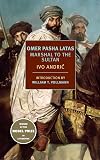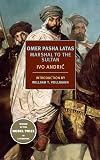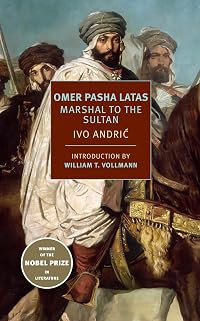
Omer Pasha Latas: Marshal to the Sultan
by Ivo Andrić
On This Page
Description
This previously untranslated historical novel by the Nobel Prize-winner Andric tells the story of Omer Pasha Latas, born Mihailo Latas, a Serbian Christian who rose to a position of power in the Ottoman Empire. When Mihailo's chances of a military career in Austria fail, he flees across the border into Ottoman Bosnia, converts to Islam, and makes his way to Istanbul where his exceptional intelligence and qualities as a potential military leader are recognized by the sultan. Having show more distinguished himself in mercilessly suppressing uprisings in Albania, Syria, and Kurdistan, and subsequently in Montenegro, Herzegovina, and Albania, Omer Pasha is sent to Bosnia in 1850 to quell resistance by local landowners to modernizing reforms. Now in the land of his fathers, Omer Pasha's display and misuse of power is all the more urgent but also more complex. Along with an exquisitely drawn array of local characters, Ivo Andric portrays a man who is both supremely arrogant and pitifully vulnerable, and a city in the grip of fear. show lessTags
Recommendations










Member Reviews
The inhabitants of Sarajevo had good reason for alarm that day in 1850. The Sultan in far off Istanbul was sending his latest seraskier to impose order by whatever means required in this distant part of his Ottoman Empire. This time around, the seraskier arrived with a large well equipped army. Its leader had quelled rebellions in Albania, Syria and Kurdistan already. His mission here was to discipline and bring to heel not the rebellious populace nor an external enemy but those who had ruled Bosnia for centuries and who had until the previous day been called the sultan's sons: the beys, the leaders and members of the most prominent families. ... He was not coming as an authority to rule and manage, but to wage war and punish.
Who was show more this potentate? His Turkish name was Omer Pasha Latas, and he was a convert to the Muslim faith. The people of Bosnia and Herzegovinia, however, knew that this man who held the highest military office in the sultan's forces was not only a former Christian, but also an Austrian, Micó Latas; a man who had fled that country for Bosnia twenty-five years earlier, then made his way to Turkey. There, through diligence and hard work, he had achieved his current status. These were characteristics to be admired. Yet such a transformation also requires a mastery of deceit to hide away and bury one part of life. In other words, this was a man to be feared.
This idea of a person from two worlds, one who never really fits into either, is a theme to which Andrić returns again and again throughout the book. Unfinished at the time of his death, it is not really a novel, but rather a series of sketches of those around Omer Pasha. Each is not only complete in itself, but also serves to give the reader another piece of the puzzle that is Omer. Each of these characters shares in one way or another that lack of belonging. There is a pervading sense of loneliness in this book, an inability to make human connections, even though some of these very same people are indispensable to the Bosnian foray. The vignette technique highlights this.
Eventually this army too will leave, "... a blessing in this country where pleasure is scarce." Over a hundred years later, Andrić knew this all too well about his country, a place with its own conflicting worlds. Switching from third person narrator to first person as the army finally leaves, he says What counts is that they are leaving, vanishing, disappearing, at least from our country, and we are staying on our own land, to endure, to live out our lives, to eat their bread as well as our own, and to warm ourselves in this sun, which was once also theirs. That is the only victory of which we are capable. And it is our right that we be victorious. show less
Who was show more this potentate? His Turkish name was Omer Pasha Latas, and he was a convert to the Muslim faith. The people of Bosnia and Herzegovinia, however, knew that this man who held the highest military office in the sultan's forces was not only a former Christian, but also an Austrian, Micó Latas; a man who had fled that country for Bosnia twenty-five years earlier, then made his way to Turkey. There, through diligence and hard work, he had achieved his current status. These were characteristics to be admired. Yet such a transformation also requires a mastery of deceit to hide away and bury one part of life. In other words, this was a man to be feared.
This idea of a person from two worlds, one who never really fits into either, is a theme to which Andrić returns again and again throughout the book. Unfinished at the time of his death, it is not really a novel, but rather a series of sketches of those around Omer Pasha. Each is not only complete in itself, but also serves to give the reader another piece of the puzzle that is Omer. Each of these characters shares in one way or another that lack of belonging. There is a pervading sense of loneliness in this book, an inability to make human connections, even though some of these very same people are indispensable to the Bosnian foray. The vignette technique highlights this.
Eventually this army too will leave, "... a blessing in this country where pleasure is scarce." Over a hundred years later, Andrić knew this all too well about his country, a place with its own conflicting worlds. Switching from third person narrator to first person as the army finally leaves, he says What counts is that they are leaving, vanishing, disappearing, at least from our country, and we are staying on our own land, to endure, to live out our lives, to eat their bread as well as our own, and to warm ourselves in this sun, which was once also theirs. That is the only victory of which we are capable. And it is our right that we be victorious. show less
Ratings
Members
- Recently Added By
Author Information

239+ Works 4,895 Members
Ivo Andric was born October 10, 1892, in Docu, Bosnia. He was raised in Bosnia, a region of violent political turmoil for centuries. As a young patriot, Andric became associated with political organizations, leading to his imprisonment for three years during World War I. He was also under virtual house arrest during World War II. While imprisoned show more Andric wrote his most creative material as he explored the agonies of Bosnia's oppression and exploitation. His World War I incarceration led to Ex Ponto, his collection of prison meditations and philosophy. His World War II house arrest provided Andric with the material and time to produce his most memorable novels, known as the Bosnian trilogy-Gospodjica (The Woman From Sarajevo), Travnicka hronicka (Bosnian Story or Chronicle), and Na Drini cuprija (The Bridge on the Drina). His devotion to truth and morality in times of despair and struggle is one of his strengths. His work has been translated into German, French, Russian, Spanish, and Italian. After the wars, Andric served as a Yugoslav diplomat, deputy, and representative from Bosnia. He was a member of the Federation of Writers of Yugoslavia. Andric was awarded the Prize for Life Work from the Yugoslav government in 1956, the Nobel Prize for Literature in 1961, and was bestowed an honorary doctorate from the University of Krakon in 1964. Andric died March 13, 1975, in Belgrade, Yugoslavia. (Bowker Author Biography) show less
Some Editions
Awards and Honors
Series
Belongs to Publisher Series
Common Knowledge
- Canonical title
- Omer Pasha Latas: Marshal to the Sultan
- Original title
- Omerpaša Latas
- Important places*
- Servië
- Original language
- Serbo-Croatian
- Disambiguation notice
- Omer Pasha Latas (a novel) is not the same work as The Pasha's Concubine and Other Tales (a volume of short stories).
*Some information comes from Common Knowledge in other languages. Click "Edit" for more information.
Classifications
- Genres
- Fiction and Literature, General Fiction, Historical Fiction
- DDC/MDS
- 891.8 — Literature & rhetoric Literatures of other languages East Indo-European and Celtic literatures West and South Slavic languages (Bulgarian, Slovene, Polish, Czech, Slovak, Serbo-Croatian, and Macedonian)
- LCC
- PG1418 .A6 .O513 — Language and Literature Slavic languages and literatures. Baltic languages. Albanian language Slavic. Baltic. Albanian Serbo-Croatian
- BISAC
Statistics
- Members
- 160
- Popularity
- 205,451
- Reviews
- 1
- Rating
- (3.78)
- Languages
- 7 — English, French, German, Hungarian, Polish, Serbian, Turkish
- Media
- Paper, Ebook
- ISBNs
- 16
- ASINs
- 4