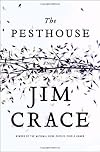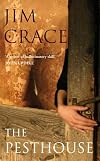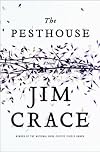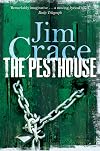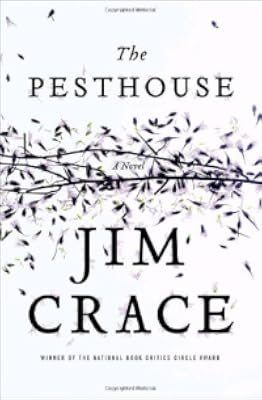
The Pesthouse
by Jim Crace
On This Page
Description
Fiction. Literature. HTML:Once the safest, most prosperous place on earth, the United States has become sparsely populated and chaotically unstable. Across the country, families have traveled toward the one hope left: passage on a ship to Europe. As Franklin Lopez makes his way towards the ocean, he finds Margaret, a sick woman shunned to die in isolation. Tentatively, the two join forces, heading towards their future. With striking prose and a deep understanding of the American ethos, Jim show more Crace, one of our most consistently ambitious writers, creates in The Pesthouse a masterful tale of the human drive to endure. show lessTags
Recommendations






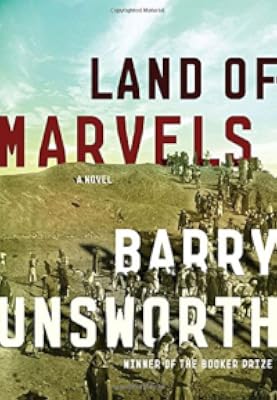
Member Recommendations
urania1 If you enjoy dystopian fiction or long for "literary" science fiction, read this book. It deals with the big questions, namely can people retain their humanity in dehumanizing conditions?
47degreesnorth More literary and more detailed characters. Post-apocalyptic.
BookshelfMonstrosity Spare prose and unexpectedly moving romances characterize these post-apocalyptic novels, set in bleak futures in which humanity has been decimated by horrible diseases.
11
Member Reviews
I am a big fan of Jim Crace and treat his novels like a warm blanket, although his subjects are not always easy. I have had this one on the shelf for some time saving it for a time when his wonderful prose was just what I needed. In the Pesthouse he takes us to a regressing America, where 'People were becoming scarce. America was emptying.' This is a novel of a rural America, there are highwaymen and human dangers but little sense of wild animals. Occasionally a relic of the former industrial America is stumbled upon. He writes with poetic sentences that are never a 'difficult' read, they flow. Jim Crace's characters are characters you know, they are people who doubt themselves, who are awkward and lonely. He writes affectionately about show more these people and understands their stories. The novel has a sense of the wild west, a sense of the medieval and a sense of the future, it is an excellent read. show less
I really enjoyed this story of an apocalyptic America in which Margaret, a woman who recovered from the deadly disease called flux, and Franklin, a large man with a disabling knee injury, knew that they had to flee east to escape America by ship without even knowing what that would entail. I found both of their stories intriguing in that what happened to each seemed unique and unpredictable. The writing was very beautiful. I am a fan of this author and would gladly read more of his works.
If I could write, I’d want to write like Jim Crace. From the first moment I first discovered his The Gift of Stones he entered my list of ‘favourite authors’ alongside Graham Swift, Heinrich Böll, Iain M Banks, Juan José Saer and very few others. The kind of writer you check the shelves for every single time you enter a bookshop; then when you buy the latest book you leave it unopened a while, savouring the anticipation, fearing that once you’ve read it there’ll be no more Jim Crace to discover unless he writes another; and the day may come when he won’t. He’s already hinted that, though thankfully it now seems that two more are in the pipeline.
The Pesthouse is not his masterpiece (see Arcadia for that) but it is solid show more reliable Crace. Reading it I was in familiar territory. First, it reminded me of Signals of Distress though I can’t say why other than a feeling about the attitudes portrayed. Then it recalled The Gift of Stones and it is, in a sense, its mirror image, evoking a world that is regressing. Later again I felt stirrings of Quarantine with the trek across the wilderness and Being Dead with all the death and decomposition. That’s the thing about Crace; his books may be all about different things but they’re fashioned from the same tools. His sentences are short and poetic. His characters are lonely people, inhabiting slightly surreal but still recognisable worlds. There is an overarching misanthropy, tempered by great affection for individual characters.
Crace described Pesthouse as follows:
The novel provides America not with a science fiction future but with something that it has always wanted and lacked – a medieval “past”, an ancient European experience.
In some ways we’ve been there many times before in science fiction, and also in westerns. It’s the post-apocalyptic world of Mad Max inhabited by the grubby frontier people of High Plains Drifter but without any heroic ‘man-with-no-name’ to take revenge on wrong-doers. This is a western told in the European style. Cormac McCarthy came close in The Border Trilogy but ultimately Crace’s characters, timid, fearful and chaste, strike me as most believable. show less
The Pesthouse is not his masterpiece (see Arcadia for that) but it is solid show more reliable Crace. Reading it I was in familiar territory. First, it reminded me of Signals of Distress though I can’t say why other than a feeling about the attitudes portrayed. Then it recalled The Gift of Stones and it is, in a sense, its mirror image, evoking a world that is regressing. Later again I felt stirrings of Quarantine with the trek across the wilderness and Being Dead with all the death and decomposition. That’s the thing about Crace; his books may be all about different things but they’re fashioned from the same tools. His sentences are short and poetic. His characters are lonely people, inhabiting slightly surreal but still recognisable worlds. There is an overarching misanthropy, tempered by great affection for individual characters.
Crace described Pesthouse as follows:
The novel provides America not with a science fiction future but with something that it has always wanted and lacked – a medieval “past”, an ancient European experience.
In some ways we’ve been there many times before in science fiction, and also in westerns. It’s the post-apocalyptic world of Mad Max inhabited by the grubby frontier people of High Plains Drifter but without any heroic ‘man-with-no-name’ to take revenge on wrong-doers. This is a western told in the European style. Cormac McCarthy came close in The Border Trilogy but ultimately Crace’s characters, timid, fearful and chaste, strike me as most believable. show less
Crace's novel The Pesthouse is a love story set against the backdrop of an America centuries in the future, long after some calamity has wiped away our technological culture and the nation-state known as the United States. What ancestral memory remains is shroulded in legend and myth. America has become a thinly-populated land ravaged by disease and prowled by bands of brutal men in search of plunder, whether in material form such as valuable metal objects or in human form as women to be raped and young men to be enslaved.
Amidst this grim setting, two young people, a woman named Margaret, consigned to a pesthouse as she suffers from a malady resembling the plague, and a younger man named Franklin, separated from his brother in their show more journey to the Atlantic coast and the ships bound for Europe, meet and become companiions and platonic lovers. Franklin and Margaret are torn apart when they are set upon by a band of thieves and slavers. After a hard winter, they are reunited. Margaret has "adopted" a baby girl left in her custody, another love story.
They learn a hard truth upon reaching the coast and then turn back to build new lives as a family in the interior of America. Despite the violence and squalor Crace depicts in the novel, there are also passages of lyrical beauty describing the land, moments of tenderness and sweet humor among the family, and episodes in which compassion and empathy prevail over the savagery of a land of hardness and danger. This wild and harsh America of the future is still a land that can inspire hope in those restless adventurers willing to push out toward the horizon. show less
Amidst this grim setting, two young people, a woman named Margaret, consigned to a pesthouse as she suffers from a malady resembling the plague, and a younger man named Franklin, separated from his brother in their show more journey to the Atlantic coast and the ships bound for Europe, meet and become companiions and platonic lovers. Franklin and Margaret are torn apart when they are set upon by a band of thieves and slavers. After a hard winter, they are reunited. Margaret has "adopted" a baby girl left in her custody, another love story.
They learn a hard truth upon reaching the coast and then turn back to build new lives as a family in the interior of America. Despite the violence and squalor Crace depicts in the novel, there are also passages of lyrical beauty describing the land, moments of tenderness and sweet humor among the family, and episodes in which compassion and empathy prevail over the savagery of a land of hardness and danger. This wild and harsh America of the future is still a land that can inspire hope in those restless adventurers willing to push out toward the horizon. show less
First Line: Everybody died at night.
In the fishing village along the riverbank-- a place called Ferrytown that likes to charge exorbitant fees to any stranger traveling through-- Margaret is showing definite signs of sickness. Her head is shaved, and she is taken to a small stone cottage where she is left to recover... or to die. She is found by a young man named Franklin, and together they begin a long journey through an America laid waste by this disease they call the flux. Margaret and Franklin will be traveling through an America reduced to medieval methods of living where everyone hopes to make it to the East Coast to pay for passage on a ship bound for Europe-- the Promised Land. The couple will have many adventures along the show more way.
Crace swiftly sets the tone of his book and makes his readers uneasy in the prologue: "This used to be America, this river crossing in the ten-month stretch of land, this sea-to-sea. It used to be the safest place on earth." Franklin is young and impulsive, which soon leads to trouble. Margaret is older and used to staying beneath the radar. She is the more observant and adaptable one. As they pass the rusted-out hulks of factories and the weed-choked arteries of disused highways, Crace leads us further and further away from our traditional American values of progress, technology and industriousness.
It is an engrossing journey, but one that I never completely believed. Although I liked the characters of Margaret and Franklin, and I found Crace's view of an America forgotten by history to be quite interesting, I felt as though I were being held at a distance... as though I had the flux. If not for that No Man's Land between the characters and me, I would rate this book even higher. Unfortunately, this lover of dystopian fiction felt a bit quarantined. show less
In the fishing village along the riverbank-- a place called Ferrytown that likes to charge exorbitant fees to any stranger traveling through-- Margaret is showing definite signs of sickness. Her head is shaved, and she is taken to a small stone cottage where she is left to recover... or to die. She is found by a young man named Franklin, and together they begin a long journey through an America laid waste by this disease they call the flux. Margaret and Franklin will be traveling through an America reduced to medieval methods of living where everyone hopes to make it to the East Coast to pay for passage on a ship bound for Europe-- the Promised Land. The couple will have many adventures along the show more way.
Crace swiftly sets the tone of his book and makes his readers uneasy in the prologue: "This used to be America, this river crossing in the ten-month stretch of land, this sea-to-sea. It used to be the safest place on earth." Franklin is young and impulsive, which soon leads to trouble. Margaret is older and used to staying beneath the radar. She is the more observant and adaptable one. As they pass the rusted-out hulks of factories and the weed-choked arteries of disused highways, Crace leads us further and further away from our traditional American values of progress, technology and industriousness.
It is an engrossing journey, but one that I never completely believed. Although I liked the characters of Margaret and Franklin, and I found Crace's view of an America forgotten by history to be quite interesting, I felt as though I were being held at a distance... as though I had the flux. If not for that No Man's Land between the characters and me, I would rate this book even higher. Unfortunately, this lover of dystopian fiction felt a bit quarantined. show less
They say that you should never judge a book by its cover, but never mention the seduction of a great title. I have been lured in by many a lovely title only to have the content be merely adequate, as if the only thing they had was the title and the rest of the story was just an afterthought. I almost did not read Pesthouse because of its non-cozy title. One would think that for a girl who loves apocalypse non-cozy is a must, but no. Beauty, art and well crafted prose are still a requirement.
The book told a simple story of two people who struggle to survive, struggle with love, and struggle with remaining true in a world where survival has altered what we as a people once were. It really is a tender tale with questions on what America show more used to be artfully mixed in. They marveled at destroyed cities, and pondered the use of unknown items. The characters were adults and had known only the destroyed world, yet no crazy, absurd mysticism had sprouted up and rules of polite society still existed. The bad is there, yet not the ugly and heavy handed evil that so many authors love to use when talking about how we as humans will decline. Our characters Margaret and Pigeon have their flaws, their vanities, their skills, and their stupidities, yet you fall in love with them as their mix of innocence and knowledge of the struggle to survive carries them across America.
The journey is a common theme in apocalypse novels. It has been done over and over, and I groaned just a bit when my characters set off to the unknown sea for a boat that would take them to a new America. Usually stories use this time to show just how destroyed the world is, and the characters almost always face more violence, more ugliness and more evil as they travel. The end of the journey is the end of the book, and we are all thankful that it is over. It is in a way a natural progression through a story, and it has been abused by many, many writers. Yet this story seemed valid to me. The agonies, struggles and beauties that were happened upon as they journeyed seemed to tell a truer tale then the oh so popular The Road to me. I felt as if I was following immigrants trying to make it to a new world. Their wonder and learning was not foolish, or overdone. The hardships faced were not raving lunatics or half mad cannibals.
I am glad that the harsh title did not turn me away. Inside I found a tale that answered the questions on what we could become if the big bad happened with optimism, bravery, a fair bit of luck, and a smidge of old fashioned romanticism. show less
The book told a simple story of two people who struggle to survive, struggle with love, and struggle with remaining true in a world where survival has altered what we as a people once were. It really is a tender tale with questions on what America show more used to be artfully mixed in. They marveled at destroyed cities, and pondered the use of unknown items. The characters were adults and had known only the destroyed world, yet no crazy, absurd mysticism had sprouted up and rules of polite society still existed. The bad is there, yet not the ugly and heavy handed evil that so many authors love to use when talking about how we as humans will decline. Our characters Margaret and Pigeon have their flaws, their vanities, their skills, and their stupidities, yet you fall in love with them as their mix of innocence and knowledge of the struggle to survive carries them across America.
The journey is a common theme in apocalypse novels. It has been done over and over, and I groaned just a bit when my characters set off to the unknown sea for a boat that would take them to a new America. Usually stories use this time to show just how destroyed the world is, and the characters almost always face more violence, more ugliness and more evil as they travel. The end of the journey is the end of the book, and we are all thankful that it is over. It is in a way a natural progression through a story, and it has been abused by many, many writers. Yet this story seemed valid to me. The agonies, struggles and beauties that were happened upon as they journeyed seemed to tell a truer tale then the oh so popular The Road to me. I felt as if I was following immigrants trying to make it to a new world. Their wonder and learning was not foolish, or overdone. The hardships faced were not raving lunatics or half mad cannibals.
I am glad that the harsh title did not turn me away. Inside I found a tale that answered the questions on what we could become if the big bad happened with optimism, bravery, a fair bit of luck, and a smidge of old fashioned romanticism. show less
The pesthouse is Jim Crace's seventh novel, published in 2007. It is another novel, among many, of a distopian future, in which people are desperate to leave the United States. The books contains many story elements from similar novels in the genre, and immediately calls Cormac McCarthy's novel The Road to mind. However, The pesthouse is not as horrific and offers more of an idyll.
In fact, the realization that the novel is set in the future comes very late in the book, as the hatred of iron cannot be otherwise explained. The pesthouse is very well-written, and particularly the first chapter, ominous and dark, is extremely well conceived and executed. It is borne of a magnificent idea, and perfectly executed, and seems to be a core show more element in the work of Crace in its dark pondering of death. Subsequent chapters are also extremely well-written, and th novel as a whole is very enjoyable to read.
It seems a bit odd that such a distopian novel about America is written by a British author, and at a deeper level this does seem significant. Unlike The Road, The pesthouse is not all bleak and pessimistic. Various story elements seem to draw on the typical American experience, such as the frontier exerpience, aptly reversed in people trekking to the East, in almost equal circumstances as the famous expansion to the West. The religious sekt which harbours and shelters refugees like an ark, and the procedures to come on board are about as strict as boarding an airplane to the US in our own days. Finally, refugees leaving the shores in ships to Europe is another odd reversal of the actual history of the United States.
Various parts of the novel are convincing and interesting to read. Perhaps among the distopian novels, The pesthouse is the most beautiful and ultimately the most optimistic, as the novel opens a vista to some form of hope, albeit feeble. The novel does not disclose what disaster caused the country to fall back into a much more primitive stage of civilization, but, as in the episode of Margaret's stay in the pesthouse, the novel seems to suggest that a prolonged period of waiting and patience may bring better times to the continent, the pesthouse of the title becoming a metaphor for the future of America.
The pesthouse is very well-written, and presents a beautiful story in very dire circumstances. show less
In fact, the realization that the novel is set in the future comes very late in the book, as the hatred of iron cannot be otherwise explained. The pesthouse is very well-written, and particularly the first chapter, ominous and dark, is extremely well conceived and executed. It is borne of a magnificent idea, and perfectly executed, and seems to be a core show more element in the work of Crace in its dark pondering of death. Subsequent chapters are also extremely well-written, and th novel as a whole is very enjoyable to read.
It seems a bit odd that such a distopian novel about America is written by a British author, and at a deeper level this does seem significant. Unlike The Road, The pesthouse is not all bleak and pessimistic. Various story elements seem to draw on the typical American experience, such as the frontier exerpience, aptly reversed in people trekking to the East, in almost equal circumstances as the famous expansion to the West. The religious sekt which harbours and shelters refugees like an ark, and the procedures to come on board are about as strict as boarding an airplane to the US in our own days. Finally, refugees leaving the shores in ships to Europe is another odd reversal of the actual history of the United States.
Various parts of the novel are convincing and interesting to read. Perhaps among the distopian novels, The pesthouse is the most beautiful and ultimately the most optimistic, as the novel opens a vista to some form of hope, albeit feeble. The novel does not disclose what disaster caused the country to fall back into a much more primitive stage of civilization, but, as in the episode of Margaret's stay in the pesthouse, the novel seems to suggest that a prolonged period of waiting and patience may bring better times to the continent, the pesthouse of the title becoming a metaphor for the future of America.
The pesthouse is very well-written, and presents a beautiful story in very dire circumstances. show less
Members
- Recently Added By
Published Reviews
ThingScore 63
Crace revels in putting his protagonists in rough spots and watching their survival instincts take over.
added by MikeBriggs
Where Crace’s first, Calvino-inspired novel, “Continent,” conjured an imaginary continent through the sheer poetry of language, “The Pesthouse” is blandly and perfunctorily narrated, as if in the debased speech of Dogpatch . . .
The book’s droll, mock-tall-tale tone soon grates: it isn’t clear whether Crace wants us to feel sympathy for his characters or laugh at them as fools who show more have brought their collective doom upon themselves. show less
The book’s droll, mock-tall-tale tone soon grates: it isn’t clear whether Crace wants us to feel sympathy for his characters or laugh at them as fools who show more have brought their collective doom upon themselves. show less
added by MikeBriggs
So it wasn’t any affront to my delicate, jingoistic sensibilities that kept making me put down “The Pesthouse.” Days would pass before I picked it up again to learn Pigeon and Mags’s fate. I hoped things would work out for them, but I didn’t much need to know.
added by MikeBriggs
Lists

Top Five Books of 2013
1,562 works; 715 members

It's the end of the world as we know it!
90 works; 23 members

An End of the World Reading List
63 works; 4 members

Post-Apocalyptic Fiction
57 works; 3 members

to get
244 works; 2 members

2008-2012 Notable Books for Adults
127 works; 10 members

Dystopian and Apocalyptic Literature
350 works; 74 members

Best Dystopias
280 works; 276 members
Author Information

British author Jim Crace has won the 2015 International IMPAC Dublin Literary Award for his novel Harvest (Picador). The ¿100,000 (A$205,140) award is presented annually for a novel written in English or translated into English, and is chosen by judges from a selection of titles nominated by libraries across the world. (Bowker Author Biography)
Some Editions
Awards and Honors
Distinctions
Common Knowledge
- Original publication date
- 2007-03-16
- People/Characters
- Franklin Lopez; Jackson Lopez; Margaret
- Important places
- St. Albans, Hertfordshire, England, UK; USA; the Pesthouse; the Ark
- Quotations
- She knew too well the way the community was ordained, how if every single mortal there were lying down in bed, unable to lift a finger for himself, at least you could expect, even at this distance, the dogs to be complaining ... (show all)and – suddenly it occurred to her – the cocks to carry out their duties for the day, proclaiming their raucous intentions to the hens as soon as the sun came up and maintaining their vanities until sundown.
“Who can say when we might need to run away ourselves? Or on what side of the river safety will prefer to live next season? The bridge is our security.” (Margaret)
Wise people do not stay, as the valley floods, to witness for themselves how high the waters will reach.
It was a lesson to the others, according to the one comedian among the horsemen: “If you let your legs run, then we'll make sure your blood runs, too,“ and “Use your head or lose your head,“ and “The man who quits i... (show all)s cut in bits. His toes are separated from his nose.“ He never tired of rhyming threats.
Only the most obedient, the strongest, and the fittest could survive such a demanding and relentless regime.
Classifications
Statistics
- Members
- 947
- Popularity
- 27,928
- Reviews
- 43
- Rating
- (3.53)
- Languages
- English, French, Italian
- Media
- Paper, Audiobook, Ebook
- ISBNs
- 18
- ASINs
- 9