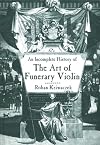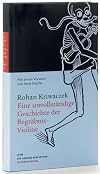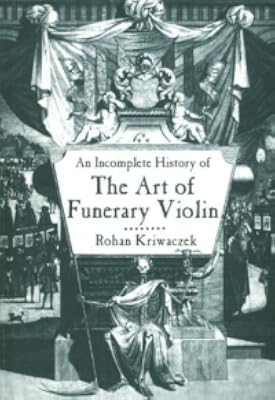
An Incomplete History of the Art of Funerary Violin
by Rohan Kriwaczek
On This Page
Description
Exposed by the New York times as a "brilliant hoax," this imaginative volume of fiction is presented as a scholarly history of a secretive art form: "the rise, flourishing, and ruthless suppression of a tradition of [solo] violin music played at funerals." It includes detailed fictional biographies of real or invented persons, alleged "period" illustrations, and elaborate musical scores. --Compiled from the New York times Oct. 4, 2006 article and online reviews.Tags
Recommendations
























Member Reviews
A brilliant and witty piece of pseudo-history that includes some profound thoughts on death, consumerism, and music.
Well, I'd thought to cease Reviewing at an even four-hundred, but when I saw that nobody else had written about this book on LT, I had to offer a few words. If memory serves, this strange little opus had its twenty minutes of fame some years ago, even to the extent of being mentioned on National Public Radio. But then it lapsed back into comparative obscurity. Perhaps that was inevitable, considering that it is an elaborate hoax. Is there any body who doesn't get that?
This book purports to describe a semi-secret society of fiddlers who, as the name suggests, practiced a specialized form of graveside music, until the group and its art was supressed in the Nineteenth Century. OK, there actually ARE traditions of funerary violin music -- show more but they're not even remotely what's represented here. Perhaps some people have been intimidated by the tone and jargon of the book into accepting it at its face-value, musiciology being entirely too often among the most pompous and poorly written prose offered to an unsuspecting world. But even a brief attempt to cross-check the few genuine names and incidents described reveals that it's all fluff. For those who can read music, the abundant examples prove to be arrant foolishness.
OK, so it's a joke. But is it funny? Well, it's entertaining up to a point. The concept has a certain goofy charm, like the fantastic stories John Fahey liked to wrap aound himseld, first in album-notes, later in his two books of stories. But it goes on way too long. Doubtless the Author enjoyed himself so much that he couldn't stop. But just as we can't possibly like all children (no matter how much we like their parents), so I suspect that most readers will not, perhaps even should not, follow him very along his goofy way. show less
This book purports to describe a semi-secret society of fiddlers who, as the name suggests, practiced a specialized form of graveside music, until the group and its art was supressed in the Nineteenth Century. OK, there actually ARE traditions of funerary violin music -- show more but they're not even remotely what's represented here. Perhaps some people have been intimidated by the tone and jargon of the book into accepting it at its face-value, musiciology being entirely too often among the most pompous and poorly written prose offered to an unsuspecting world. But even a brief attempt to cross-check the few genuine names and incidents described reveals that it's all fluff. For those who can read music, the abundant examples prove to be arrant foolishness.
OK, so it's a joke. But is it funny? Well, it's entertaining up to a point. The concept has a certain goofy charm, like the fantastic stories John Fahey liked to wrap aound himseld, first in album-notes, later in his two books of stories. But it goes on way too long. Doubtless the Author enjoyed himself so much that he couldn't stop. But just as we can't possibly like all children (no matter how much we like their parents), so I suspect that most readers will not, perhaps even should not, follow him very along his goofy way. show less
Ratings
Members
- Recently Added By
Lists

Die Andere Bibliothek
8 works; 1 member

Fakes, Forgeries, and Fictitious Authors
112 works; 4 members
Author Information
3 Works 143 Members
Series
Belongs to Publisher Series
Die Andere Bibliothek (278)
Common Knowledge
- Original publication date
- 2006-09
- People/Characters
- George Babcotte; Bulstrode Wycherley; Herbert Stanley Littlejohn; Herr Hieronymous Gratchenfleiss; Wolfgang Amadeus Mozart; Pierre Dubuisson (show all 10); Charles Sudbury; Matthew Connisten; Niccolò Paganini; Father Elis Passmore Jarvis
- First words
- The origins of the funeral procession are shrouded in the mists of time, though we can be certain that it goes back at least 10,000 years. Burial, being underground hidden, provides considerable protection from environmental ... (show all)and cultural destruction, and as a result we know more the burial, and therefore in some cases the funeral practices, of early human cultures than about anything else.
- Last words
- (Click to show. Warning: May contain spoilers.)In today's world the Funerary Violinist is the lone Romantic who dares to stand on the peak and look down into the black chasm beyond, whilst everyone else cowers in the foothills admiring designer shoes in shop windows. As a civilised culture we cannot afford to let this ancient and venerable tradition, which dates back over 400 years, remain forgotten; we cannot afford to ignore the many valuable lessons it holds for us; and most of all, we cannot afford to push death and mortality ever further from our minds, for that way lies only madness.
Classifications
Statistics
- Members
- 98
- Popularity
- 328,821
- Reviews
- 2
- Rating
- (3.25)
- Languages
- English, German
- Media
- Paper
- ISBNs
- 4
- ASINs
- 1