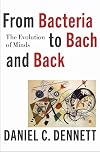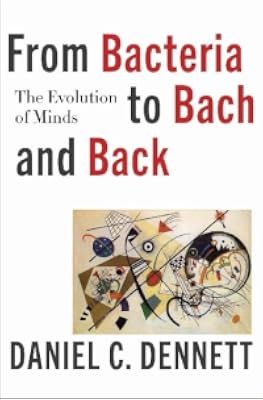
From Bacteria to Bach and Back: The Evolution of Minds
by Daniel C. Dennett
On This Page
Description
A leading philosopher offers a major new account of the origins of the conscious mind that explores the deep interactions of evolution, brains, and human culture, demonstrating the role of culture in installing memes, including language, in the mind.Tags
Recommendations





Member Reviews
One is tempted to boil down the conclusion of Dennett's latest book as follows: Consciousness is not magic; it is an illusion. On first glance at the summation, it seems a ridicule--after all, magicians are called masters of illusion--because it seems that Dennett is contradicting himself. If he is a staunch Darwinian materialist, how can he even use such a word-concept as illusion seriously? If one takes a step back, however, and considers all of Dennett's evidence, one will find that magic (in the sense that Dennett means: supernatural phenomena) and illusion (the phenomena of "mind stuff") are quite different things.
First, an appreciation of the man and the work. Dennett is without a doubt a gifted thinker and a lucid, engaging show more writer to boot--no small feat for someone who has spent over fifty years in academia, let alone immersed in a panoply of fields of concentration. He is, like E. O. Wilson ([b:Consilience: The Unity of Knowledge|55981|Consilience The Unity of Knowledge|Edward O. Wilson|https://images.gr-assets.com/books/1403192416s/55981.jpg|54561]), Alan Lightman ([b:The Accidental Universe: The World You Thought You Knew|17756352|The Accidental Universe The World You Thought You Knew|Alan Lightman|https://images.gr-assets.com/books/1390109671s/17756352.jpg|24841340]), and others, one of those rare polymaths attempting to bridge the chasm between natural sciences and the humanities. He is aware of his shortcomings and values mistakes in the manner of a rigorous and ethical scientist while yet philosophizing in a way an average person can digest. (In fact, one of the first tools he offers in his previous book, [b:Intuition Pumps And Other Tools for Thinking|18378002|Intuition Pumps And Other Tools for Thinking|Daniel C. Dennett|https://images.gr-assets.com/books/1381288490s/18378002.jpg|22251262], is centered around the importance of mistakes; and he keeps an updated errata for all of his publications on his Tufts University website--on which you will find my offerings: click here!)
Now for the criticism. In general, I expected to get much more than some add-ons which reiterate the theories in his 1991 book, [b:Consciousness Explained|2069|Consciousness Explained|Daniel C. Dennett|https://images.gr-assets.com/books/1386924714s/2069.jpg|1860288]. Not that I expected Dennett to sway from the belief that consciousness consists of nothing outside the material world, but I expected more than a glut of field-relevant literature surveys and the addition of his new theory of "strange inversions of reasoning" (with its Darwin, Hume, and Turing flavors). Perhaps my disappointment stems from his audacious promise early on: "I have been struggling through the thickets and quagmires for over fifty years, and I have found a path that takes us all the way to a satisfactory--and satisfying--account of how the 'magic' of our minds is accomplished without any magic, but it is neither straight nor easy" (4). The same bold promise was proclaimed early in [b:Consciousness Explained|2069|Consciousness Explained|Daniel C. Dennett|https://images.gr-assets.com/books/1386924714s/2069.jpg|1860288], too, but with only "thirty years" to tout.
Let's look at and comment on some choice excerpts:
1. "Some people would like to persuade the curious to keep their hands off the beloved mysteries, not realizing that a mystery solved is even more ravishing than the ignorant fantasies it replaces" (10). This is precisely the type of inflammatory remark with just enough ambiguity to further divide those who will agree with it from those who do not. In my opinion, I don't see anything wrong with "the curious" (i.e. people like Dennett, presumably) scientifically investigating "beloved mysteries" (i.e. creationism, God's existence, presumably); and those that do are lacking the very substance after which they purport to strive: faith. In most cases between these two camps, the contestants have gone far outside original sources. I do, however, take umbrage with the statement that a solved mystery is even more ravishing than otherwise. But then again I am a bit of a Romantic and I crave mystery and revel in imagination to the point that I am often deflated by the anticlimactic explanation of reality (how many times, for example, have I wanted to leave the last chapter of a book unread because the mystery has been so invigorating). I think this ravishment has more to do with proving one party or another is right more than basking in the solution itself.
2. "Nature's way of generating complex systems (organs, behaviors, etc.) is so unlike an artificer's way that we should not use the same language to describe them" (35). This statement is made in response to the claims of Intelligent Design (ID), and while not unwarranted it still seems a convenient way to level the playing field while also invalidating the very tool in use by both sides: language. But Dennett has much to cover concerning language.
3. Notes from chapter three: Evolution by natural selection is a blind algorithm that causes gradual change over vast amounts of time. There is no deliberate designer or reasoner; there is only the natural algorithm that, given enough time, caused the right configuration to snap into place and spark reproduction. There is never a hard dividing line between non-existence to existence (i.e. no first reason or first cause); there is only ever a gradual emergence. These are the main points to keep in mind throughout the text; they are the keys to understanding the propositions. If one is tempted to revert to arguments of first cause, one must realize that that concept has been stripped from the conversation, based on my second bullet point (above). There is simply an algorithm that is constantly in research-and-development mode, writing and testing and rewriting until, eventually, monkeys could conceivably write Hamlet. Of course, Dennett has already anticipated my reductio ad absurdum conjecture while not entirely throwing it out: "Not everything 'possible in principle' is automatically available, but given lots of time, and lots of cycles, there are likely to be paths of happenstance that lead to the Good Tricks in the neighborhood, but not always" (121). A bit of waffling of uncharacteristic waffling that works as levity.
4. Competence without comprehension. This is a major point in Dennett's theory and a strong one. There are, of course, many examples of objects that perform tasks well without any comprehension, even if the examples given (e.g. an elevator) had an intelligent designer (i.e. us), but the thought is that there could conceivably have been a time when humans were competent without comprehension. This is what he parallels to top-down design: during the competence without comprehension phase, the object executes instructions without any understanding; but this can evolve into bottom-up design, which is in the realm of strong AI (the former phase being, in essence, GOFAI).
5. "...a process with no Intelligence Designer can create intelligent designers who can then design things that permit us to understand how a process with no Intelligent Designer can create intelligent designers who can then design things" (78). Honestly, this is so well put, I seized on it with both highlighter and pen when I read it. Dennett has quite the knack for eloquently articulating complex thoughts. My only qualm here, however, is that we've just swapped an ID that no one understands for a process no one understands (or at least no one understands how the process came to be; and if we scientifically figure that out, it will only begin an infinite regression of first causes).
6. Informavores. Dennett uses psychologist George Miller's word here, and I think it's utterly brilliant. This describes humans today perfectly. We are informavores; that is, we feed on information.
7. "...human culture started out profoundly Darwinian, with uncomprehending competences yielding various valuable structures...and then gradually de-Darwinized, becoming even more comprehending..." (148). This is what Dennett means by the transition of top-down design to bottom-up design, but this is a novel idea--that we have gone from Darwinian to de-Darwinized. How did this happen? We find out in my ninth bullet (below).
8. "...nobody has yet demonstrated that the difference in underlying chemistry [between carbon-based brains and silicon-based computers] gives an edge to carbon" (156). This is offered up as a sort of pithy aside but it is certainly potent. It nears the seeds of what could bloom into the portentous arena of eugenics and biohacking, or into the sensationalism found in Nick Bostrom's [b:Superintelligence: Paths, Dangers, Strategies|20527133|Superintelligence Paths, Dangers, Strategies|Nick Bostrom|https://images.gr-assets.com/books/1400884046s/20527133.jpg|37286000] or Ray Kurzweil's [b:The Singularity is Near: When Humans Transcend Biology|83518|The Singularity is Near When Humans Transcend Biology|Ray Kurzweil|https://images.gr-assets.com/books/1348757857s/83518.jpg|1080] (or, on a really unwarranted scale, James Barrat's [b:Our Final Invention: Artificial Intelligence and the End of the Human Era|17286699|Our Final Invention Artificial Intelligence and the End of the Human Era|James Barrat|https://images.gr-assets.com/books/1361640176s/17286699.jpg|23906757]). But, refreshingly, Dennett doesn't go down those rabbit holes; and, in fact, Dennett explicitly maintains that he isn't concerned with creating a race of robots that will enslave us.
9. Memes. Oh, boy. Memes. This is the portion of the book (in addition to strange inversioning) that undoubtedly urged Dennett and Norton to get a book out there. To sum it up: qualia do not exist, but memes do. In fact--sit down for this one--memes make comprehension possible: "Comprehension--our kind of comprehension--is only made possible by the arrival on the scene quite recently of a new kind of evolutionary replicator--culturally transmitted informational entities: memes" (175). Although the term and concept of the meme were put forth by Richard Dawkins in [b:The Selfish Gene|61535|The Selfish Gene|Richard Dawkins|https://images.gr-assets.com/books/1366758096s/61535.jpg|1746717], it is given exhaustive fleshing out here. After embarking on his definition of memes and the role they play in consciousness, Dennett spends a nice chunk of time defending memes from all manner of opposition.
10. Teleology of memetics: "What memetics promises to do is provide the framework for making sense of all this [culture] in some of its aspects" (242). Dennett isn't proposing to throw out literary theory, molecular biology, ecology, philosophy, physics, anthropology, or virtually any other discipline, but rather to supplement their foundation. He is focusing more on the phenomenology of memes rather than the teleology.
11. "The arrival of language set the stage for yet another great moment in evolutionary history: the origin of comprehension" (281). Language is a slippery subject, especially where theories of the mind are concerned, because (like our minds) we are trapped within language. Here the analog of computer hardware and software is fitting. Just as hardware is useless without software and software is useless without hardware, our bodies and minds are useless on their own. Consciousness is a user-illusion just as a UI, with its windows and dialogs and buttons, is an illusion that springs from the computer hardware on which it runs. But a key note is that the hardware does not understand the software--you cannot look at the contents of a Word document on a disc or chip; and the hardware cannot speak the same language as even the object-oriented code (e.g. C#) used to write the program; yet everything is "there" just the same. The late Robert Pirsig expounds on this exact analogy in his sorely neglected second novel, [b:Lila: An Inquiry Into Morals|31093|Lila An Inquiry Into Morals|Robert M. Pirsig|https://images.gr-assets.com/books/1346459192s/31093.jpg|2374212].
Really, on the topic of language, following Dennett's paths, we really don't have a way to talk of matters like consciousness at all. We can only communicate due to language and memes, but this is the same as discussing the code of a program. We cannot talk about these phenomena from the perspective of the hardware, i.e. the actual material matter doing the processing, because we cannot speak that language. (Of course, we can speak binary in a way, so the computer analogy breaks down if we go one level deeper than binary, but, in general, we cannot speak about what's going on in our biological processes from the standpoint of the hardware--or, wetware--because we do not have that capacity.)
12. "...we don't need...a gift from God to have arrived where we ate today" (284). I tire of these cheap inflammatory shots from both sides of the arguments. This is a lofty statement when all that's been given is part of the story (the middle part) in the form of an analogous theory. Thankfully, Dennett's prose is much more focused and thoughtful than that of, say, Richard Dawkins or the late Christopher Hitches, so at least Dennett seems to rouse more thoughtful people instead of the legions of premature activists (credit for this term goes to Harold Bloom).
13. Original image vs. manifest image. "When we notice our memes, and start to own them, and reflect on them, we have moved from the original image to the manifest image..." (289). Another striking parallel here to [b:Lila: An Inquiry Into Morals|31093|Lila An Inquiry Into Morals|Robert M. Pirsig|https://images.gr-assets.com/books/1346459192s/31093.jpg|2374212], where Pirsig talks of Dynamic and static quality. Both articulations have antecedents in Kant's concept of a priori and a posteriori knowledge.
14. Wrapping it all up. Just as with [b:Consciousness Explained|2069|Consciousness Explained|Daniel C. Dennett|https://images.gr-assets.com/books/1386924714s/2069.jpg|1860288], Dennett maintains his tight metaphorical coupling with the field of computer science. Hardware = wetware; desktop = necktop; apps = memes; "...you download a new app to your necktop...." (295). From what I can tell, he is quite serious about this. Now, he doesn't think that we are computers, of course, but there is almost a one-to-one mapping between a fully-conscious modern human and a computer; almost, because we haven't reached fully-aware AI (or have we?). Qualia, he still maintains, is just "...an artifact of bad theorizing" (260).
15. Dennett's revised definition of Human consciousness: "...a system of virtual machines that evolved, genetically and memetically, to play very specialized roles in the 'cognitive niche' our ancestors have created over the millennia" (335). "Our thinking is enabled by the installation of a virtual machine made of virtual machines made of virtual machines" (341).
16. So what of these strong emotive feelings we have and the barrier that separates our consciousness (what Dennett calls autophenomenology) from others' consciousness (heterophenomenology)? "When you attempt to tell us what is happening in your experience, you ineluctably slide into a metaphorical idiom simply because you have no deeper, truer, more accurate knowledge of what was going [on] inside you...you simply reproduce...your everyday model of how you know about what is going on outside you" (348). This is so well said that I need say hardly anything. This is exactly what I tried to articulate to a friend some time ago, but found myself groping for the most coherent way to say it. Now, what makes this phenomenon provocative is Dennett's suggestion that "[i]nsisting...that you know more about your own consciousness just because it's yours, is lapsing into dogma" (351). This struck me right on the nose. What a thought! Our thoughts and memories and sensations seem so highly subjective/personal, it is hard to think of them as pure, objective data.
Overall, I thoroughly enjoyed my time with this book. Dennett is an important thinker and a pleasure to read. In a way, I wish I hadn't read [b:Consciousness Explained|2069|Consciousness Explained|Daniel C. Dennett|https://images.gr-assets.com/books/1386924714s/2069.jpg|1860288] first, and, in fact, if someone asked where to start with Dennett, I would suggest skipping the former and reading this one, which is basically an updated version. show less
First, an appreciation of the man and the work. Dennett is without a doubt a gifted thinker and a lucid, engaging show more writer to boot--no small feat for someone who has spent over fifty years in academia, let alone immersed in a panoply of fields of concentration. He is, like E. O. Wilson ([b:Consilience: The Unity of Knowledge|55981|Consilience The Unity of Knowledge|Edward O. Wilson|https://images.gr-assets.com/books/1403192416s/55981.jpg|54561]), Alan Lightman ([b:The Accidental Universe: The World You Thought You Knew|17756352|The Accidental Universe The World You Thought You Knew|Alan Lightman|https://images.gr-assets.com/books/1390109671s/17756352.jpg|24841340]), and others, one of those rare polymaths attempting to bridge the chasm between natural sciences and the humanities. He is aware of his shortcomings and values mistakes in the manner of a rigorous and ethical scientist while yet philosophizing in a way an average person can digest. (In fact, one of the first tools he offers in his previous book, [b:Intuition Pumps And Other Tools for Thinking|18378002|Intuition Pumps And Other Tools for Thinking|Daniel C. Dennett|https://images.gr-assets.com/books/1381288490s/18378002.jpg|22251262], is centered around the importance of mistakes; and he keeps an updated errata for all of his publications on his Tufts University website--on which you will find my offerings: click here!)
Now for the criticism. In general, I expected to get much more than some add-ons which reiterate the theories in his 1991 book, [b:Consciousness Explained|2069|Consciousness Explained|Daniel C. Dennett|https://images.gr-assets.com/books/1386924714s/2069.jpg|1860288]. Not that I expected Dennett to sway from the belief that consciousness consists of nothing outside the material world, but I expected more than a glut of field-relevant literature surveys and the addition of his new theory of "strange inversions of reasoning" (with its Darwin, Hume, and Turing flavors). Perhaps my disappointment stems from his audacious promise early on: "I have been struggling through the thickets and quagmires for over fifty years, and I have found a path that takes us all the way to a satisfactory--and satisfying--account of how the 'magic' of our minds is accomplished without any magic, but it is neither straight nor easy" (4). The same bold promise was proclaimed early in [b:Consciousness Explained|2069|Consciousness Explained|Daniel C. Dennett|https://images.gr-assets.com/books/1386924714s/2069.jpg|1860288], too, but with only "thirty years" to tout.
Let's look at and comment on some choice excerpts:
1. "Some people would like to persuade the curious to keep their hands off the beloved mysteries, not realizing that a mystery solved is even more ravishing than the ignorant fantasies it replaces" (10). This is precisely the type of inflammatory remark with just enough ambiguity to further divide those who will agree with it from those who do not. In my opinion, I don't see anything wrong with "the curious" (i.e. people like Dennett, presumably) scientifically investigating "beloved mysteries" (i.e. creationism, God's existence, presumably); and those that do are lacking the very substance after which they purport to strive: faith. In most cases between these two camps, the contestants have gone far outside original sources. I do, however, take umbrage with the statement that a solved mystery is even more ravishing than otherwise. But then again I am a bit of a Romantic and I crave mystery and revel in imagination to the point that I am often deflated by the anticlimactic explanation of reality (how many times, for example, have I wanted to leave the last chapter of a book unread because the mystery has been so invigorating). I think this ravishment has more to do with proving one party or another is right more than basking in the solution itself.
2. "Nature's way of generating complex systems (organs, behaviors, etc.) is so unlike an artificer's way that we should not use the same language to describe them" (35). This statement is made in response to the claims of Intelligent Design (ID), and while not unwarranted it still seems a convenient way to level the playing field while also invalidating the very tool in use by both sides: language. But Dennett has much to cover concerning language.
3. Notes from chapter three: Evolution by natural selection is a blind algorithm that causes gradual change over vast amounts of time. There is no deliberate designer or reasoner; there is only the natural algorithm that, given enough time, caused the right configuration to snap into place and spark reproduction. There is never a hard dividing line between non-existence to existence (i.e. no first reason or first cause); there is only ever a gradual emergence. These are the main points to keep in mind throughout the text; they are the keys to understanding the propositions. If one is tempted to revert to arguments of first cause, one must realize that that concept has been stripped from the conversation, based on my second bullet point (above). There is simply an algorithm that is constantly in research-and-development mode, writing and testing and rewriting until, eventually, monkeys could conceivably write Hamlet. Of course, Dennett has already anticipated my reductio ad absurdum conjecture while not entirely throwing it out: "Not everything 'possible in principle' is automatically available, but given lots of time, and lots of cycles, there are likely to be paths of happenstance that lead to the Good Tricks in the neighborhood, but not always" (121). A bit of waffling of uncharacteristic waffling that works as levity.
4. Competence without comprehension. This is a major point in Dennett's theory and a strong one. There are, of course, many examples of objects that perform tasks well without any comprehension, even if the examples given (e.g. an elevator) had an intelligent designer (i.e. us), but the thought is that there could conceivably have been a time when humans were competent without comprehension. This is what he parallels to top-down design: during the competence without comprehension phase, the object executes instructions without any understanding; but this can evolve into bottom-up design, which is in the realm of strong AI (the former phase being, in essence, GOFAI).
5. "...a process with no Intelligence Designer can create intelligent designers who can then design things that permit us to understand how a process with no Intelligent Designer can create intelligent designers who can then design things" (78). Honestly, this is so well put, I seized on it with both highlighter and pen when I read it. Dennett has quite the knack for eloquently articulating complex thoughts. My only qualm here, however, is that we've just swapped an ID that no one understands for a process no one understands (or at least no one understands how the process came to be; and if we scientifically figure that out, it will only begin an infinite regression of first causes).
6. Informavores. Dennett uses psychologist George Miller's word here, and I think it's utterly brilliant. This describes humans today perfectly. We are informavores; that is, we feed on information.
7. "...human culture started out profoundly Darwinian, with uncomprehending competences yielding various valuable structures...and then gradually de-Darwinized, becoming even more comprehending..." (148). This is what Dennett means by the transition of top-down design to bottom-up design, but this is a novel idea--that we have gone from Darwinian to de-Darwinized. How did this happen? We find out in my ninth bullet (below).
8. "...nobody has yet demonstrated that the difference in underlying chemistry [between carbon-based brains and silicon-based computers] gives an edge to carbon" (156). This is offered up as a sort of pithy aside but it is certainly potent. It nears the seeds of what could bloom into the portentous arena of eugenics and biohacking, or into the sensationalism found in Nick Bostrom's [b:Superintelligence: Paths, Dangers, Strategies|20527133|Superintelligence Paths, Dangers, Strategies|Nick Bostrom|https://images.gr-assets.com/books/1400884046s/20527133.jpg|37286000] or Ray Kurzweil's [b:The Singularity is Near: When Humans Transcend Biology|83518|The Singularity is Near When Humans Transcend Biology|Ray Kurzweil|https://images.gr-assets.com/books/1348757857s/83518.jpg|1080] (or, on a really unwarranted scale, James Barrat's [b:Our Final Invention: Artificial Intelligence and the End of the Human Era|17286699|Our Final Invention Artificial Intelligence and the End of the Human Era|James Barrat|https://images.gr-assets.com/books/1361640176s/17286699.jpg|23906757]). But, refreshingly, Dennett doesn't go down those rabbit holes; and, in fact, Dennett explicitly maintains that he isn't concerned with creating a race of robots that will enslave us.
9. Memes. Oh, boy. Memes. This is the portion of the book (in addition to strange inversioning) that undoubtedly urged Dennett and Norton to get a book out there. To sum it up: qualia do not exist, but memes do. In fact--sit down for this one--memes make comprehension possible: "Comprehension--our kind of comprehension--is only made possible by the arrival on the scene quite recently of a new kind of evolutionary replicator--culturally transmitted informational entities: memes" (175). Although the term and concept of the meme were put forth by Richard Dawkins in [b:The Selfish Gene|61535|The Selfish Gene|Richard Dawkins|https://images.gr-assets.com/books/1366758096s/61535.jpg|1746717], it is given exhaustive fleshing out here. After embarking on his definition of memes and the role they play in consciousness, Dennett spends a nice chunk of time defending memes from all manner of opposition.
10. Teleology of memetics: "What memetics promises to do is provide the framework for making sense of all this [culture] in some of its aspects" (242). Dennett isn't proposing to throw out literary theory, molecular biology, ecology, philosophy, physics, anthropology, or virtually any other discipline, but rather to supplement their foundation. He is focusing more on the phenomenology of memes rather than the teleology.
11. "The arrival of language set the stage for yet another great moment in evolutionary history: the origin of comprehension" (281). Language is a slippery subject, especially where theories of the mind are concerned, because (like our minds) we are trapped within language. Here the analog of computer hardware and software is fitting. Just as hardware is useless without software and software is useless without hardware, our bodies and minds are useless on their own. Consciousness is a user-illusion just as a UI, with its windows and dialogs and buttons, is an illusion that springs from the computer hardware on which it runs. But a key note is that the hardware does not understand the software--you cannot look at the contents of a Word document on a disc or chip; and the hardware cannot speak the same language as even the object-oriented code (e.g. C#) used to write the program; yet everything is "there" just the same. The late Robert Pirsig expounds on this exact analogy in his sorely neglected second novel, [b:Lila: An Inquiry Into Morals|31093|Lila An Inquiry Into Morals|Robert M. Pirsig|https://images.gr-assets.com/books/1346459192s/31093.jpg|2374212].
Really, on the topic of language, following Dennett's paths, we really don't have a way to talk of matters like consciousness at all. We can only communicate due to language and memes, but this is the same as discussing the code of a program. We cannot talk about these phenomena from the perspective of the hardware, i.e. the actual material matter doing the processing, because we cannot speak that language. (Of course, we can speak binary in a way, so the computer analogy breaks down if we go one level deeper than binary, but, in general, we cannot speak about what's going on in our biological processes from the standpoint of the hardware--or, wetware--because we do not have that capacity.)
12. "...we don't need...a gift from God to have arrived where we ate today" (284). I tire of these cheap inflammatory shots from both sides of the arguments. This is a lofty statement when all that's been given is part of the story (the middle part) in the form of an analogous theory. Thankfully, Dennett's prose is much more focused and thoughtful than that of, say, Richard Dawkins or the late Christopher Hitches, so at least Dennett seems to rouse more thoughtful people instead of the legions of premature activists (credit for this term goes to Harold Bloom).
13. Original image vs. manifest image. "When we notice our memes, and start to own them, and reflect on them, we have moved from the original image to the manifest image..." (289). Another striking parallel here to [b:Lila: An Inquiry Into Morals|31093|Lila An Inquiry Into Morals|Robert M. Pirsig|https://images.gr-assets.com/books/1346459192s/31093.jpg|2374212], where Pirsig talks of Dynamic and static quality. Both articulations have antecedents in Kant's concept of a priori and a posteriori knowledge.
14. Wrapping it all up. Just as with [b:Consciousness Explained|2069|Consciousness Explained|Daniel C. Dennett|https://images.gr-assets.com/books/1386924714s/2069.jpg|1860288], Dennett maintains his tight metaphorical coupling with the field of computer science. Hardware = wetware; desktop = necktop; apps = memes; "...you download a new app to your necktop...." (295). From what I can tell, he is quite serious about this. Now, he doesn't think that we are computers, of course, but there is almost a one-to-one mapping between a fully-conscious modern human and a computer; almost, because we haven't reached fully-aware AI (or have we?). Qualia, he still maintains, is just "...an artifact of bad theorizing" (260).
15. Dennett's revised definition of Human consciousness: "...a system of virtual machines that evolved, genetically and memetically, to play very specialized roles in the 'cognitive niche' our ancestors have created over the millennia" (335). "Our thinking is enabled by the installation of a virtual machine made of virtual machines made of virtual machines" (341).
16. So what of these strong emotive feelings we have and the barrier that separates our consciousness (what Dennett calls autophenomenology) from others' consciousness (heterophenomenology)? "When you attempt to tell us what is happening in your experience, you ineluctably slide into a metaphorical idiom simply because you have no deeper, truer, more accurate knowledge of what was going [on] inside you...you simply reproduce...your everyday model of how you know about what is going on outside you" (348). This is so well said that I need say hardly anything. This is exactly what I tried to articulate to a friend some time ago, but found myself groping for the most coherent way to say it. Now, what makes this phenomenon provocative is Dennett's suggestion that "[i]nsisting...that you know more about your own consciousness just because it's yours, is lapsing into dogma" (351). This struck me right on the nose. What a thought! Our thoughts and memories and sensations seem so highly subjective/personal, it is hard to think of them as pure, objective data.
Overall, I thoroughly enjoyed my time with this book. Dennett is an important thinker and a pleasure to read. In a way, I wish I hadn't read [b:Consciousness Explained|2069|Consciousness Explained|Daniel C. Dennett|https://images.gr-assets.com/books/1386924714s/2069.jpg|1860288] first, and, in fact, if someone asked where to start with Dennett, I would suggest skipping the former and reading this one, which is basically an updated version. show less
Dennett, again. Unknowing to knowing from the bottom up. The Nagel review in NY Review is an embarrassment, the entire argument hinging on - 'Dennett asks us to turn our backs on what is glaringly obvious - that in consciousness we are immediately aware of real subjective experiences of color, flavor, sound, touch, etc. that cannot be fully described in neural terms even though they have a neural cause'
WTF - beg the question much? assertion upon assertion upon assertion. None of those are obvious, nor subjective.
The closing chapter includes this sobering paragraph, more so in light of Nov 2016:
'Our civilization has been running smoothly - with some serious disruptions - for thousands of years, growing in complexity and power, could it show more break down? Yes, it could, and to whom could we then turn to help us get on the road? You can't buy a new civilization if yours collapses, so we had better keep the civilization we have running in good repair. Who, though, are the reliable mechanics? The politicians, the judges, the bankers, the industrialists, the journalists, the professors - the leaders of our society, in short - are much more like the average motorist than you might like to think: doing their local bit to steer their part of the whole contraption, while blissfully ignorant of the complexities on which the whole system depends. According to the economist and evolutionary thinker Paul Seabright, the optimistic tunnel vision with which they operate is not a deplorable and correctable flaw in the system but an enabling condition. This distribution of partial comprehension is not optional. The edifices of social construction that shape our lives in so many regards depends in our myopic confidence that their structure is sound and needs no attention from us."
See also, the USSR. show less
WTF - beg the question much? assertion upon assertion upon assertion. None of those are obvious, nor subjective.
The closing chapter includes this sobering paragraph, more so in light of Nov 2016:
'Our civilization has been running smoothly - with some serious disruptions - for thousands of years, growing in complexity and power, could it show more break down? Yes, it could, and to whom could we then turn to help us get on the road? You can't buy a new civilization if yours collapses, so we had better keep the civilization we have running in good repair. Who, though, are the reliable mechanics? The politicians, the judges, the bankers, the industrialists, the journalists, the professors - the leaders of our society, in short - are much more like the average motorist than you might like to think: doing their local bit to steer their part of the whole contraption, while blissfully ignorant of the complexities on which the whole system depends. According to the economist and evolutionary thinker Paul Seabright, the optimistic tunnel vision with which they operate is not a deplorable and correctable flaw in the system but an enabling condition. This distribution of partial comprehension is not optional. The edifices of social construction that shape our lives in so many regards depends in our myopic confidence that their structure is sound and needs no attention from us."
See also, the USSR. show less
There are excellent insights and ideas in this book, sometimes obscured by the author's meandering style and academic presentation. At one point, he laments the current lack of inspired communicators who, like Hawking and Bernstein, were able to communicate complicated subject matter to a general audience. If he has it in him, he's named his next project -- remove the jargon, the arguments with those who disagree with him, the redundancies, the irrelevant digressions, and present a clear message about how both genetic evolution and cultural evolution have created our minds. This volume has all the material, but reads like a textbook.
I love Dennett and I think he's brilliant. At the same time he's quirky and cranky and I don't know what else. A few bits in the book flew past me, but not so much - I think he was trying to reach a big audience. But I think the reason why I understood maybe 90% of this instead of 60% is because I've read other books of his and it's all beginning to sink in. So anyway, I liked it a lot, but I'm not sure I'd recommend it to someone who hasn't already read and enjoyed Dennett.
This is an interesting summary of some current thinking about what consciousness is, how it got to be, and what it might become. Daniel Dennett writes this philosophy book from the point of view of a generalist, giving his opinions, considering his critics, and mentioning the work of any number of other people from various fields of study.
For Dennett, the mind is the way the brain works, and it came to be what it is through natural selection much in the way bacteria came to be over time. He makes much of how our neurons arranged themselves through random mutations that worked long enough to be carried on to future generations, and that were helpful to the brains that carried them.
Further, he discusses how society might have come about show more partly by bottom-up natural selection, and partly by top-down intelligent design. He usefully contrasts lower-case "intelligent design", by smart people, with the upper-case "Intelligent Design" advocated by creationists.
This all makes a lot of sense, even though the 500 page path to explaining it all can get a bit trying at times.
Consciousness is a big subject and no one book can cover everything about how we are what we are. This book is a great start, though - gave me much to think about. show less
For Dennett, the mind is the way the brain works, and it came to be what it is through natural selection much in the way bacteria came to be over time. He makes much of how our neurons arranged themselves through random mutations that worked long enough to be carried on to future generations, and that were helpful to the brains that carried them.
Further, he discusses how society might have come about show more partly by bottom-up natural selection, and partly by top-down intelligent design. He usefully contrasts lower-case "intelligent design", by smart people, with the upper-case "Intelligent Design" advocated by creationists.
This all makes a lot of sense, even though the 500 page path to explaining it all can get a bit trying at times.
Consciousness is a big subject and no one book can cover everything about how we are what we are. This book is a great start, though - gave me much to think about. show less
Very interesting but i don't like Dennett's style of writing. He elates and references himself a few times too many and seems to be proving something against other scientists rather than just bring the topics for what they are.
There's a lot of great information in this book, however there is a certain amount of arrogance in his approach. He knows what consciousness is, you don't, and the point of the book is to convince you with his arguments. He isn't the greatest of writers, because he's always referring back to other books he's written. Therefore he doesn't explain everything. His knowledge in some areas like computing isn't great. On the other hand, there are some excellent points being made in the book, especially his theory of 'competence without comprehension' being used to describe evolution. I would recommend this book with the understanding that his atheism informs his attitude.
Members
- Recently Added By
Published Reviews
ThingScore 75
Un llibre profund i alhora accessible d’un dels pensadors més importants, que ens ofereix una visió de la consciència humana des del punt de vista de l’evolució.
added by Ruminahui
Bacteria to Bach and Back is an infuriating book. It is too long, repetitive, indulgently digressive and self-referential (no fewer than 64 references to his own publications). But underlying it all there is a subtle and interesting argument. The bare bones are these: mind and consciousness are no more and no less mysterious than other natural phenomena, such as gravity. Granted the right show more chemical and physical conditions, life forms will emerge from the primeval slime, and granted the right conditions, life will evolve large-brained organisms such as humans – who are profoundly social animals and hence need to be able to communicate, cooperate and compete with their fellows. This requires the ability to think, remember, plan, empathise – in a word, to have a mind. And minds require large and complex brains to enable and sustain them, all generated by Natural Selection.
The capitals are important; they emphasise a point Dennett repeatedly makes, stealing the clothes of the creationists, that Natural Selection is an Intelligent Designer, constantly improving life forms through the blind Darwinian processes of favouring fitter, better adapted variants and winnowing out less fit ones. From the very origins of life, Natural Selection generates Intelligent Design, producing organisms that show competence without comprehension. Both an amoeba retreating from a noxious stimulus and, say, a room thermostat are competent in this sense, without comprehending the reasons for their actions. show less
The capitals are important; they emphasise a point Dennett repeatedly makes, stealing the clothes of the creationists, that Natural Selection is an Intelligent Designer, constantly improving life forms through the blind Darwinian processes of favouring fitter, better adapted variants and winnowing out less fit ones. From the very origins of life, Natural Selection generates Intelligent Design, producing organisms that show competence without comprehension. Both an amoeba retreating from a noxious stimulus and, say, a room thermostat are competent in this sense, without comprehending the reasons for their actions. show less
added by jimroberts
Lists

Science: Health & Medical
100 works; 1 member

Books Read in 2018
4,360 works; 110 members

Books Read in 2023
5,638 works; 147 members

Finished in 2024
19 works; 1 member
Author Information

43+ Works 17,441 Members
Daniel C. Dennett is a University Professor and Austin B. Fletcher Professor of Philosophy at Tufts University and the author of numerous books including Intuition Pumps and Other Tools for Thinking, Breaking the Spell, Darwin's Dangerous Idea, and Consciousness Explained.
Some Editions
Awards and Honors
Distinctions
The Guardian Book of the Day (2017-02-02)
Common Knowledge
- Canonical title*
- Från bakterier till Bach och tillbaka : medvetandets evolution
- Original title
- From Bacteria to Bach and Back: The Evolution of Minds
- Original publication date
- 2017
- Original language
- English
- Canonical DDC/MDS
- 128.2
*Some information comes from Common Knowledge in other languages. Click "Edit" for more information.
Classifications
Statistics
- Members
- 831
- Popularity
- 33,208
- Reviews
- 13
- Rating
- (3.66)
- Languages
- 8 — Dutch, English, German, Italian, Polish, Portuguese, Spanish, Swedish
- Media
- Paper, Audiobook, Ebook
- ISBNs
- 22
- ASINs
- 3