Dear Mr. Rosenwald
by Carole Boston Weatherford
On This Page
Description
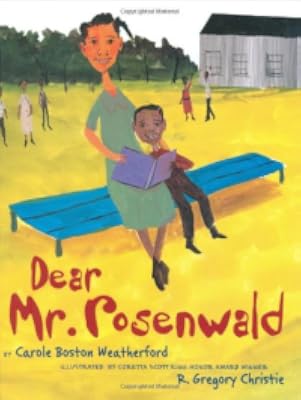
Young Ovella rejoices as her community comes together to raise money and build a much-needed school in the 1920s, with matching funds from the president of Sears, Roebuck, and Company and support from Professor James of the Normal School.Tags
Recommendations




Member Reviews
This book brought tears to my eyes. I didn't know what to expect when I began reading, especially that it's written in the form of poetry. As I continued reading the story, the one question that I kept asking was, "what's the little girl's name"? The author did a fantastic job not only educating the reader on who Mr. Rosenwald was, but the author just nailed it with the last words in the book, "Yours truly, Ovella." The way the author wrapped up the story was brilliant. Mr. Rosenwald funded schools for slave children, and he had stipulations that the white community needed to contribute as well in the development of these schools. He helped provide books, desks, and, most importantly, hope to children who had thought their future was on show more a field picking cotton - being slaves. Mr. Rosenwald gave Ovella, the little girl in the story, the opportunity to dream to one day become a teacher and educate others. I truly loved this book, and I will introduce this book to a class of mine soon. show less
This book exemplifies the path many African Americans took to secure education and a better future for their children. This book reminds children that education is and was important enough that our ancestors sacrificed the little money they had to pave the way for our children. Must read for those who want to educate their children on the importance of the things we often take for granted. This connects to the Brown vs Board of Education. Highly recommended because many lessons can be learned out of this book.
17. In my opinion, “Dear Mr. Rosenwald” by Carole Boston Weatherford is a great book to have in the classroom. The book brings historical relevance to classrooms as it encompasses the impact of the development of Rosenwald schools for African Americans in the rural south during the 1920s. The language is well organized and the plot is sequentially organized into sections with labeled headings describing the steps in which a town developed a Rosenwald school. I liked that the point of view is in first person from a child’s perspective because it would be relatable for children reading this book and it provides the reader with a direct view of the difficulties children in the rural south suffered through within the schooling system. show more The main point of this story is to have faith in others and to work hard to create an honorable education system for children in the community. show less
The impact one person can make toward changes is very apparent in this book. It informs me of how Julius Rosenwald built schools for African Americans back in the day. The setting of 1921 segregation added to the empathy for the character especially in the line "picked cotton until our fingers bled." Tells how Booker T. Washington wanted new schools and how Rosenwald paid, box parties were thrown and people bid on these boxes to raise money. The sense of selflessness and community help was contiguous, the character Miss Etta gave up her burial dollar in hopes to read the bible before her passing. This made me realize how this generation of children take education for granted and do not see it as a gift like we should. They received hand show more me downs from the white schools and were beyond grateful as a future teacher it makes me happy to see kids who want to learn. The use of language toward the end was astonishing, "learning is priceless", "I will polish you bright as stars", "tomorrow is in our hands", it was simply put inspiring. After reading this I felt a sense of optimism and my yearning to learn grew stronger. show less
Something I appreciate about this book is that it discusses that aspects of history that are ignored and looked over. There are hard and difficult things that people have done in the past and I appreciated the realism of the book. It also emphasizes the importance of being in the community, which is easily looked over in our society today.
I really enjoyed this book. It tells the story of Ovella and her love for learning. She years to learn all she can, but struggles to find the time to because of the work her family does in the field. When an idea comes up to raise money to build a school for the children, Ovella is ecstatic. It shows how dedicated Ovella is as to help provide the future children education. With the help of the entire community, they are able to make this dream a reality. I love how you can see the dream of the school come to life in the illustrations. I would definitely read this to my students.
This story is told by an African-American girl named Ovella, who lives in poverty. She currently goes to a one-room school, but their church is raising money to build a bigger and better school for all of the children to go to, along with getting help from the Mr. Rosenwald foundation. At the end of the book, the school is built and the first lesson given to the students is letter writing, where each student must write a letter to Mr. Rosenwald thanking him.
This book was set in the early 1920s in the South of the United States. This setting clarifies the conflict of the story, not having a sufficient school for students due to living in poverty as an African American.
Although it is very sweet and informative, it's not really my type. I show more think this book would have a lot better flow if it weren't written in chapters. All in all, I would still recommend reading this book to your students to give them a glimpse of what this time period was like. show less
This book was set in the early 1920s in the South of the United States. This setting clarifies the conflict of the story, not having a sufficient school for students due to living in poverty as an African American.
Although it is very sweet and informative, it's not really my type. I show more think this book would have a lot better flow if it weren't written in chapters. All in all, I would still recommend reading this book to your students to give them a glimpse of what this time period was like. show less
Members
- Recently Added By
Published Reviews
ThingScore 100
Written in verse, this moving story narrated by a 10-year-old African-American girl in 1921 in the rural South follows a community's efforts to build a desperately needed school. Weatherford… takes her inspiration for this fictionalized account from the actual construction (from 1917 to 1932) of more than 5,000 such schools, with financial aid from Julius Rosenwald, president of Sears, show more Roebuck. … A heartening sliver of American history. Ages 7-10. show less
added by CourtyardSchool
Lists

Newbery Adjacent
747 works; 3 members
Author Information

86+ Works 9,756 Members
Awards and Honors
Classifications
Statistics
- Members
- 156
- Popularity
- 209,871
- Reviews
- 36
- Rating
- (4.29)
- Languages
- English
- Media
- Paper
- ISBNs
- 4
- ASINs
- 1