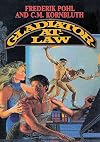
Gladiator-at-law
by Frederik Pohl, C. M. Kornbluth
On This Page
Description
CAUTION! You are about to enter a world...where all engineering ingenuity has been employed for public spectacles of torture and deathwhere the stock market operates with pari-mutuel machineswhere a court clerk transcribes testimony on punch cards, then feeds it to a jury machinewhere the dream real-estate development of today has become a cracked-concrete savage jungleIn this world, young lawyer Charles Mundin battles a great combine of corporate interests-battles them in board meetings and show more in dark alleys-in a struggle that lays bare some brutal promises of the future...promises we are beginning to make right now show lessTags
Recommendations











Member Reviews
review of
Frederik Pohl & C. M. Kornbluth's Gladiator-At-Law
by tENTATIVELY, a cONVENIENCE - February 13, 2012
This is the 3rd Pohl/Kornbluth collaboration I've read so far. W/ each new one I'm more & more impressed by their skill at social analysis & at their ability to just tell an engrossing tale. Reading this one led me to compare them to Aldous Huxley & the comparison's in their favor. When I was a teenager & 1st hearing about what I'd now call dystopian novels or social critique or prophesy novels, I heard of George Orwell's 1984, Huxley's Brave New World, & Ayn Rand's Anthem. I read all 3. That was something like 40 yrs ago.
Much more recently, I listened to an old radio program of Huxley reading Brave New World &/or talking show more about it & I was surprised to find the main thrust be a theme of state-enforced-sexual-promiscuity. Maybe that's only one aspect of Brave New World but it seemed a little odd as an emphasis - kindof like: look-what-these-godless-commies-are-going-to-make-you-do. Anyway, Huxley wrote 'serious literature' & Kornbluth & Pohl wrote 'pulp sci-fi' so they probably weren't taken as seriously. The thing is that Gladiator-At-Law, despite its seemingly trashy title, strikes me as a much less trite social critique than Brave New World may have been.
If this is a "What If?" type of novel, the fuller question might be: What if people were to invent a solution to one of mankind's problems, in this case housing, & that solution were to be commandeered in the interest of greed? The answer is: corporations will get very rich providing good housing but at a cost of only allowing people to live in it that go along w/ the company-store style program. Everyone else has to live in dangerous run-down areas.
& there're plenty of great details & characters to flesh out this premise. At the beginning, the reader witnesses a severe penalty given to someone who steals from a stadium. It's obvious that stadiums & 'sports' are 'sacred'. Why? B/c the oppressive corporate-run society uses bread & circuses / shock & awe to keep the masses 'in their place' in more ways than one. Is this really so different from now? Not from my POV.
One of the main sortof comic relief villains works for a company that was formerly I. G. Farben. I. G. Farben, of course, used concentration camp victims for slave labor amongst many other war crimes. This sets the mood - but not every reader will understand this.
The inventor of the housing solution 'hung himself in his cell' when he was falsely arrested after he was basically driven out of the company he created. I was once told by the police that I was "the kinda guy who hangs himself in his cell." I, too, was arrested on false charges. This story rang all too true for me.
Even Anaconda Copper, an old villain in the annals of labor & ecology activists, makes a cameo appearance. As the lawyer protagonist is being advised on how to proceed against the offending mega-corporation, this dialog occurs:
"'Just keep your head, and remember the essential nature of a great private utility corporation.'
"'A legal entity,' guessed Mundin, 'A fictive person.'
"'No, boy.' The old eyes were gleaming in the ruined face. 'Forget that. Think of an oriental court. A battlefield; a government; a poker game that never ends. The essence of a corporation is the subtle flux of power, now thrusting this man up, now smiting this group low.'"
Notice that in the latter example, it's a single person who rises up & multitudes who suffer. I'm giving this bk a 5 star rating not b/c I think it's the equivalent of Finnegans Wake as a work of great writing but b/c I think that the authors of SF shd get credit for doing what they often do astonishingly well: see the present w/ great clarity & warn us about its future. Unfortunately for the general populace, 57 yrs after this bk was written in 1955, corporations seem to have gotten closer to the dystopic possibilities explored in this bk - rather than further away.
Interestingly, Gladiator-At-Law was published by Bantam & so was Brave New World. But Huxley's bk is touted as a "modern classic" while this is just categorized as "science fiction". Given that Pohl was "science fiction editor of Bantam Books" as of the January, 1977 edition of this that the quoted biographical entry is in, maybe that's one of the main reasons why the bk cd even get published at all. show less
Frederik Pohl & C. M. Kornbluth's Gladiator-At-Law
by tENTATIVELY, a cONVENIENCE - February 13, 2012
This is the 3rd Pohl/Kornbluth collaboration I've read so far. W/ each new one I'm more & more impressed by their skill at social analysis & at their ability to just tell an engrossing tale. Reading this one led me to compare them to Aldous Huxley & the comparison's in their favor. When I was a teenager & 1st hearing about what I'd now call dystopian novels or social critique or prophesy novels, I heard of George Orwell's 1984, Huxley's Brave New World, & Ayn Rand's Anthem. I read all 3. That was something like 40 yrs ago.
Much more recently, I listened to an old radio program of Huxley reading Brave New World &/or talking show more about it & I was surprised to find the main thrust be a theme of state-enforced-sexual-promiscuity. Maybe that's only one aspect of Brave New World but it seemed a little odd as an emphasis - kindof like: look-what-these-godless-commies-are-going-to-make-you-do. Anyway, Huxley wrote 'serious literature' & Kornbluth & Pohl wrote 'pulp sci-fi' so they probably weren't taken as seriously. The thing is that Gladiator-At-Law, despite its seemingly trashy title, strikes me as a much less trite social critique than Brave New World may have been.
If this is a "What If?" type of novel, the fuller question might be: What if people were to invent a solution to one of mankind's problems, in this case housing, & that solution were to be commandeered in the interest of greed? The answer is: corporations will get very rich providing good housing but at a cost of only allowing people to live in it that go along w/ the company-store style program. Everyone else has to live in dangerous run-down areas.
& there're plenty of great details & characters to flesh out this premise. At the beginning, the reader witnesses a severe penalty given to someone who steals from a stadium. It's obvious that stadiums & 'sports' are 'sacred'. Why? B/c the oppressive corporate-run society uses bread & circuses / shock & awe to keep the masses 'in their place' in more ways than one. Is this really so different from now? Not from my POV.
One of the main sortof comic relief villains works for a company that was formerly I. G. Farben. I. G. Farben, of course, used concentration camp victims for slave labor amongst many other war crimes. This sets the mood - but not every reader will understand this.
The inventor of the housing solution 'hung himself in his cell' when he was falsely arrested after he was basically driven out of the company he created. I was once told by the police that I was "the kinda guy who hangs himself in his cell." I, too, was arrested on false charges. This story rang all too true for me.
Even Anaconda Copper, an old villain in the annals of labor & ecology activists, makes a cameo appearance. As the lawyer protagonist is being advised on how to proceed against the offending mega-corporation, this dialog occurs:
"'Just keep your head, and remember the essential nature of a great private utility corporation.'
"'A legal entity,' guessed Mundin, 'A fictive person.'
"'No, boy.' The old eyes were gleaming in the ruined face. 'Forget that. Think of an oriental court. A battlefield; a government; a poker game that never ends. The essence of a corporation is the subtle flux of power, now thrusting this man up, now smiting this group low.'"
Notice that in the latter example, it's a single person who rises up & multitudes who suffer. I'm giving this bk a 5 star rating not b/c I think it's the equivalent of Finnegans Wake as a work of great writing but b/c I think that the authors of SF shd get credit for doing what they often do astonishingly well: see the present w/ great clarity & warn us about its future. Unfortunately for the general populace, 57 yrs after this bk was written in 1955, corporations seem to have gotten closer to the dystopic possibilities explored in this bk - rather than further away.
Interestingly, Gladiator-At-Law was published by Bantam & so was Brave New World. But Huxley's bk is touted as a "modern classic" while this is just categorized as "science fiction". Given that Pohl was "science fiction editor of Bantam Books" as of the January, 1977 edition of this that the quoted biographical entry is in, maybe that's one of the main reasons why the bk cd even get published at all. show less
Pohl and Kornbluth's's sharp satire of the consumer society and corporate corruption of government is as relevant today as when it was first published 50 years ago. "Gladiator at law" describes a possible future for the 1950s in which the working and middle classes are kept under control by the threat of losing their job and with it their tied housing--and the unemployed masses are kept quiescent with bread and circuses, Roman style. Reality tv may not have gone quite as far as the entertainment for the proles depicted in this novel, and science fiction is an exploration of possible futures rather than a prediction of an actual future, but Pohl and Kornbluth's depiction of one of those potential futures is uncomfortably close to present show more day reality.
There are some nicely drawn characters, and a realistic look at the hazards of battling powerful vested interests -- while there is a happy ending, it comes at a price. The novel is short by today's standards, but a good read, and well worth hunting down a copy at a reasonable price.
Comment thread: http://julesjones.livejournal.com/196309.html show less
There are some nicely drawn characters, and a realistic look at the hazards of battling powerful vested interests -- while there is a happy ending, it comes at a price. The novel is short by today's standards, but a good read, and well worth hunting down a copy at a reasonable price.
Comment thread: http://julesjones.livejournal.com/196309.html show less
Terrific 1955 novel, which takes place in a dystopia that looks frighteningly more possible now than it did then. In a world run by massive corporations and big corporate law firms, a lawyer with a marginal grip on a reasonable life teams up with various members of the underclass to challenge the system. The satire is still pointed, and the corporate manoeuvering is still of interest. Worth reading, and re-reading.
Kornbluth and Pohl came up with this attire of American Corporate life in 1955. As time goes by, with the gradual destruction of the Middle Class it's growing more relevant. The 2000's were not supposed to be as much like this as it has turned out. So still a good read, and trenchant!
The beginning is a bit slow moving and VERY 1950s in futuristic dress (I thought of the Jetsons) but once the action shifts to the dystopian, anarchic suburb inhabited by the unemployed (and a wonderfully tough pre-teen gang called the Wabbits), things start to pick up. Not top 100 of all time, but a good read.
The title of this book is deceiving. I mean, seriously, you think there are going to be lawyers fighting it out in the stadium -- blood, guts, and all the rest. Rock on! But it never really happens. There are a lot of potentially interesting social themes in the book -- too many really -- but none are handled masterfully.
The writing is also less than stellar, possibly exacerbated by having two authors. (For example, I'd lose track of which character was being discussed because they'd switch between using first name, last name, or no name to refer to the person.) Many characters were just caricatures. Women were either skanks or just kind of dumb or petty or, in the case of one, evil. There were no women who had positive, substantive show more roles in the book.
I also just didn't get it. At the end, we find out (spoiler ahead) that there are these two ancient, decrepit shells of human beings running their evil empire from an otherwise abandoned New York City. What? I know there's some lesson to be learned about greed or something, but I'm not sure what it is.
I did like the guerrilla tactics the protagonists employed to destroy the reputation of the bubble house. Otherwise, I don't have anything very good to say about this book.
I wanted to like this book because of its name and sexy cover art. (The cover art on my book is not what appears on GoodReads.) Alas, it was not to be. Even on a 10-hour airplane ride with only children's movies to watch, I could barely bring myself to finish it. show less
The writing is also less than stellar, possibly exacerbated by having two authors. (For example, I'd lose track of which character was being discussed because they'd switch between using first name, last name, or no name to refer to the person.) Many characters were just caricatures. Women were either skanks or just kind of dumb or petty or, in the case of one, evil. There were no women who had positive, substantive show more roles in the book.
I also just didn't get it. At the end, we find out (spoiler ahead) that there are these two ancient, decrepit shells of human beings running their evil empire from an otherwise abandoned New York City. What? I know there's some lesson to be learned about greed or something, but I'm not sure what it is.
I did like the guerrilla tactics the protagonists employed to destroy the reputation of the bubble house. Otherwise, I don't have anything very good to say about this book.
I wanted to like this book because of its name and sexy cover art. (The cover art on my book is not what appears on GoodReads.) Alas, it was not to be. Even on a 10-hour airplane ride with only children's movies to watch, I could barely bring myself to finish it. show less
Hát, egyszer el lehet olvasni. Annyira nem lehetett jo, mert nem igen maradt meg bennem :)
Members
- Recently Added By
Author Information

641+ Works 42,936 Members
Frederik Pohl was born in New York City on November 26, 1919. More interested in writing than in school, he dropped out of high school in his senior year and took a job with a publishing company. After serving as a public relations officer in the United States Army from 1943 to 1945, he returned to publishing as copywriter for Popular Science, a show more literary agent for several sci-fi writers, and the editor for the magazines Galaxy and If from 1959 until 1969, with If winning three successive Hugo awards. His first published work, a poem entitled Elegy to a Dead Satellite: Luna, was printed in Amazing Stories magazine in 1937 under the pen name Elton Andrews. His first science fiction novels were published in the mid 1960's, some written in collaboration with other writers, others created alone. During his lifetime, he won over 16 major awards for his writing (much of which was published pseudonymously) including six Hugo Awards and three Nebula Awards. His works include Gateway, which won the Campbell Memorial, Hugo, Locus SF, and Nebula Awards, Beyond the Blue Event Horizon, and Jem, which won the National Book Award in 1979. He also embraced blogging in his later years, using his online journal as an ongoing sequel to his autobiography, The Way the Future Was. He died on September 2, 2013 at the age 93. (Bowker Author Biography) show less

145+ Works 7,637 Members
Some Editions
Series
Belongs to Publisher Series
Born Pockets (SF26)
Pocket (5004)
Goldmann Science Fiction (0224)
Common Knowledge
- Canonical title
- Gladiator-at-law
- Original title
- Gladiator-at-law
- Original publication date
- 1955-05
- People/Characters
- Charles Mundin; Norvell Bligh
- Important places
- Monmouth City, New Jersey, USA
- First words
- The accused was a tallow-faced weasel with "Constitutional Psychopathic Inferior" stamped all over him.
- Last words
- (Click to show. Warning: May contain spoilers.)"We'd better get below," said Mundin. "We've got cleaning up to do."
- Original language*
- English
*Some information comes from Common Knowledge in other languages. Click "Edit" for more information.
Classifications
Statistics
- Members
- 593
- Popularity
- 49,660
- Reviews
- 11
- Rating
- (3.32)
- Languages
- 9 — Dutch, English, French, German, Hungarian, Italian, Portuguese, Spanish, Turkish
- Media
- Paper, Ebook
- ISBNs
- 14
- ASINs
- 22