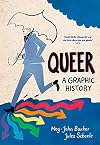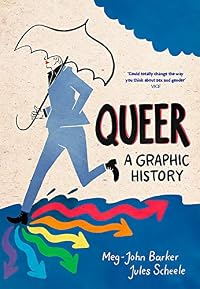
Queer: A Graphic History
by Meg-John Barker (Author), Jules Scheele (Illustrator)
Barker and Scheele's Graphic Guides
On This Page
Description
'Queer: A Graphic History Could Totally Change the Way You Think About Sex and Gender' Vice Activist-academic Meg-John Barker and cartoonist Julia Scheele illuminate the histories of queer thought and LGBTQ+ action in this groundbreaking non-fiction graphic novel. From identity politics and gender roles to privilege and exclusion, Queer explores how we came to view sex, gender and sexuality in the ways that we do; how these ideas get tangled up with our culture and our understanding of show more biology, psychology and sexology; and how these views have been disputed and challenged. Along the way we look at key landmarks which shift our perspective of what’s ‘normal’ – Alfred Kinsey’s view of sexuality as a spectrum, Judith Butler’s view of gendered behaviour as a performance, the play Wicked, or moments in Casino Royale when we’re invited to view James Bond with the kind of desiring gaze usually directed at female bodies in mainstream media. Presented in a brilliantly engaging and witty style, this is a unique portrait of the universe of queer thinking. show lessTags
Recommendations
















Member Reviews
The title made me expect this would be a graphic novel about the history of queerness; instead, it's a basic, slightly bland sociological primer on academic queer theory broken up by lots of black-and-white illustrations. Less Queer: A Graphic History and more Queer Studies: A Primer with Some Infographics. The illustrations help to explain some of the more abstract concepts described here by Meg-John Barker, but I was disappointed at how, well, normative they were—I feel that a book on this topic could and should have made more expansive use of the graphic novel format. And while I appreciate that there's only so much you can cram into a brief, accessible introduction to a topic, I found some of the explanations to be simplified to show more the point of confusion and lack of rationale for the (stated) focus on Western (by which they really mean almost entirely Anglophone scholars + Foucault) scholarship a bit odd. show less
Probably more accurate to be called "Queer Theory: A Graphic History" - in just knowing the title I wasn't sure what to expect but it's an overview of the main theories and theorists that fall under the umbrella of queer theory.
A nice overview for me, as someone who hasn't read a thing about academic queer theory. Though sometimes I would think, I definitely understand this concept, and then close the book and be totally unable to explain it to someone else, that's mostly how I deal with academic concepts in general. I liked the style of this book, and the illustrations were great. Here's my favourite one:
I also liked this one just for the fun juxtaposition of nihilism with the happy talking head:
At the end there's a nice section on how show more to incorporate queer theory into your everyday life, which is hard to imagine considering how dense and academic a lot of it is; but I think what they've suggested is a nice broad idea for critical thinking in general:
"Try to avoid polarizing into either/or binaries: male/female and straight/gay, but also, beyond that, (sex) positive/negative, good/bad, real/fake, essential/constructed, healthy/harmful, transgressive/conforming, assimilationist/liberatory, reformist/radical...
Instead ask what an idea or representation opens up and closes down. What is included and what is excluded? Might it be a matter of both/and rather than either/or?"
I've been reading this at the same time as [b:Testosterone Rex: Myths of Sex, Science, and Society|30231724|Testosterone Rex Myths of Sex, Science, and Society|Cordelia Fine|https://images.gr-assets.com/books/1466695471s/30231724.jpg|50692501] which dovetailed pretty nicely in terms of muddling gender and sex binaries. show less
A nice overview for me, as someone who hasn't read a thing about academic queer theory. Though sometimes I would think, I definitely understand this concept, and then close the book and be totally unable to explain it to someone else, that's mostly how I deal with academic concepts in general. I liked the style of this book, and the illustrations were great. Here's my favourite one:
I also liked this one just for the fun juxtaposition of nihilism with the happy talking head:
At the end there's a nice section on how show more to incorporate queer theory into your everyday life, which is hard to imagine considering how dense and academic a lot of it is; but I think what they've suggested is a nice broad idea for critical thinking in general:
"Try to avoid polarizing into either/or binaries: male/female and straight/gay, but also, beyond that, (sex) positive/negative, good/bad, real/fake, essential/constructed, healthy/harmful, transgressive/conforming, assimilationist/liberatory, reformist/radical...
Instead ask what an idea or representation opens up and closes down. What is included and what is excluded? Might it be a matter of both/and rather than either/or?"
I've been reading this at the same time as [b:Testosterone Rex: Myths of Sex, Science, and Society|30231724|Testosterone Rex Myths of Sex, Science, and Society|Cordelia Fine|https://images.gr-assets.com/books/1466695471s/30231724.jpg|50692501] which dovetailed pretty nicely in terms of muddling gender and sex binaries. show less
Firstly, for a graphic novel called: Queer: a Graphic Novel, I expected more of a discussion on the word queer and its connotations. I use the word queer freely and like it for its umbrella term. I find that using queer (although it has been directed at me in a derogatory way) is something that I personally feel comfortable doing. I like it because I find that people who accept it really readily accept it and don’t challenge it. I find that people who ask me to clarify in a certain way, “So does that make you gay or like…?” instead of “How do you identify and what are your pronouns?” raises a red flag that allows me to keep a safe distance.
The word queer is something I use to protect me, to identify me, to celebrate myself. show more I understand that other people may not use it or be offended by it, and that I totally understand. I try not to use the word around them and respect them and their boundaries and choices. I also use the words gay / bi / pan to identify myself because those are all spaces I occupy and feel that multiple labels aren’t a hindrance on me.
And the first thing I was disappointed about with this book was its one-sentence discussion on how the word queer was a hurtful term to some people. That’s it. That’s all.
… okay?
This also doesn’t feel very cohesive at all. There are separate headings on each page, discussing one or two items or theories or people at a time and I get no sense of continuity when I read. I don’t feel a strong argument, there’s just lots and lots and lots of definitions of things I already know or have studied. That’s not to say I’m pretentious but I’ve heard of Freud before and I know his basic theories.
So to go into this graphic history with an open mind, an open heart, ready to learn and to find I could’ve written some of these pages myself was really a let-down. This might’ve been useful for me ten years ago, when I was starving for genuine queer thought but at the same time, some of its content really doesn’t fit with me. The way they define queer is not how I define queer but somehow, despite always insisting that the queer identity is fluid and is different to different people, they’ve… managed to tell me this is what queer is and this is what it means and if you’re outside of that then you’re performing as something else?
It’s weird and hard to explain or to give an exact quotation, but it feels odd considering the authors go to great lengths to discuss subjectivity without ever critiquing their own definitions.
I like my queer theory and critical feminist theory to challenge me. I read feminist books published by trans people, people of colour and first nations people for this reason. I try to push my own boundaries away from what I’ve learned and try to be inclusive as much as possible. I am the first to admit I need to be more active in my activism. I need to stop passively re-tweeting or sharing images and to take part in marches, protests, sit ins and to write letters to my representatives. I need to use my white privilege better.
However, this didn’t challenge me, it was perplexing. The two authors constantly talk about subjectivity without mentioning their own, deconstructing others’ biases and not their own. They seem to champion academia while only ever mentioning its pitfalls within academia itself, with one single page limited to “Queer theory should be open to all". The first real mention of trans people, by the way, is on page 80 of 175, which is “You might be wondering how trans people fit into this. We’ll get back to this soon.”
On page 83, which talks about disrupting binary / sexuality / gender norms, the three people pictured are Miley Cyrus, Ruby Rose and Kristen Stewart. I have nothing against these women but (I believe) they are all bisexual or gay and, as far as I know, all identify as cisgender. No trans people are included. No non-binary or asexual people are included. Non-binary people are not even mentioned until page 160 .
I feel as though this is confirming some deep-rooted neoliberal biases I’ve been trying very, very hard to get rid of and after page 83, I got tired of this book. The rest of the pages were just a total chore. This is a shame because there were many voices I was interested in hearing from (Julia Serano, Cordelia Fine and so on) that were included in this theory book. That said, I did learn things and wrote down a few names I’d be interested in looking up. Because of this, I kept reading because I kept discovering new names of people who sounded interesting and have contributed a lot to queer theory. Feels a lot like intermittent reinforcement.
With asexuality, crip / discussions around disabled people and discussions around fat phobia all lumped together on the one page, I can’t help but wonder if they could’ve done better. So many of these pages almost feel like afterthoughts, and for my body queer body to be considered an afterthought in a book about queerness is… othering, and sad. They did well in regards to discussing race and queerness and intersectionality multiple times throughout the book, so I know they could do it, but… it was just depressing to see them discuss how queering others happens in theory to have them do it in their own book.
It feels like a bunch of mismatched infographics rather than a graphic novel. This might be a great book to some people and that’s fine, but it’s not a book for me.
This was too broad and not critical enough. I learned a lot, but it was work.
I had such high hopes for this. show less
The word queer is something I use to protect me, to identify me, to celebrate myself. show more I understand that other people may not use it or be offended by it, and that I totally understand. I try not to use the word around them and respect them and their boundaries and choices. I also use the words gay / bi / pan to identify myself because those are all spaces I occupy and feel that multiple labels aren’t a hindrance on me.
And the first thing I was disappointed about with this book was its one-sentence discussion on how the word queer was a hurtful term to some people. That’s it. That’s all.
… okay?
This also doesn’t feel very cohesive at all. There are separate headings on each page, discussing one or two items or theories or people at a time and I get no sense of continuity when I read. I don’t feel a strong argument, there’s just lots and lots and lots of definitions of things I already know or have studied. That’s not to say I’m pretentious but I’ve heard of Freud before and I know his basic theories.
So to go into this graphic history with an open mind, an open heart, ready to learn and to find I could’ve written some of these pages myself was really a let-down. This might’ve been useful for me ten years ago, when I was starving for genuine queer thought but at the same time, some of its content really doesn’t fit with me. The way they define queer is not how I define queer but somehow, despite always insisting that the queer identity is fluid and is different to different people, they’ve… managed to tell me this is what queer is and this is what it means and if you’re outside of that then you’re performing as something else?
It’s weird and hard to explain or to give an exact quotation, but it feels odd considering the authors go to great lengths to discuss subjectivity without ever critiquing their own definitions.
I like my queer theory and critical feminist theory to challenge me. I read feminist books published by trans people, people of colour and first nations people for this reason. I try to push my own boundaries away from what I’ve learned and try to be inclusive as much as possible. I am the first to admit I need to be more active in my activism. I need to stop passively re-tweeting or sharing images and to take part in marches, protests, sit ins and to write letters to my representatives. I need to use my white privilege better.
However, this didn’t challenge me, it was perplexing. The two authors constantly talk about subjectivity without mentioning their own, deconstructing others’ biases and not their own. They seem to champion academia while only ever mentioning its pitfalls within academia itself, with one single page limited to “Queer theory should be open to all". The first real mention of trans people, by the way, is on page 80 of 175, which is “You might be wondering how trans people fit into this. We’ll get back to this soon.”
On page 83, which talks about disrupting binary / sexuality / gender norms, the three people pictured are Miley Cyrus, Ruby Rose and Kristen Stewart. I have nothing against these women but (I believe) they are all bisexual or gay and, as far as I know, all identify as cisgender. No trans people are included. No non-binary or asexual people are included. Non-binary people are not even mentioned until page 160 .
I feel as though this is confirming some deep-rooted neoliberal biases I’ve been trying very, very hard to get rid of and after page 83, I got tired of this book. The rest of the pages were just a total chore. This is a shame because there were many voices I was interested in hearing from (Julia Serano, Cordelia Fine and so on) that were included in this theory book. That said, I did learn things and wrote down a few names I’d be interested in looking up. Because of this, I kept reading because I kept discovering new names of people who sounded interesting and have contributed a lot to queer theory. Feels a lot like intermittent reinforcement.
With asexuality, crip / discussions around disabled people and discussions around fat phobia all lumped together on the one page, I can’t help but wonder if they could’ve done better. So many of these pages almost feel like afterthoughts, and for my body queer body to be considered an afterthought in a book about queerness is… othering, and sad. They did well in regards to discussing race and queerness and intersectionality multiple times throughout the book, so I know they could do it, but… it was just depressing to see them discuss how queering others happens in theory to have them do it in their own book.
It feels like a bunch of mismatched infographics rather than a graphic novel. This might be a great book to some people and that’s fine, but it’s not a book for me.
This was too broad and not critical enough. I learned a lot, but it was work.
I had such high hopes for this. show less
I picked this up on a recent trip through the graphic non-fiction section of the local library. I do think Queer Theory: A Graphic History would have been a better title, but they might have worried people would find it intimidating. Think of this as a pocket guide to queer theory, but illustrated. Starting with the origins of the word queer and how it came to be an umbrella term for the LGBTQIA+, and moving through a history of theiry. Think of this as a quick introduction to the major players, themes, movements. Familiar figures like Freud, Kinsey, & Butler are covered, but the coverage is broad enough that most readers will find a theorist or movement that is new to them.
Obviously, this can't be a comprehensive coverage of the show more history, but it works well as either a referesher or an introduction. And it gives you so many jumping off points to follow new academics/activists/organizations if you find something you are excited and want to learn more about. show less
Obviously, this can't be a comprehensive coverage of the show more history, but it works well as either a referesher or an introduction. And it gives you so many jumping off points to follow new academics/activists/organizations if you find something you are excited and want to learn more about. show less
I sought out this work because of the subtitle, "A Graphic History." I was hoping for a graphic novel and instead received a pretty dull PowerPoint presentation. Basically a droning lecture is typeset in big blocks of text that float over bland illustrations that exhibit little continuity or flow. The most amusing part of the book for me was the several minutes I spent afterward using Google Images to search for the various real people whose images appear in the book and counting how many times the illustrator used the very first picture to appear in the search as her direct photo reference. And then I spent more time registering how many times that single portrait was simply copied and pasted, tweaked or flipped as the person show more reappeared throughout the book. That seems like a pretty lazy and uninspired technique for an artist.
Speaking of lazy and uninspired, I always like to find my own thoughts on a work summarized within it: "Perhaps the most well-known criticism of queer theory is that it is inaccessible....There's a serious point here that if a theory is too abstract, complex, and opaque it will exclude those outside academia from engaging with it. It may also be regarded as elitist and class-biased." I did not engage with this work, but I do appreciate the exposure to ideas that are new to me even if the presentation is lacking. show less
Speaking of lazy and uninspired, I always like to find my own thoughts on a work summarized within it: "Perhaps the most well-known criticism of queer theory is that it is inaccessible....There's a serious point here that if a theory is too abstract, complex, and opaque it will exclude those outside academia from engaging with it. It may also be regarded as elitist and class-biased." I did not engage with this work, but I do appreciate the exposure to ideas that are new to me even if the presentation is lacking. show less
This wasn’t a history of queerness or queer people, but rather something akin to the historiagraphy of queer academic theories and their intersection, over time, with other emergent schools of thought like critical race theory and feminism. Accordingly, I find it hard to call it a history at all, as queer people were absent (a bit ironic, as there is an emphasis on queer is doing rather than being). The only “people” were the authors of the various theories. Told in news-bite sized text with illustrations, which helped break up the tedium of academic jargon, I struggled to be drawn in.
Gosh darn it, I did not want to rate this book so lowly, but it's entirely my fault. I read Erica Moen's glowing review of this book all the way back in 2016 and I guess I forgot (a lot of) the details over time, because I went into this book expecting something very different from what it is.
Based on that subtitle, "A Graphic History", I anticipated a comic-style format introduction to the history of queerness, of being queer, in society throughout history. Instead, Barker and Scheele give us a crash course in queer theory, largely as an academic discipline with only a side order of on-the-street LGBT feelings about some ideas--such as the changing perception of "queer" as identity, slur, and reclaimed term.
The format is very show more different from what I expect when I see the word "graphic"--not panels, but large illustrations that take up most of the page, with the explanatory text shoved up at the top and the bottom in regular font. The illustrations are occasionally helpful illustrations of abstract concepts--and there are a lot of abstract concepts--but they're often just pictures of critical theorists, and these pictures are recycled any time these theorists come up. I might not critique that in a book more like The Cartoon Introduction to Economics, but in that book there more small pictures breaking down and illustrating concepts step-by-step. Queer, while it has the significant benefits of being concise and friendly-looking, does not take advantage of the illustrated format. Even with just a few paragraphs a page, I found my brain floating in space with the kind of "mind blown" feeling that's more like "exploded into bits" than "expanded understanding."
In other words, this book requires work. Not a problem, just waaaaay out of left field compared to what I expected.
Now that I've adjusted my expectations, I'm going to go back and start again. A chief and--I cannot stress this enough--significant strength of this book is how very concise it is. I can tell that these concepts, as difficult as I may find them on an evening where I wanted something lighter, have been boiled down to the basis. I found the first third of the book and approachable and friendly walk through of more basic concepts, like intersectionality. It was only when we started wading into the weeds of which academic/thinker said what that it started feeling really dense, at which point the conciseness was what saved me from being totally lost.
So I do recommend this book--but only if you, unlike me, do your research and know what you're getting into. Fortunately I got lucky and found my copy on the $1 cart at Strand, so I feel like I got a great deal for what is, essentially, a light-but-meaty academic book.
(Here's another case where I'm not sure what to do about the star rating. The two is for me, personally, not for the quality of the book itself.)
((I'm so far behind in reviews... Might just have to do ratings for some of them, sadly.)) show less
Based on that subtitle, "A Graphic History", I anticipated a comic-style format introduction to the history of queerness, of being queer, in society throughout history. Instead, Barker and Scheele give us a crash course in queer theory, largely as an academic discipline with only a side order of on-the-street LGBT feelings about some ideas--such as the changing perception of "queer" as identity, slur, and reclaimed term.
The format is very show more different from what I expect when I see the word "graphic"--not panels, but large illustrations that take up most of the page, with the explanatory text shoved up at the top and the bottom in regular font. The illustrations are occasionally helpful illustrations of abstract concepts--and there are a lot of abstract concepts--but they're often just pictures of critical theorists, and these pictures are recycled any time these theorists come up. I might not critique that in a book more like The Cartoon Introduction to Economics, but in that book there more small pictures breaking down and illustrating concepts step-by-step. Queer, while it has the significant benefits of being concise and friendly-looking, does not take advantage of the illustrated format. Even with just a few paragraphs a page, I found my brain floating in space with the kind of "mind blown" feeling that's more like "exploded into bits" than "expanded understanding."
In other words, this book requires work. Not a problem, just waaaaay out of left field compared to what I expected.
Now that I've adjusted my expectations, I'm going to go back and start again. A chief and--I cannot stress this enough--significant strength of this book is how very concise it is. I can tell that these concepts, as difficult as I may find them on an evening where I wanted something lighter, have been boiled down to the basis. I found the first third of the book and approachable and friendly walk through of more basic concepts, like intersectionality. It was only when we started wading into the weeds of which academic/thinker said what that it started feeling really dense, at which point the conciseness was what saved me from being totally lost.
So I do recommend this book--but only if you, unlike me, do your research and know what you're getting into. Fortunately I got lucky and found my copy on the $1 cart at Strand, so I feel like I got a great deal for what is, essentially, a light-but-meaty academic book.
(Here's another case where I'm not sure what to do about the star rating. The two is for me, personally, not for the quality of the book itself.)
((I'm so far behind in reviews... Might just have to do ratings for some of them, sadly.)) show less
Members
- Recently Added By
Lists

Books Read in 2023
5,547 works; 144 members

Best Graphic Novel Nonfiction
199 works; 101 members
Books recommended in the history category on FiveBooks.com
329 works; 4 members

Queer Nonfiction (Owned TBR)
25 works; 1 member
Author Information

Series

Work Relationships
Has as a commentary on the text
Common Knowledge
- Original publication date
- 2016
- Blurbers
- Bornstein, Kate; Gillen, Kieron; Czyzselka, Jane
- Original language
- English
Classifications
- Genres
- LGBTQ+, General Nonfiction, Nonfiction, Graphic Novels & Comics
- DDC/MDS
- 306.76 — Society, Government, and Culture Social sciences, sociology & anthropology Social Behavior - Dating, Marriage, Divorce Sexual relations Sexual orientation, transgender identity, intersexuality
- LCC
- HQ76.25 .B37 — Social sciences The family. Marriage, Women and Sexuality The Family. Marriage. Women Sexual life
- BISAC
Statistics
- Members
- 850
- Popularity
- 32,005
- Reviews
- 19
- Rating
- (3.77)
- Languages
- English, French, German, Spanish
- Media
- Paper, Ebook
- ISBNs
- 7
- ASINs
- 3