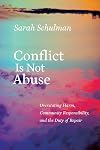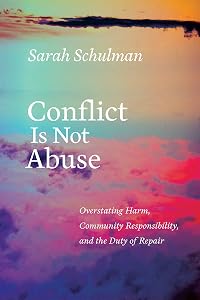
Conflict Is Not Abuse: Overstating Harm, Community Responsibility, and the Duty of Repair
by Sarah Schulman
On This Page
Description
From intimate relationships to global politics, Sarah Schulman observes a continuum: that inflated accusations of harm are used to avoid accountability. Illuminating the difference between Conflict and Abuse, Schulman directly addresses our contemporary culture of scapegoating. This deep, brave, and bold work reveals how punishment replaces personal and collective self-criticism, and shows why difference is so often used to justify cruelty and shunning. Rooting the problem of escalation in show more negative group relationships, Schulman illuminates the ways cliques, communities, families, and religious, racial, and national groups bond through the refusal to change their self-concept. She illustrates how Supremacy behavior and Traumatized behavior resemble each other, through a shared inability to tolerate difference. This important and sure to be controversial book illuminates such contemporary and historical issues of personal, racial, and geo-political difference as tools of escalation towards injustice, exclusion, and punishment, whether the objects of dehumanization are other individuals in our families or communities, people with HIV, African Americans, or Palestinians. Conflict Is Not Abuse is a searing rejection of the cultural phenomenon of blame, cruelty, and scapegoating, and how those in positions of power exacerbate and manipulate fear of the "other" to achieve their goals. Sarah Schulman is a novelist, nonfiction writer, playwright, screenwriter, journalist and AIDS historian, and the author of eighteen books. A Guggenheim and Fulbright Fellow, Sarah is a Distinguished Professor of the Humanities at the City University of New York, College of Staten Island. Her novels published by Arsenal include Rat Bohemia, Empathy, After Delores, and The Mere Future. She lives in New York. show lessTags
Recommendations













Member Reviews
Sarah Schulman’s Conflict is not Abuse is the best book I have read this year, bar none. Even when I disagreed Sarah always made me think, question my own beliefs and tease out how my own patterns of managing conflict impacted others, especially in individual conflict and in the many political groups I have been a member.
Basically Sarah says that conflict and abuse are conflated which can lead to a victimization mindset, ruin relationships and break up political and community groups. Sarah also notes that global conflicts have the same roots as interpersonal and group struggles. Projection and denial and differing values based in race, class, gender and personality are the sources of conflict and that to heal there must be an show more understanding of these sources and the dynamic it has created. I agree with Sarah about projection and denial in interpersonal and group dynamics but am not convinced that projection and denial is the most salient cause of global conflict. This is when Sarah's concepts become unhelpful generalizations. Yes, it plays a part but it is not sufficient.
I also disagreed with Sarah that survivors of sexual abuse and domestic violence are main disruptors of individual relationships and political groups. It is a double edge sword to place blame on the blameless and add to the pigeon holding of survivors. It's hurtful and maddening to survivors to be seen as a malignant force. This may be true that this dynamic can occur and it makes sense that survivors would have distortions of thinking and may act out but this is stereotypical and harmful. Sometimes because of abuse survivors have the ability to cut right through the drama and dynamic right in front of them and call it out. Seeing bullshit all their lives make them exquisitely perceptive and they know how to create boundaries and when and whom it makes sense to talk to. It is hard to know whether this is Sarah's projections, based in her own experience or not.
I also believe that cut-offs are especially problematic and hard. It is really heartbreaking to have a friend walk away without warning and block communication. It had happened to me and is so painful. I have never walked away from somebody but I have fought with somebody and disengaged from them even when they wanted to try to mend the relationship. I can’t say there was really any reason except fear. It is hard for me to decide whether to try to engage again and if/when trying to do so is productive. In any case, Conflict is not Abuse, is a beautiful and profound book that will keep with asking questions and remaining woke to the issues and that is a wonderful gift. show less
Basically Sarah says that conflict and abuse are conflated which can lead to a victimization mindset, ruin relationships and break up political and community groups. Sarah also notes that global conflicts have the same roots as interpersonal and group struggles. Projection and denial and differing values based in race, class, gender and personality are the sources of conflict and that to heal there must be an show more understanding of these sources and the dynamic it has created. I agree with Sarah about projection and denial in interpersonal and group dynamics but am not convinced that projection and denial is the most salient cause of global conflict. This is when Sarah's concepts become unhelpful generalizations. Yes, it plays a part but it is not sufficient.
I also disagreed with Sarah that survivors of sexual abuse and domestic violence are main disruptors of individual relationships and political groups. It is a double edge sword to place blame on the blameless and add to the pigeon holding of survivors. It's hurtful and maddening to survivors to be seen as a malignant force. This may be true that this dynamic can occur and it makes sense that survivors would have distortions of thinking and may act out but this is stereotypical and harmful. Sometimes because of abuse survivors have the ability to cut right through the drama and dynamic right in front of them and call it out. Seeing bullshit all their lives make them exquisitely perceptive and they know how to create boundaries and when and whom it makes sense to talk to. It is hard to know whether this is Sarah's projections, based in her own experience or not.
I also believe that cut-offs are especially problematic and hard. It is really heartbreaking to have a friend walk away without warning and block communication. It had happened to me and is so painful. I have never walked away from somebody but I have fought with somebody and disengaged from them even when they wanted to try to mend the relationship. I can’t say there was really any reason except fear. It is hard for me to decide whether to try to engage again and if/when trying to do so is productive. In any case, Conflict is not Abuse, is a beautiful and profound book that will keep with asking questions and remaining woke to the issues and that is a wonderful gift. show less
I could not finish this book, despite how much I wanted to.
I think the main premise of the book is excellent. There are a lot of very relatable and meaninful points about how people overstate harm in conflict, and how that creates more problems in our communities.
But the author also makes some pretty ignorant statements, like claiming that all important conversations must happen in person or the person asking for otherwise is being intentionally cruel (I guess she's never talked to Autistic people before), and that requiring content warnings in academic settings is the same thing as censorship.
I think the main premise of the book is excellent. There are a lot of very relatable and meaninful points about how people overstate harm in conflict, and how that creates more problems in our communities.
But the author also makes some pretty ignorant statements, like claiming that all important conversations must happen in person or the person asking for otherwise is being intentionally cruel (I guess she's never talked to Autistic people before), and that requiring content warnings in academic settings is the same thing as censorship.
Addresses an important issue, and well-written in parts, but the central thesis is rather undermined by the author's unwillingness to take accountability for her own mistakes, or even accept that she may be wrong sometimes.
There's some real insight here, but I think this book would have been better as a single focused essay. Instead the author has added a lot of anecdata which I'm not sure holds up to scrutiny, a thesis-less critique of the queer reclamation of family as a thing we get to have, and an extended piece on the 2014 Gaza war that is mostly other people's social media posts (and no evidence that permission was given for publication of those posts).
Hated it. Felt like reading a C- masters thesis.
Sarah Schulman is brilliant.
Members
- Recently Added By
Lists

Brooklyn Public Library Literary Prize 2017
16 works; 1 member

Mo's Reading List
218 works; 1 member

Mo's Reading List (Abridged)
75 works; 1 member
Author Information

29+ Works 3,669 Members
Sarah Schulman is Distinguished Professor of English at the College of Staten Island, CUNY, USA. She is a novelist, playwright, screenwriter, nonfiction writer, AIDS historian, journalist, and active participation citizen.
Awards and Honors
Common Knowledge
- Epigraph
- “I am grateful to the men and women who create books, and I forgive the men and women who make books necessary.”
— VOICE AT QUAKER MEETING, Peterborough New Hampshire
“It is not only that we may not choose with whom to cohabitate, but that we must actively preserve the unchosen character of inclusive and plural cohabitation; we not only live with those we never chose and to whom we may f... (show all)eel no social sense of belonging, but we are also obligated to preserve their lives and the plurality of which they form a part. In this sense, concrete political norms and ethical prescriptions emerge from the unchosen character of these modes of cohabitation.”
— JUDITH BUTLER, Parting Ways: Jewishness and the Critique of Zionism, 2013
“Shunning is so often the go-to tool of people dealing with problems or conflict in queer communities, which only contributes to cycles of dehumanization and abuse. It’s the easy, simplistic response too often deployed fo... (show all)r all manner of interpersonal and inter-community conflict.”
— COOPER LEE BOMBARDIER, Facebook post, January 2015
“I want people to be open to the little power that they do have.”
— LISA HENDERSON, personal conversation, 2015 - Dedication
- This book is dedicated with love to Hindeleh Pivko,
who was only a little girl. - First words
- AS I BEGAN THIS BOOK during the summer of 2014, the human community witnessed systemic repetition of unjustified cruelty with exhaustion and frustration.
- Last words
- (Click to show. Warning: May contain spoilers.)And nothing disrupts dehumanization more quickly than inviting someone over, looking into their eyes, hearing their voice, and listening.
- Canonical DDC/MDS
- 303.69
- Canonical LCC
- HM1126.S34
Classifications
- Genres
- Nonfiction, Sociology, General Nonfiction, LGBTQ+, Sexuality and Gender Studies, Philosophy, History
- DDC/MDS
- 303.69 — Society, government, & culture Social sciences, sociology & anthropology Social processes Conflict and conflict resolution ; Violence Conflict resolution
- LCC
- HM1126 .S34 — Social sciences Sociology (General) Sociology Social psychology Interpersonal relations. Social behavior
- BISAC
Statistics
- Members
- 534
- Popularity
- 56,113
- Reviews
- 7
- Rating
- (3.63)
- Languages
- English, French, Italian, Spanish
- Media
- Paper, Audiobook, Ebook
- ISBNs
- 8
- ASINs
- 2