Rambles: Round Reformed Lands (Classic Reprint)
by James I. Good
On This Page
Description
Excerpt from Rambles: Round Reformed Lands The object of the book is to interest the reader in the history of the Reformed Church in Ger many and Switzerland. This branch of the Calvinistic Church has had a great history. Germany owes much to her. She once occupied a much more prominent position in the world's affairs than she does now. These splendid facts ought to be brought to the notice of her de scendants in this far-ofi' land that they may be kept in the faith and gain an inspiration show more for her future. About the Publisher Forgotten Books publishes hundreds of thousands of rare and classic books. Find more at www.forgottenbooks.com This book is a reproduction of an important historical work. Forgotten Books uses state-of-the-art technology to digitally reconstruct the work, preserving the original format whilst repairing imperfections present in the aged copy. In rare cases, an imperfection in the original, such as a blemish or missing page, may be replicated in our edition. We do, however, repair the vast majority of imperfections successfully; any imperfections that remain are intentionally left to preserve the state of such historical works. show lessTags
Member Reviews
The Rev. Dr. Good turns out to have been a prominent clergyman in the American Reformed Church in Pennsylvania, who also taught at the Central Theological Seminary and served for a time as president of the General Synod (thanks, once again, Wikipedia!). He published a number of historical works about the Reformed Church in Europe.
Researching his historical works, Dr Good, like any conscientious nineteenth-century writer, wanted to see things for himself, and made a series of visits to the places associated with the great figures of the Reformation. Visits he most certainly would not have used a popish word like "pilgrimages" for, although that was clearly what they came down to. This travel book about his experiences in Switzerland and show more Germany is evidently intended as a frivolous spin-off from his more serious work. But we can't reasonably expect very high standards of frivolity from a Calvinist pastor in search of Zwingli's birthplace...
I was expecting to dip into this book, have a good laugh at its period quaintness and prejudices, and put it back on the shelf. But I found myself warming to Dr Good's style in an odd way: he's so patently a kind and sincere person, despite his frequently expressed prejudices against Catholics, Lutherans, Baptists, Methodists, "rationalists", foreigners (other than Reformed clergy), Jews and black people (the last of these doesn't really come into play in this book, but I deduce it from his reaction to the Black Madonna at Einsiedeln). He reminds me very much of certain kindly old clergymen and church elders I knew when I was a child (obviously, they would have been at least a generation younger than Good) - people you feel too much respect for to want to disagree with them, even when they are exhibiting 20/20 tunnel vision. His style really has all the elements of that type: the rambling anecdotes about vaguely embarrassing misunderstandings (usually involving going into a church by the wrong door); the unsubstantiated tales in which unnamed and unverifiable people experience good fortune as a result of following the Reformed faith; the ludicrously weak pulpit puns (standing on a bridge in Berlin: "And here (I am almost ashamed to confess it) I find myself on a spree."). Silly, but so delightful, at least when it's a century away and not happening over an interminable Sunday tea when you really want to get away and play in the garden.
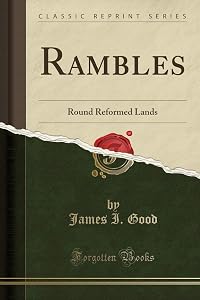
Dr Good seems to have been unlucky with his printer, but his loss is our gain. Apart from the unfortunate title page layout ("yes, but what about the square ones?" was my automatic reaction...) we get a whole string of unconventional American spellings of German place names: Frankford for Frankfurt and Meurs for Moers being the most striking. A few historical figures also get Americanised in a rather Mark Twainish way - "Thomas A. Kempis" was easy enough to decode, but "John A. Lasco" took me a moment or two longer to work out (he's more usually either Johannes a Lasco or Jan Łaski).
An engaging little bit of fun, but also mildly interesting in filling in a few little gaps in my knowledge - I wasn't really conscious of the distinction between the Lutheran and Reformed traditions in German protestantism, for instance, but reading his account of things like the Diakoniewerk in Kaiserswerth (which I knew of as the place where my mother's parents met) the pieces started to fall into place with what I already knew. show less
Researching his historical works, Dr Good, like any conscientious nineteenth-century writer, wanted to see things for himself, and made a series of visits to the places associated with the great figures of the Reformation. Visits he most certainly would not have used a popish word like "pilgrimages" for, although that was clearly what they came down to. This travel book about his experiences in Switzerland and show more Germany is evidently intended as a frivolous spin-off from his more serious work. But we can't reasonably expect very high standards of frivolity from a Calvinist pastor in search of Zwingli's birthplace...
I was expecting to dip into this book, have a good laugh at its period quaintness and prejudices, and put it back on the shelf. But I found myself warming to Dr Good's style in an odd way: he's so patently a kind and sincere person, despite his frequently expressed prejudices against Catholics, Lutherans, Baptists, Methodists, "rationalists", foreigners (other than Reformed clergy), Jews and black people (the last of these doesn't really come into play in this book, but I deduce it from his reaction to the Black Madonna at Einsiedeln). He reminds me very much of certain kindly old clergymen and church elders I knew when I was a child (obviously, they would have been at least a generation younger than Good) - people you feel too much respect for to want to disagree with them, even when they are exhibiting 20/20 tunnel vision. His style really has all the elements of that type: the rambling anecdotes about vaguely embarrassing misunderstandings (usually involving going into a church by the wrong door); the unsubstantiated tales in which unnamed and unverifiable people experience good fortune as a result of following the Reformed faith; the ludicrously weak pulpit puns (standing on a bridge in Berlin: "And here (I am almost ashamed to confess it) I find myself on a spree."). Silly, but so delightful, at least when it's a century away and not happening over an interminable Sunday tea when you really want to get away and play in the garden.
Dr Good seems to have been unlucky with his printer, but his loss is our gain. Apart from the unfortunate title page layout ("yes, but what about the square ones?" was my automatic reaction...) we get a whole string of unconventional American spellings of German place names: Frankford for Frankfurt and Meurs for Moers being the most striking. A few historical figures also get Americanised in a rather Mark Twainish way - "Thomas A. Kempis" was easy enough to decode, but "John A. Lasco" took me a moment or two longer to work out (he's more usually either Johannes a Lasco or Jan Łaski).
An engaging little bit of fun, but also mildly interesting in filling in a few little gaps in my knowledge - I wasn't really conscious of the distinction between the Lutheran and Reformed traditions in German protestantism, for instance, but reading his account of things like the Diakoniewerk in Kaiserswerth (which I knew of as the place where my mother's parents met) the pieces started to fall into place with what I already knew. show less
Members
- Recently Added By
Lists

Books Read in 2016
4,666 works; 199 members
Author Information
35 Works 186 Members
Classifications
- Genres
- Nonfiction, Biography & Memoir, Travel
- DDC/MDS
- 914 — History & geography Geography & travel Geography of and travel in Europe
- LCC
- BX9415 — Philosophy, Psychology and Religion Christian Denominations Christian Denominations Protestantism Other Protestant denominations Reformed or Calvinistic Churches
- BISAC
Statistics
- Members
- 4
- Popularity
- 3,971,768
- Reviews
- 1
- Rating
- (2.00)
- Languages
- English
- Media
- Paper
- ISBNs
- 1