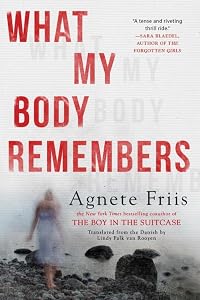
What My Body Remembers
by Agnete Friis
On This Page
Description
"From New York Times bestselling author Agnete Friis comes the chilling story of a young mother who will do whatever it takes to protect her son. Ella Nygaard, 27, has been a ward of the state since she was seven years old, the night her father murdered her mother. She doesn't remember anything about that night or her childhood before it--but her body remembers. The PTSD-induced panic attacks she now suffers incapacitate her for hours--sometimes days--at a time and leave her physically and show more psychically drained. After one particularly bad episode lands Ella in a psych ward, she discovers her son, Alex, has been taken from her by the state and placed with a foster family. Driven by desperation, Ella kidnaps Alex and flees to the seaside town in northern Denmark where she was born. Her grandmother's abandoned house is in grave disrepair, but she can live there for free until she can figure out how to convince social services that despite everything, she is the best parent for her child. But being back in the small town forces Ella to confront the demons of her childhood--the monsters her memory has tried so hard to obscure. What really happened that night her mother died? Was her grandmother right--was Ella's father unjustly convicted? What other secrets were her parents hiding from each other? If Ella can start to remember, maybe her scars will begin to heal--or maybe the truth will put her in even greater danger"-- show lessTags
Recommendations





















Member Reviews
Many thrillers are focused on the future: something terrible is about to happen; someone has to stop it. The clock is ticking, and the fuse is growing shorter, minute by minute. Then there are stories that are focused on something terrible that happened in the past, an event that left the potential for violence hidden below the surface like a land mine. You know it's there, somewhere, and every step you take could trigger the detonator and set it off. That's the animating tension in the first adult novel by Agnete Friis, who previously co-authored the Nina Borg series with Lene Kaaberbøl.
Ella Nygaard is an unlikely heroine. She's wary and cynical about the social system that provides her a place to live and counseling for her show more debilitating anxiety attacks, but strips her of her dignity and threatens, always, to take the one thing from her that matters: her son, Alex. She knows Denmark's social system all too well, having been a ward of the state since she was seven years old. That was the year her father murdered her mother somewhere in the dunes on the wild north coast of Jutland. She was never able to reconstruct what happened, not in the days following the murder when police tried to coax an eyewitness account from a traumatized child, not now–but she feels it in her body, tension and tingling in her fingers, followed by a full-blown storm that knocks her off her feet. After one of those attacks, she is hospitalized and learns, on her release, that her son has been placed with foster parents in the countryside. She coaxes a neighbor to drive her to their farm, and then to help her and her son escape north, to the neglected seaside house her paternal grandmother has left her. It's her only refuge, but it's also the place where the knowledge of what happened when her father killed her mother lies buried.
We approach that moment from two directions: from flashback chapters about her father's affair with a bewitching woman, and about her mother, who left a millennial religious sect to marry for love but can't escape the deeply embedded belief that she is damned. In the present, Ella has met a childhood friend and acquired a strange acquaintance – an eccentric woman artist who is losing her home and moves in with Ella and her son, a temporary visitor who can't be dislodged. The three of them create a strange sort of family haunted by a sense that something is deeply wrong.
Friis has stretched her neck out with a prickly protagonist who has resigned herself to life on welfare, always struggling to get buy without money, often focused on getting a packet of smokes or a bottle of vodka. She loves her son fiercely, but does things that puts their future at risk–and puts her one step closer to triggering that buried memory. Though veteran mystery readers may not be entirely surprised by the denouement of this complex and multi-layered mystery, they may well be caught off guard by a character who stubbornly does everything she can to be unlovable, yet somehow becomes an enormously sympathetic guide to the experience of lives lived on the fringes of society.
Reposted with permission from Reviewing the Evidence. show less
Ella Nygaard is an unlikely heroine. She's wary and cynical about the social system that provides her a place to live and counseling for her show more debilitating anxiety attacks, but strips her of her dignity and threatens, always, to take the one thing from her that matters: her son, Alex. She knows Denmark's social system all too well, having been a ward of the state since she was seven years old. That was the year her father murdered her mother somewhere in the dunes on the wild north coast of Jutland. She was never able to reconstruct what happened, not in the days following the murder when police tried to coax an eyewitness account from a traumatized child, not now–but she feels it in her body, tension and tingling in her fingers, followed by a full-blown storm that knocks her off her feet. After one of those attacks, she is hospitalized and learns, on her release, that her son has been placed with foster parents in the countryside. She coaxes a neighbor to drive her to their farm, and then to help her and her son escape north, to the neglected seaside house her paternal grandmother has left her. It's her only refuge, but it's also the place where the knowledge of what happened when her father killed her mother lies buried.
We approach that moment from two directions: from flashback chapters about her father's affair with a bewitching woman, and about her mother, who left a millennial religious sect to marry for love but can't escape the deeply embedded belief that she is damned. In the present, Ella has met a childhood friend and acquired a strange acquaintance – an eccentric woman artist who is losing her home and moves in with Ella and her son, a temporary visitor who can't be dislodged. The three of them create a strange sort of family haunted by a sense that something is deeply wrong.
Friis has stretched her neck out with a prickly protagonist who has resigned herself to life on welfare, always struggling to get buy without money, often focused on getting a packet of smokes or a bottle of vodka. She loves her son fiercely, but does things that puts their future at risk–and puts her one step closer to triggering that buried memory. Though veteran mystery readers may not be entirely surprised by the denouement of this complex and multi-layered mystery, they may well be caught off guard by a character who stubbornly does everything she can to be unlovable, yet somehow becomes an enormously sympathetic guide to the experience of lives lived on the fringes of society.
Reposted with permission from Reviewing the Evidence. show less
Having read and enjoyed the Nina Borg mysteries Agnete Friis co-wrote with Lene Kaaberbøl, I looked forward to What My Body Remembers with a great deal of anticipation. What I discovered was something else entirely. Normally unlikable main characters don't bother me, but I've been plagued with a rash of them in my reading recently, so by the time I was introduced to Ella Nygaard my patience had already been worn down to a nub.
This one quote sums up Ella's character: "...when anybody tries to talk to you, you just turn your back. Literally. That boy of yours must have been miraculously conceived when you either were too drunk or too high to fend another person off." Ella depends upon social services for money in order to live, but she show more spends a great deal of time doing nothing but making everything harder for herself and for the agencies trying to help her. If you try to do her a kindness, be prepared to get punched in the nose.
The pace of the book is glacial, and I deduced the villain and an important plot twist well in advance of their reveal. I hate to say it, but reading What My Body Remembers was a chore and the only reason why I finished it was because I wanted to see if my deductions were correct. If a slow pace doesn't bother you-- and if you haven't had a surfeit of unlikable characters in your recent reading, this may very well be your cup of tea. It just wasn't mine. show less
This one quote sums up Ella's character: "...when anybody tries to talk to you, you just turn your back. Literally. That boy of yours must have been miraculously conceived when you either were too drunk or too high to fend another person off." Ella depends upon social services for money in order to live, but she show more spends a great deal of time doing nothing but making everything harder for herself and for the agencies trying to help her. If you try to do her a kindness, be prepared to get punched in the nose.
The pace of the book is glacial, and I deduced the villain and an important plot twist well in advance of their reveal. I hate to say it, but reading What My Body Remembers was a chore and the only reason why I finished it was because I wanted to see if my deductions were correct. If a slow pace doesn't bother you-- and if you haven't had a surfeit of unlikable characters in your recent reading, this may very well be your cup of tea. It just wasn't mine. show less
Broken lives, broken people. Ella has been under state care since the age of seven when her father killed her mother. She was there, but remembers nothing of that time, and little from the time before. Her body though, does remember and she has severe PTSD, panic attacks that are crippling. She has a son now, a son she loves but is unable to handle a job, so, she receives money from the social services available. She drinks too much and is under the supervision of a social worker. When a severe attack hospitalizes her, the social services take her son, a son she recovers and then runs back to the town she is from. There she begins to gain control of her life, she also begins to remember, pieces here and there.
There was something about show more the atmosphere in this novel that I found captivating. Melancholy and almost haunting, this story is well written and well plotted. Although it is easy to dislike Ella and the things she does, I found myself rooting for her and her son, Alex. Suspenseful without being horrible graphic, was quite caught up in the story and once again did not guess the outcome.
ARC from Netgalley. show less
There was something about show more the atmosphere in this novel that I found captivating. Melancholy and almost haunting, this story is well written and well plotted. Although it is easy to dislike Ella and the things she does, I found myself rooting for her and her son, Alex. Suspenseful without being horrible graphic, was quite caught up in the story and once again did not guess the outcome.
ARC from Netgalley. show less
This book was unpleasant to read and didn't reward the reader with interesting characters or an engaging plot. I understand that had difficult lives that toughened them up, or something, but it was difficult to connect with them when they were so one-dimensional, and that one dimension was aggressively rude.
Thanks to SoHo Crime publishers and Edelweiss-AboveTheTreeline for [b: What My Body Remembers|31544900|What My Body Remembers|Agnete Friis|https://images.gr-assets.com/books/1478732053s/31544900.jpg|52223981] by [a: Agnete Friis|3398035|Agnete Friis|https://images.gr-assets.com/authors/1320909596p2/3398035.jpg]. I received an ARC Kindle e-book edition at no cost.
There are people in our world who have never experienced nightmares that come to life.
Post-Traumatic Stress has become a buzz-phrase in society, that makes it seem a fad rather than a disease or ailment. Only recently people outside of War experience were diagnosed with Post-Traumatic Stress Disease.
Unlike a broken bone or paralysis, PTSD is a psychological manifestation of show more tragic or traumatic experiences. The effects are felt by a sufferer in different ways.
There is little acknowledgment or treatment for deep trauma. Many sufferers end up self-medicating with alcohol and/or drugs.
It is easy to judge others when we cannot see the deep poisonous pains that handicap their lives.
This novel is about a remarkable woman; Ella Nygaard of Denmark. For twenty years she has done the best she can to keep some kind of life balance and provide a life for her adolescent son.
The only family she knows or claims is her son. Every day is a struggle to keep enough balance to keep her son and a way to provide for them.
At the age of seven Ella experienced a grisly nightmare which claimed the life of her mother. Her father went to prison. She cannot remember any of it.
Ella experiences physical ailments called tremors when she dreams. Some of the memories start to come through and her body cannot take it. But science will not brand what she experiences as a disability. Their lives remain cataclysmic.
Her only friends are also broken. Sober alcoholics who care about Ella and her son Alex.
A series of events takes Ella back to the physical place where the nightmare began.
Will this be the end of it all? Will Ella and Alex be able to stay together?
Can there be any possible redemption or resolution?
I will recommend this haunting novel for our library collection, and to other readers I know. show less
There are people in our world who have never experienced nightmares that come to life.
Post-Traumatic Stress has become a buzz-phrase in society, that makes it seem a fad rather than a disease or ailment. Only recently people outside of War experience were diagnosed with Post-Traumatic Stress Disease.
Unlike a broken bone or paralysis, PTSD is a psychological manifestation of show more tragic or traumatic experiences. The effects are felt by a sufferer in different ways.
There is little acknowledgment or treatment for deep trauma. Many sufferers end up self-medicating with alcohol and/or drugs.
It is easy to judge others when we cannot see the deep poisonous pains that handicap their lives.
This novel is about a remarkable woman; Ella Nygaard of Denmark. For twenty years she has done the best she can to keep some kind of life balance and provide a life for her adolescent son.
The only family she knows or claims is her son. Every day is a struggle to keep enough balance to keep her son and a way to provide for them.
At the age of seven Ella experienced a grisly nightmare which claimed the life of her mother. Her father went to prison. She cannot remember any of it.
Ella experiences physical ailments called tremors when she dreams. Some of the memories start to come through and her body cannot take it. But science will not brand what she experiences as a disability. Their lives remain cataclysmic.
Her only friends are also broken. Sober alcoholics who care about Ella and her son Alex.
A series of events takes Ella back to the physical place where the nightmare began.
Will this be the end of it all? Will Ella and Alex be able to stay together?
Can there be any possible redemption or resolution?
I will recommend this haunting novel for our library collection, and to other readers I know. show less
Ella Nygaard lives with her son, but cannot work because of her medical condition. She is estranged from her family as her father went to prison for the killing of her mother. Following a minor altercation, Ella grabs her son from a relation and heads out of the city to her grandmother's abandoned home on the coast, where they try to establish new lives. The book goes back and forth between the present and the events leading up to her mother's death until we understand what actually occurred. I like the series about Nina Borg that Friis co-writes with Lene Kaaberbol, but found this solo effort rather flat.
I'd probably have given it 2-3 stars if it were a more popular book but it wasn't bad-- I predicted the ending pretty early on and I hated pretty much all of the characters so there wasn't a lot to latch onto, and a few things were confusing but overall it was well-written and interesting and the plot twists were well placed.
Members
- Recently Added By
Lists

Scandinavian Crime
90 works; 3 members
Author Information

16+ Works 2,491 Members
Awards and Honors
Common Knowledge
- Original publication date
- 2017
- Canonical DDC/MDS
- 839.8138
- Canonical LCC
- PT8177.16.R55
Classifications
- Genres
- Fiction and Literature, Mystery
- DDC/MDS
- 839.8138 — Literature & rhetoric German & related literatures Other Germanic literatures Danish and Norwegian literatures Danish Danish fiction 2000–
- LCC
- PT8177.16 .R55 — Language and Literature German, Dutch and Scandinavian literatures Danish literature Individual authors or works 2001-
- BISAC
Statistics
- Members
- 79
- Popularity
- 401,633
- Reviews
- 9
- Rating
- (3.43)
- Languages
- Danish, English
- Media
- Paper, Audiobook, Ebook
- ISBNs
- 13
- ASINs
- 3