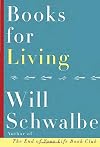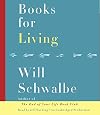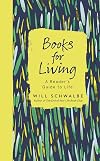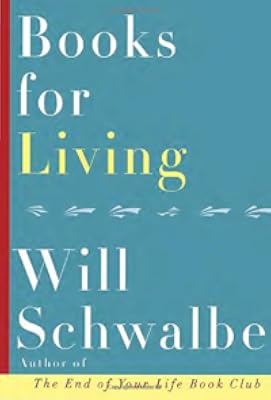
Books for Living
by Will Schwalbe
On This Page
Description
"For Will Schwalbe, reading is a way to entertain himself but also to make sense of the world, to become a better person, and to find the answers to the big (and small) questions about how to live his life. In this delightful celebration of reading, Schwalbe invites us along on his quest for books that speak to the specific challenges of living in our modern world, with all its noise and distractions.'"--Tags
Recommendations


Member Reviews
Do you love books about books? Most serious book worms do. I know I sure love them. I am always happy to read a book that has the potential to add so many titles to my want to read list. If you're a reader, people like to ask what your favorite book is or what kind of books you like to read or what book changed your life. The answer to the latter portion of the question is that every book changes your life. Sometimes the ways in which this happens are big and obvious and sometimes the ways are so small as to be almost dismissable. Sometimes the ways depend on what else is going on in your life and your head when you read that particular book. I believe that each book, from the fluffiest fluff to the most serious philosophy becomes a show more part of you, shapes you and your way of thinking, changes you. So when a book like Schwalbe's essay collection about his reading life examined and illustrated with pieces of his non-book life comes along, it's a sure bet that I'll read it.
Schwalbe believes that you can find everything you need in a book and his collection of essays discuss what he has taken away from the books he's read, how it has made him look at his life in particular but also life and society in general. The essays center around a whole variety of books, classics and modern/recent books both. The reader sees right into the very soul of Schwalbe through the lens of the books that have shaped his thinking and his being and can, if they so choose, take Schwalbe's choices as suggestions for their own further reading and examination. His writing is conversational and accessible, personal and approachable. The books that touched Schwalbe came at just the right moment for him to read and reflect on them in terms of his life, his experience, and as such they are unlikely to represent the same things to his readers. I know several of the books he notes as seminal in his reading life left me cold but I have my own books that he doesn't mention. And that, of course, is the beauty of reading. We all come away from each book with something incredibly personal. Reading Schwalbe's insights into his reading did make me reflect on my own and seeing into the heart of someone else's life through their reading was fascinating. This is a type of reflective memoir I can really get behind. show less
Schwalbe believes that you can find everything you need in a book and his collection of essays discuss what he has taken away from the books he's read, how it has made him look at his life in particular but also life and society in general. The essays center around a whole variety of books, classics and modern/recent books both. The reader sees right into the very soul of Schwalbe through the lens of the books that have shaped his thinking and his being and can, if they so choose, take Schwalbe's choices as suggestions for their own further reading and examination. His writing is conversational and accessible, personal and approachable. The books that touched Schwalbe came at just the right moment for him to read and reflect on them in terms of his life, his experience, and as such they are unlikely to represent the same things to his readers. I know several of the books he notes as seminal in his reading life left me cold but I have my own books that he doesn't mention. And that, of course, is the beauty of reading. We all come away from each book with something incredibly personal. Reading Schwalbe's insights into his reading did make me reflect on my own and seeing into the heart of someone else's life through their reading was fascinating. This is a type of reflective memoir I can really get behind. show less
*Free e-book ARC provided by the publisher through Edelweiss/Above the Treeline in exchange for an honest review. No money or other goods were exchanged, and all views are my own.*
Will Schwalbe, the author of The End of Your Life Book Club, returns with another book about books: this one focuses on books that, while they may not be his favorites, have in some way influenced Schwalbe's life and philosophy.
There is something warm and comforting in reading a book by a fellow booklover, a recognition of a like-minded soul and a voyeuristic joy in peeking into someone else's reading brain. This one was no exception. I enjoyed the author's descriptions of books, his general way of dealing with spoilers (usually eschewing them except in the show more case of classics that most people would know the story even if they had not read it, but on one occasion warning those who still wanted to read a book that they should probably not read the rest of the chapter), and the way the most influential books would make connections and find their way into other chapters. While the idea of "books for living" sounds instructive, Schwalbe's style is more confessional than preachy. He's also not a book snob, and his list of influential books includes children's books and popular fiction as well as classics and less well-known texts. Some of the essays were heart-wrenching and others made me laugh, making for delightful reading from beginning to end. show less
Will Schwalbe, the author of The End of Your Life Book Club, returns with another book about books: this one focuses on books that, while they may not be his favorites, have in some way influenced Schwalbe's life and philosophy.
There is something warm and comforting in reading a book by a fellow booklover, a recognition of a like-minded soul and a voyeuristic joy in peeking into someone else's reading brain. This one was no exception. I enjoyed the author's descriptions of books, his general way of dealing with spoilers (usually eschewing them except in the show more case of classics that most people would know the story even if they had not read it, but on one occasion warning those who still wanted to read a book that they should probably not read the rest of the chapter), and the way the most influential books would make connections and find their way into other chapters. While the idea of "books for living" sounds instructive, Schwalbe's style is more confessional than preachy. He's also not a book snob, and his list of influential books includes children's books and popular fiction as well as classics and less well-known texts. Some of the essays were heart-wrenching and others made me laugh, making for delightful reading from beginning to end. show less
''Reading challenges you to figure out what kind of person you want to be.''
I might as well spare you all with my boring introduction and tell you this is an astonishing book. Not simply good or well-written or interesting, but astonishing! One of the best non-fiction books I've ever read, one of the best book ''about books'' of recent times.
As you might know from my reviews, I'm not usually moved by a book, no matter how much I may have loved it. But this one...one must have a heart of stone (yes, cliché, I know) so as not to be deeply touched by Will Schwalbe's writing. He has a way with words that cries out to the reader and the reader freezes and listens, transfixed. I've never felt that with a non-fiction book. He takes some of show more life's greatest difficulties, some of its most well-felt emotions, and tries to show how books can help us- nay, heal us- to overcome them, to cope with them, to avoid being defeated and traumatised. Not only he succeeds in doing that, but has managed to make me look upon well-loved books under a different light, to realise them better, to love them even more.
He bares his soul and talks about his life in a conversational tone, as if he's talking to a close friend. How can one not appreciate that, especially as he touches upon some really sensitive topics. In beautiful, engaging language, he shares his views, his experiences and not once does he become bossy or self-centered. He is open, honest and sympathetic, the voice of a friend you haven't met for a long time. His ''me'' and ''I'' are confessions, not egocentric speeches of achievements.
His heartfelt, moving remarks about the horrific discrimination against the LGBT community during the 1970's are wonderfully reflected in his text about [b:Giovanni's Room|38462|Giovanni's Room|James Baldwin|http://images.gr-assets.com/books/1389658936s/38462.jpg|814207] by [a:James Baldwin|10427|James Baldwin|http://images.gr-assets.com/authors/1343346341p2/10427.jpg]. While I was reading his text about the outbreak of HIV, the hysteria, the hatred of the misinformed society, I felt terror gripping my heart. This is how good Schwalbe's writing is. Images from history pass through your eyes as if you have been carried away in that era (and I wasn't even born at the time), as if you're experiencing them this very moment.
I really enjoyed the fact that he writes primarily about less well-known books. Yes, you'll find [b:1984|5470|1984|George Orwell|http://images.gr-assets.com/books/1348990566s/5470.jpg|153313], [b:Rebecca|17899948|Rebecca|Daphne du Maurier|http://images.gr-assets.com/books/1386605169s/17899948.jpg|46663], Murakami's works, but his focus turns elsewhere, and I found that extremely refreshing. He makes a text about a book which advises you on how to de-clutter interesting and enjoyable. On a more personal note, I loved his references to his teachers, and as a teacher myself, I sincerely appreciated his wonderful passage about mediocrity, using none other than Odysseus, the mythical king of Ithaca, as his inspiration.
I don't have much to say. To state that I recommend this book would be a frightful understatement. I think it is essential that everyone who loves books shoud read Books For Living, not to discover new books (that as well), but to experience a kind of writing that is immediate, sincere, free of pretensions and fake philosophies full of verbose nonsence. This is a breath of fresh air. Breathe it deeply. I leave you with one of the most touching sentences I've ever had the pleasure to read...
''I read to live. I read for life''. show less
I might as well spare you all with my boring introduction and tell you this is an astonishing book. Not simply good or well-written or interesting, but astonishing! One of the best non-fiction books I've ever read, one of the best book ''about books'' of recent times.
As you might know from my reviews, I'm not usually moved by a book, no matter how much I may have loved it. But this one...one must have a heart of stone (yes, cliché, I know) so as not to be deeply touched by Will Schwalbe's writing. He has a way with words that cries out to the reader and the reader freezes and listens, transfixed. I've never felt that with a non-fiction book. He takes some of show more life's greatest difficulties, some of its most well-felt emotions, and tries to show how books can help us- nay, heal us- to overcome them, to cope with them, to avoid being defeated and traumatised. Not only he succeeds in doing that, but has managed to make me look upon well-loved books under a different light, to realise them better, to love them even more.
He bares his soul and talks about his life in a conversational tone, as if he's talking to a close friend. How can one not appreciate that, especially as he touches upon some really sensitive topics. In beautiful, engaging language, he shares his views, his experiences and not once does he become bossy or self-centered. He is open, honest and sympathetic, the voice of a friend you haven't met for a long time. His ''me'' and ''I'' are confessions, not egocentric speeches of achievements.
His heartfelt, moving remarks about the horrific discrimination against the LGBT community during the 1970's are wonderfully reflected in his text about [b:Giovanni's Room|38462|Giovanni's Room|James Baldwin|http://images.gr-assets.com/books/1389658936s/38462.jpg|814207] by [a:James Baldwin|10427|James Baldwin|http://images.gr-assets.com/authors/1343346341p2/10427.jpg]. While I was reading his text about the outbreak of HIV, the hysteria, the hatred of the misinformed society, I felt terror gripping my heart. This is how good Schwalbe's writing is. Images from history pass through your eyes as if you have been carried away in that era (and I wasn't even born at the time), as if you're experiencing them this very moment.
I really enjoyed the fact that he writes primarily about less well-known books. Yes, you'll find [b:1984|5470|1984|George Orwell|http://images.gr-assets.com/books/1348990566s/5470.jpg|153313], [b:Rebecca|17899948|Rebecca|Daphne du Maurier|http://images.gr-assets.com/books/1386605169s/17899948.jpg|46663], Murakami's works, but his focus turns elsewhere, and I found that extremely refreshing. He makes a text about a book which advises you on how to de-clutter interesting and enjoyable. On a more personal note, I loved his references to his teachers, and as a teacher myself, I sincerely appreciated his wonderful passage about mediocrity, using none other than Odysseus, the mythical king of Ithaca, as his inspiration.
I don't have much to say. To state that I recommend this book would be a frightful understatement. I think it is essential that everyone who loves books shoud read Books For Living, not to discover new books (that as well), but to experience a kind of writing that is immediate, sincere, free of pretensions and fake philosophies full of verbose nonsence. This is a breath of fresh air. Breathe it deeply. I leave you with one of the most touching sentences I've ever had the pleasure to read...
''I read to live. I read for life''. show less
A nice follow-up to The End-of-Life Book Club that Schwalbe compiled with his dying mother. Here he looks at books that have impacted his life or simply accompanied a particular stand-out moment. His premise is that "Every book changes your life." some in profound ways and some in almost imperceptible ways. He believes the question we should be asking each other is not "where are you from?" or "what do you do?" but "what are you reading?" Each chapter looks at a book and a condition or state of being: "Wonder" and Choosing Kindness; "The Odyssey" and Embracing Mediocrity; "The Girl on the Train" and Trusting; "Rebecca" and Betraying -- some are well-known and so are rather esoteric and probably out of print, but each is a well-examined show more way to make a connection. Some commemorate major events/epiphanies in Schwalbe's personal life and others are just thoughtful reflections on our common society. It was interesting to intersect on a book I've read, but find a totally different reaction or understanding. Dozens of other titles and authors are peppered throughout and a complete list is provided at the end for those who like to be methodical and thorough. Perfect book for a bibliophile. show less
Almost any book can teach us something, even if what it teaches us is to avoid that particular author in the future. Will Schwalbe identifies lessons learned from a wide assortment of books in “Books for Living.” And what a wide assortment it is. There are classic books (“David Copperfield”), best-sellers (“The Girl on the Train”), obscure books (“Zen in the Art of Archery”), children's books (“Stuart Little”) and even a cookbook (“The Taste of Country Cooking”).
The lessons learned are equally varied. From “Reading Lolita in Tehran” he learns about choosing the life one wants to lead. From “A Little Life” he learns the value of a good hug. From “What I Talk About When I Talk About Running” he learns show more about the importance of a nap. From “Bartleby, the Scrivener” he learns not to never give up but rather that sometimes quitting can be the best option.
In each chapter he delves into his own past, as well as into the book that is the focus of that chapter, what it's about, how the author came to write it and, of course, how it taught him the lesson he needed at that particular time in his life. He recognizes that other readers will discover other lessons at different times. The best books have an endless number of lessons for an endless number of readers.
Schwalbe's book has a lesson for me: Pay more attention to what each book is saying. The right book at the right time means nothing if one is not alert for the lessons hiding in its pages. show less
The lessons learned are equally varied. From “Reading Lolita in Tehran” he learns about choosing the life one wants to lead. From “A Little Life” he learns the value of a good hug. From “What I Talk About When I Talk About Running” he learns show more about the importance of a nap. From “Bartleby, the Scrivener” he learns not to never give up but rather that sometimes quitting can be the best option.
In each chapter he delves into his own past, as well as into the book that is the focus of that chapter, what it's about, how the author came to write it and, of course, how it taught him the lesson he needed at that particular time in his life. He recognizes that other readers will discover other lessons at different times. The best books have an endless number of lessons for an endless number of readers.
Schwalbe's book has a lesson for me: Pay more attention to what each book is saying. The right book at the right time means nothing if one is not alert for the lessons hiding in its pages. show less
Schwalbe writes about why he likes to read and how his some of the books he read has influenced his life. To be honest, I read very few of the books cited by Schwalbe. His reading was more high brow than mine. I also had no interest in poetry. I'm not sure that his book will encourage others to read but I could appreciate the connections between the books read and how they impacted his thinking and his life. He cited how influenced he was by The Importance of Living written by Lin Yutang. That book is on my future reading list.
I remember my insatiable appetite for books started with The Hardy Boys, Tom Swift, Chip Hilton and Rick Brant. I rushed to get my school work done so I could read those series. I still get a rush from finding a show more book that I have been looking forward to reading---just not the same fervor I had when I was ten and eleven.
I skimmed through Schwalbe's book but what I read, I enjoyed and appreciated. show less
I remember my insatiable appetite for books started with The Hardy Boys, Tom Swift, Chip Hilton and Rick Brant. I rushed to get my school work done so I could read those series. I still get a rush from finding a show more book that I have been looking forward to reading---just not the same fervor I had when I was ten and eleven.
I skimmed through Schwalbe's book but what I read, I enjoyed and appreciated. show less
Books about books, I can never exist them Love reading about books others love, the meanings they find in them, books to guide one and book read to gain knowledge. This book covers all this and more. Loved his [book:The End of Your Life Book Club|13414676], though sad I found it a special read. He uncovers further relationships and the books that remind him of these. Books that he will never part with and why. He quotes extensively from [book:The Importance of Living|84352], seems to e the book he takes his guiding philosophy from, one he turns to time and rime again.
He discusses why we read and the many ways reading can help. Love his thoughts on fiction and how it teaches us how and how not to act. Our turned on and into world which show more has pretty much diminished quiet time and solitude. Plus, how could I not love a writer who loves many of the same books I do, including A Little Life?
Divided into sections, each one an essay on its own, and I enjoyed each and every one. He is a clear and concise writer, stating his reasons for each of his chosen books and acknowledges there are many more he did not mention. The biggest problem with reading a book such as this, are more additions to my already overflowing TBR. Brought one home from work yesterday that I hope to read soon, [book:What I Talk About When I Talk About Running|2195464] and since he includes a list at books end will certainly be adding more.
ARC from Knopf publishers.
Publication date: December 29th. show less
He discusses why we read and the many ways reading can help. Love his thoughts on fiction and how it teaches us how and how not to act. Our turned on and into world which show more has pretty much diminished quiet time and solitude. Plus, how could I not love a writer who loves many of the same books I do, including A Little Life?
Divided into sections, each one an essay on its own, and I enjoyed each and every one. He is a clear and concise writer, stating his reasons for each of his chosen books and acknowledges there are many more he did not mention. The biggest problem with reading a book such as this, are more additions to my already overflowing TBR. Brought one home from work yesterday that I hope to read soon, [book:What I Talk About When I Talk About Running|2195464] and since he includes a list at books end will certainly be adding more.
ARC from Knopf publishers.
Publication date: December 29th. show less
Members
- Recently Added By
Lists

Books about Books
149 works; 24 members

Writers and Readers
11 works; 1 member
Author Information

4 Works 3,503 Members
Awards and Honors
Common Knowledge
- Epigraph
- "A reader lives a thousand lives before he dies, " said Jojen. "The man who never reads lives only one."
-George R. R. Martin, "A Dance with Dragons" - Dedication
- For David Cheng / And for Andy Brimmer and Tom Molner
- First words
- From time to time I have a terrifying dream. I call it the Reader's Nightmare.
- Quotations
- I believe that everything you need to know you can find in a book. People have always received life-guiding wisdom from certain types of nonfiction ... But I have found that all sorts of books can carry this kind of wisdom; a... (show all) random sentence in a thriller will give me an unexpected insight. (If I hadn't read "Killing Floor, the masterful 1997 novel that introduced the world to Jack Reacher, a former military cop turned vagrant, I never would have learned this valuable piece of wisdom, which still guides me in work and life: "Waiting is a skill like anything else." (p. 11)
We can find meaning in everything and everything is fair game. (p. 12)
... I think we need to read and to be readers now more than ever. (p. 13)
... connectivity is one thing.; constant connectivity is another. Constant connectivity can be a curse ... Books are uniquely suited to helping us change our relationship to the rhythms and habits of daily life in this world ... (show all)of endless connectivity. They are the expression of an individual or a group of individuals, not of a hive mind or collective consciousness. They speak to us, thoughtfully, one at a time. They demand our attention. And they demand that we briefly put aside our own beliefs and prejudices and listen to someone else's. (p. 14-15)
But there's one question I think we should ask of one another a lot more often, and that's "What are you reading?" It's a simple questions but a powerful one, and it can change lives, creating a shared universe for people who... (show all) are otherwise separated by culture and age and by time and space. (p. 15)
"What are you reading?" isn't a simple question when asked with genuine curiosity; it's really a way of asking, "Who are you now and who are you becoming?" (p. 17)
Some of these are not works I would list among my favorites books, but they are all books that I found (or that found me) when I needed them, or that prompted me to remember something, realize something, or see my life and th... (show all)e world differently. Every reader can construct a list like this; ... Compiling and constantly revising this kind of book list is an exercise I highly recommend: it's a path to creating your own practical philosophy. (p. 18)
But more than anything: Try to be as cheerful and optimistic as you can be in the face of whatever comes next. [Lesson from "Stuart Little" by E. B. White] (p. 43)
[Anne Morrow Lindbergh in "Gifts from the Sea"] is particularly adamant that women need solitude - and must find a way to get it, however they can. (p. 112)
Reading is an art we practice our whole lives. (p. 180) - Last words
- (Click to show. Warning: May contain spoilers.)When I read, I'm reminded to be more thoughtful about how I approach each day. I read to live. I read for life.
- Canonical DDC/MDS
- 028.9
- Canonical LCC
- Z1003.2
Classifications
- Genres
- Nonfiction, Literature Studies and Criticism, Biography & Memoir, General Nonfiction
- DDC/MDS
- 028.9 — Computer science, information & general works Library & information sciences Reading and use of other information media Character of reading in libraries
- LCC
- Z1003.2 — Bibliography, Library Science and Information Resources General bibliography Choice of books. Books and reading. Book reviews
- BISAC
Statistics
- Members
- 593
- Popularity
- 49,538
- Reviews
- 27
- Rating
- (3.67)
- Languages
- English
- Media
- Paper, Audiobook, Ebook
- ISBNs
- 15
- ASINs
- 3