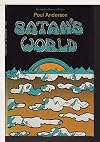
Satan's World
by Poul Anderson
Chronicles of the Polesotechnical League (German numbering) (03), Polesotechnic League (4)
On This Page
Tags
Recommendations

















Member Reviews
A solid, fun, little space opera with some sparse attempts at harder science. A perfectly enjoyable easy way to pass the time. I appreciate that, especially for the era, Anderson really tries to make his 'aliens' as aliens as he can while still working within some general sf bounds of size and structure.
This is part of the Polysothechnic League books by Anderson. I'm not sure where this one falls in the series.
The plot was pretty thin. It seemed more an exercise of hard science by thinking about what certain planets might be like given certain circumstances. And also an exercise in anthropology by describing some of the aliens already in the League, what their planets are like and how they evolved. And even more so about the new aliens they encounter. How did herbivores evolve into a warlike culture?
It was interesting for seeing how Anderson thought these things through, but mainly the book was a big datadump with a little plot thrown in to facilitate the musings.
The plot was pretty thin. It seemed more an exercise of hard science by thinking about what certain planets might be like given certain circumstances. And also an exercise in anthropology by describing some of the aliens already in the League, what their planets are like and how they evolved. And even more so about the new aliens they encounter. How did herbivores evolve into a warlike culture?
It was interesting for seeing how Anderson thought these things through, but mainly the book was a big datadump with a little plot thrown in to facilitate the musings.
Satan's World is either the third or fourth book in Poul Anderson's Polesotechnic League series (Anderson's Wikipedia entry lists it as the fourth book, but I've seen it listed elsewhere as the third; the omnibus The Earth Book of Stormgate, which is itself the fifth or sixth book in the series for all that it includes chronologically earlier stories, includes Anderson's complete, preferred text of the first novel in the series, which was originally published in 1958 in a heavily edited form as War of the Wing-Men; the complete manuscript was published for the first time in The Earth Book of Stormgate as The Man Who Counts), which features a loose inter-spatial alliance of merchant princes modeled roughly on the adventurer capitalists show more from the Dutch Golden Age of the 17th century; the chief characters in the series are the "globular," flamboyantly hedonistic, bombastic and self-pitying (and wily, crafty, subtle, shrewd, frighteningly capable, physically formidable and, at bottom, compassionate) Earthman Nicholas van Rijn and his protégé, the pleasant though bland brick David Falkayn, the lesser scion of a colonial, human, baronial family on the planet Hermes.
Satan's World begins on Earth, where van Rijn has sent Falkayn to query the supercomputers of the business consultancy firm (it's indicative of this novel's publication date that the word "consultant" is not used to describe them) Serendipity, Inc., in the hopes of discovering a hitherto unknown market opportunity that van Rijn can exploit to the betterment of his conglomerate, Solar Spice & Liquors Company; Falkayn hits paydirt to such an extent that he is captured by the odd and aloof human operators of Serendipity so that their unknown extraterrestrial masters may benefit, causing both Falkayn's shipmates -- the hot-tempered, sassy feline Chee Lan from a planet that humans have named Cynthia (for the discoverer's mistress) and the intellectual and naïve Buddhist dracocentauroid Adzel from the planet dubbed Woden by humans -- and van Rijn to stage a raid on the personal Lunar domain of Serendipity's human agents to recapture the "brainscrubbed" Falkayn and race to the find of Serendipity's computers: a rogue planet with the perfect environment for transmuting the heavier, rarer (and, consequently, enormously lucrative) elements that is hurtling towards a blue star designated Beta Crucis that Falkayn in the event christens "Satan," owing to the catastrophic atmospheric and geological conditions thereon. The two teams -- Falkayn and Chee Lan; van Rijn and Adzel -- have to deal with Luna's police force (headed by a man named Edward Garver, who seems to be modeled on the long-time, and then-current, at the time that Satan's World was written and published, head of the FBI, J. Edgar Hoover; see, for example, p. 59; Chapter VIII and p. 72; Chapter X), the Commonwealth government, the Polesotechnic League's perpetually squabbling members, and a hitherto unknown race of sophonts (Anderson's preferred term for intelligent, technology-using races), the Shenna, who are in their own way as threatening as Star Trek: Next Generation's the Borg.
Satan's World is, along with The Earth Book of Stormgate, the most enjoyable book so far in the series (I've yet to read Mirkheim or The People of the Wind; the latter book takes place towards the end of the League's existence, and, as such, doesn't feature either van Rijn or Falkayn). Satan's World showcases Anderson's strengths as a writer: the ability to present, in a relatively painless fashion, lengthy hard science exposition (indeed, I felt at some points as though I were reading a Scientific American or Nature article); a facility for wryly amusing dialogue (especially when Chee Lan is involved) and punnish, usually apropos, malapropisms (the irreplaceable, irrepressible van Rijn); and a talent for writing action sequences that are both clearly intelligible and exciting. But what really sets Satan's World apart from the preceding volumes is the psychology of the Shenna: Anderson spent some little effort in the development and presentation of them, such that they are more convincingly non-human than many extraterrestrial species from the classic days of science fiction, even from many of Anderson's previous tales of the League.
Anderson rides his libertarian -- pro-capitalist entrepreneur; anti-government -- hobbyhorse here, but not at any great length; and while his sexism is, as in other books, in full flower, it's not of the strain that holds that females are intellectually or physically inferior to males, merely that females are invariably more emotional than males, and that there's nothing inherently wrong with a man being a skirt-chaser, or even an out-and-out lecher (as in the case of van Rijn), given that males' sex drives are necessarily stronger than females', and that females tend to use their sexuality to gain advantage over males. (If this type of sexism was that objectionable to me, I'd have to forswear noir pretty much in toto.) Like many of the classic writers of science fiction, Anderson tends to show off his erudition ever so slightly more than is strictly necessary: as, for example, in his naming a character Hugh Latimer for no obvious -- or, as far as I can tell, obscure -- reason.
Satan's World is also buoyed by Anderson's strongest female character that I've yet encountered: the sleek, belligerent and acerbic Chee Lan, who is most clearly shown here to be more akin to an Earth feline than to a lemur, for all that she possesses two opposable thumbs (previously, to me at least, she seemed to be a cross between the two) -- see, for example, the descriptions of her behavior in Chapter XXIII, p. 186 and p. 188 -- and who, judging by the author photo on the back of the book's jacket, seems to have been based at least in her markings on those of the kitty that Anderson is petting or holding in place (see Chapter IV, p. 26). The novel is about perfectly balanced between the four protagonists -- no one hangs around long enough to wear out their welcome -- but I'm enough of an ailurophile that Chee Lan made the book for me (although I've got enough sense to blanch at the thought of a typical Felis domesticus with thumbs and assortment of projectile weapons and getaway vehicles), even moreso than the blustery van Rijn. show less
Satan's World begins on Earth, where van Rijn has sent Falkayn to query the supercomputers of the business consultancy firm (it's indicative of this novel's publication date that the word "consultant" is not used to describe them) Serendipity, Inc., in the hopes of discovering a hitherto unknown market opportunity that van Rijn can exploit to the betterment of his conglomerate, Solar Spice & Liquors Company; Falkayn hits paydirt to such an extent that he is captured by the odd and aloof human operators of Serendipity so that their unknown extraterrestrial masters may benefit, causing both Falkayn's shipmates -- the hot-tempered, sassy feline Chee Lan from a planet that humans have named Cynthia (for the discoverer's mistress) and the intellectual and naïve Buddhist dracocentauroid Adzel from the planet dubbed Woden by humans -- and van Rijn to stage a raid on the personal Lunar domain of Serendipity's human agents to recapture the "brainscrubbed" Falkayn and race to the find of Serendipity's computers: a rogue planet with the perfect environment for transmuting the heavier, rarer (and, consequently, enormously lucrative) elements that is hurtling towards a blue star designated Beta Crucis that Falkayn in the event christens "Satan," owing to the catastrophic atmospheric and geological conditions thereon. The two teams -- Falkayn and Chee Lan; van Rijn and Adzel -- have to deal with Luna's police force (headed by a man named Edward Garver, who seems to be modeled on the long-time, and then-current, at the time that Satan's World was written and published, head of the FBI, J. Edgar Hoover; see, for example, p. 59; Chapter VIII and p. 72; Chapter X), the Commonwealth government, the Polesotechnic League's perpetually squabbling members, and a hitherto unknown race of sophonts (Anderson's preferred term for intelligent, technology-using races), the Shenna, who are in their own way as threatening as Star Trek: Next Generation's the Borg.
Satan's World is, along with The Earth Book of Stormgate, the most enjoyable book so far in the series (I've yet to read Mirkheim or The People of the Wind; the latter book takes place towards the end of the League's existence, and, as such, doesn't feature either van Rijn or Falkayn). Satan's World showcases Anderson's strengths as a writer: the ability to present, in a relatively painless fashion, lengthy hard science exposition (indeed, I felt at some points as though I were reading a Scientific American or Nature article); a facility for wryly amusing dialogue (especially when Chee Lan is involved) and punnish, usually apropos, malapropisms (the irreplaceable, irrepressible van Rijn); and a talent for writing action sequences that are both clearly intelligible and exciting. But what really sets Satan's World apart from the preceding volumes is the psychology of the Shenna: Anderson spent some little effort in the development and presentation of them, such that they are more convincingly non-human than many extraterrestrial species from the classic days of science fiction, even from many of Anderson's previous tales of the League.
Anderson rides his libertarian -- pro-capitalist entrepreneur; anti-government -- hobbyhorse here, but not at any great length; and while his sexism is, as in other books, in full flower, it's not of the strain that holds that females are intellectually or physically inferior to males, merely that females are invariably more emotional than males, and that there's nothing inherently wrong with a man being a skirt-chaser, or even an out-and-out lecher (as in the case of van Rijn), given that males' sex drives are necessarily stronger than females', and that females tend to use their sexuality to gain advantage over males. (If this type of sexism was that objectionable to me, I'd have to forswear noir pretty much in toto.) Like many of the classic writers of science fiction, Anderson tends to show off his erudition ever so slightly more than is strictly necessary: as, for example, in his naming a character Hugh Latimer for no obvious -- or, as far as I can tell, obscure -- reason.
Satan's World is also buoyed by Anderson's strongest female character that I've yet encountered: the sleek, belligerent and acerbic Chee Lan, who is most clearly shown here to be more akin to an Earth feline than to a lemur, for all that she possesses two opposable thumbs (previously, to me at least, she seemed to be a cross between the two) -- see, for example, the descriptions of her behavior in Chapter XXIII, p. 186 and p. 188 -- and who, judging by the author photo on the back of the book's jacket, seems to have been based at least in her markings on those of the kitty that Anderson is petting or holding in place (see Chapter IV, p. 26). The novel is about perfectly balanced between the four protagonists -- no one hangs around long enough to wear out their welcome -- but I'm enough of an ailurophile that Chee Lan made the book for me (although I've got enough sense to blanch at the thought of a typical Felis domesticus with thumbs and assortment of projectile weapons and getaway vehicles), even moreso than the blustery van Rijn. show less
Стандартна космическа фантастика, която не блести нито с особена оригиналност, нито с някакво зарибяващо действие.
Мене лично доста ме дразни когато във фантастиките писани по-отдавна основните усилия на автора са насочени към обясняването на някакви астрономически явления и принципи, когато (най-често) това няма особена връзка с действието в книгата. Също и като най-подробно обясняват "новите show more технологии" както си ги представят, пак без никакво особено значение за действието - например като се обажда героя по "видеовръзката" автора надълго и нашироко обяснява как ставя тя, сякаш в един съвременен роман ако героят телефонира, авторът да седне, по средата на действието, да обяснява как точно функционира телефонът.
Ай сиктир - стига сте ми обяснявали как ВИЕ си представяте че стават нещата, оставете ме АЗ да си фантазирам как стават - нали затова жанрът се нарича "фантастика"... show less
Мене лично доста ме дразни когато във фантастиките писани по-отдавна основните усилия на автора са насочени към обясняването на някакви астрономически явления и принципи, когато (най-често) това няма особена връзка с действието в книгата. Също и като най-подробно обясняват "новите show more технологии" както си ги представят, пак без никакво особено значение за действието - например като се обажда героя по "видеовръзката" автора надълго и нашироко обяснява как ставя тя, сякаш в един съвременен роман ако героят телефонира, авторът да седне, по средата на действието, да обяснява как точно функционира телефонът.
Ай сиктир - стига сте ми обяснявали как ВИЕ си представяте че стават нещата, оставете ме АЗ да си фантазирам как стават - нали затова жанрът се нарича "фантастика"... show less
As I have said elsewhere, I like PL novels better when the old scoundrel Nicholas van Rijn is active in them, and he is quite active in this one. It starts quietly with his scout David Falkayn consulting a mysterious company called Serendipity Inc. run by humans apparently from an unknown planet. It has made a fortune by providing clients with relevant information gathered from a wide range of sources. It gives Falkayn data about the planet he later names Satan -- a rogue planet originally without a sun, but currently making one pass around a bright sun, creating (very violent) weather and conditions suitable for very valuable industrial processes. (It later reappears in The Rebel Worlds in Flandry's time) Spoiler warning: the odd show more people running Serendipity seize Falkayn and brainwash him (by strictly illegal methods); he is rescued by his old alien shipmates Chee Lan and Adzel. He and Chee go off to Satan, and meet an automated squadron of spaceships commanded by Gahood, one of the aliens (Shenna) who had sent the humans of Serendipity, together with one of those humans. They capture the human and learn the location of the alien's home planet. Using the violent nature of the planet, Falkayn is about to destroy most enemy ships, but Gahood's own ship gets away. Meanwhile van Rijn and Adzel, after trouble with a human police bureaucrat based on J. Edgar Hoover, Ed Garver (who reappears in Mirkheim) but force a deal with the remaining Serendipity people to sell off the company, while some go ahead home and one, Thea (whom they ha tried to brainwash Falkayn into being in love with) goes with van Rijn and Adzel to the Shenna home planet to try to negotiate an agreement and prevent all-out war. The negotiations are stalled by the belligerence of the bull-like natives until Gahood returns with word of his defeat.This sets off extreme reactions and Falkayn and van Rijn become prisoners, but are rescued by Chee and Adzel and their good ship Muddlin' Through. They escape back to the PL, which is able to force the surrender and disarmament of the Shenna. Meanwhile Van Rijn and the rest have figured out that the barbaric Shena evolved from an advanced peaceful race (after a severe solar storm that devastated the planet); the Shenna exterminated their gentler forerunners, but had mastered enough of their technology to build spaceships etc. show less
Most men called it the Devil Planet. Only David Falkayn saw it as a world where he could make the greatest fortune of his career, only when an entire alien armada could be kept at bay!
Across this grand expanse of space roams the Polesotechnic League, a band of merchant princes from every inhabited planet, in search of adventure and riches beyond the wildest dreams of our earthbound time!
Across this grand expanse of space roams the Polesotechnic League, a band of merchant princes from every inhabited planet, in search of adventure and riches beyond the wildest dreams of our earthbound time!
In una città interplanetaria ancora intenta a esplorare le proprie frontiere, le figure di maggior rilievo sono quelle dei grandi mercanti: ad esempio Nicholas van Rijn e i suoi aiutanti. Gli aiutanti di van Rijn sono tre: David Falkayn e gli extraterrestri Adzel (che è lungo più di quattro metri e ricorda i draghi delle favole) e Chee Lang, appartenente a una razza di felini intelligenti. Buona parte della loro attività consiste nell'assicurarsi informazioni commerciali in anteprima, e l'informazione che esiste un pianeta vagabondo a duecento anni luce da Sol è estremamente importante per loro: soprattutto perché quel pianeta, passando accanto a un sole, libererà i minerali che contiene.
Falkayn, Adzel e Chee Lang sono pronti ad show more affrontare qualsiasi pericolo per impadronirsi di quelle ricchezze, certo; ma se si trattasse di un pericolo assai diverso, che riguarda tutta la civiltà umana? show less
Falkayn, Adzel e Chee Lang sono pronti ad show more affrontare qualsiasi pericolo per impadronirsi di quelle ricchezze, certo; ma se si trattasse di un pericolo assai diverso, che riguarda tutta la civiltà umana? show less
May 20, 2011Italian
Members
- Recently Added By
Lists

Books Read in 2025
4,128 works; 98 members
Author Information

693+ Works 53,582 Members
Poul Anderson, November 25, 1926 - July 31, 2001 Poul Anderson was born on November 25, 1926 in Bristol, Pennsylvania to parents Anton and Astrid. After his father's death, Poul's mother took them first to Denmark and then to Maryland and Minnesota. He earned his degree in Physics from the University of Minnesota, but chose instead to write show more stories for science fiction magazines, such as "Astounding." Anderson is considered a "hard science fiction" writer, meaning that his books have a basis in scientific fact. To attain this high level of scientific realism, Anderson spent many hours researching his topics with scientists and professors. He liked to write about individual liberty and free will, which was a well known theme in many of his books. He also liked to incorporate his love of Norse mythology into his stories, sometimes causing his modern day characters to find themselves in fantastical worlds, such as in "Three Hearts and Three Lions," published in 1961. Anderson has written over a hundred books, his last novel, "Genesis" won the John W. Campbell Award, one of the three major science fiction awards. He is a former president of the Science Fiction and Fantasy Writers of America and won three Nebula awards and nine Hugo Awards. In 1997, Anderson was named a Grandmaster by the Science Fiction and Fantasy Writers of America and was also inducted into the Science Fiction Fantasy Hall of Fame. Poul Anderson died on July 31, 2001 at the age of 74. (Bowker Author Biography) show less
Some Editions
Series

Chronicles of the Polesotechnical League (German numbering)
5 works (03)

Polesotechnic League
7 works (4)
Belongs to Publisher Series
Présence du futur (130-131)
Bastei Lübbe SF (21169)
Bastei Science Fiction-Action (21169)
Terra-Taschenbuch (204)
Science Fiction Book Club (2188)
Work Relationships
Common Knowledge
- Canonical title
- Satan's World
- Original title
- Satan's World
- Alternate titles*
- Satans Welt
- Original publication date
- 1968
- People/Characters
- Nicholas van Rijn
- Important places*
- Serendipity Company, Lunogard, Mond; Dathyna; Satan
- Dedication
- To Dana and Grace Warren
- First words*
- Elfland ist der neue Teil von Lunograd. So steht es geschrieben, und so verzeichnen es die Verwaltungskomputer.
Der neue Teil von Lunograd heißt Elfland. So steht es geschrieben und wird von den Computern der Verwaltungsbehörden so gespeichert. - Quotations*
- Ich bin ein alter Sünder vielleicht, aber niemals sündhaft genug, um nicht zu kämpfen gegen so ein Verbrechen.
- Last words*
- (Click to show. Warning: May contain spoilers.)Konfusius schloß aus diesen Sätzen haarscharf, daß die Schiffsroutine begonnen hatte, und versorgte die drei mit Pokerkarten und einem Stapel Chips.
(Click to show. Warning: May contain spoilers.)Schlauköpfchen ließ ein Päckchen Karten, dazu einen Stapel Poker-Chips mit seinem eigens für diesen Zweck eingebauten mechanischen Arm auf den Tisch knallen. »In diesem Fall, Kapitän, wollen wir das Programm absolvieren, das Sie für uns vorgesehen haben. Ich schlage vor, daß Sie jetzt den Mund halten und austeilen.« - Blurbers
- Frederik Pohl
- Original language*
- Englisch
*Some information comes from Common Knowledge in other languages. Click "Edit" for more information.
Classifications
Statistics
- Members
- 544
- Popularity
- 54,882
- Reviews
- 8
- Rating
- (3.32)
- Languages
- 6 — Dutch, English, French, German, Italian, Spanish
- Media
- Paper, Ebook
- ISBNs
- 11
- ASINs
- 24