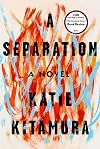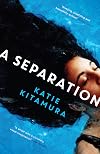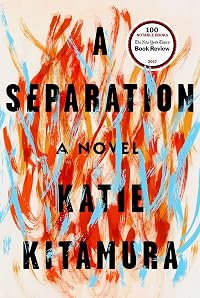
A Separation
by Katie Kitamura
On This Page
Description
A PBS NewsHour/New York Times Book Club PickA NEW YORK TIMES NOTABLE BOOK
Named a best book of the year by the New York Times, NPR, Huffington Post, The A.V. Club, The San Francisco Chronicle, The Guardian, Refinery29, Town & Country, Harper's Bazaar, NYLON, BookRiot.
“Kitamura’s prose gallops, combining Elena Ferrante-style intricacies with the tensions of a top-notch whodunit.” —Elle
This is her story. About the end of her marriage. About what happened when Christopher show more went missing and she went to find him. These are her secrets, this is what happened...
A young woman has agreed with her faithless husband: it's time for them to separate. For the moment it's a private matter, a secret between the two of them. As she begins her new life, she gets word that Christopher has gone missing in a remote region in the rugged south of Greece; she reluctantly agrees to go look for him, still keeping their split to herself. In her heart, she's not even sure if she wants to find him. As her search comes to a shocking breaking point, she discovers she understands less than she thought she did about her relationship and the man she used to love.
A searing, suspenseful story of intimacy and infidelity, A Separation lays bare what divides us from the inner lives of others. With exquisitely cool precision, Katie Kitamura propels us into the experience of a woman on edge, with a fiercely mesmerizing story to tell. show less
Tags
Recommendations










Member Reviews
I managed to listen to the end of this extremely well written novel, but I have to say, at times it was like watching paint dry, a beautiful paint nevertheless.
It’s a story of a married couples separation and it takes place on a beautiful Greek island. Every characters is described minutely - their facial characteristics, their moods, their in-the-moment actions, imagined thoughts, the opposite of those imagined thoughts, their imagined future actions, their imagined motives nuanced to a literature nanosecond. All from the point of view if the wife, the narrator.
There is a mystery that kept me reading, but it was really the quality of the writing that saw me through to the end.
Honestly, it took me 10 minutes of listening time round show more about chapter 13, for one of the characters to walk from one room to the next.
Still it was a good read. The audio narrator’s voice had a softly eerie quality, but it was I think in her imagined spirit of the novel.
Overall a good read. show less
It’s a story of a married couples separation and it takes place on a beautiful Greek island. Every characters is described minutely - their facial characteristics, their moods, their in-the-moment actions, imagined thoughts, the opposite of those imagined thoughts, their imagined future actions, their imagined motives nuanced to a literature nanosecond. All from the point of view if the wife, the narrator.
There is a mystery that kept me reading, but it was really the quality of the writing that saw me through to the end.
Honestly, it took me 10 minutes of listening time round show more about chapter 13, for one of the characters to walk from one room to the next.
Still it was a good read. The audio narrator’s voice had a softly eerie quality, but it was I think in her imagined spirit of the novel.
Overall a good read. show less
A married couple have separated, but agreed to keep their marital status quiet for a while, when the husband disappears while in Greece. Sent by her mother-in-law, who still believes them to be together, the unnamed narrator of A Separation checks in to a room at the resort hotel in an isolated area to look for her husband.
A Separation reminded me a lot of Rachel Cusk's Outline series, with its detached tone and how the narrator is content to keenly observe what is going on around her. She's in an odd position, being viewed as the wife of the absent man, but having been apart for six months, she's moved on with her life.
There is a crime in this novel, but this is not a crime novel, or a thriller, but a quiet examination of show more relationships and how a change in one relationship affects other relationships. Katie Kitamura's writing is clear and lovely and does much to enhance the meditative feel of this novel. show less
A Separation reminded me a lot of Rachel Cusk's Outline series, with its detached tone and how the narrator is content to keenly observe what is going on around her. She's in an odd position, being viewed as the wife of the absent man, but having been apart for six months, she's moved on with her life.
There is a crime in this novel, but this is not a crime novel, or a thriller, but a quiet examination of show more relationships and how a change in one relationship affects other relationships. Katie Kitamura's writing is clear and lovely and does much to enhance the meditative feel of this novel. show less
As much as I was uncomfortable with the authors writing style, I found the book difficult to put down. The narrator seemed to rambled on in her own head most of the time. The narrator seemed unconvinced by her own musings which had me doubting her observations and assumptions throughout much of the book.
The title "The Separation" is symbolic of the many events and situations in life where we might experience a separation. With birth, one is separated from a mother. In marriage there is a separation of families, such as with death or divorce. On the same note, that which separates also connects in an awkward fashion.
Ultimately, my patience was rewarded with a rather thought provoking ending. It is interesting how emotional ties can show more endure the many trials and tribulations in life. show less
The title "The Separation" is symbolic of the many events and situations in life where we might experience a separation. With birth, one is separated from a mother. In marriage there is a separation of families, such as with death or divorce. On the same note, that which separates also connects in an awkward fashion.
Ultimately, my patience was rewarded with a rather thought provoking ending. It is interesting how emotional ties can show more endure the many trials and tribulations in life. show less
A very British stiff-upper-lip story - it is so devoid of emotion as to be almost repressed, but very reflective and mines the nature of marriage and infidelity. The narrator (unnamed) has mutally separated from her husband after 5 years of marriage riddled with his infidelity. They are both living elsewhere, but she has honored his request to tell no one. When his mother calls looking for Christopher, the narrator is at a loss as to where he could be and is also bound by her promise not to reveal the reality of their situation. The mother-in-law, Isabella, a force, tracks him to Greece where he is researching a book on death and mourning, and insists that the narrator go there to check on him. It is a rather surreal experience, as he show more is nowhere to be found in the small village, but clearly has left an impression - all his things are still in his hotel room, he has had dalliances with some of the local women. The narrator, who has started her own extramarital relationship back in London is both resentful at her need to "babysit" and confront his inadequacies, but also unsettled by the limbo of their marriage. SPOILER ALERT: When he winds up dead, a victim of violent theft, I thought the story might morph into a whodunit, but it stays the course of contemplation and expands into the quandary of how truthful she should be with her inlaws or just accept being a widow vs. a potential divorcee. Though the book is a little slow, I appreciated the thoughtful angle and the underlying themes of death, mourning, translation (her profession) and marriage. Great quotes: "Imagination, after all, costs nothing, it's the living that is the harder part." (97) Because of this question of concern - one that is in the end a question of fidelity, translators are always worried about being faithful to the original, an impossible task because there are multiple and often contradictory ways of being faithful, there is literal fidelity and there is 'in the spirit of', a phrase without concrete meaning...(186) "How many times are we offered the opportunity to rewrite the past and therefore the future, to reconfigure our present personas - a widow rather than a divorcee, faithful rather than faithless? The past is subject to all kinds of revision, it is hardly a stable field, and every alteration in the past dictates an alteration in the future. Even a change in our conception of the past can result in a different future, different to the one we planned." (200) show less
I loathed this book, and that doesn't happen often. I could live with the stream of consciousness and the lack of quotation marks. I was fine being in her head as a writing approach. I just found her, the narrator, deplorable. I don't know WHY I was in her head. The book is marinated in privilege, and the occasional line of self-awareness doesn't excuse the overall treatment of Greece and the Greeks as backdrop to Aimless Rich One-Percenters. But even that I could have put up with, if I hadn't been so revolted by the narrator, especially in the 2nd half. I was OK with her in the first half, but she really went off the rails for me in the second. In real life you would find this person appalling, so what am I supposed to get from her as show more a fictional character? What does she illuminate?
Also, I now hate comma splices with the heat of a thousand suns. I didn't hate them before this book, but I'm transformed.
So why 3 stars? Because it was accomplished at what it was trying to do, I think.
ETA: After talking with friends about the book and reading the ToB discussion and comments, I think I get what the author was trying to do a bit better. It doesn't change my rating, though. show less
Also, I now hate comma splices with the heat of a thousand suns. I didn't hate them before this book, but I'm transformed.
So why 3 stars? Because it was accomplished at what it was trying to do, I think.
ETA: After talking with friends about the book and reading the ToB discussion and comments, I think I get what the author was trying to do a bit better. It doesn't change my rating, though. show less
After Intimacies and now this one, I think I really like Kitamura's writing style. The narrator analyzes others' behavior so minutely, makes so many assumptions, and seems to second-guess herself so much that she feels like an unreliable narrator, even as she appears to be very journalistic in how she tells her story. Her comments about the work of a translator might have deeper meaning here. I almost want to read it again to dig in more.
The premise is promising as a mystery novel: a wife separated from her husband is enlisted to cross the ocean to find him on behest of his mother. However, what develops is less plot development and more an internal monologue, a treatise on the nature of relationships, love, and the ambiguities and ambivalences of separation. It has the makings of a nice Highsmithian mystery, with a slow build-up of what seem like clues to the husband's story -- a disheveled hotel room, an unsavory ad at the back of a literary magazine circled, an angry desk clerk, a shady cab driver -- but these fizzle out rather than lead to a great reveal. The narrator is a cold and over-intellectual navel-gazer, and the writing style is beyond pretentious. The show more absence of quotation marks is the newest favorite in post-modern fiction, but it serves to alienate the characters from the reader (the purpose here?) and confuse. Commas and run-on sentences are the norm, purporting to illustrate what? - the mind frame of the narrator? How cool and post-grammatical the author is? Here is a typical sentence:
"At first I thought it was her modesty, the question was abrupt and none too subtle, perhaps
she was affronted, it was more evidence of my erratic personality, Christopher might have complained of it, it was not surprising that he was running away from his hysterical and irrational wife -- but then, why would Christopher have mentioned me at all?"
There are no fewer than 6 independent clauses separated by commas here. Look, an occasional deviation from grammatical rules can enhance a novel and illustrate a personality, but run-ons like this dominated every single paragraph, and the effect is more to discombobulate the reader rather than help the reader engage with the characters. Grammar and writing style should be like well-applied makeup: unnoticeable yet enhancing the subject. show less
"At first I thought it was her modesty, the question was abrupt and none too subtle, perhaps
she was affronted, it was more evidence of my erratic personality, Christopher might have complained of it, it was not surprising that he was running away from his hysterical and irrational wife -- but then, why would Christopher have mentioned me at all?"
There are no fewer than 6 independent clauses separated by commas here. Look, an occasional deviation from grammatical rules can enhance a novel and illustrate a personality, but run-ons like this dominated every single paragraph, and the effect is more to discombobulate the reader rather than help the reader engage with the characters. Grammar and writing style should be like well-applied makeup: unnoticeable yet enhancing the subject. show less
Members
- Recently Added By
Lists

Female Author
1,234 works; 67 members

Books Read in 2017
4,249 works; 129 members

to get
244 works; 2 members

To Read
617 works; 7 members

Kirkus Starred Fiction Reviews of Books Published in 2017
412 works; 7 members

Books Read in 2024
4,623 works; 126 members

Rooster Summer Reading Challenge 2017
6 works; 3 members
Author Information

11+ Works 2,625 Members
Some Editions
Awards and Honors
Common Knowledge
- Canonical title
- A Separation
- Original title
- A Separation
- Original publication date
- 2017
- People/Characters
- Christopher; Isabella; Mark; Kostas; Yvan; Maria (show all 7); Stefano
- Important places
- Greece
- Dedication
- For Hari
- First words
- It began with a telephone call from Isabella.
- Last words
- (Click to show. Warning: May contain spoilers.)For what? - after all, wasn't I here, in his home, in his bed, and weren't we engaged - I knew exactly what he meant, and I could only say that I was sorry, and that I agreed - although what we were waiting for, what exactly it was neither of us could say.
- Blurbers
- Offill, Jenny; Knausgaard, Karl Ove; Kushner, Rachel; Jamison, Leslie; Galchen, Rivka
Classifications
Statistics
- Members
- 702
- Popularity
- 40,613
- Reviews
- 43
- Rating
- (3.10)
- Languages
- 8 — English, French, German, Greek, Italian, Portuguese (Portugal), Spanish, Swedish
- Media
- Paper, Audiobook, Ebook
- ISBNs
- 27
- ASINs
- 7