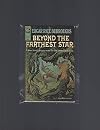
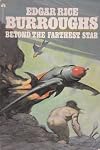
Beyond the Farthest Star
by Edgar Rice Burroughs
On This Page
Description
Never-Before-Published Restored Edition In 1940, as the world hurtled into the darkness of global conflict, Edgar Rice Burroughs turned his legendary writing talents toward an interstellar tale of wonder and adventure set on a war-racked planet-one whose star was so distant that it was invisible to the Earth's most powerful telescopes. Featuring a protagonist who is transported to the planet Poloda by means reminiscent of John Carter's projection to Mars, Beyond the Farthest Star is set in a show more wholly unique solar system in which all the planets are aligned in the same orbit and connected by means of an atmosphere tube that allows for potential travel between worlds via airplane. What has been unknown to readers is that the 1941 Blue Book magazine publication comprising Part I of Beyond the Farthest Star was heavily edited, with a substantial number of line edits on almost every page and several lengthy and meaningful passages-some more than a page long-excised throughout. That altered and abridged text was used as the basis for all editions of the novel-until now. We are pleased to announce that we have gone back to Edgar Rice Burroughs' original typescript from our archives in Tarzana, California, and restored the author's preferred text of the novel in Beyond the Farthest Star: Restored Edition. Now, for the first time, enjoy this classic science fiction adventure in the way that Edgar Rice Burroughs intended! A PLANET IN PERIL When Nazi warplanes blast an American fighter pilot out of the sky, he awakens not in the expected afterlife but on a far-flung planet-one of eleven interconnected worlds hurtling around a strangely constructed star system. On Poloda, he earns a new name-Tangor, one who came from nothing-and a new home among the brave people of Unis, a nation locked in perpetual war against the brutish, totalitarian Kapars. But when news comes of a powerful invention that could turn the tides of the conflict, Tangor must undertake a daring undercover mission behind enemy lines. There, in vile Kapara, he will not only risk life and limb, but also brand himself as a traitor in the eyes of his newfound friends, as he continues his fight for freedom beyond the farthest star! Beyond the Farthest Star: Restored Edition ? 2021 Oasis Audio © 1941, 1964, 2021 Edgar Rice Burroughs, Inc. All Rights Reserved. Trademarks Beyond the Farthest Star™, Tarzan®, Tarzan of the Apes®, John Carter®, John Carter of Mars®, Barsoom®, Pellucidar®, Amtor™, and Edgar Rice Burroughs® Owned by ERB, Inc. Associated logos, characters, names, and the distinctive likenesses thereof are trademarks or registered trademarks of ERB, Inc. Used by Permission. When Nazi warplanes blast an American fighter pilot out of the sky, he awakens not in the expected afterlife but on a far-flung planet-one of eleven interconnected worlds hurtling around a strangely constructed star system. On Poloda, he earns a new name-Tangor, one who came from nothing-and a new home among the brave people of Unis, a nation locked in perpetual war against the brutish, totalitarian Kapars. But when news comes of a powerful invention that could turn the tides of the conflict, Tangor must undertake a daring undercover mission behind enemy lines. There, in vile Kapara, he will not only risk life and limb, but also brand himself as a traitor in the eyes of his newfound friends, as he continues his fight for freedom beyond the farthest star!. show lessTags
Recommendations












Member Reviews
I was very pleasantly surprised by this book. I had recently become quite disenchanted with Burroughs' Princess of Mars series as it seemed to have become by the third installment an endless cycle of fight, win, have loved one kidnapped, rescue them, discover more scary aliens, fight, etc. and I expected this book to be more of the same. Particularly when it began in much the same way: our hero is mysteriously transported via unexplained means to another planet which is remarkably similar to ours in that the environment is hospitable and the natives are pretty much homo sapiens. If one can suspend disbelief enough to buy that, well, there is very little that is still unbelievable. Fortunately, this book diverged from that other series show more almost immediately. While the culture our hero is thrown into is at war, it is not necessarily because they are a war-loving people. They are forced mostly into self defense by the other society of the planet who are if not all-out war-lovers, are at least in no mood to stop until every other nation is obliterated. As the book was written in 1941, it might not be too hard to guess who this is a thinly-veiled reference to. Our hero is not gifted with any supernatural powers (a la John Carter's ability to jump really, really high because of Mars' lower gravity and his over-developed Earth muscles), he's just an ordinary fighting man who might as well go to service in his new nation. They seem like they have a righteous enough cause. He is extraordinarily lucky, returning from several missions that were expected to kill him.
As mentioned in the forward, Burroughs did quite a bit of world-building, note writing, and outlining, probably intending to turn this into a new series. Unfortunately, only two parts were completed, the second of which was not published until 1964, posthumously. I would very much have liked to know what happens to our hero next, and the end of this volume, which contains both parts, definitely set up the sequel. show less
As mentioned in the forward, Burroughs did quite a bit of world-building, note writing, and outlining, probably intending to turn this into a new series. Unfortunately, only two parts were completed, the second of which was not published until 1964, posthumously. I would very much have liked to know what happens to our hero next, and the end of this volume, which contains both parts, definitely set up the sequel. show less
"Beyond the Farthest Star" is yet another example of ERB's uniquely imaginative world-building despite the failure in achieving plausibility for his solar system design of multiple planets sharing the same orbit within an orbital torus of atmosphere from his astronomer consultant (these letters being one of many bonus features in this volume).
The two novelette length tales that make up this story with, it is implied, intended future ones that were never written are extensively inspired by the author's perceptions of the early history c.1940 of the burgeoning war between the Allies and the Nazis in WWII. The analogy, the allegory, is unsubtle to the point of being distracting, with the good country the protagonist, Tangor, joins named show more "Unis" (a frying pan to the head implied United States), and the despicable enemy's secret police are the Zapo (implied Gestapo). The goals of the enemy, the Kapars, are never specified other than they live and die for war, war being, as one character declares, "the natural state" of Mankind. With a singular exception, all depictions of the enemy Kapar's are grotesque, not only in their morals, attitudes, and behavior, but also in their physical appearance -- in a manner that paradoxically mirrors the historical despicable racial phenotyping used by the Nazis themselves. Similiarly uncomfortable is the depiction of the war-unified Unis, its government, and its unforgiving laws that, despite mirroring fascism, are so admired as superior to that of the protagonist's own United States.
Unlike the protagonists in ERB's other works, Tangor is first and foremost (if not solely) motivated by and devoted to his duty as a soldier of Unis and not by his love for a woman of his new adopted world. On the one hand, this is a refreshing change for an ERB novel; on the other, this change dulls the emotional stakes for the protagonist, and the work is less for this lack. show less
The two novelette length tales that make up this story with, it is implied, intended future ones that were never written are extensively inspired by the author's perceptions of the early history c.1940 of the burgeoning war between the Allies and the Nazis in WWII. The analogy, the allegory, is unsubtle to the point of being distracting, with the good country the protagonist, Tangor, joins named show more "Unis" (a frying pan to the head implied United States), and the despicable enemy's secret police are the Zapo (implied Gestapo). The goals of the enemy, the Kapars, are never specified other than they live and die for war, war being, as one character declares, "the natural state" of Mankind. With a singular exception, all depictions of the enemy Kapar's are grotesque, not only in their morals, attitudes, and behavior, but also in their physical appearance -- in a manner that paradoxically mirrors the historical despicable racial phenotyping used by the Nazis themselves. Similiarly uncomfortable is the depiction of the war-unified Unis, its government, and its unforgiving laws that, despite mirroring fascism, are so admired as superior to that of the protagonist's own United States.
Unlike the protagonists in ERB's other works, Tangor is first and foremost (if not solely) motivated by and devoted to his duty as a soldier of Unis and not by his love for a woman of his new adopted world. On the one hand, this is a refreshing change for an ERB novel; on the other, this change dulls the emotional stakes for the protagonist, and the work is less for this lack. show less
These aren't the most polished Burroughs stories, but they are an interesting product of the war years and come off as more political than much of his other work. The anti-war sentiments and the theme of fighting against a Stalinesque dictatorship are hard to miss. You should definitely read these if you are a Burroughs completest, or if you just like old science fiction novels with naked men on the cover.
[full review here: http://spacebeer.blogspot.com/2012/11/beyond-farthest-star-by-edgar-rice.html ]
[full review here: http://spacebeer.blogspot.com/2012/11/beyond-farthest-star-by-edgar-rice.html ]
Beyond the Farthest Star
Intro (not mine!)
“Beyond the Farthest Star was first published in The Blue Book Magazine, January 1942. It was written in 12 days a week after he completed “Men of the Bronze Age” in October of 1940. Tangor Returns was written in only 5 days -- December 17-21, 1940. It’s first publication was 24 years later in Tales of Three Planets, a hardback edition by Canaveral Press, April 27, 1964. It was published with Beyond the Farthest Star, "The Resurrection of Jimber-Jaw", and The Wizard of Venus.”
First thoughts:
I liked this little collection. Easy to read and before you know it you’re done. A man gets killed in a plane war with a German fighter plane and ends up on a planet 400,000 light years away. show more Somehow he reaches out to ERB and has him type out his life’s story. How he was appearing on the country of Unis on the planet Polodar, how he fights with the Kaparas, and lastly how he decides to go to another planet to help the Unis folks migrate there.
All the planets in their system are covered with an atmosphere between planets, so it’s possible to fly to another. This never happens. Apparently there was supposed to be a sequel but was never written.
ERB writes some pretty interesting stories. The hero has never a dull moment. Clearly the stories are parodies of the Nazi versus the West way of life. The Kapara live under constant suspicion and oppression which the Unis live like the West.
Not as entertaining as John Carter or Carson of Venus and definitely not on par with Tarzan. Still, pick up a copy and be entertained. show less
Intro (not mine!)
“Beyond the Farthest Star was first published in The Blue Book Magazine, January 1942. It was written in 12 days a week after he completed “Men of the Bronze Age” in October of 1940. Tangor Returns was written in only 5 days -- December 17-21, 1940. It’s first publication was 24 years later in Tales of Three Planets, a hardback edition by Canaveral Press, April 27, 1964. It was published with Beyond the Farthest Star, "The Resurrection of Jimber-Jaw", and The Wizard of Venus.”
First thoughts:
I liked this little collection. Easy to read and before you know it you’re done. A man gets killed in a plane war with a German fighter plane and ends up on a planet 400,000 light years away. show more Somehow he reaches out to ERB and has him type out his life’s story. How he was appearing on the country of Unis on the planet Polodar, how he fights with the Kaparas, and lastly how he decides to go to another planet to help the Unis folks migrate there.
All the planets in their system are covered with an atmosphere between planets, so it’s possible to fly to another. This never happens. Apparently there was supposed to be a sequel but was never written.
ERB writes some pretty interesting stories. The hero has never a dull moment. Clearly the stories are parodies of the Nazi versus the West way of life. The Kapara live under constant suspicion and oppression which the Unis live like the West.
Not as entertaining as John Carter or Carson of Venus and definitely not on par with Tarzan. Still, pick up a copy and be entertained. show less
Life after death. Is this perhaps Valhalla?
Shot down and expecting to die, thinking he HAD died, he awoke on a strange world to find a new war going on one that he intended to end.
Burroughs crafts an intriguing tale of why wars are fought anyways.
Shot down and expecting to die, thinking he HAD died, he awoke on a strange world to find a new war going on one that he intended to end.
Burroughs crafts an intriguing tale of why wars are fought anyways.
If you can jump the gap of disbelief presented up front that the protagonst dies on earth and to awake naked on a planet half a million light years away, complete with human natives that speak English!; if you can go with that, the rest of the story is easy and entertaining.
Such a great story. Very saddened that we will never know how it all ended. I really wish someone would find the rest in an attic somewhere and publish it.
Members
- Recently Added By
Author Information

769+ Works 65,540 Members
Edgar Rice Burroughs was born on September 1, 1875, in Chicago. His father, George Tyler was a distiller and a battery manufacturer. Early in life Burroughs attempted to support his family in a variety of occupations, including railroad policeman, business partner, and miner. None of these proved successful. However, Burroughs had always enjoyed show more reading adventure fiction and decided to try his hand at writing. His first attempt, written under the pseudonym Normal Bean, sold very quickly and Burroughs' career took off. Although critics and educators have not always been supportive of Burroughs' writing, the characters in his stories have entertained readers for many years. Tarzan was the most popular, earning Burroughs enough money to start his own publishing house and a motion picture company. Another character, John Carter, is the hero of Burroughs' Mars adventure series. The continuing popularity of these characters has led some critics to reconsider the value of Burroughs' writing and to acknowledge significant themes in his stories. Burroughs died on March 19, 1950. (Bowker Author Biography) show less
Common Knowledge
- Canonical title
- Beyond the Farthest Star
- Original title
- Beyond the Farthest Star
- Original publication date
- 1941
- First words
- We had attended a party at Diamond Head; and after dinner, comfortable on hikiee and easy-chairs on the lanai, we fell to talking about the legends and superstitions of the ancient Hawaiians.
I was shot down behind the German lines in September, 1939. - Last words
- (Click to show. Warning: May contain spoilers.)I wonder if I shall ever know.
- Original language
- English
- Canonical DDC/MDS
- 813.087626
Classifications
- Genres
- Fiction and Literature, Science Fiction
- DDC/MDS
- 813.087626 — Literature & rhetoric American literature in English American fiction in English By type Genre fiction Adventure fiction Speculative fiction Science fiction Planetary romance
- LCC
- PS3503 .U687 — Language and Literature American literature American literature Individual authors 1900-1960
- BISAC
Statistics
- Members
- 355
- Popularity
- 89,360
- Reviews
- 7
- Rating
- (3.38)
- Languages
- English, Estonian
- Media
- Paper, Audiobook, Ebook
- ISBNs
- 14
- ASINs
- 14