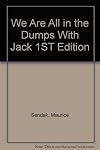
We Are All in the Dumps with Jack and Guy: Two Nursery Rhymes with Pictures
by Maurice Sendak
On This Page
Description
Joins together two traditionaI nursery rhymes with illustrations depicting the plight and eventual triumph of orphaned and homeless children.Tags
Recommendations













Member Reviews
I was surprised to learn that this is one of Maurice Sendak's most controversial books. The book, on the surface, is an innocent mash-up of two Mother Goose nursery rhymes, set in modern times (or at least, modern when the book was published). The story follows Jack and Guy, two homeless men who witness a black baby and a litter of kittens being stolen by large, monster-like rats. The rats challenge Jack and Guy to a game of bridge, where the baby and the kittens would be the prize. They lose, and the rats take the baby and kittens to St. Paul's orphanage and bakery. Jack and Guy follow them, and a large cat (presumably the kittens' mother) chase the rats away. Jack and Guy save the baby, and Guy suggests that he and Jack raise the baby show more as their own. I really enjoyed Sendak's masterful illustrations, and I could tell that the book was making statements on society's views towards the homeless and possibly even gay couples. Upon further research online, I learned that my thoughts about the book's message were right; the book was written during the peak of the AIDS crisis and when homelessness in America was being considered an epidemic. This book was a message to the public, telling them to show these people experiencing hardships mercy and kindness. The book has layers of meaning- on the surface layer, it's obvious that Sendak is stressing the importance of people coming together in times of need. The deeper layers are criticizing culture's view towards the homeless; when the baby is taken in the game of bridge, the homeless say they were "trumped," as they cry in front of a building that looks almost exactly like Trump Tower. I've always enjoyed books that have many layers of meaning, as they allow me to do research and dig to find all the different messages the author wanted to send to the reader. I think that this book is appropriate for all ages, as children will enjoy the surface message of hope and the importance of working together, and adults will enjoy the commentary and criticisms Sendak included. show less
Full of adorable creatures and astonishing cruelty. And jokes. In 1993, I didn't notice that after the rats seize the little brown boy, the speech bubble TRUMPED is right next to the background word TOWER.
While sold as children's books, many of Sendak's works contain very serious topics.
In this work, the author deals with the subject of homeless children.
As the illustrations portray shacks, boxes, rubble and soiled clothes, the text tells the tale of Jack and Guy who reside in the squalor of New York streets. With them are a host of unnamed characters and a large litter of kittens.
When a small black child asks for help, Jack and Guy say "BEAT IT!"
When two large rats kidnap the kittens and the boy, the dynamic duo run to help and are lured to a card game where they are tricked, trumped and dumped.
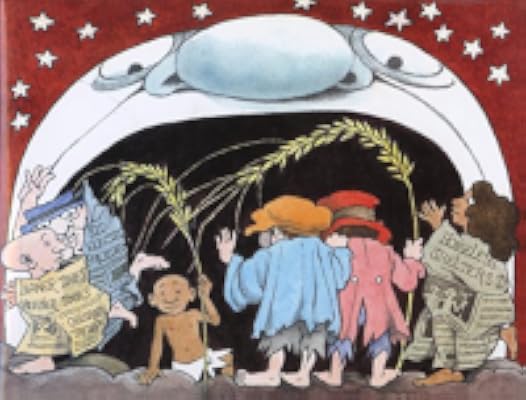
As a mad moon looks down, homeless children are clothed in newspaper stories of mean times and big banks.
Both the words and illustrations are show more filled with symbolism.
In the second tale, Jack and Guy went out into the rye and found the little guy who has one big black eye.
Now, they embrace the little boy and do not turn their backs. Instead, they vow to bring him up, as other folk do. show less
In this work, the author deals with the subject of homeless children.
As the illustrations portray shacks, boxes, rubble and soiled clothes, the text tells the tale of Jack and Guy who reside in the squalor of New York streets. With them are a host of unnamed characters and a large litter of kittens.
When a small black child asks for help, Jack and Guy say "BEAT IT!"
When two large rats kidnap the kittens and the boy, the dynamic duo run to help and are lured to a card game where they are tricked, trumped and dumped.
As a mad moon looks down, homeless children are clothed in newspaper stories of mean times and big banks.
Both the words and illustrations are show more filled with symbolism.
In the second tale, Jack and Guy went out into the rye and found the little guy who has one big black eye.
Now, they embrace the little boy and do not turn their backs. Instead, they vow to bring him up, as other folk do. show less
A kid's nursery rhyme in large gay letters and colorful playing cards held by giant rats belie the scathing undercurrent of the artist's commentary on homelessness in the Madison avenue age. Sendak at his best.
This was a strange but interesting book. Kittens and a little kid are taken by a rat. With the help of a watchful moon cat, they find their way home again. One thing Sendak has done in this story is to keep the reader in suspense as to what is going on. I don't know if this is at all where he was going with this book, but I felt like the rats were political figures they were gambling with the lives of less privileged. The sky or someone up in the heavens was watching over the world and intervened when necessary. The illustrations gave off feelings of frustration, sadness, sorrow, and helplessness.
Dark, strange, heavy book from Sendak showing the horrors of homelessness. Probably not a book to keep lying around a classroom, but it's a good book to read with your kids just to see what kinds of questions it elicits from them.
I think this book is a wonderful book for children for it's powerful hidden message, and the poetic nature of the writing. The only writing in the book is two nursery rhymes in which Maurice Sendak takes a spin on by turning the nursery rhymes into a story of homelessness. The topic of homelessness is a powerful topic and this book pushes readers to think about the less fortunate and how they are taken advantage of by society, whether the reader realizes the deeper message of the story or not. I find it interesting how Maurice Sendak is able to completely transform simple nursery rhymes just from illustrations. Two nursery rhymes initially about kittens and diamonds is now about inequality and giving back to the needy. I believe the show more overall message of this story is to reflect and aid those less fortunate than you because that could easily become you. show less
Members
- Recently Added By
Author Information

171+ Works 67,924 Members
Maurice Sendak was born on June 10, 1928 in Brooklyn, New York. While in high school, he worked part time as an illustrator for All-American Comics adapting the Mutt and Jeff newspaper comic strip to a comic book format. His first professional illustrations were for a physics textbook, Atomics for the Millions, published in 1947. He later worked show more as a window-display director for F.A.O. Schwartz while attending night school at the Art Students League. In 1950, he illustrated his first children's book The Wonderful Farm by Marcel Aymé. He wrote his first children's book Kenny's Window in 1956 and went on to become a prolific author-illustrator. His works include Chicken Soup with Rice; In the Night Kitchen; Outside Over There; Higglety Pigglety Pop; The Sign on Rosie's Door; We Are All in the Dumps with Jack and Guy; Brundibar; Bumble Ardy; and My Brother's Book. He received numerous awards including the Caldecott medal for Where The Wild Things Are in 1964, the Hans Christian Andersen International Medal in 1970, the Laura Ingalls Wilder Award, and the National Medal of Arts in 1996. Characters from two of his books were the basis of an animated television special, Really Rosie, which first aired in 1975. He was also the set designer and lyricist for a subsequent off-Broadway musical of the same title. He was the lyricist, as well as the set and costume designer, for the original production of an opera based on Where The Wild Things Are in 1980. In addition, he has designed sets and costumes for performances of operas by Mozart, Prokofiev, and other classical composers. He died due to complications from a recent stroke on May 8, 2012 at the age of 83. (Bowker Author Biography) show less
Awards and Honors
Awards
Distinctions
Common Knowledge
- Original publication date
- 1993
- First words
- We are all in the dumps
For diamonds are trumps - Last words
- (Click to show. Warning: May contain spoilers.)You buy one loaf
And I'll buy two
And we'll bring him up
As other folk do
Classifications
- Genres
- Children's Books, Picture Books, Poetry
- DDC/MDS
- 398.8 — Society, government, & culture Customs, etiquette & folklore Folklore & Folktales Rhymes and rhyming games
- LCC
- PZ8.3 .S4684 .W — Language and Literature Fiction and juvenile belles lettres Fiction and juvenile belles lettres Juvenile belles lettres
- BISAC
Statistics
- Members
- 439
- Popularity
- 69,748
- Reviews
- 19
- Rating
- (3.70)
- Languages
- Chinese, English, French
- Media
- Paper
- ISBNs
- 6
- UPCs
- 2
- ASINs
- 3