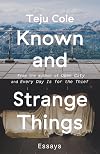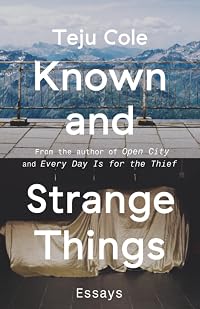
Known and Strange Things: Essays
by Teju Cole
On This Page
Description
"With this collection of more than fifty pieces on politics, photography, travel, history, and literature, Teju Cole solidifies his place as one of today's most powerful and original voices. On page after page, deploying prose dense with beauty and ideas, he finds fresh and potent ways to interpret art, people, and historical moments, taking in subjects from Virginia Woolf, Shakespeare, and W. G. Sebald to Instagram, Barack Obama, and Boko Haram."--Amazon.com.Tags
Recommendations

Member Reviews
Rating: 4* of five
The Publisher Says: A blazingly intelligent first book of essays from the award-winning author of Open City and Every Day Is for the Thief
With this collection of more than fifty pieces on politics, photography, travel, history, and literature, Teju Cole solidifies his place as one of today’s most powerful and original voices. On page after page, deploying prose dense with beauty and ideas, he finds fresh and potent ways to interpret art, people, and historical moments, taking in subjects from Virginia Woolf, Shakespeare, and W. G. Sebald to Instagram, Barack Obama, and Boko Haram. Cole brings us new considerations of James Baldwin in the age of Black Lives Matter; the African American photographer Roy DeCarava, who, show more forced to shoot with film calibrated exclusively for white skin tones, found his way to a startling and true depiction of black subjects; and (in an essay that inspired both praise and pushback when it first appeared) the White Savior Industrial Complex, the system by which African nations are sentimentally aided by an America “developed on pillage.”
Persuasive and provocative, erudite yet accessible, Known and Strange Things is an opportunity to live within Teju Cole’s wide-ranging enthusiasms, curiosities, and passions, and a chance to see the world in surprising and affecting new frames.
I RECEIVED A DRC FROM THE PUBLISHER VIA NETGALLEY. THANK YOU.
My Review: Teju Cole says clearly and distinctly: "I am a novelist, and my goal in writing a novel is to leave the reader not knowing what to think. A good novel shouldn't have a point." This is true; though he does not say a word about a novel not being pointed. All of his very much are; so are his essays collected here.
Fragments might be a better term for the shrapnel in this collection. None of them dig into their topic, develop a theme to a conclusion. It's more postmodern than that. I was "treated" to the horrors of mob justice in Nigeria; the fact of colorism, a strain of racism, in Brazil; the shame that's missing from the US's reckoning with its sin of racism and its ugly consequences; the horrors of Israeli apartheid (pre-2025):
An unsparing gaze, always roving, roaming wherever he is. Quite a bit of the shards are centered on the photographic, framed for visual images, moments and techniques. He is making himself Isherwood's camera: "I am a camera with its shutter open, quite passive, recording, not thinking," only adding the thinking back, more in the vein of James Baldwin.
It is, I suppose, unsurprising that Author Cole expends a lot of his energy on thinking about race in the US, as the Obama years were recent as this collection was taking shape. As those years radicalized the lowest of the low into the actions whose disgusting fruits we're being served now, his meditations on Obama's shortcomings as president feel...true, but not really the point. (He was, in my estimation, the best Republican president since Eisenhower. Measured as a Democrat, he was abysmal.) The fact that Author Cole lived half his life in Nigeria (at the point he was writing these pieces) meant he was looking at the US reaction to a Black man as our president with detached, slightly bemused, incomprehension.
More to my own personal taste was the selection of literarians Author Cole engaged with, eg Naipaul and Walcott. Both men were still living, both were being fêted, and both are now receding from the popular literary conversation into more academic renown. It is the course things take, so I can't say "boo hoo" very convincingly. It was a pleasure to re-engage with them through the author's intense, admiring (on balance) gaze.
I'm not that confident this is a collection of enough enduring insight to survive the long test of time. It was enjoyable to me, an adult in the Aughties, an Obama voter, a reader of Naipaul; it might not reach too much lower on the age ladder to find a large audience.
Erudite, pleasant reading, in a vein of early-internet pieces that don't go as deep as the old-fashioned word "essay" implies. Solidly four stars for me; maybe different for younger folk. show less
The Publisher Says: A blazingly intelligent first book of essays from the award-winning author of Open City and Every Day Is for the Thief
With this collection of more than fifty pieces on politics, photography, travel, history, and literature, Teju Cole solidifies his place as one of today’s most powerful and original voices. On page after page, deploying prose dense with beauty and ideas, he finds fresh and potent ways to interpret art, people, and historical moments, taking in subjects from Virginia Woolf, Shakespeare, and W. G. Sebald to Instagram, Barack Obama, and Boko Haram. Cole brings us new considerations of James Baldwin in the age of Black Lives Matter; the African American photographer Roy DeCarava, who, show more forced to shoot with film calibrated exclusively for white skin tones, found his way to a startling and true depiction of black subjects; and (in an essay that inspired both praise and pushback when it first appeared) the White Savior Industrial Complex, the system by which African nations are sentimentally aided by an America “developed on pillage.”
Persuasive and provocative, erudite yet accessible, Known and Strange Things is an opportunity to live within Teju Cole’s wide-ranging enthusiasms, curiosities, and passions, and a chance to see the world in surprising and affecting new frames.
I RECEIVED A DRC FROM THE PUBLISHER VIA NETGALLEY. THANK YOU.
My Review: Teju Cole says clearly and distinctly: "I am a novelist, and my goal in writing a novel is to leave the reader not knowing what to think. A good novel shouldn't have a point." This is true; though he does not say a word about a novel not being pointed. All of his very much are; so are his essays collected here.
Fragments might be a better term for the shrapnel in this collection. None of them dig into their topic, develop a theme to a conclusion. It's more postmodern than that. I was "treated" to the horrors of mob justice in Nigeria; the fact of colorism, a strain of racism, in Brazil; the shame that's missing from the US's reckoning with its sin of racism and its ugly consequences; the horrors of Israeli apartheid (pre-2025):
The reality is that, as a Palestinian Arab, in order to defend yourself against the persecution you face, not only do you have to be an expert in Israeli law, you also have to be a Jewish Israeli and have the force of the Israeli state as your guarantor…Israel uses an extremely complex legal and bureaucratic apparatus to dispossess Palestinians of their land, hoping perhaps to forestall accusations of a brutal land grab.
An unsparing gaze, always roving, roaming wherever he is. Quite a bit of the shards are centered on the photographic, framed for visual images, moments and techniques. He is making himself Isherwood's camera: "I am a camera with its shutter open, quite passive, recording, not thinking," only adding the thinking back, more in the vein of James Baldwin.
It is, I suppose, unsurprising that Author Cole expends a lot of his energy on thinking about race in the US, as the Obama years were recent as this collection was taking shape. As those years radicalized the lowest of the low into the actions whose disgusting fruits we're being served now, his meditations on Obama's shortcomings as president feel...true, but not really the point. (He was, in my estimation, the best Republican president since Eisenhower. Measured as a Democrat, he was abysmal.) The fact that Author Cole lived half his life in Nigeria (at the point he was writing these pieces) meant he was looking at the US reaction to a Black man as our president with detached, slightly bemused, incomprehension.
More to my own personal taste was the selection of literarians Author Cole engaged with, eg Naipaul and Walcott. Both men were still living, both were being fêted, and both are now receding from the popular literary conversation into more academic renown. It is the course things take, so I can't say "boo hoo" very convincingly. It was a pleasure to re-engage with them through the author's intense, admiring (on balance) gaze.
I'm not that confident this is a collection of enough enduring insight to survive the long test of time. It was enjoyable to me, an adult in the Aughties, an Obama voter, a reader of Naipaul; it might not reach too much lower on the age ladder to find a large audience.
Erudite, pleasant reading, in a vein of early-internet pieces that don't go as deep as the old-fashioned word "essay" implies. Solidly four stars for me; maybe different for younger folk. show less
An impressive collection of elegantly written essays!
I have read a couple of fiction books by Teju Cole and was interesting in reading his essay collection to see if his nonfiction writing would shed light on his fiction writing. Not only did I gain a new appreciation for his fiction writing but was treated to a thoughtful contemplative journey of timely and informative issues.
While this enthralling collection covers a diverse range of subjects it is the sincere honesty in the writing that had me in a thoughtful mood after each essay. I highly recommend this collection to readers looking for an intelligent thought-provoking read
I have read a couple of fiction books by Teju Cole and was interesting in reading his essay collection to see if his nonfiction writing would shed light on his fiction writing. Not only did I gain a new appreciation for his fiction writing but was treated to a thoughtful contemplative journey of timely and informative issues.
While this enthralling collection covers a diverse range of subjects it is the sincere honesty in the writing that had me in a thoughtful mood after each essay. I highly recommend this collection to readers looking for an intelligent thought-provoking read
Teju Cole is one of those authors who make me feel inadequate; what he does seems so simple that you think you could do it yourself (albeit not exactly the same, different lives and all that) but you know you couldn't. He's ridiculously well-read (-watched, -travelled, -listened) and uses it, putting it all together into patterns with the greatest of ease.
Known and Strange Things is divided into three headings: books, images, travel. As with all essay collections, the trouble is that he's going to be talking about books I haven't read, phootographers I'm not familiar with, places I haven't been... but that's only a problem if that's all he talks about, and he rarely does. He uses them as jumping-off points to discuss everything from show more race relations (as an African American as opposed to an African-American) to the narrative of Google Image Search, from awkward dinner parties with VS Naipaul to hilarious takedowns of modern journalism.
I miss Cole on Twitter, and I really hope he has another 20 novels or so in him. But for now, this'll do quite nicely. show less
Known and Strange Things is divided into three headings: books, images, travel. As with all essay collections, the trouble is that he's going to be talking about books I haven't read, phootographers I'm not familiar with, places I haven't been... but that's only a problem if that's all he talks about, and he rarely does. He uses them as jumping-off points to discuss everything from show more race relations (as an African American as opposed to an African-American) to the narrative of Google Image Search, from awkward dinner parties with VS Naipaul to hilarious takedowns of modern journalism.
I miss Cole on Twitter, and I really hope he has another 20 novels or so in him. But for now, this'll do quite nicely. show less
This book of essays by Teju Cole aren’t always essays: they might be scraps of thought, well-digested and to an immediate point. They are fiercely intelligent, opinionated, meaningful in a way that allow us to get to the heart of how another thinks. And does he think! Let’s be frank: many of us don’t do enough thinking, and Cole shows us the way it can be done in a way that educates, informs, and excites us.
The work in this volume are nonfiction pieces published in a wide variety of outlets and that he chose from an eight-year period of travel and almost constant writing. The emphasis in these pieces, he tells us in the Preface, is on “epiphany.” We can enjoy kernels of ideas that may have had a long gestation, but have show more finally burst onto the scene with a few sentences but little heavy-handedness or any of the weight of “pronouncements.” This reads like a bared heart in the midst of negotiating life, as James Baldwin says in The Fire Next Time, “as nobly as possible, for the sake of those coming after us.”
Cole references Baldwin in all these pieces in his unapologetic gaze, but he does so explicitly in several pieces, notably “Black Body” in which he tells of visiting the small town in Switzerland, Leukerbad (or Loèche-les-Bains), where Baldwin’s Go Tell It on the Mountain found its final form. Cole expands on his time in Switzerland in “Far Away From Here,” which might be my favorite of these essays. Cole tells how he was given six months to live and write in Zurich and though he did precious little writing, he was totally absorbed every day, gazing at the landscape, walking the mountains, photographing the crags, trails, and lakes, thinking, unfettered. This is someone who carries all he needs in his head, and I loved that freedom as much as he.
But how can I choose a favorite from among these pieces when each spoke of ways to approach a subject with which we have struggled—or haven’t yet…About race and class: “how little sense of shame [Americans] seemed to have,” he writes, looking at America from his upbringing in Lagos. Cole echoes Baldwin again in “Bad Laws” about Israel and its laws concerning the rights of Palestinians:
”The reality is that, as a Palestinian Arab, in order to defend yourself against the persecution you face, not only do you have to be an expert in Israeli law, you also have to be a Jewish Israeli and have the force of the Israeli state as your guarantor…Israel uses an extremely complex legal and bureaucratic apparatus to dispossess Palestinians of their land, hoping perhaps to forestall accusations of a brutal land grab.”
Earlier Baldwin reminded us that “…few liberals have any notion of how long, how costly, and how heartbreaking a task it is to gather the evidence that one can carry into court [to prove malfeasance, official or not], or how long such court battles take.” Americans looking at Israel and Palestine should be able to discern some outline of our own justifications and methods, and vice versa.
Photography is one of Cole’s special interests and he is eloquent in Section Two "Seeing Things" discussing what makes great photography as opposed to the “dispiriting stream of empty images [that the] Russians call poshlost: fake emotion, unearned nostalgia.” And then he discusses “Death in the Browser Tab,” wherein he tells us what he sees and what he knows after retracing the steps caught by the phone footage of Walter Scott, shot in the back with eight bullets from a .45-caliber Glock 21.
Politics is what humans do, though “the sheer quantity of impacted bullshit in politics” is clearly not something Cole relishes. In "The Reprint" Cole admits he did not vote until sixteen years after he was eligible, and when he did vote finally, for Obama, “like a mutation that happens quietly on a genetic level and later completely alters the body’s function, I could feel my relationship to other Americans changing. I had a sense—dubious to me for so long, and therefore avoided—of common cause.” He notes that Obama was “not an angry black man, the son of slaves” but a biracial outsider who invisibly worked his way to the center of the political establishment by piggybacking the experience of American blacks by hiding in plain sight. The night Obama won, Cole was in Harlem.
“There was as exuberant and unscripted an outpouring of joy as I ever expect to see anywhere… Black presidents are no novelty for to me. About half my life, the half I lived in Nigeria, had been spent under their rule, and, in my mind, the color of the president was neither here nor there. But this is America. Race mattered.”
Cole will speak out in "A Reader's War" against Obama’s “clandestine brand of justice” and his “ominous, discomfiting, illegal, and immoral use of weaponized drones against defenseless strangers…done for our sakes.” He admits that Obama believes he is trying “to keep us safe,” and writes “I am not naive…and I know our enemies are not all imaginary…I am grateful to those whose bravery keeps us safe.” It is one of the most difficult questions about political and military power that we face today and Cole wrestles the issue heroically. Not any of us have yet answered this question well, and until we do, the disconnect between justice and drone strikes will continue to plague us. We have unleashed a terrible swift sword on far away lands while we continue to suffer the brutality of a thousand cuts from our own citizens. Cosmic justice?
When Cole talks about literature I experience a frisson. There is nothing quite like someone very clever and well-spoken addressing something about which one cares deeply. His insights add to my pleasure, and detract nothing. His description of the poetry of Derek Walcott remind me of the first time I encountered Walcott’s work: “This is poetry with a painterly hand, stroke by patient stroke.” I have forever thought of Walcott in this way, in color and in motion: turquoise and pale yellow, cool beige and hibiscus pink, the palest gray and an ethereal green I am not sure is water, air, or sea grass. The ocean creates tides through his work, and it seems so fresh.
When Cole writes of his visit to V.S. Naipaul in “Natives on the Boat," we sense how Cole’s initial reserve is eventually won over by Naipaul’s deeply curious and wide-ranging questions. In the very next essay, “Housing Mr. Biswas,” Cole writes an ecstatic celebration of Naipaul’s accomplishment in creating the “smart and funny, but also often petulant, mean, and unsympathetic” Mr. Biswas in Trinidad,
“an important island in the Caribbean but not a particularly influential one on the world stage…the times and places—the farms, the roads, the villages, the thrumming energy of the city, the mornings, afternoon, dusks, and nights—are described with profound and vigilant affection…it brings to startling fruition in twentieth century Trinidad the promise of the nineteenth century European novel.”
He’s right of course. Naipaul is a beloved writer of a type of novel no longer written, and perhaps now not often read.
Reading all these essays in one big gulp was a lot to digest so I am going to recommend a slower savoring. This is a book one must own and keep handy for those small moments when one wants a short, sharp shock of something wonderful. By all means read it all at once so you know where to go back to when you can dig up copies of some of the photos he talks about or want to recall how Cole manages in so few words to convey so much meaning. His is a voice thoughtful in expressing what he sees and yet so vulnerable and human I want to say—read this—this man is what’s been missing from your lives.
These collected essays will be published August 9, 2016. I read the e-galley provided to me by Netgalley and Random House. I note that some of the essays about art or photography that were initially published in newspapers sometimes were accompanied by examples of the work he discusses. In a perfect world, these would be included in the final book, but truthfully, his writing is clear and compelling enough to not make that nicety strictly necessary. Apologies to the publisher for quoting from a galley: my excuse is that the work is previously published and therefore no surprise. show less
The work in this volume are nonfiction pieces published in a wide variety of outlets and that he chose from an eight-year period of travel and almost constant writing. The emphasis in these pieces, he tells us in the Preface, is on “epiphany.” We can enjoy kernels of ideas that may have had a long gestation, but have show more finally burst onto the scene with a few sentences but little heavy-handedness or any of the weight of “pronouncements.” This reads like a bared heart in the midst of negotiating life, as James Baldwin says in The Fire Next Time, “as nobly as possible, for the sake of those coming after us.”
Cole references Baldwin in all these pieces in his unapologetic gaze, but he does so explicitly in several pieces, notably “Black Body” in which he tells of visiting the small town in Switzerland, Leukerbad (or Loèche-les-Bains), where Baldwin’s Go Tell It on the Mountain found its final form. Cole expands on his time in Switzerland in “Far Away From Here,” which might be my favorite of these essays. Cole tells how he was given six months to live and write in Zurich and though he did precious little writing, he was totally absorbed every day, gazing at the landscape, walking the mountains, photographing the crags, trails, and lakes, thinking, unfettered. This is someone who carries all he needs in his head, and I loved that freedom as much as he.
But how can I choose a favorite from among these pieces when each spoke of ways to approach a subject with which we have struggled—or haven’t yet…About race and class: “how little sense of shame [Americans] seemed to have,” he writes, looking at America from his upbringing in Lagos. Cole echoes Baldwin again in “Bad Laws” about Israel and its laws concerning the rights of Palestinians:
”The reality is that, as a Palestinian Arab, in order to defend yourself against the persecution you face, not only do you have to be an expert in Israeli law, you also have to be a Jewish Israeli and have the force of the Israeli state as your guarantor…Israel uses an extremely complex legal and bureaucratic apparatus to dispossess Palestinians of their land, hoping perhaps to forestall accusations of a brutal land grab.”
Earlier Baldwin reminded us that “…few liberals have any notion of how long, how costly, and how heartbreaking a task it is to gather the evidence that one can carry into court [to prove malfeasance, official or not], or how long such court battles take.” Americans looking at Israel and Palestine should be able to discern some outline of our own justifications and methods, and vice versa.
Photography is one of Cole’s special interests and he is eloquent in Section Two "Seeing Things" discussing what makes great photography as opposed to the “dispiriting stream of empty images [that the] Russians call poshlost: fake emotion, unearned nostalgia.” And then he discusses “Death in the Browser Tab,” wherein he tells us what he sees and what he knows after retracing the steps caught by the phone footage of Walter Scott, shot in the back with eight bullets from a .45-caliber Glock 21.
Politics is what humans do, though “the sheer quantity of impacted bullshit in politics” is clearly not something Cole relishes. In "The Reprint" Cole admits he did not vote until sixteen years after he was eligible, and when he did vote finally, for Obama, “like a mutation that happens quietly on a genetic level and later completely alters the body’s function, I could feel my relationship to other Americans changing. I had a sense—dubious to me for so long, and therefore avoided—of common cause.” He notes that Obama was “not an angry black man, the son of slaves” but a biracial outsider who invisibly worked his way to the center of the political establishment by piggybacking the experience of American blacks by hiding in plain sight. The night Obama won, Cole was in Harlem.
“There was as exuberant and unscripted an outpouring of joy as I ever expect to see anywhere… Black presidents are no novelty for to me. About half my life, the half I lived in Nigeria, had been spent under their rule, and, in my mind, the color of the president was neither here nor there. But this is America. Race mattered.”
Cole will speak out in "A Reader's War" against Obama’s “clandestine brand of justice” and his “ominous, discomfiting, illegal, and immoral use of weaponized drones against defenseless strangers…done for our sakes.” He admits that Obama believes he is trying “to keep us safe,” and writes “I am not naive…and I know our enemies are not all imaginary…I am grateful to those whose bravery keeps us safe.” It is one of the most difficult questions about political and military power that we face today and Cole wrestles the issue heroically. Not any of us have yet answered this question well, and until we do, the disconnect between justice and drone strikes will continue to plague us. We have unleashed a terrible swift sword on far away lands while we continue to suffer the brutality of a thousand cuts from our own citizens. Cosmic justice?
When Cole talks about literature I experience a frisson. There is nothing quite like someone very clever and well-spoken addressing something about which one cares deeply. His insights add to my pleasure, and detract nothing. His description of the poetry of Derek Walcott remind me of the first time I encountered Walcott’s work: “This is poetry with a painterly hand, stroke by patient stroke.” I have forever thought of Walcott in this way, in color and in motion: turquoise and pale yellow, cool beige and hibiscus pink, the palest gray and an ethereal green I am not sure is water, air, or sea grass. The ocean creates tides through his work, and it seems so fresh.
When Cole writes of his visit to V.S. Naipaul in “Natives on the Boat," we sense how Cole’s initial reserve is eventually won over by Naipaul’s deeply curious and wide-ranging questions. In the very next essay, “Housing Mr. Biswas,” Cole writes an ecstatic celebration of Naipaul’s accomplishment in creating the “smart and funny, but also often petulant, mean, and unsympathetic” Mr. Biswas in Trinidad,
“an important island in the Caribbean but not a particularly influential one on the world stage…the times and places—the farms, the roads, the villages, the thrumming energy of the city, the mornings, afternoon, dusks, and nights—are described with profound and vigilant affection…it brings to startling fruition in twentieth century Trinidad the promise of the nineteenth century European novel.”
He’s right of course. Naipaul is a beloved writer of a type of novel no longer written, and perhaps now not often read.
Reading all these essays in one big gulp was a lot to digest so I am going to recommend a slower savoring. This is a book one must own and keep handy for those small moments when one wants a short, sharp shock of something wonderful. By all means read it all at once so you know where to go back to when you can dig up copies of some of the photos he talks about or want to recall how Cole manages in so few words to convey so much meaning. His is a voice thoughtful in expressing what he sees and yet so vulnerable and human I want to say—read this—this man is what’s been missing from your lives.
These collected essays will be published August 9, 2016. I read the e-galley provided to me by Netgalley and Random House. I note that some of the essays about art or photography that were initially published in newspapers sometimes were accompanied by examples of the work he discusses. In a perfect world, these would be included in the final book, but truthfully, his writing is clear and compelling enough to not make that nicety strictly necessary. Apologies to the publisher for quoting from a galley: my excuse is that the work is previously published and therefore no surprise. show less
Teju Cole is, I think, the most interesting writer of his generation. One reason for this is that he manages to blend a very sophisticated aesthetic sensibility with an equally sophisticated political engagement. His masters are, on the one hand, W.G. Sebald, and, on the other, John Berger. Having placed Cole where I believe he belongs in the pantheon, I am a bit surprised that I didn't enjoy his collection Known and Strange Things more than I did.
The essay is a favorite form, and the essays of Cole's I've read here and there have always been stimulating. In fact, several of those previously read essays are included in this collection, and they are just as good as I remembered them. I have to confess, though, that it's those essays, his show more greatest hits, as it were, that seem to me the best in the collection. It's not that the other essays are not worthy; indeed, several of them are, no doubt, essential for anyone who wants to think seriously about photography. That could be me: I remember my excitement upon first encountering Susan Sontag's On Photography, but Cole's essays seem to me more for the specialist than Sontag's tour de force. It is probably just that, though the reviews, appreciations, memories and other fugitive pieces here collected, though models of their kind, taken together lose some of their power, a slackening I never felt when turning the pages of Open City.
I only hope that, unlike other multi-talented authors who've written superb novels and then turned away from the form—Pankaj Mishra, Ian Buruma—that Cole hasn't decided to abandon the genre in which, thus far (and it's still early days) he's had his most impressive success to date. show less
The essay is a favorite form, and the essays of Cole's I've read here and there have always been stimulating. In fact, several of those previously read essays are included in this collection, and they are just as good as I remembered them. I have to confess, though, that it's those essays, his show more greatest hits, as it were, that seem to me the best in the collection. It's not that the other essays are not worthy; indeed, several of them are, no doubt, essential for anyone who wants to think seriously about photography. That could be me: I remember my excitement upon first encountering Susan Sontag's On Photography, but Cole's essays seem to me more for the specialist than Sontag's tour de force. It is probably just that, though the reviews, appreciations, memories and other fugitive pieces here collected, though models of their kind, taken together lose some of their power, a slackening I never felt when turning the pages of Open City.
I only hope that, unlike other multi-talented authors who've written superb novels and then turned away from the form—Pankaj Mishra, Ian Buruma—that Cole hasn't decided to abandon the genre in which, thus far (and it's still early days) he's had his most impressive success to date. show less
I am a novelist, and my goal in writing a novel is to leave the reader not knowing what to think. A good novel shouldn't have a point.
This past Saturday my wife and I viewed the Parts Unknown episode devoted to Lagos. This viewing was obviously burdened with grief. What did my mourning betray? I spent much of the weekend lodged in such contemplation but alas Saturday I watched Anthony Bourdain traipsing the frenetic streets of the Nigerian capital.
He made allusions to the improvisational nature of the city, how it self-regulated. There was only a casual gloss to the idea that the city "policed itself". This minor point was the subject of essay late in Cole's collection. Lynching or popular justice is still somewhat common in Nigeria. show more Apparently it is often documented on Youtube. I told my best friend who was about to fly back from the Netherlands I wish I could unread the graphic essay. This is Cole's gift: he makes us uneasy, not expectedly like when discussing racial politics but about the reality of the fleeting human experience.
Cole name-drops, but with a deadpan air. He introduces figures, like Peter Sculthorpe of whom I wasn't at all aware. He cites lines of poetry and ruminates on why in Brazil the wait staff ignore him in a restaurant. Much of this volume is on photography which offers minimal interest to me. There is also some excellent journalism. Cole went to Harlem in 2008 the night of president Obama's election. Cole looks at his unlikely origins born in Michigan, raised in Nigeria and back to the US as a plethora of challenges and opportunities. He is haunted by his own doppelgänger: W.G. Sebald. He parses Sebald's work and reflects. there is a rich vein of estrangement in his work. perhaps in my own life. Maybe that's why even when in deep disagreement with the author, Teju Cole feels like home. show less
This past Saturday my wife and I viewed the Parts Unknown episode devoted to Lagos. This viewing was obviously burdened with grief. What did my mourning betray? I spent much of the weekend lodged in such contemplation but alas Saturday I watched Anthony Bourdain traipsing the frenetic streets of the Nigerian capital.
He made allusions to the improvisational nature of the city, how it self-regulated. There was only a casual gloss to the idea that the city "policed itself". This minor point was the subject of essay late in Cole's collection. Lynching or popular justice is still somewhat common in Nigeria. show more Apparently it is often documented on Youtube. I told my best friend who was about to fly back from the Netherlands I wish I could unread the graphic essay. This is Cole's gift: he makes us uneasy, not expectedly like when discussing racial politics but about the reality of the fleeting human experience.
Cole name-drops, but with a deadpan air. He introduces figures, like Peter Sculthorpe of whom I wasn't at all aware. He cites lines of poetry and ruminates on why in Brazil the wait staff ignore him in a restaurant. Much of this volume is on photography which offers minimal interest to me. There is also some excellent journalism. Cole went to Harlem in 2008 the night of president Obama's election. Cole looks at his unlikely origins born in Michigan, raised in Nigeria and back to the US as a plethora of challenges and opportunities. He is haunted by his own doppelgänger: W.G. Sebald. He parses Sebald's work and reflects. there is a rich vein of estrangement in his work. perhaps in my own life. Maybe that's why even when in deep disagreement with the author, Teju Cole feels like home. show less
This book was an accidental find in a bookshop in which I work. What a lovely discovery. Teju Cole's topics range from books and authors to photography and politics. Throughout the book, Cole demonstrates that he has the education, intellect and writing skills to convey his thoughts to the reader in an accessible and interesting style. Some readers may accuse Cole of name-dropping or disagree with what he says and I will not argue with them. However, for me, this book was both a conversation and an education.
Members
- Recently Added By
Author Information

17+ Works 3,742 Members
Awards and Honors
Awards
Distinctions
Common Knowledge
- Canonical title
- Known and Strange Things: Essays
- Alternate titles
- Known and Strange Things
- Original publication date
- 2016
- Dedication
- For Michael, Amitava, and Siddhartha
- First words
- Preface: When I am trying out a new pen in a shop, I write out the first words of Beowulf as translated by Seamus Heaney.
Then the bus began driving into clouds, and between one cloud and the next we caught glimpses of the town below. - Last words
- (Click to show. Warning: May contain spoilers.)And I expect that it will happen again, and again, until it is supplanted by something worse, as it was written.
- Blurbers
- Bulawayo, NoViolet; Habila, Helon; Morris, Jan; Abani, Chris; Botton, Alain de; Solnit, Rebecca
Classifications
Statistics
- Members
- 564
- Popularity
- 52,543
- Reviews
- 12
- Rating
- (4.09)
- Languages
- 6 — Dutch, English, German, Italian, Spanish, Swedish
- Media
- Paper, Audiobook, Ebook
- ISBNs
- 18
- ASINs
- 5