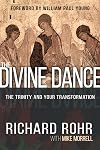
The Divine Dance: The Trinity and Your Transformation
by Richard Rohr, Mike Morrell
On This Page
Description
The Trinity is supposed to be the central doctrine grounding Christianity, yet we're often told that we shouldn't attempt to understand it because it's a mystery. But what if we breached that mystery? How might it transform our relationship with God? Although the word 'trinity' isn't found in the New Testament-it wasn't until the third century that it was coined-the idea of the Father, Son, and Holy Spirit was present in Jesus' life and teachings. In the pages of this book, internationally show more recognized teacher Richard Rohr circles around this paradoxical idea-and circling around is an apt metaphor: early Christians applied the Greek verb for dance to the mystery of the Trinity, saying whatever is going on in God is a flow-it's like a dance. show lessTags
Recommendations






Member Reviews
This book is an attempt to understand the concept of the Trinity in relational terms. It’s taken me several weeks to finish it, and it’s the kind of book that I could start rereading immediately, as I’m sure I’ve missed a great deal.
Much of the book, as its critics point out, refers to ‘flow’ and the ‘dance’ of the Trinity, existing from before the universe existed, in a perfect love relationship. These aren't new thoughts to me, but I was struck by the idea of continual flow in ongoing creation, and participating in the ‘divine dance’.
Traditional evangelicals will probably find much to criticise in this book. I admit I had moments myself of wondering whether some of it was heresy. However I like the style very show more much; the writing is persuasive, and encouraging, and most of it resonated strongly.
Overall I liked this book very much, and would recommend it to anyone interested in knowing more about the Trinity. show less
Much of the book, as its critics point out, refers to ‘flow’ and the ‘dance’ of the Trinity, existing from before the universe existed, in a perfect love relationship. These aren't new thoughts to me, but I was struck by the idea of continual flow in ongoing creation, and participating in the ‘divine dance’.
Traditional evangelicals will probably find much to criticise in this book. I admit I had moments myself of wondering whether some of it was heresy. However I like the style very show more much; the writing is persuasive, and encouraging, and most of it resonated strongly.
Overall I liked this book very much, and would recommend it to anyone interested in knowing more about the Trinity. show less
Another white male theologian pretends to have just discovered ideas that have been part of womanist theology (and almost any discussion of contemplative spirituality) for decades. Lots of discussion of the relational dance of the trinity peppered with an annoying amount of pop psychology and false dichotomies. And lots of !!!! I should of stopped reading after the first week of book group discussion with folks who clearly worship Rohr and don't see any problems with the poor writing and blanket assumptions. My second attempt at a Rohr book will definitely be my last.
The Christian doctrine of the Trinity is a mystery; a commonly accepted Christian truth that is rationally incomprehensible. In The Divine Dance, Richard Rohr attempts to explain it in a way that feels both familiar and completely foreign. Rather than the mystery being the end of the conversation, he uses it as an invitation to deeper understanding.
The book is profound and insightful. Rohr puts words to your unconscious and intuitive understanding of the nature of God. But he does not try to make it a comprehensive, systematic explanation. It never completely settles on the rational side of things. His instruction adds confidence and clarity to your experiential intuition over your logical.
The traditional understanding of the Trinity is that it consists of three distinct beings existing in perfect relationship. The emphasis on the beings. Rohr emphasizes how the relationship, the space between the members of the Trinity, is the foundational component.
This subtle shift in weight caused so much to click into place for me. Think about it: God (The Trinity) is love because he is relationship itself. This adds a whole new dimension to why isolation and disconnectedness are so destructive. When I become vulnerable, when die to myself, I participate in fuller relationship with those around me. But it doesn’t stop there. In this movement towards weakness and self emptying, I participate, in some way, with whatever is going on in the Trinity!
Back to the book itself, it is not a book of quick answers or comprehensive solutions. The best explanation I can give is that it works to resonate with you. As it resonates, you will understand certain things with a little more clarity. Some parts of the book resonate more than others. I’m certain that’s a result of where I am in my life and how much I am capable of understanding now. I’m excited to come back to it in a couple years and see how my thoughts have changed, because I am certain they will.
Be prepared for a period of adjustment as you start to read this book. Especially if you’re from a traditional Protestant background and have not read anything by Rohr before. He a friar in the Franciscan tradition, which holds different views on the incarnation and atonement, among other things. Franciscans also draw heavily on mystical and contemplative interpretations of scripture. I found this very valuable, but it’s possible it all may be too big a jump for you to make.
Originally posted at https://mcmanus.io/2018/the-divine-dance-by-richard-rohr show less
God for us, we call you Father.
God alongside us, we call you Jesus.
God within us, we call you Holy Spirit.
You are the eternal mystery that enables, enfolds, and enlivens all things,
Even us and even me. Every name falls short of your goodness and greatness.
We can only see who you are in what is.
We ask for such perfect seeing—
As it was in the beginning, is now, and ever shall be.
show more Amen.
The book is profound and insightful. Rohr puts words to your unconscious and intuitive understanding of the nature of God. But he does not try to make it a comprehensive, systematic explanation. It never completely settles on the rational side of things. His instruction adds confidence and clarity to your experiential intuition over your logical.
Rational certitude is exactly what the Scriptures do not offer us. They offer us something much better and an entirely different way of knowing: an intimate relationship, a dark journey, a path where we must discover for ourselves that grace, love, mercy, and forgiveness are absolutely necessary for survival—in an always and forever uncertain world.
The traditional understanding of the Trinity is that it consists of three distinct beings existing in perfect relationship. The emphasis on the beings. Rohr emphasizes how the relationship, the space between the members of the Trinity, is the foundational component.
Whatever is going on in God is a flow, a radical relatedness, a perfect communion between Three—a circle dance of love.
This subtle shift in weight caused so much to click into place for me. Think about it: God (The Trinity) is love because he is relationship itself. This adds a whole new dimension to why isolation and disconnectedness are so destructive. When I become vulnerable, when die to myself, I participate in fuller relationship with those around me. But it doesn’t stop there. In this movement towards weakness and self emptying, I participate, in some way, with whatever is going on in the Trinity!
The Christian God’s power comes through his powerlessness and humility. Our God is much more properly called all-vulnerable than almighty.
Back to the book itself, it is not a book of quick answers or comprehensive solutions. The best explanation I can give is that it works to resonate with you. As it resonates, you will understand certain things with a little more clarity. Some parts of the book resonate more than others. I’m certain that’s a result of where I am in my life and how much I am capable of understanding now. I’m excited to come back to it in a couple years and see how my thoughts have changed, because I am certain they will.
Be prepared for a period of adjustment as you start to read this book. Especially if you’re from a traditional Protestant background and have not read anything by Rohr before. He a friar in the Franciscan tradition, which holds different views on the incarnation and atonement, among other things. Franciscans also draw heavily on mystical and contemplative interpretations of scripture. I found this very valuable, but it’s possible it all may be too big a jump for you to make.
Originally posted at https://mcmanus.io/2018/the-divine-dance-by-richard-rohr show less
I had three reasons for picking up The Divine Dance: The Trinity and Your Transformation. First, it is about the Trinity and how belief in the triune Godhead is a game changer. There are few topics which make me this giddy. My reading of Zizioulas, Volf, Moltmann and Barth in grad school made me a passionately Trinitarian. Secondly,I read this book because its author is Richard Rohr. I mean who doesn't love Rohr? He is the reigning guru on all things enneagram, contemplative prayer in the perennial tradition, Franciscan spirituality and the masculine journey. So what if his mystic speak is a little fuzzy and he pushes things in more of a progressive direction that many of us are comfortable with? His progressive bent is not show more characterized by a demythologizing, deconstructive tendency, but a desire to squeeze every generous ounce out of God's grace. I don't agree with everything Rohr says, I don't even understand everything Rohr says (he's deeper than I am); yet I am always challenged by reading his books and walk away believing and trusting God just a little more.
My third reason was Rohr's co-author Mike Morrell. Morrell is best known as the organizer of the Wild Goose Festival. One of his seven or eight other day jobs is curating SpeakEasy,a blog review program which has introduced me to some great books the past few years. This book came into fruition when Morrell got his hands on material that Rohr had delivered at two conferences and offered to help Rohr translate them from conference to book form.So the Triune God, Rohr and Morrell conspired. The Divine Dance was born. Um. . .the book, not the dance. The Divine dance has been happening for a little while now.
The book is based on Rohr's lectures, but the concept came to Rohr during a Lenten retreat. While on retreat, he picked up Catherine LaCugna's book, God For Us: The Trinity and Christian Life and read it. Rohr describes the reading of her book as being brought into conversation with the "big tradition." For him the Trinity was no longer a "dusty doctrine" to be shelved, but "almost a phenomenology of my own—and others'—inner experience of God" (40-41).
Organizationally this is different from Rohr's other books (mostly through Morrell's influence). There is an introduction and three parts. In lieu of chapters there are sub-headings in each section—seventy headings in all. This makes it an ideal book for daily devotional reading; however I wouldn't say that there is a linear argument running through each section. Instead Rohr steps, sways, and sashays his way across the floor, circling back to aspects of the Trinity, embellish his dance moves with creative flourishes.
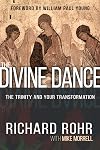
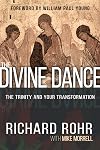
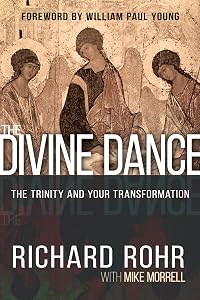
Rohr's introduction describes how despite Western Christians' affirmation of the Trinity, it has made little practical impact on our lives. The invitation, Rohr has for us, is not just to see the triune relationship at the heart of God, but to enter into communion with Father, Son and Spirit. Rohr illustrates this by describing Rublev's Trinity which depicts the Godhood sitting at Abraham's table. Rohr posits that a mirror originally hung in front of the icon, to help the observer take up her space at the table (29-31). This takes Trinity out of the world of abstraction and invites us into Divine relationship.
Part 1, Wanted: a Trinitarian Revolution is conceptual and philosophically rich. Rohr attempts to answer how entering into Triune reality changes everything—breaking all our dualisms (including political dualisms), and opens the way for new paradigms and connection with the world. Part II, Why the Trinity? Why Now?, delves deeper into the nature of God and how commitment to the Trinity dismantles our divine caricatures, and showcases a God more loving, welcoming and present to us. Part III, the Holy Spirit, concludes the book with some thoughts on how the Spirit brings helps us engage deeper with God and the world. An appendix describes seven practices for experiencing the Trinity, notably a litany of seventy evocative names for the Holy Spirit (210-212).
Rohr avoids the practical modalism of Western Christianity by looking East to the Social Trinity of the Cappadocians. He writes, "Don't start with the One and try to make it into Three, but start with the Three and see that this is the deepest nature of the One" (43). Rohr makes the case that the relationship in the Godhead between its members, is the basis of all reality, and understanding and embracing the Divine Dance opens us up to new realities which effect politics and community.
Richard Rohr and I have different starting points He's a Franciscan friar and a priest, I'm a low, roving Protestant. But I appreciate the way Rohr urges a recovery of the Trinity and has traced out its implications. I highly recommend this book for several reasons. First, Rohr is all about the great tradition. He cites Protestants, Patristic, medieval theologians and a healthy helping of notable Franciscans. Secondly, Rohr is both gracious and thoughtful in his analysis. Third, there are lots of theology books about the Trinity, but there have been few books that help us imagine what the practical implications are for our spiritual life. This one delivers. Fourth, even where we may disagree with Rohr,(i.e. his critical and selective reading of some Bible passages), he asks hard questions which we ought to press into. For example, he writes as a Franciscan priest who doesn't believe in forensic models of the atonement (131). If we are to affirm penal substitution, how does God's wrath against the Son on the cross fit into our Trinitarian theology? What impact does our belief about God impact how we live? Our politics? These are great questions. I happily recommend this book and give it four stars.
One final plea, get the hard cover edition instead of the Kindle edition. Reading this as e-book is okay, but because this is a book with no chapters and so many headings. I prefer the orientation and spacial awareness provided by a physical binding. Also, the inside of the front and back covers have a full-color reproduction of Rublev's icon of the Trinity (the same image in copper hue embossed in copper tone across the dust jacket). Divine Dance is published by Whitaker House. Many of their books reflect a charismatic aesthetic. They are best known, to me, for publishing Smith Wiggleworth and a slough of deliverance ministers. This may be the most beautiful book they've ever published.
Note: I received this book from SpeakEasy in exchange for my honest review. I wasn't asked to write a positive review. I just can't help myself. show less
My third reason was Rohr's co-author Mike Morrell. Morrell is best known as the organizer of the Wild Goose Festival. One of his seven or eight other day jobs is curating SpeakEasy,a blog review program which has introduced me to some great books the past few years. This book came into fruition when Morrell got his hands on material that Rohr had delivered at two conferences and offered to help Rohr translate them from conference to book form.So the Triune God, Rohr and Morrell conspired. The Divine Dance was born. Um. . .the book, not the dance. The Divine dance has been happening for a little while now.
The book is based on Rohr's lectures, but the concept came to Rohr during a Lenten retreat. While on retreat, he picked up Catherine LaCugna's book, God For Us: The Trinity and Christian Life and read it. Rohr describes the reading of her book as being brought into conversation with the "big tradition." For him the Trinity was no longer a "dusty doctrine" to be shelved, but "almost a phenomenology of my own—and others'—inner experience of God" (40-41).
Organizationally this is different from Rohr's other books (mostly through Morrell's influence). There is an introduction and three parts. In lieu of chapters there are sub-headings in each section—seventy headings in all. This makes it an ideal book for daily devotional reading; however I wouldn't say that there is a linear argument running through each section. Instead Rohr steps, sways, and sashays his way across the floor, circling back to aspects of the Trinity, embellish his dance moves with creative flourishes.
Rohr's introduction describes how despite Western Christians' affirmation of the Trinity, it has made little practical impact on our lives. The invitation, Rohr has for us, is not just to see the triune relationship at the heart of God, but to enter into communion with Father, Son and Spirit. Rohr illustrates this by describing Rublev's Trinity which depicts the Godhood sitting at Abraham's table. Rohr posits that a mirror originally hung in front of the icon, to help the observer take up her space at the table (29-31). This takes Trinity out of the world of abstraction and invites us into Divine relationship.
Part 1, Wanted: a Trinitarian Revolution is conceptual and philosophically rich. Rohr attempts to answer how entering into Triune reality changes everything—breaking all our dualisms (including political dualisms), and opens the way for new paradigms and connection with the world. Part II, Why the Trinity? Why Now?, delves deeper into the nature of God and how commitment to the Trinity dismantles our divine caricatures, and showcases a God more loving, welcoming and present to us. Part III, the Holy Spirit, concludes the book with some thoughts on how the Spirit brings helps us engage deeper with God and the world. An appendix describes seven practices for experiencing the Trinity, notably a litany of seventy evocative names for the Holy Spirit (210-212).
Rohr avoids the practical modalism of Western Christianity by looking East to the Social Trinity of the Cappadocians. He writes, "Don't start with the One and try to make it into Three, but start with the Three and see that this is the deepest nature of the One" (43). Rohr makes the case that the relationship in the Godhead between its members, is the basis of all reality, and understanding and embracing the Divine Dance opens us up to new realities which effect politics and community.
Richard Rohr and I have different starting points He's a Franciscan friar and a priest, I'm a low, roving Protestant. But I appreciate the way Rohr urges a recovery of the Trinity and has traced out its implications. I highly recommend this book for several reasons. First, Rohr is all about the great tradition. He cites Protestants, Patristic, medieval theologians and a healthy helping of notable Franciscans. Secondly, Rohr is both gracious and thoughtful in his analysis. Third, there are lots of theology books about the Trinity, but there have been few books that help us imagine what the practical implications are for our spiritual life. This one delivers. Fourth, even where we may disagree with Rohr,(i.e. his critical and selective reading of some Bible passages), he asks hard questions which we ought to press into. For example, he writes as a Franciscan priest who doesn't believe in forensic models of the atonement (131). If we are to affirm penal substitution, how does God's wrath against the Son on the cross fit into our Trinitarian theology? What impact does our belief about God impact how we live? Our politics? These are great questions. I happily recommend this book and give it four stars.
One final plea, get the hard cover edition instead of the Kindle edition. Reading this as e-book is okay, but because this is a book with no chapters and so many headings. I prefer the orientation and spacial awareness provided by a physical binding. Also, the inside of the front and back covers have a full-color reproduction of Rublev's icon of the Trinity (the same image in copper hue embossed in copper tone across the dust jacket). Divine Dance is published by Whitaker House. Many of their books reflect a charismatic aesthetic. They are best known, to me, for publishing Smith Wiggleworth and a slough of deliverance ministers. This may be the most beautiful book they've ever published.
Note: I received this book from SpeakEasy in exchange for my honest review. I wasn't asked to write a positive review. I just can't help myself. show less
Giving a unique, relational picture of the trinity, this book will bring Trinitarian theology to life in practical, thought-provoking ways. Though some concepts may be controversial, they are certainly worth wrestling through with God in order to explore more fully the flow of this Divine Dance that we are all invited to participate in.
This was a great read. Rohr pulls the reader out of our modern cultural perspective to view the Trinity from the perspective of relationship, rather than a hierarchical power structure. This is not a new approach and has previously been discussed by a number of theologians, but the concept has been lost due to the current trend to view the Trinity as a triangle with God the Father at the head of it. This shift in perspective is important because it creates strong guidelines for us in how we interact with one another. It emphasizes the downfall of a rule based religion and emphasizes the importance of a faith based in love and respect. Highly recommended reading.
Full review here:
show more target="_top">http://englewoodreview.org/richard-rohr-the-divine-dance-feature-review/
Note: I was given a free ARC of this title in exchange for an honest review. show less
Full review here:
show more target="_top">http://englewoodreview.org/richard-rohr-the-divine-dance-feature-review/
Note: I was given a free ARC of this title in exchange for an honest review. show less
Not a ton of new material for Richard Rohr fans, perhaps, but uplifting and offers good articulations of concepts in ways that will preach well.
Members
- Recently Added By
Published Reviews
And my long—forgive me—review has one main point: it’s that The Divine Dance isn’t about the Father, Son, and Holy Spirit. It’s a book about an alternative spirituality of Flow, committed to a metaphysic that refuses to recognize a distinction between God and the world. It’s one long looting of the language of Trinitarian theology, with an avowed goal of using that language to show more teach an entirely novel doctrine. show less
added by MarthaJeanne
Author Information

236+ Works 12,502 Members
Richard Rohr is a globally recognized ecumenical teacher whose work is grounded in Christian mysticism, practices of contemplation and self-emptying, and compassion for the marginalized. He is a Franciscan priest of the New Mexico province and founder of the Center for Action and Contemplation in Albuquerque, where he also serves as academic dean show more of the Living School for Action and Contemplation. Fr. Richard is the author of many books, including the bestsellers Just This, What Do We Do with Evil?, The Universal Christ, and The Wisdom Pattern. show less
1 Work 510 Members
Common Knowledge
- Original publication date
- 2016-11-03
- Blurbers
- Bono
Classifications
Statistics
- Members
- 512
- Popularity
- 58,339
- Reviews
- 12
- Rating
- (4.09)
- Languages
- English
- Media
- Paper, Audiobook, Ebook
- ISBNs
- 10
- ASINs
- 3