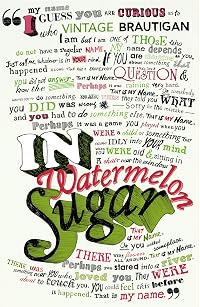
In Watermelon Sugar
by Richard Brautigan
On This Page
Description
iDEATH is a place where the sun shines a different color every day and where people travel to the length of their dreams. Rejecting the violence and hate of the old gang at the Forgotten Works, they lead gentle lives in watermelon sugar. In this book, Richard Brautigan discovers and expresses the mood of the counterculture generation.Tags
Recommendations


















Member Recommendations
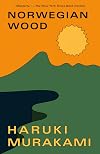
ursula Murakami is influenced by Brautigan. Both are simple but weird tales of love and life.
11
Member Reviews
Poetic 60s fantasia.
An unnamed narrator relates life at iDEATH, He tells us of the extinct Tigers who ate his parents but spared him because, as they told him, we don’t harm children, and who were beautiful singers. He tells us of Margaret, who he used have a relationship with but won’t accept it’s over, and her obsession with the Forgotten Works; where the disillusioned inBOIL lives with his followers drinking whisky. Mostly he tells us about the characters of (Pauline, whom he loves; Fred, his best friend, and Old Charlie) and day-to-day events in iDEATH.
In the land of the cult writer Richard Brautigan sits at the top table – his novels are oddball, quirky, strange (pick your adjective). They contain a little plot and a little show more characterisation but mainly they contain a dream-like prose. They often resemble linked prose poems: beautiful and intriguing but so lightweight as novels they could simply blow away. Whether or not you like Brautigan depends solely on your reaction to his poetic prose.
The community of iDEATH is the embodiment of the 1960’s hippie dream - set in a environmentally friendly community, where the buildings are built round, and from (watermelon sugar), nature, the inhabitants live, eat and sleep communally. The life is slow and easy, work gets done when it is needed by who wants to do it. Brautigan also incorporates aspects of Eastern philosophy such as living with ancestors – in iDEATH it is almost literal, as the dead are buried in glass coffins at the bottom of the river so that they are always there.
Despite the bucolic nature of iDEATH acts of violence lie at the heart of the novel. The narrator and others mourn the loss of the Tigers’ beautiful singing, while acknowledging that the community had to hunt them to extinction as they preyed on its members. Then inBOIL and his followers commit suicide by cutting off their thumbs, ears and noses, bleeding to death on the floor of the trout hatchery, after he promises to reveal the truth about iDEATH. As he lies dying he states, “I am iDEATH”. Margaret, who is questioned about her obsession with the Forgotten Works, hangs herself.
Are the deaths of inBOIL and Margaret, and the name of the community itself, suggesting that in order for iDEATH to succeed certain aspects of individual personality must be lost? It is interesting that inBOIL and Margaret both are obsessed with the Forgotten Works where there are buildings, books and objects belonging to a previous civilisation. (Watermelon is nominally a post-apocalyptic novel). For the rest of iDEATH these items should be left to decay or disappear – they are at worst dangerous; at best pointless.
In the majority of utopian novels the suppression of the self and acceptance of things as they are is portrayed as bad but Brautigan appears more ambivalent. If the community members remain happy and contented does it matter? The unnamed narrator is puzzled by the deaths of inBOIL and his followers, saddened by the death of Margaret but also believes that they these deaths may have been for the best – that inBOIL and Margaret made iDEATH a less happy place to be. It is the same with the Tigers – the community made the decision to be safe at the cost of losing beauty. People miss the songs of the Tigers but they don’t dispute the necessity of the killing them all.
Is Brautigan really saying that it is acceptable to lose some aspects of human behaviour in order to reach a placid middle place of acceptance? The characters that we are expected to empathise with in the book certainly suggest that. These characters however are completely naïve; they don’t question the world the way an ordinary person would do. To a large extent they are philosophically and intellectually empty – they don’t accept the world of iDEATH because it is the best possible world, they accept it because it is their world.
There is always the possibility that iDEATH is a personal utopia for Brautigan. He suffered from mental problems throughout his life and perhaps iDEATH is a fictional manifestation of what he would have given up in order to achieve some level of inner peace. (He later committed suicide, aged 49, after talking about it for years – he was not discovered for a month).
In the end, In Watermelon Sugar is your typical Richard Brautigan novel – full of lovely descriptions of sunsets and rivers and the colours of watermelon sugar but empty of the many of the attributes that make up a good novel. That doesn’t mean the book isn’t worth reading, there are worse ways to fill a quiet Sunday afternoon or a lazy summer evening than relaxing with Brautigan’s prose. show less
An unnamed narrator relates life at iDEATH, He tells us of the extinct Tigers who ate his parents but spared him because, as they told him, we don’t harm children, and who were beautiful singers. He tells us of Margaret, who he used have a relationship with but won’t accept it’s over, and her obsession with the Forgotten Works; where the disillusioned inBOIL lives with his followers drinking whisky. Mostly he tells us about the characters of (Pauline, whom he loves; Fred, his best friend, and Old Charlie) and day-to-day events in iDEATH.
In the land of the cult writer Richard Brautigan sits at the top table – his novels are oddball, quirky, strange (pick your adjective). They contain a little plot and a little show more characterisation but mainly they contain a dream-like prose. They often resemble linked prose poems: beautiful and intriguing but so lightweight as novels they could simply blow away. Whether or not you like Brautigan depends solely on your reaction to his poetic prose.
The community of iDEATH is the embodiment of the 1960’s hippie dream - set in a environmentally friendly community, where the buildings are built round, and from (watermelon sugar), nature, the inhabitants live, eat and sleep communally. The life is slow and easy, work gets done when it is needed by who wants to do it. Brautigan also incorporates aspects of Eastern philosophy such as living with ancestors – in iDEATH it is almost literal, as the dead are buried in glass coffins at the bottom of the river so that they are always there.
Despite the bucolic nature of iDEATH acts of violence lie at the heart of the novel. The narrator and others mourn the loss of the Tigers’ beautiful singing, while acknowledging that the community had to hunt them to extinction as they preyed on its members. Then inBOIL and his followers commit suicide by cutting off their thumbs, ears and noses, bleeding to death on the floor of the trout hatchery, after he promises to reveal the truth about iDEATH. As he lies dying he states, “I am iDEATH”. Margaret, who is questioned about her obsession with the Forgotten Works, hangs herself.
Are the deaths of inBOIL and Margaret, and the name of the community itself, suggesting that in order for iDEATH to succeed certain aspects of individual personality must be lost? It is interesting that inBOIL and Margaret both are obsessed with the Forgotten Works where there are buildings, books and objects belonging to a previous civilisation. (Watermelon is nominally a post-apocalyptic novel). For the rest of iDEATH these items should be left to decay or disappear – they are at worst dangerous; at best pointless.
In the majority of utopian novels the suppression of the self and acceptance of things as they are is portrayed as bad but Brautigan appears more ambivalent. If the community members remain happy and contented does it matter? The unnamed narrator is puzzled by the deaths of inBOIL and his followers, saddened by the death of Margaret but also believes that they these deaths may have been for the best – that inBOIL and Margaret made iDEATH a less happy place to be. It is the same with the Tigers – the community made the decision to be safe at the cost of losing beauty. People miss the songs of the Tigers but they don’t dispute the necessity of the killing them all.
Is Brautigan really saying that it is acceptable to lose some aspects of human behaviour in order to reach a placid middle place of acceptance? The characters that we are expected to empathise with in the book certainly suggest that. These characters however are completely naïve; they don’t question the world the way an ordinary person would do. To a large extent they are philosophically and intellectually empty – they don’t accept the world of iDEATH because it is the best possible world, they accept it because it is their world.
There is always the possibility that iDEATH is a personal utopia for Brautigan. He suffered from mental problems throughout his life and perhaps iDEATH is a fictional manifestation of what he would have given up in order to achieve some level of inner peace. (He later committed suicide, aged 49, after talking about it for years – he was not discovered for a month).
In the end, In Watermelon Sugar is your typical Richard Brautigan novel – full of lovely descriptions of sunsets and rivers and the colours of watermelon sugar but empty of the many of the attributes that make up a good novel. That doesn’t mean the book isn’t worth reading, there are worse ways to fill a quiet Sunday afternoon or a lazy summer evening than relaxing with Brautigan’s prose. show less
What the.
What a strange little book. I'm not quite sure what its point was, there was no explanation to anything that went on - is this post-apocalyptic? Maybe. But then again, maybe not. It's just some rather charming ramblings from a writer set in some sort of bizarre world that I couldn't hope to describe since it's never clearly set out in the book.
But I did rather enjoy it, even if I wanted some *explanations*, dagnabbit! iDEATH? Some sort of Apple product?? Mysterious book, I may be pondering it for longer than I was reading it.
What a strange little book. I'm not quite sure what its point was, there was no explanation to anything that went on - is this post-apocalyptic? Maybe. But then again, maybe not. It's just some rather charming ramblings from a writer set in some sort of bizarre world that I couldn't hope to describe since it's never clearly set out in the book.
But I did rather enjoy it, even if I wanted some *explanations*, dagnabbit! iDEATH? Some sort of Apple product?? Mysterious book, I may be pondering it for longer than I was reading it.
Egyáltalán nem érthetetlen könyv ez – csak nem a realitáshoz kell mérni a benne foglalt eseményeket, hanem simán rákapcsolódni a hangulatra. És akkor máris helyben vagyunk. Brautigan egy alternatív közösség idillikus életét skicceli fel, akik görögdinnyecukorból és fűszeres pisztrángolajból épített kicsiny kis világukban mentek minden szélsőségtől: még tragédiáik is mintha valami nagy puhaságokkal lennének kipárnázva. Akadnak azonban, akiknek elege van ebből a langyi szirupból, felrúgnák a földöntúli nyugalmat, és valami igazabb, mélyebb létezést kívánnának létrehozni – ennek érdekében pedig még a bicskájukat se félnek használni. Olyan, mintha az idilli közösség a Nagy show more Amerikai Álom metaforája lenne, a lázadók pedig a hippimozgalmat szimbolizálnák – akikhez Brautigan is ezer szállal kötődött –, annak minden vadhajtásával, ám ezt az értelmezést árnyalja, hogy a szerző még közvetve sem érvel egyik oldal mellett sem, egyszerűen hagyja, hogy a két fél szembenállása megtöltse vészjósló feszültséggel a regénytestet. Talán elvárnánk, hogy mondjon valamit, ki a jó, ki a rossz, kinek kell drukkolni, de azt hiszem, ezzel pont rövidre zárná a a szembenállásból fakadó dinamikát. Szóval nagyon jól teszi, hogy két szék között ha nem is a padlóra, de valami távolabbi trónusra ül, ami hagyományosan a mindentudó elbeszélők helye, és onnan mondja tollba szűkszavú abszurd meséjét.
Csak ne szoktam volna meg olyan nehezen, hogy ezt a világot KIThaLÁLomnak fordították.
Ui: ez a kötet a RaRe sorozat egyik mélypontja a borítótervezést illetően. Lövésem sincs, hogy mire gondolhattak, amikor kiválasztották. show less
Csak ne szoktam volna meg olyan nehezen, hogy ezt a világot KIThaLÁLomnak fordították.
Ui: ez a kötet a RaRe sorozat egyik mélypontja a borítótervezést illetően. Lövésem sincs, hogy mire gondolhattak, amikor kiválasztották. show less
It would be easy to dismiss In Watermelon Sugar as disjointed, hallucinatory wanderings. And I'm not saying that's an invalid interpretation; maybe that's all it is. But it's also amazingly tactile and immersive for a book written in short sketches and simple sentences.
If you're going to enjoy it at all, you have to abandon yourself to the experience. Everything is made of watermelon sugar? Okay. There were talking tigers? Sure. They live at a place called iDEATH? Why not. Our nameless narrator talks a little about the world in which he lives, and his job (he's a writer, kind of), and the women and friends in his life. It's a basic story about human nature and simple pleasures thrown into a surrealist setting.
I read that Haruki show more Murakami considers Brautigan an influence, and I can see the connections. Murakami does more complex world-building, but the combination of the mundane and the surreal, as well as the quiet nature of the narrative are things they have in common. In Watermelon Sugar is a little slip of a book (I read it in two short train rides), but you may find the imagery sticking with you well after you close the book.
Recommended for: anyone who's ever had occasion to say, "that's so *cosmic*, man," people who like Hieronymus Bosch, someone who wants to ease into surrealism.
Quote: "I took her hand in mine. Her hand had a lot of strength gained through the process of gentleness and that strength made my hand feel secure, but there was a certain excitement, too." show less
If you're going to enjoy it at all, you have to abandon yourself to the experience. Everything is made of watermelon sugar? Okay. There were talking tigers? Sure. They live at a place called iDEATH? Why not. Our nameless narrator talks a little about the world in which he lives, and his job (he's a writer, kind of), and the women and friends in his life. It's a basic story about human nature and simple pleasures thrown into a surrealist setting.
I read that Haruki show more Murakami considers Brautigan an influence, and I can see the connections. Murakami does more complex world-building, but the combination of the mundane and the surreal, as well as the quiet nature of the narrative are things they have in common. In Watermelon Sugar is a little slip of a book (I read it in two short train rides), but you may find the imagery sticking with you well after you close the book.
Recommended for: anyone who's ever had occasion to say, "that's so *cosmic*, man," people who like Hieronymus Bosch, someone who wants to ease into surrealism.
Quote: "I took her hand in mine. Her hand had a lot of strength gained through the process of gentleness and that strength made my hand feel secure, but there was a certain excitement, too." show less
In the late 1980s there was a revival of Sixties culture in the United States. This manifested in the reemergence of styles like tie-dye tee-shirts and torn bell-bottom jeans, nostalgic TV shows like "The Wonder Years," and classic rock as a radio genre. Sixties rock stars like Tina Turner, The Grateful Dead, The Moody Blues, Steve Winwood, and The Beach Boys were making hit records again, in some cases bigger than their success in the Sixties. I was fully invested in this revival looking back at everything my parents' generation did as much "cooler" than my own. Instead of getting into recreational drug use, though, I read books.
Somewhere along the line I discovered the writing of Richard Brautigan, a figure of the counterculture show more albeit adamantly not a hippie. In Watermelon Sugar became one of my favorite books, mostly because it was just so weird and different. Revisiting the book as an adult it feels less profound than it did as a starry-eyed teenager. But there are also nuances I didn't notice. For example, while the story takes place in a commune of sorts called iDEATH, I never realized that it was the home to surviving population of an apocalyptic scenario. The novel's narrator is also unreliable. His judgement and shunning of Margaret is cruel since all she did was associate with the novel's antagonist inBOIL and question some of the community's assumptions.
The prose in this book is simple with the dialogue bearing an almost painful verisimilitude to real life small talk. This basic nature contrasts with the strangeness of the world inhabited by the characters: a sky that changes colors, statues and tombs everywhere, anthropomorphic tigers that speak kindly to a child while devouring his parents, and the titular watermelon sugar used as a building material. There's a tenderness in this book and a sense of real community, punctuated by the brutal violence of inBOIL. But while inBOIL is the villain, the tragedy of Margaret and the narrator's indifference indicates the bigger problem in this utopia. show less
Somewhere along the line I discovered the writing of Richard Brautigan, a figure of the counterculture show more albeit adamantly not a hippie. In Watermelon Sugar became one of my favorite books, mostly because it was just so weird and different. Revisiting the book as an adult it feels less profound than it did as a starry-eyed teenager. But there are also nuances I didn't notice. For example, while the story takes place in a commune of sorts called iDEATH, I never realized that it was the home to surviving population of an apocalyptic scenario. The novel's narrator is also unreliable. His judgement and shunning of Margaret is cruel since all she did was associate with the novel's antagonist inBOIL and question some of the community's assumptions.
The prose in this book is simple with the dialogue bearing an almost painful verisimilitude to real life small talk. This basic nature contrasts with the strangeness of the world inhabited by the characters: a sky that changes colors, statues and tombs everywhere, anthropomorphic tigers that speak kindly to a child while devouring his parents, and the titular watermelon sugar used as a building material. There's a tenderness in this book and a sense of real community, punctuated by the brutal violence of inBOIL. But while inBOIL is the villain, the tragedy of Margaret and the narrator's indifference indicates the bigger problem in this utopia. show less
This book is my Irene Adler.
It's rather short and surreal. Utterly intriguing and a little disturbing. And lovely. I read it first as a child of 11 or so. At this point, I've read it too many times to count. I own four copies of it. They're on a special shelf with my other multiple copies of Brautigan works. Whenever I see a copy of this in a bookstore, I stop, pull it out and, laying both hands upon it, raise it to my forehead, then open it and read a few pages. I smile and feel becalmed. Gently I slip it back onto the shelf for someone else, because I already own more than the legal limit of In Watermelon Sugar.
It's rather short and surreal. Utterly intriguing and a little disturbing. And lovely. I read it first as a child of 11 or so. At this point, I've read it too many times to count. I own four copies of it. They're on a special shelf with my other multiple copies of Brautigan works. Whenever I see a copy of this in a bookstore, I stop, pull it out and, laying both hands upon it, raise it to my forehead, then open it and read a few pages. I smile and feel becalmed. Gently I slip it back onto the shelf for someone else, because I already own more than the legal limit of In Watermelon Sugar.
1/2012 This one is a touchstone for me, and I'm not sure exactly why. Perhaps because it is so very gentle, so loving, so open. Ostensibly, it's a few days in a commune in some mythical world that used to have beautiful, man-eating, talking tigers. A world where everything is made from watermelon sugar. But it's always struck me as a meditation on the art of the possible. It helps me to remember how to live, in the words of Annie Dillard, "yielding at every moment to the perfect freedom of single necessity." It's an imperfect science, embracing the given, but one I try to improve at.
This book also tastes like my late childhood and early adolescence, when all the world was in love with love, or so it seemed to me. We were all going to show more be hippies and live on communes and everyone was going to take a turn doing dishes.
This review makes almost as little sense as the book. I'm okay with that.
10/2005 As much as Brautigan repelled me in person, this book is a transcendent thing. It glows softly in my hands, the pages made from watermelon sugar. On the face of it, it's some hippie post-apocalyptic nonsensical rantage. But it is lyrical, and sweet, and good. show less
This book also tastes like my late childhood and early adolescence, when all the world was in love with love, or so it seemed to me. We were all going to show more be hippies and live on communes and everyone was going to take a turn doing dishes.
This review makes almost as little sense as the book. I'm okay with that.
10/2005 As much as Brautigan repelled me in person, this book is a transcendent thing. It glows softly in my hands, the pages made from watermelon sugar. On the face of it, it's some hippie post-apocalyptic nonsensical rantage. But it is lyrical, and sweet, and good. show less
Members
- Recently Added By
Lists

1001 Books You Must Read Before You Die
1,448 works; 1,137 members
Books That Changed Me
158 works; 47 members

Lithub: 50 Great Classic Novels Under 200 pages
50 works; 10 members

1,001 BYMRBYD Concensus
723 works; 27 members

XB-1: Osobnosti zanru doporucuji
67 works; 1 member

My TBR
371 works; 3 members

Best Sellers / Popular 1968
237 works; 5 members

NTS Book Channel
316 works; 1 member
Author Information

50+ Works 14,823 Members
Awards and Honors
Series
Belongs to Publisher Series
Work Relationships
Is contained in
Has the adaptation
Common Knowledge
- Canonical title
- In Watermelon Sugar
- Original title
- In Watermelon Sugar
- Original publication date
- 1968
- People/Characters
- Doc Edwards; Margaret; Pauline; Charley; InBOIL; The Grand Old Trout
- Important places
- iDeath; Pauline's Shack; Watermelon Works; Trout hatchery; Forgotten Works
- Important events
- Killing of the last tiger
- Dedication
- This novel is for Don Allen, Joanne Kyger and Michael McClure. (noted at end of book)
- First words
- In watermelon sugar the deeds were done and done again as my life is done in watermelon sugar.
- Last words
- (Click to show. Warning: May contain spoilers.)This novel was started May 13, 1964 in a house at Bolinas, California, and was finished July 19, 1964 in the front room at 123 Beaver Street, San Francisco, California.
(Click to show. Warning: May contain spoilers.)The musicians were poised with their instruments. They were ready to go. It would only be a few seconds now, I wrote. - Blurbers*
- A charming and original work - The Times
- Original language
- English
*Some information comes from Common Knowledge in other languages. Click "Edit" for more information.
Classifications
Statistics
- Members
- 1,743
- Popularity
- 12,721
- Reviews
- 42
- Rating
- (3.86)
- Languages
- 15 — Czech, Dutch, English, Estonian, Finnish, German, Hungarian, Italian, Japanese, Lithuanian, Farsi/Persian, Russian, Spanish, Turkish, Portuguese (Portugal)
- Media
- Paper, Audiobook, Ebook
- ISBNs
- 32
- ASINs
- 22