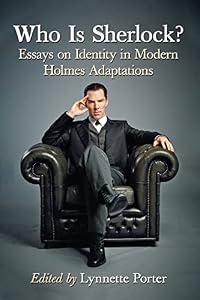
Who Is Sherlock? Essays on Identity in Modern Holmes Adaptations
by Lynnette R. Porter (Editor)
On This Page
Description
"Nearly 130 years after the introduction of Sherlock Holmes to readers, the Great Detective's identity is being questioned, deconstructed, and reconstructed more than ever. Who is Sherlock Holmes? is still a viable question. The answers provided by illustrators, scriptwriters, directors, costume designers, set designers, actors, scholars, and fans provide insights into Victorian or modern-day Sherlock"--Tags
Member Reviews
"Who Is Sherlock?" is a collection of thought-provoking essays, a comparative history, if you will, of the Conan Doyle Canon and recent television and film adaptations. The contributions tend to be on the dry/academia side, but nonetheless for the most part are interesting, if a tough read. What intrigued me was the insistent use of "visual Holmes" (TV and film adaptations); Porter says that's because most people these days watch Holmes instead of reading Holmes. I had to think about that, because, indeed, my first introduction to the world's first (and greatest!) consulting detective was indeed from the 1930s and 1940s movies starring Basil Rathbone and Nigel Bruce. My enjoyment of those films led me to the libraries and the book shops show more where I subsequently inhaled Conan Doyle ... and beyond. It's no secret that Conan Doyle's Holmes has inspired many authors to create their own versions of 221B Baker Street; my own modest Holmes collection includes two anthologies of short stories, plus novels by nine other authors, whose diversity ranges from Caleb Carr ("The Italian Secretary") to Kareem Abdul-Jabbar ("Mycroft"). And that's just it: Holmes has hypnotized and captured so many adherents, spanning both world and time. Thus, it wasn't all that much of a revelation to read in "Who Is Sherlock?" that different generations have adapted Holmes to suit time and taste and culture. Perhaps some enterprising scholar will attempt a similar comparison, only using Conan Doyle and other authors, and omitting the visual media (certainly, LT'ers aren't among those whose only source of literature is from the big and/or little screen). I especially thought of this while reading one essay in this collection, which asks if Holmes is gay or straight, bisexual, or even asexual; well then, what to think of the author Laurie R. King and her series of (twenty, I think) Mary Russell novels, where Sherlock Holmes is ... married! In the end, I believe that, while Conan Doyle created Holmes, it is all of us, 130 years' worth of readers and viewers, authors and producers, who continue to reinvent him. And that is who Sherlock Holmes "is." show less
 This review was written for LibraryThing Early Reviewers.
Who is Sherlock? Essays on Identity in Modern Holmes Adaptations, edited by Lynnette Porter, examines the modern adaptations of Sir Arthur Conan Doyle’s consulting detective – the BBC’s Sherlock, CBS’s Elementary, Guy Ritchie’s Sherlock Holmes films (starring Robert Downey, Jr.), and Mr. Holmes (2015, dir. Bill Condon). When necessary, Porter and her fellow contributors reference everything from Sidney Paget’s original illustrations to William Gillette’s Sherlock Holmes 1916 film, the first feature-length film about the detective, up through the popular Jeremy Brett series from the 1980s-1990s. Porter summarizes in her introduction, “Nearly 130 years after the introduction of Sherlock Holmes to readers, the Great show more Detective’s identity is being questions, deconstructed, and reconstructed more than ever. In this book alone, the authors analyze not only who Sherlock Holmes is or has become, but why and how his identity has been formed in a specific way” (pg. 1).
Discussing the role of identity in the Sherlock special, “The Abominable Bride,” Felecia McDuffie writes, “Mycroft understands, better than Sherlock does himself, that his detective-persona also has unacknowledged romance embedded in it. Sherlock doesn’t want to be a forensic scientist; he wants to be St. George” (pg. 42). This plays a role in how this version of Holmes casts a Victorian Watson in his hallucination. McDuffie continues, “Sherlock imagines a John as a heroic figure, treating the wounded under difficult conditions. John is his moral compass as Sherlock tries to find his way from what he suspects or fears he is – an addict and a failure – to what he hopes he can be: the ‘gentleman hero,’ the person who can hold himself to a higher moral standard for the people who need him” (pgs. 42-43). In this role Holmes’ most important tool is his mind.
Porter examines the portrayal of his Holmes’ thought process and brain attic, arguing, “In canon, as well as in these adaptations, Holmes is defined by the way his brain has been trained to work. Understanding the mind of Sherlock Holmes is key to knowing how Holmes thinks of himself and the ways that everyone else – from friends and family to the general public – perceives him” (pg. 49). Specifically, “Sherlock Holmes’s brain and his thinking process distinguish him from other characters and often make him the object of awe” (pg. 51). While every film finds its own way to demonstrate the superiority of Holmes’s brain and thinking process, Porter argues, “Among adaptations’ visualizations of Holmes’s mind, two stand out as technically superior: the Guy Ritchie-directed Sherlock Holmes film series and Sherlock. They employ sophisticated, innovative uses of filming technologies. (In contrast, Mr. Holmes deals with Holmes’s memories through the well-known and often-used flashback, and Elementary, like canon, most often relies on Holmes’s dialogue to explain his thoughts)” (pgs. 54-55).
The visual also plays a role in distinguishing Holmes and his arch nemesis, Moriarty. Heather Powers begins with the Paget drawings and Doyle’s own description, which she describes as “what we would today call ‘profiling’” as Victorians “took for granted that criminals could be identified just by looking at them” (pg. 112). In the original work, “the two characters’ mirroring of one another is clearly indicated by Conan Doyle, although Holmes is on the side of good, whereas Moriarty is his opposite – an evil influence on society. Neither of them possesses the charm that will characterize their later depictions on television or film” (pg. 112). Over time, portrayals of both characters have used more attractive actors to increase their sex appeal, but Powers argues that Moriarty remains the more tantalizing character. She writes, “Because Moriarty’s backstory in canon is limited, he has been largely created by the imaginations of audiences and adaptors. He is a perfect ‘blank slate’ upon whom audiences (and film and television series’ creators) can write their greatest fears and secret desires” (pg. 120). While audiences expect certain elements in Holmes’s identity, Moriarty offers more opportunity for variation.
These examinations of identity encourage an examination of Sherlock Holmes’s continued prominence in popular culture. Unfortunately, the book was outdated shortly after McFarland published it as the BBC completed its Sherlock series, offering new material for analysis as well as answering the question of Redbeard’s identity. With that caveat in mind, fans of the character and of the recent adaptations will find plenty to enjoy here, though some of the articles read more like well-crafted examinations from fans rather than scholarly works and the BBC series receives the most attention. show less
Discussing the role of identity in the Sherlock special, “The Abominable Bride,” Felecia McDuffie writes, “Mycroft understands, better than Sherlock does himself, that his detective-persona also has unacknowledged romance embedded in it. Sherlock doesn’t want to be a forensic scientist; he wants to be St. George” (pg. 42). This plays a role in how this version of Holmes casts a Victorian Watson in his hallucination. McDuffie continues, “Sherlock imagines a John as a heroic figure, treating the wounded under difficult conditions. John is his moral compass as Sherlock tries to find his way from what he suspects or fears he is – an addict and a failure – to what he hopes he can be: the ‘gentleman hero,’ the person who can hold himself to a higher moral standard for the people who need him” (pgs. 42-43). In this role Holmes’ most important tool is his mind.
Porter examines the portrayal of his Holmes’ thought process and brain attic, arguing, “In canon, as well as in these adaptations, Holmes is defined by the way his brain has been trained to work. Understanding the mind of Sherlock Holmes is key to knowing how Holmes thinks of himself and the ways that everyone else – from friends and family to the general public – perceives him” (pg. 49). Specifically, “Sherlock Holmes’s brain and his thinking process distinguish him from other characters and often make him the object of awe” (pg. 51). While every film finds its own way to demonstrate the superiority of Holmes’s brain and thinking process, Porter argues, “Among adaptations’ visualizations of Holmes’s mind, two stand out as technically superior: the Guy Ritchie-directed Sherlock Holmes film series and Sherlock. They employ sophisticated, innovative uses of filming technologies. (In contrast, Mr. Holmes deals with Holmes’s memories through the well-known and often-used flashback, and Elementary, like canon, most often relies on Holmes’s dialogue to explain his thoughts)” (pgs. 54-55).
The visual also plays a role in distinguishing Holmes and his arch nemesis, Moriarty. Heather Powers begins with the Paget drawings and Doyle’s own description, which she describes as “what we would today call ‘profiling’” as Victorians “took for granted that criminals could be identified just by looking at them” (pg. 112). In the original work, “the two characters’ mirroring of one another is clearly indicated by Conan Doyle, although Holmes is on the side of good, whereas Moriarty is his opposite – an evil influence on society. Neither of them possesses the charm that will characterize their later depictions on television or film” (pg. 112). Over time, portrayals of both characters have used more attractive actors to increase their sex appeal, but Powers argues that Moriarty remains the more tantalizing character. She writes, “Because Moriarty’s backstory in canon is limited, he has been largely created by the imaginations of audiences and adaptors. He is a perfect ‘blank slate’ upon whom audiences (and film and television series’ creators) can write their greatest fears and secret desires” (pg. 120). While audiences expect certain elements in Holmes’s identity, Moriarty offers more opportunity for variation.
These examinations of identity encourage an examination of Sherlock Holmes’s continued prominence in popular culture. Unfortunately, the book was outdated shortly after McFarland published it as the BBC completed its Sherlock series, offering new material for analysis as well as answering the question of Redbeard’s identity. With that caveat in mind, fans of the character and of the recent adaptations will find plenty to enjoy here, though some of the articles read more like well-crafted examinations from fans rather than scholarly works and the BBC series receives the most attention. show less
This review was written for LibraryThing Early Reviewers.Full disclosure: I've so far only read about half the essays in this volume. I would have read them all, but I got distracted by the final episode of Sherlock series 4, which aired two days after I received this copy. Bad timing!
Nevertheless, I feel confident saying that this book is a must-have for any serious, analytically-minded fan of BBC Sherlock. It will probably be of less interest to fans of the original stories only, or other adaptations.
Perhaps the strongest essay of those I've read is "I Made Me": Narrative Construction of Identity in Sherlock's The Abominable Bride, which features a very astute Freudian reading of the 10th episode.
Overall, this collection brings together some intelligent analysis of the show itself, its show more relationship to other adaptations, plus also commentaries on the fan culture surrounding it. show less
Nevertheless, I feel confident saying that this book is a must-have for any serious, analytically-minded fan of BBC Sherlock. It will probably be of less interest to fans of the original stories only, or other adaptations.
Perhaps the strongest essay of those I've read is "I Made Me": Narrative Construction of Identity in Sherlock's The Abominable Bride, which features a very astute Freudian reading of the 10th episode.
Overall, this collection brings together some intelligent analysis of the show itself, its show more relationship to other adaptations, plus also commentaries on the fan culture surrounding it. show less
This review was written for LibraryThing Early Reviewers.It is a challenge to review an anthology of literary essays: different authors, different topics, different levels of skill. This collection focuses not on the original canon by Doyle but on responses to modern interpretations of Holmes, specifically recent films and television versions, including Sherlock, Mr. Holmes and the two films featuring Robert Downing, Jr. From "Paget to Screen" and "Modernizing Victorian Sherlock Holmes for Mr. Holmes and the BBC's Sherlock Special" both examine the visual presentation of the characters of Holmes and Watson, starting with the illustrations of the original stories in the Strand and extending to the Jerermy Brett portrayal in the 1990s and the recent films and television series. Other essays, show more including "inside the Mind of Sherlock Holmes," and "The BBC's Sherlock: A 'Sociopathic' Master of the Social Game" discuss the construction of Holmes's character, including the question of whether he is indeed a 'high functioning sociopath' or some more benign sort of genius. The essays "Chosen Families," "Fan Fiction as Argument" and "Sherlock and the Case of the Feminist Fans" examine gender and sexual roles within the BBC series and the canon stories, with a good deal of discussion of the question of gayness. A certain subset of fan fiction (fiction written by fans of a work using the characters and settings to create original stories) is known as slash (/) fiction or Johnlock. In these stories Sherlock and John become lovers. Obviously the different essays will appeal to different interests. Nor is the book aimed at the general reader or the casual fan. The essays are academic in style and content and include extensive bibliographies. The volume is indexed and is the second on the subject edited by Professor Porter. show less
This review was written for LibraryThing Early Reviewers.This collection should really be titled Who Is Sherlock?: Essays on Identity in BBC's Sherlock. Yes, the book does have some space for Elementary, Mr. Holmes, and the Guy Ritchie films, but a look in the index shows Sherlock has more mentions than the rest of the works combined.
This review was written for LibraryThing Early Reviewers.The essays in this book are all academic studies of the BBC 'Sherlock', CBS 'Elementary', and the recent movies with Robert Downey, Jr. The excellent Ian McKeller movie 'Mr. Homes' merits a few lines as well. The articles span a wide range of topics, from artistic presentation to religion to sexuality. Not all will appeal to all readers, of course. This is one of those books where if you think it is something you would like, you probably will, if you don't, you certainly won't. Just be prepared for college literature course level reading and thought.
This review was written for LibraryThing Early Reviewers.I received this as an advanced reader copy from the publisher in exchange for an honest review.
I love Sherlock Holmes. So far I've loved every adaptation that I've seen. This as a fascinating book is about those adaptations, and about Mr. Holmes himself. While the content can be slightly dry and times, the book was well thought out. If you love the original series AND the adaptations please pick this one up.
I love Sherlock Holmes. So far I've loved every adaptation that I've seen. This as a fascinating book is about those adaptations, and about Mr. Holmes himself. While the content can be slightly dry and times, the book was well thought out. If you love the original series AND the adaptations please pick this one up.
This review was written for LibraryThing Early Reviewers.Members
- Recently Added By
Lists

Chronological 2017
30 works; 1 member
Author Information
Lynnette Porter is a professor in the Humanities and Communication Department at Embry-Riddle Aeronautical University in Daytona Beach, Florida, and has written extensively on television and film.
Classifications
- Genres
- Nonfiction, Literature Studies and Criticism
- DDC/MDS
- 791.43651 — Arts & recreation Recreation, sports, and performing arts Public performances Motion pictures, radio, television, podcasting Motion pictures Special aspects of films; film adaptations, film genres {class specific films in 791.437} Films dealing with humanity Specific persons
- LCC
- PN1995.9 .S5 .W46 — Language and Literature Literature (General) Literature (General) Drama Motion pictures
- BISAC
Statistics
- Members
- 16
- Popularity
- 1,442,353
- Reviews
- 8
- Rating
- (3.25)
- Languages
- English
- Media
- Paper, Ebook
- ISBNs
- 2
- ASINs
- 1