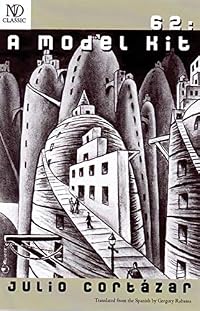
62: A Model Kit
by Julio Cortázar
On This Page
Description
As one of the main characters, the intellectual Juan, puts it: to one person the City might appear as Paris, to another it might be where one goes upon getting out of bed in Barcelona; to another it might appear as a beer hall in Oslo. This cityscape, as Carlos Fuentes describes it, "seems drawn up by the Marx Brothers with an assist from Bela Lugosi!" It is the meeting place for a wild assortment of bohemians in a novel described by The New York Times as "Deeply touching, enjoyable, show more beautifully written and fascinatingly mysterious." Library Journal has said 62: A Model Kit is "a highly satisfying work by one of the most extraordinary writers of our time." show lessTags
Recommendations























Member Reviews
El experimento de Morelli en el capítulo 62 de 'Rayuela' termina siendo una maravilla de novela. Con mucho del aire de la misma 'Rayuela', '62/Modelo para armar' se siente como una segunda parte o al menos como una ramificación digna del tronco de origen. Cortázar en su mejor momento, con un estilo particularísimo, esa manera de pasar casi imperceptiblemente de un narrador a otro en medio de un mismo párrafo, como si las consciencias se pegaran unas con otras y se confundieran. Un nuevo grupo de personajes memorables, más memorables, me atrevo a decir, que los del club de la serpiente; aquí todos son protagonistas perfectamente caracterizados. En fin, una novela deliciosa.
I'm a big Julio Cortázar fan. I read Rayuela in high school, in English, and have read it three or four times in Spanish. I read it while I was a student in Buenos Aires, and can only daydream that some day I'll read it while living in Paris. It's also one of the books I recommend most frequently to my friends. I would like to see a renaissance of Cortázar in the 21st century, because when I read books like Rayuela and 62/Modelo para armar, I think that this is what my contemporaries in the young (hipster?) class should be reading: watching themselves in the bodies of Horacio, Ronald, Ossip, Babs and La Maga, Juan, Marrast, Hélène and Tell, growing older yet still as cool as ever, drinking cheap vodka with their creative and witty show more friends and rambling on about jazz (or rap, these days) as life's responsibilities and tragedies creep in, one loves another and the feelings aren't mutual, a baby dies, a young woman is raped, and loneliness and sadness become overwhelming as they realize that no system, no way of organizing life's events and justifying one's existence, is rigorous enough to stand up to the onslaught of time and provide order to the chaos of life.
This book, built from an idea proposed in chapter 62 of Rayuela, begins with Juan sitting in the restaurant Polidor, analyzing a series of events and images (a fat man ordering a "château saignant," the purchase of a book Juan probably won't read, his being led to a seat facing a mirror, the reflected script of the menu--looks like Russian to Juan--, a bottle of Sylvaner), trying to organize them into some sort of system. He also thinks about a woman, Hélène, as well as the city and the "zone," where his group of friends crosses paths. The possibility for interconnection between random events is tantalizing, but ultimately discouraging in that moments that may have been built through these random occurrences pass by so fleetingly, and one is left wondering if A were truly a unique result caused by B and C, or whether things would have been different had D or E occurred instead, or if they had occurred in a different order.
After Juan analyzes his surroundings orbiting around him, the focus expands, and Juan's group of friends are examined as they orbit around Paris (including extended stays in Vienna and London). Marrast and Nicole (who pines for Juan) are in London, where Marrast is trying to order a large stone to sculpt, Nicole is painting gnomes for a book, and Marrast sets off an absurd daily congregation of neurotics in front of a mediocre painting by slipping a provocative note into their association. Also in London are Calac and Polanco, two Argentines whose conversations are verbally exuberant and who counteract some of the seriousness of the others' relationships. A young laudist, learning French from Marrast, is also in the mix. Juan is working as an interpreter in Vienna, accompanied by Tell, a Danish woman who joins him in obsessing over the odd couple of "Frau Mirta" and a young English woman, following them from hotel to hotel and fearfully stalking their every action. In Paris, Hélène the anesthesiologist is distraught over the death of her young patient and meets up with Celia at the Cluny (another favorite haunt of the group). Celia has run away, and Hélène suggests that she come stay with her until she can find a place of her own. They get drunk on cognac and she watches Celia prepare a bed for a doll sent to her by Tell from Vienna, which reminds her of how she prepared her patient for his surgery in a bed from which he would never rise again. These groupings of characters eventually splinter, with some coming to London to meet others. They eventually all return to Paris.
Their lives and conversations are accompanied by entities known as "paredroi," whom I liked to think of as "absent presences." The paredros concept is introduced in the following manner:
"My paredros was a routine to the extent that between us there was always someone whom we called my paredros, a denomination introduced by Calac which we employed in complete seriousness given that the quality of paredros alluded, as is known, to an associated entity, to a species of compadre or substitute or babysitter of exceptionality, and by extension to a delegation of selfness to that momentary alien dignity, without losing, deep down, any part of our own dignity, like how any particular image of the places through which we passed could be a delegation of the city, or the city could delegate a part of its self (the plaza of the streetcars, the doorways with the women selling fish, the north canal) in any of the places through which we passed and lived in those days."
These ghosts of missing pieces in the puzzle of friends, haunting others' interactions and filling the role of he or she who is not there, are an intriguing presence in the story, and I spent a lot of time trying to figure out who/what they were. Like, when Calac and Polanco are stranded on the island in the middle of the little pond, who is the "my paredros" who participates in their conversation? Is the paredros a reflection of who's there and who's not there out of the group of friends, such that the paredros would be more of a Juan-type figure as Marrast and Nicole interact in London? I constantly tried to constuct different paredroi in different situations, trying to better understand conversations between different people and the different "my paredros" who accompany them. My efforts, along with my attempts to construct any system providing structure, order, and completeness to this book, were ultimately only partially successful. As I thought about this book as a "model kit" to be assembled by the reader, I wondered if the instructions could be found not only in chapter 62 of Rayuela, but also in Juan's initial meal at that Polidor. I was trying to connect a group of people and their stories, ordering them into a whole as Juan attempts to do with books, mirrors, cities and chateaux sanglants in the restaurant. Does it all add up, or should it?
A final word on why I think this book is great: Cortázar is a master at depicting emotions and relationships. I found myself dogearing pages with passages that I found remarkable for their emotional intensity, then I had to stop, because I was dogearing too many. Maybe the next person to check it out from the library will struggle to understand my dogearing system, adding a new level of complexity/frustration. I thought 62/Modelo para armar was a wonderful representation of life, and will return to it every so often in between rereads of Rayuela.
In reading this book, I found it helpful to have chapter 62 of Rayuela handy. Here is a translation of that chapter:
"For a time Morelli had considered writing a book whose form remained in loose notes. That which most clearly described it is the following: 'Psychology, words with an air of age and maturity. A Swede is working on a chemical theory of thought. Chemistry, electromagnetism, secret flows of life force, it all comes to strangely evoke the notion of mana; thus, in the margins of social conduct, an interaction of a different nature could be suspected, a billiard ball that some individuals sustain or suffer, a drama without Oedipus, without Rastignac, without Phaedra, a drama impersonal in the measure that the consciences and the passions of its actors only come to be compromised a posteriori. As if the subliminal levels were those that linked and unlinked the ball of yarn made up of the group of individuals compromised in the drama. Or, to give the Swede his due: as if certain individuals affected the profound chemistry of others and vice versa, such that the most curious and inquieting chain reactions came to pass, fissions and transmutations.
In such a situation, a genial extrapolation is enough to postulate a group of humans who believe themselves to react psychologically in the classic sense of that old, old word, but who don't represent anything more than an instance of that flow of inanimate material, of the infinite interaction of what we formerly called desires, sympathies, volitions, convictions, and which here appear as something irreducible to all reason and to all description: inhabiting, foreign forces that advance in an attempt to obtain their right to exist; a search superior to our own selves as individuals, that brings us together for its own ends, a dark necessity to evade the homo sapiens state, moving toward... what homo? Because sapiens is another old, old word, one of those that must be deeply and thoroughly cleansed before attempting to use it with any certain meaning.
If I were to write that book, standard behaviors (including those most bizarre, that most privileged category) would be unexplainable through customary psychological instruments. The actors would appear insane or completely idiotic. They wouldn't show themselves totally incapable of the usual behaviors of challenge and response: love, jealousy, piety and so on; rather, in their persons, a thing that homo sapiens guards in the subliminal plane would open laboriously as a pathway, as if a third eye were laboriously blinking below the frontal bone. Everythying would exist as an inquietude, an unease, a continuous uprootment, a territory where psychological causality would give way disconcertedly, and the puppets would destroy each other or love each other or acknowledge each other, only rarely suspecting that life attempts to change its key in and through and for them, that a hardly-conceivable attempt is being born in man as in other times were born the key-of-reason, the key-of-sentiment, the key-of-pragmatism. That in each successive defeat there lies a rapproachment to the final mutation, and that man is not, rather he seeks to be, designs to be, grasping between words and behaviors and happiness splattered with blood and other rhetorics such as this.'"
And here is a link to an article I found entitled “The privileged horror…of the constellation”: Cortazar’s use of the Gothic in 62: A Model Kit." Its author, Victor Sage, has done a great job of analyzing this complicated book: http://erea.revues.org/134 show less
This book, built from an idea proposed in chapter 62 of Rayuela, begins with Juan sitting in the restaurant Polidor, analyzing a series of events and images (a fat man ordering a "château saignant," the purchase of a book Juan probably won't read, his being led to a seat facing a mirror, the reflected script of the menu--looks like Russian to Juan--, a bottle of Sylvaner), trying to organize them into some sort of system. He also thinks about a woman, Hélène, as well as the city and the "zone," where his group of friends crosses paths. The possibility for interconnection between random events is tantalizing, but ultimately discouraging in that moments that may have been built through these random occurrences pass by so fleetingly, and one is left wondering if A were truly a unique result caused by B and C, or whether things would have been different had D or E occurred instead, or if they had occurred in a different order.
After Juan analyzes his surroundings orbiting around him, the focus expands, and Juan's group of friends are examined as they orbit around Paris (including extended stays in Vienna and London). Marrast and Nicole (who pines for Juan) are in London, where Marrast is trying to order a large stone to sculpt, Nicole is painting gnomes for a book, and Marrast sets off an absurd daily congregation of neurotics in front of a mediocre painting by slipping a provocative note into their association. Also in London are Calac and Polanco, two Argentines whose conversations are verbally exuberant and who counteract some of the seriousness of the others' relationships. A young laudist, learning French from Marrast, is also in the mix. Juan is working as an interpreter in Vienna, accompanied by Tell, a Danish woman who joins him in obsessing over the odd couple of "Frau Mirta" and a young English woman, following them from hotel to hotel and fearfully stalking their every action. In Paris, Hélène the anesthesiologist is distraught over the death of her young patient and meets up with Celia at the Cluny (another favorite haunt of the group). Celia has run away, and Hélène suggests that she come stay with her until she can find a place of her own. They get drunk on cognac and she watches Celia prepare a bed for a doll sent to her by Tell from Vienna, which reminds her of how she prepared her patient for his surgery in a bed from which he would never rise again. These groupings of characters eventually splinter, with some coming to London to meet others. They eventually all return to Paris.
Their lives and conversations are accompanied by entities known as "paredroi," whom I liked to think of as "absent presences." The paredros concept is introduced in the following manner:
"My paredros was a routine to the extent that between us there was always someone whom we called my paredros, a denomination introduced by Calac which we employed in complete seriousness given that the quality of paredros alluded, as is known, to an associated entity, to a species of compadre or substitute or babysitter of exceptionality, and by extension to a delegation of selfness to that momentary alien dignity, without losing, deep down, any part of our own dignity, like how any particular image of the places through which we passed could be a delegation of the city, or the city could delegate a part of its self (the plaza of the streetcars, the doorways with the women selling fish, the north canal) in any of the places through which we passed and lived in those days."
These ghosts of missing pieces in the puzzle of friends, haunting others' interactions and filling the role of he or she who is not there, are an intriguing presence in the story, and I spent a lot of time trying to figure out who/what they were. Like, when Calac and Polanco are stranded on the island in the middle of the little pond, who is the "my paredros" who participates in their conversation? Is the paredros a reflection of who's there and who's not there out of the group of friends, such that the paredros would be more of a Juan-type figure as Marrast and Nicole interact in London? I constantly tried to constuct different paredroi in different situations, trying to better understand conversations between different people and the different "my paredros" who accompany them. My efforts, along with my attempts to construct any system providing structure, order, and completeness to this book, were ultimately only partially successful. As I thought about this book as a "model kit" to be assembled by the reader, I wondered if the instructions could be found not only in chapter 62 of Rayuela, but also in Juan's initial meal at that Polidor. I was trying to connect a group of people and their stories, ordering them into a whole as Juan attempts to do with books, mirrors, cities and chateaux sanglants in the restaurant. Does it all add up, or should it?
A final word on why I think this book is great: Cortázar is a master at depicting emotions and relationships. I found myself dogearing pages with passages that I found remarkable for their emotional intensity, then I had to stop, because I was dogearing too many. Maybe the next person to check it out from the library will struggle to understand my dogearing system, adding a new level of complexity/frustration. I thought 62/Modelo para armar was a wonderful representation of life, and will return to it every so often in between rereads of Rayuela.
In reading this book, I found it helpful to have chapter 62 of Rayuela handy. Here is a translation of that chapter:
"For a time Morelli had considered writing a book whose form remained in loose notes. That which most clearly described it is the following: 'Psychology, words with an air of age and maturity. A Swede is working on a chemical theory of thought. Chemistry, electromagnetism, secret flows of life force, it all comes to strangely evoke the notion of mana; thus, in the margins of social conduct, an interaction of a different nature could be suspected, a billiard ball that some individuals sustain or suffer, a drama without Oedipus, without Rastignac, without Phaedra, a drama impersonal in the measure that the consciences and the passions of its actors only come to be compromised a posteriori. As if the subliminal levels were those that linked and unlinked the ball of yarn made up of the group of individuals compromised in the drama. Or, to give the Swede his due: as if certain individuals affected the profound chemistry of others and vice versa, such that the most curious and inquieting chain reactions came to pass, fissions and transmutations.
In such a situation, a genial extrapolation is enough to postulate a group of humans who believe themselves to react psychologically in the classic sense of that old, old word, but who don't represent anything more than an instance of that flow of inanimate material, of the infinite interaction of what we formerly called desires, sympathies, volitions, convictions, and which here appear as something irreducible to all reason and to all description: inhabiting, foreign forces that advance in an attempt to obtain their right to exist; a search superior to our own selves as individuals, that brings us together for its own ends, a dark necessity to evade the homo sapiens state, moving toward... what homo? Because sapiens is another old, old word, one of those that must be deeply and thoroughly cleansed before attempting to use it with any certain meaning.
If I were to write that book, standard behaviors (including those most bizarre, that most privileged category) would be unexplainable through customary psychological instruments. The actors would appear insane or completely idiotic. They wouldn't show themselves totally incapable of the usual behaviors of challenge and response: love, jealousy, piety and so on; rather, in their persons, a thing that homo sapiens guards in the subliminal plane would open laboriously as a pathway, as if a third eye were laboriously blinking below the frontal bone. Everythying would exist as an inquietude, an unease, a continuous uprootment, a territory where psychological causality would give way disconcertedly, and the puppets would destroy each other or love each other or acknowledge each other, only rarely suspecting that life attempts to change its key in and through and for them, that a hardly-conceivable attempt is being born in man as in other times were born the key-of-reason, the key-of-sentiment, the key-of-pragmatism. That in each successive defeat there lies a rapproachment to the final mutation, and that man is not, rather he seeks to be, designs to be, grasping between words and behaviors and happiness splattered with blood and other rhetorics such as this.'"
And here is a link to an article I found entitled “The privileged horror…of the constellation”: Cortazar’s use of the Gothic in 62: A Model Kit." Its author, Victor Sage, has done a great job of analyzing this complicated book: http://erea.revues.org/134 show less
This book came from analytical, almost scientific beginnings, the concept of which is detailed in chapter 62 of Hopscotch. But the experience of reading this book is anything but scientific, it is like waking up from a dream: you genuinely feel things in your own logical way, but now that you're awake and back in this world it is impossible to put into our human words, words that are real ones, that seem so insufficient, mere human words which are the same instruments that Cortazar uses to make you feel this way to begin with. This has got to be one of the most ambitious books ever attempted. I still have very little idea what happened or what it means, but the general "feel" of the book is in my bones, as if I had just walked into a show more heavy fog.
That said, I still think Cortazar can do better. The first half of this book blew me away, but in the last half that precarious and perfect balance started to break down a little bit for me. What is it exactly? Hard to say, as everything about this book is so hard to put into words. But it has something to do with the silliness of the whole Carac, Pollanco, snail thing that worked in the first half because it was still mysteriously strange and relatively rare but by the second half I started dreading their appearance. It also has to do with the fact that some of the plot elements began to come into focus, and almost get in the way of the actual emotions/atmosphere. That may not be the case on a second read, though.
If this were from any other author, I would give it 5 stars. But even though I haven't read a book by Cortazar that I have given a 5 star rating yet, I definitely feel like he's already one of my favorites, and yet... Cortazar in my mind is like a pure writer. I don't know if that makes sense, but in his sentences sometimes I see the perfect unadulterated writer, driven purely by something within the writing itself, within the sounds and the logic that has nothing to do with things outside. Perhaps because it is the glimpse of this perfection that I see so often in him that I want to find something of his that sustains it purely. But also perhaps because he is a pure writer that he can never write something that sustains this, that it only comes out in bursts--because his messiness is what makes him so pure and beautiful and human.
I have a feeling that last paragraph only made sense to me. show less
That said, I still think Cortazar can do better. The first half of this book blew me away, but in the last half that precarious and perfect balance started to break down a little bit for me. What is it exactly? Hard to say, as everything about this book is so hard to put into words. But it has something to do with the silliness of the whole Carac, Pollanco, snail thing that worked in the first half because it was still mysteriously strange and relatively rare but by the second half I started dreading their appearance. It also has to do with the fact that some of the plot elements began to come into focus, and almost get in the way of the actual emotions/atmosphere. That may not be the case on a second read, though.
If this were from any other author, I would give it 5 stars. But even though I haven't read a book by Cortazar that I have given a 5 star rating yet, I definitely feel like he's already one of my favorites, and yet... Cortazar in my mind is like a pure writer. I don't know if that makes sense, but in his sentences sometimes I see the perfect unadulterated writer, driven purely by something within the writing itself, within the sounds and the logic that has nothing to do with things outside. Perhaps because it is the glimpse of this perfection that I see so often in him that I want to find something of his that sustains it purely. But also perhaps because he is a pure writer that he can never write something that sustains this, that it only comes out in bursts--because his messiness is what makes him so pure and beautiful and human.
I have a feeling that last paragraph only made sense to me. show less
This review contains spoilers-
What I loved about 62: A Model Kit is that even when I wasn't entirely sure I had the full scope of the story by the end I knew that I had. Everything weaved together and I allowed myself to be swept along. I didn't discover until the end where the city ended and the real world of the characters began until the very end. I had a few "Ah hah!" moments here and there, where I'd flip back and make a connection to a particular development. Where the characters they spied on were really Helene, or Helene's subconscious desires to destroy Juan. Her horrible actions towards Celia where she was either molesting her or trying to kill her. There seemed a fine line there when said wanted to take something from Celia.
I show more loved all of the Tarters deeply, with the exception of Helene/Frau Marta/The Countess. She was so sinister underneath her vengeful fantasies and basilisk imagery. Juan was frustrating in his refusal to see Helene, until it was too late, for what she was. I didn't realise until her actions towards Celia that was actually evil. I had my doubts of Juan's blending of her with The Countess in the beginning until I was near the end of the book.
While Nicole, the malcontent, was heartbreaking for essentially doing the same thing to Marrast as Juan did to Tell. I can't accept her depression relied solely on his complete indifference to her. I felt so much emptiness on her part, hope that Marrast was going to kill her, inability and inaction to do anything but paint gnomes. Until she slept with the silly Austin.
Marrast's letter to Tell, that they did not love themselves which is how they allowed to be touched by them was quite revealing. I screamed when Frau Marta whispers in Nicole's ear about a hotel to stay in while she was in the midst of a suicide attempt. I never got until that point the girl Frau Marta was assaulting in the hotel room was Nicole, nor that Juan sighting of Marta on the train car had been a hint.
The use of the city to highlight the subconscious desires was riveting. Everything was laid right out there on the table, the motivations and desires to be assembled together as you read.
I have quite a few favourite antics of the tartars, but I'll highlight the castaway moment for Calac, Palanco and my paedros. When they watched the whole affair of being rescued as it were a matter of someone else being rescued. Palanco's boss didn't care for them for being existentialists.
I enjoyed them immensely, their little games and thoughts on life. The Danish girl Tell, summed it up best, they were crazy but they were healthy. show less
What I loved about 62: A Model Kit is that even when I wasn't entirely sure I had the full scope of the story by the end I knew that I had. Everything weaved together and I allowed myself to be swept along. I didn't discover until the end where the city ended and the real world of the characters began until the very end. I had a few "Ah hah!" moments here and there, where I'd flip back and make a connection to a particular development. Where the characters they spied on were really Helene, or Helene's subconscious desires to destroy Juan. Her horrible actions towards Celia where she was either molesting her or trying to kill her. There seemed a fine line there when said wanted to take something from Celia.
I show more loved all of the Tarters deeply, with the exception of Helene/Frau Marta/The Countess. She was so sinister underneath her vengeful fantasies and basilisk imagery. Juan was frustrating in his refusal to see Helene, until it was too late, for what she was. I didn't realise until her actions towards Celia that was actually evil. I had my doubts of Juan's blending of her with The Countess in the beginning until I was near the end of the book.
While Nicole, the malcontent, was heartbreaking for essentially doing the same thing to Marrast as Juan did to Tell. I can't accept her depression relied solely on his complete indifference to her. I felt so much emptiness on her part, hope that Marrast was going to kill her, inability and inaction to do anything but paint gnomes. Until she slept with the silly Austin.
Marrast's letter to Tell, that they did not love themselves which is how they allowed to be touched by them was quite revealing. I screamed when Frau Marta whispers in Nicole's ear about a hotel to stay in while she was in the midst of a suicide attempt. I never got until that point the girl Frau Marta was assaulting in the hotel room was Nicole, nor that Juan sighting of Marta on the train car had been a hint.
The use of the city to highlight the subconscious desires was riveting. Everything was laid right out there on the table, the motivations and desires to be assembled together as you read.
I have quite a few favourite antics of the tartars, but I'll highlight the castaway moment for Calac, Palanco and my paedros. When they watched the whole affair of being rescued as it were a matter of someone else being rescued. Palanco's boss didn't care for them for being existentialists.
I enjoyed them immensely, their little games and thoughts on life. The Danish girl Tell, summed it up best, they were crazy but they were healthy. show less
No se pierde esa mano inconfundible, es el mismo de nuevo en su intento de volarnos la cabeza con su juego a escribir pero juego en serio. En las muchas reseñas que tiene este libro; eso sin contar que son mas las que están en ingles que en español; podes ver que a mas de uno lo dejo anodadado el Julio y les ha inspirado a escribir tan detalladamente sobre lo que les ofreció que te das cuenta que en serio lo disfrutaron.
Y no es para menos, tenes que concentrarte para deshilvanar sus palabras y encontrar esa figura literaria que dibuja los sentimientos y los hechos en la forma que quiere el texto, y cuando la ves quizas en alguna pequeña relectura sino se te dio a la primera, vez que encaja, se desliza facil y cubre todo el hueco. show more Encontras maneras de escribir a las que el solo se anima, experimenta, mezcla quimicos para obtener algo nuevo: deja frases para que tu mente rellene, inventa palabras cuyo contexto te dan su significado, las contorsiona, las hace un juego de niños, detalla demasiado, detalla poco, detalla lo justo. La novela esta desestructurada no es convencional.
El libro es sobre un periodo en la vida de un grupo de amigos de Europa y Argentina que se mueven entre ciudades reconocibles, Paris, Viena, Londres: Juan y su danesa loca Tell compañeros cuya comprension mutua es sorprendente, la misteriosa Hellene que no sabe resolverse a si misma. Marrast y Nicole, los voseadores y analistas Polanco y Callac junto al caracol Osvaldo, duetos inimaginables que pueden funcionar o no pero que agregan mas delicias a la lectura.
Después de deborar sus cuentos y viñetas es la primer novela a la que me asomo y me sale la frase: no se porque espere tanto para empezarlas show less
Y no es para menos, tenes que concentrarte para deshilvanar sus palabras y encontrar esa figura literaria que dibuja los sentimientos y los hechos en la forma que quiere el texto, y cuando la ves quizas en alguna pequeña relectura sino se te dio a la primera, vez que encaja, se desliza facil y cubre todo el hueco. show more Encontras maneras de escribir a las que el solo se anima, experimenta, mezcla quimicos para obtener algo nuevo: deja frases para que tu mente rellene, inventa palabras cuyo contexto te dan su significado, las contorsiona, las hace un juego de niños, detalla demasiado, detalla poco, detalla lo justo. La novela esta desestructurada no es convencional.
El libro es sobre un periodo en la vida de un grupo de amigos de Europa y Argentina que se mueven entre ciudades reconocibles, Paris, Viena, Londres: Juan y su danesa loca Tell compañeros cuya comprension mutua es sorprendente, la misteriosa Hellene que no sabe resolverse a si misma. Marrast y Nicole, los voseadores y analistas Polanco y Callac junto al caracol Osvaldo, duetos inimaginables que pueden funcionar o no pero que agregan mas delicias a la lectura.
Después de deborar sus cuentos y viñetas es la primer novela a la que me asomo y me sale la frase: no se porque espere tanto para empezarlas show less
This is a wonderful novel, hard to follow at times, but once you break through, it can only be captivating. It's fair to say that anyone who enjoyed 'Rayuela' will probably be delighted by this book as well. I can now say that this is will certainly be one of my favorite works by Cortázar.
8402070396
Members
- Recently Added By
Lists

Cooper
79 works; 1 member
Author Information

399+ Works 21,881 Members
Julio Cortazar is an Argentine poet, short story writer, and translator, whose pseudonym is Julio Denis. He was born in Brussels, Belgium, in 1914. In 1918, he moved with his parents to their native Argentina. He taught high school and later French literature at the University of Cuyo, resigning after participating in demonstrations against show more Argentine President Juan Peron. He worked for a Buenos Aires publishing company and also earned a degree as a translator. Cortazar is part of the "boom" of excellence in Latin American letters in the 1950s and 1960s. He combines fantastic plots with commonplace events and characters, and looks for new ways for literature to represent life. His first novel, The Winners, tells the story of passengers on a luxury liner who are restricted to a certain area of the ship and forbidden to communicate with the crew. He explores the ways passengers react. Hopscotch has a complex narrative structure with 165 chapters that can be read in at least two logical sequences to create variations. A Change of Light and Other Stories is a short story collection dealing with themes ranging from political oppression to fantasy. We Love Glenda So Much is about a fan club murder of their favorite actress whose films do not meet their standards. A Certain Lucas is comprised of three sections of short observations, discussing the nature of reality, the exploration of literary form, and search for new ways to view the world. (Bowker Author Biography) show less
Some Editions
Series
Belongs to Publisher Series
Common Knowledge
- Canonical title*
- 62 Modelo para armar
- Original title
- 62: Modelo para Armar
- Original publication date
- 1968-10
- Important places
- Argentinia
- Dedication
- This novel and this translation are
dedicated to
Cronopio Paul Blackburn. - First words
- Why did I go into the Polidor restaurant? Why, since I'm asking the kind of question, did I buy a book I probably wouldn't read?
- Last words
- (Click to show. Warning: May contain spoilers.)"Bisbis bisbis," said Feuille Morte.
- Original language
- Spanish
*Some information comes from Common Knowledge in other languages. Click "Edit" for more information.
Classifications
Statistics
- Members
- 678
- Popularity
- 42,158
- Reviews
- 10
- Rating
- (4.10)
- Languages
- 13 — Dutch, English, French, German, Hungarian, Italian, Lithuanian, Polish, Portuguese, Romanian, Russian, Spanish, Turkish
- Media
- Paper, Ebook
- ISBNs
- 46
- ASINs
- 14