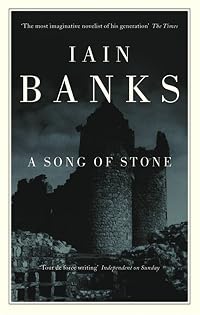
A Song of Stone
by Iain Banks
On This Page
Description
The war is ending, perhaps ended. For the castle and its occupants the troubles are just beginning. Armed gangs roam a lawless land where each farm and house supports a column of dark smoke. Taking to the roads with the other refugees, anonymous in their raggedness, seems safer than remaining in the ancient keep. However, the lieutenant of an outlaw band has other ideas and the castle becomes the focus for a dangerous game of desire, deceit and death. Iain Banks' masterly novel reveals his show more unique ability to combine gripping narrative with a relentlessly voyaging imagination. The narrative technique and sheer brio of A SONG OF STONE reveal a great novelist at the height of his powers. show lessTags
Recommendations






Member Reviews
A rather different sort of story from Banks, here we are pitched into what feels like some sort of civil war - where? A future Britain? Somewhere in Central Europe? (All bets are off - early on, there is a stream of refugees heading east, which is not the usual direction: as Sellars and Yateman put it, the approved direction for overrunning a land with fire and the sword is Left to Right...) An aristocratic couple are trying to escape the fighting in a horse-drawn carriage; the narrator attempts to justify this as a ruse to make them less likely to be stopped and relieved of useful motorised transport, but as the story progresses we realise that many of the narrator's ideas are rather eccentric, to say the least. (Later, we cross the show more boundary from eccentric to transgressive, but that's getting a bit ahead of things.)
Their escape is thwarted by a troop of soldiers, who turn them back and take them into custody, the better to occupy their castle, a local strongpoint. At first, relations are guarded between the couple and the female commander of the soldiers; but familiarity begins to breed contempt, and matters deteriorate. In the course of the narrator describing this, we see his life and that of his consoirt in flashback, and piece together their lives and attitudes.
Ultimately, the narrator comes undone through his own impulsive actions. Much as he knows himself not to be a man of action, he puts himself into positions of vulnerability through a lack of caution. The consequences are not good.
The language is different for Banks; it is florid, and sensual. The novel has a Banksian theme in the form of a central role for a structure; the couple grew up in this castle, and the action and characters keep returning to it, try as they might to get away. Banks enjoys his structures: think of the bridge in "The Bridge", the MacHoan family house in 'The Crow Road', and the commune in 'Whit', let alone all the Orbitals in the Culture novels and 'Feersum Endjinn', which wholly takes place inside a megastructure.
Perhaps after all those science fiction novels with super-competant heroes and many different varieties of interstellar war, Banks wanted to show us the way war might be for most of us were we to fall victim to modern conflict. Despite all the politicians trying to persaude us that modern warfare is high-tech, waged at a distance in foreign lands and with only the bad guys getting killed, the reality is very different. Along the way, his narrator spares thoughts for his antagonists, who he sees as victims almost as much as he becomes.
The book is set in winter; the narrative is as bleak as the weather, and the florid language does nothing to dispel this. It will not be to every reader's taste. show less
Their escape is thwarted by a troop of soldiers, who turn them back and take them into custody, the better to occupy their castle, a local strongpoint. At first, relations are guarded between the couple and the female commander of the soldiers; but familiarity begins to breed contempt, and matters deteriorate. In the course of the narrator describing this, we see his life and that of his consoirt in flashback, and piece together their lives and attitudes.
Ultimately, the narrator comes undone through his own impulsive actions. Much as he knows himself not to be a man of action, he puts himself into positions of vulnerability through a lack of caution. The consequences are not good.
The language is different for Banks; it is florid, and sensual. The novel has a Banksian theme in the form of a central role for a structure; the couple grew up in this castle, and the action and characters keep returning to it, try as they might to get away. Banks enjoys his structures: think of the bridge in "The Bridge", the MacHoan family house in 'The Crow Road', and the commune in 'Whit', let alone all the Orbitals in the Culture novels and 'Feersum Endjinn', which wholly takes place inside a megastructure.
Perhaps after all those science fiction novels with super-competant heroes and many different varieties of interstellar war, Banks wanted to show us the way war might be for most of us were we to fall victim to modern conflict. Despite all the politicians trying to persaude us that modern warfare is high-tech, waged at a distance in foreign lands and with only the bad guys getting killed, the reality is very different. Along the way, his narrator spares thoughts for his antagonists, who he sees as victims almost as much as he becomes.
The book is set in winter; the narrative is as bleak as the weather, and the florid language does nothing to dispel this. It will not be to every reader's taste. show less
During an ongoing Apocalypse that may or may not be winding down, Abel and Morgan, an elderly Lord and Lady, see their castle taken over by a platoon of semi-professional soldiers. The castle has been in their family for centuries and wouldn’t stand up to modern artillery shelling, but it’s got walls, towers and a moat, and it represents a minimally defensible home base for the squad. Abel, self-important and with more than a vibe of decrepit aristocracy, finds himself humiliated at every turn by the soldiers, and especially by their (female) leader, who revel in their new-found dominance. And while the former lord of the manor tries to maintain a polite illusion of being nominally in charge, he also seems to take a perverse show more pleasure in seeing his heirlooms thrashed and his wine cellar ransacked. Still, he’s got these grand ideas about getting back at his tormentors, and he is cunning and twisted enough to really stick it to them.
I’m in two minds about this book. On the one hand, it was another book of the type ”ageing unreliable narratorwhose self-image doesn’t quite comport with reality” . Maybe it’s because I’ve read a few of these in a fairly short amount of time, but that part I could have done without. There’s also the build-up of a plot thread about Abel’s twistedness , which, while well-done, turns out to be relatively tame at the end (and is easily guessable).
But I did find things to like in this book, too. There’s some good writing in there, for one thing, mainly in balancing the reader between pity for an old has-beenwho doesn’t know he is a has-been and an acceptance of the realities of war. I also liked how Banks toys with his protagonist: he’s an aged bear mechanically performing his old circus tricks for an audience that merely pities him, but at the same time he’s an unpleasant git, and so I kind of enjoyed seeing him humiliated -- the same complex feelings, I guess, that Abel had for his destroyed heirlooms.
What I liked best, though, is that even for a book set during an ongoing apocalypse, A song of stone is bleak on a meta-level. Banks toys with us, readers, too, and our expectations of how wartime stories develop: instead of centring on military-perspective action beats, like fortifying a stronghold or taking out rival claimants, the bulk of the story deals with the chafing between Classes and with the respectless tearing apart of the old world in the conflagration of the not-yet-new one.
So yeah. While I won’t call this a great book, it’s got enough going for it to warrant at least a quick browse. show less
I’m in two minds about this book. On the one hand, it was another book of the type ”ageing unreliable narrator
But I did find things to like in this book, too. There’s some good writing in there, for one thing, mainly in balancing the reader between pity for an old has-been
What I liked best, though, is that even for a book set during an ongoing apocalypse, A song of stone is bleak on a meta-level. Banks toys with us, readers, too, and our expectations of how wartime stories develop: instead of centring on military-perspective action beats, like fortifying a stronghold or taking out rival claimants, the bulk of the story deals with the chafing between Classes and with the respectless tearing apart of the old world in the conflagration of the not-yet-new one.
So yeah. While I won’t call this a great book, it’s got enough going for it to warrant at least a quick browse. show less
well. bleakest book i've ever read. how did the author survive the writing of it, i wonder? not so easy to survive the reading of it, even. the question of why arises. ironically, Banks' Culture sf series is notable for its unusually optimistic canvas in a fairly utopian far future. here, in contrast, a war (about what? dunno. between who? dunno. when about? dunno. hey, it's existential) has deteriorated into an apocalyptic landscape divided only into partisan marauders and hapless refugees. the narrator is a sociopath society protected, under the guise of civilization: but now civilization is gone. he experiences in a kind of dreamstate chaotic events as they occur, through the filter of his own repellent worldview. and he tries to show more identify the moment when he, like society, lost all control and gave over to mindless destruction. he has himself always been about destruction, but that's about power, and now he has no power at all; he finds that interesting too. very nicely written, but even the central metaphors seem to have broken down. not an uninteresting book from several critical points of view, and Banks never writes the same book twice, but hard to read, and possibly harder to forget than one might subsequently wish. but i guess literature isn't supposed to be forgettable, eh? still, i can't personally recommend making the journey. show less
Set in a contemporary (or recent-past), vaguely Eastern European country, torn by civil (?) war, this is an insular, even claustrophobic tale which mixes philosophy and perversion.
(In it's non-specificity, it almost feels like a fantasy setting, but there are no supernatural elements in the book.)
Stylistically and even thematically, it reminded me very strongly of Hermann Hesse - but much, much nastier. The writing is also, however, just full of hilariously clever, witty turns of phrase.
The book begins with an aristocratic couple fleeing their castle along with a host of more plebeian refugees. However, escape is not to be. A female military lieutenant stops them and decides to commandeer their services and their home as barracks for show more her men.
The story is presented solely through the eyes of the lord of the manor - Abel. No other point of view is presented, and he's rather - odd, psychologically, which gives the other characters a strangely 'flat' feel. Some reviewers criticized this as a failure of characterization, but it's definitely an intentional part of the writing - it's not that the people lack character or voice, but that Abel does not perceive them fully.
As might be expected when a number of rag-tag guerilla-type fighters are garrisoned in a beautiful medieval estate - unpleasant things happen. But are the aristocrats innocent victims of a brutal conflict? Are their self-centered and perverse secrets somehow, indirectly responsible? Is the violence and crudity of the soldiers a symbol for the state of the common man?
Or are all these things just incidental, presented for shock value? After a slow build-up of unpleasantness, it ends with a quite entertaining twisted religious allegory...
Lots to think about... but also quite fun. show less
(In it's non-specificity, it almost feels like a fantasy setting, but there are no supernatural elements in the book.)
Stylistically and even thematically, it reminded me very strongly of Hermann Hesse - but much, much nastier. The writing is also, however, just full of hilariously clever, witty turns of phrase.
The book begins with an aristocratic couple fleeing their castle along with a host of more plebeian refugees. However, escape is not to be. A female military lieutenant stops them and decides to commandeer their services and their home as barracks for show more her men.
The story is presented solely through the eyes of the lord of the manor - Abel. No other point of view is presented, and he's rather - odd, psychologically, which gives the other characters a strangely 'flat' feel. Some reviewers criticized this as a failure of characterization, but it's definitely an intentional part of the writing - it's not that the people lack character or voice, but that Abel does not perceive them fully.
As might be expected when a number of rag-tag guerilla-type fighters are garrisoned in a beautiful medieval estate - unpleasant things happen. But are the aristocrats innocent victims of a brutal conflict? Are their self-centered and perverse secrets somehow, indirectly responsible? Is the violence and crudity of the soldiers a symbol for the state of the common man?
Or are all these things just incidental, presented for shock value? After a slow build-up of unpleasantness, it ends with a quite entertaining twisted religious allegory...
Lots to think about... but also quite fun. show less
Good story almost lost at times in the writing. Ultimately I enjoyed the book but there were one or two times when I almost gave up and only wanting to know what happened kept me going. The reason I almost gave up? What you might call "writing for the sake of writing" instead of writing to tell the story. I know this is what makes a book "literature" in the eyes of some but I personally read a book for the story not to admire how the author can take a whole paragraph to describe a stream of urine making its way into the castle moat. But enough moaning, as I said before the story is really good and well worth persevering with. Those of you who nod sagely at the choices of the booker prize panel will no doubt disagree with me, the rest of show more you give it a go yourself. show less
A curious Banks novel, written in a voice that's quite different from the one he usually employs for regular fiction. Told in a formal and somewhat archaic first person, it describes on the surface the events around the abandonment and capture of a castle caught up in a war whose nature is never made clear and whose location - in time and place - is deliberately uncertain. It could be central Europe at some time in the 20th century - there are diesel-driven vehicles and machine guns, but the narrator, whose castle this is, clearly comes from a different age of decayed nobility and gentry, surrounded by an obedient peasant class.
The themes are decay at every level - the collapse of civilisation in a chaotic civil war, the decline and show more destruction of the castle, the loss of discipline in the rebel troops who first capture them and the decay which preceded it all, revealed slowly as the narrator recalls his delight in his debauched past and slowly reveals the nature of his relationship to the lover who is present throughout but whose voice we never hear. It is, as other reviewers have commented, a dark book and clearly many don't find any redeeming features in it. I was kept interested to the end but I can't say it's an uplifting end; Banks's destructive tendencies towards his characters and settings are definitely to the fore here.
As I was reading this book I kept recalling scenes from one of the authors science fiction novels, but couldn't really recall which one and why. I've since checked, and it's "Inversions". There are really no similarities of plot, but there are of mood - and both feature castles and suggestions of depravity within. They were published close together, it seems, so perhaps the similarity has some basis after all. show less
The themes are decay at every level - the collapse of civilisation in a chaotic civil war, the decline and show more destruction of the castle, the loss of discipline in the rebel troops who first capture them and the decay which preceded it all, revealed slowly as the narrator recalls his delight in his debauched past and slowly reveals the nature of his relationship to the lover who is present throughout but whose voice we never hear. It is, as other reviewers have commented, a dark book and clearly many don't find any redeeming features in it. I was kept interested to the end but I can't say it's an uplifting end; Banks's destructive tendencies towards his characters and settings are definitely to the fore here.
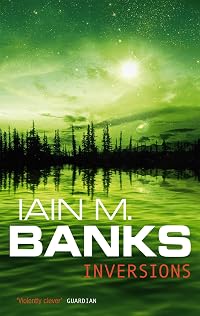
As I was reading this book I kept recalling scenes from one of the authors science fiction novels, but couldn't really recall which one and why. I've since checked, and it's "Inversions". There are really no similarities of plot, but there are of mood - and both feature castles and suggestions of depravity within. They were published close together, it seems, so perhaps the similarity has some basis after all. show less
When I realised that God, like Santa and the Tooth Fairy was wishful thinking, the universe was a vast and cold place to be I never pictured anything as unremittingly dismal as Banks' vision in this book. Normally I can't put down his Sci-fi and find the serious novels somewhat heavy going but this one took some stamina to reach the end. It has the gruesome fascination of watching a car being taken to the scrapyard in slow motion.
Taken as an allegorical comment on the human condition - seen here as the slow decay of a set of arbitrary norms already rejected by the protagonist - it makes grim reading even given the virtuosity and occasional beauty of the writing. There is something stereotypically Scottish in the atmosphere and this is show more not one for the fainthearted but it will probably be something that will haunt the reader long after more cheerful books are forgotten. show less
Taken as an allegorical comment on the human condition - seen here as the slow decay of a set of arbitrary norms already rejected by the protagonist - it makes grim reading even given the virtuosity and occasional beauty of the writing. There is something stereotypically Scottish in the atmosphere and this is show more not one for the fainthearted but it will probably be something that will haunt the reader long after more cheerful books are forgotten. show less
Members
- Recently Added By
Lists

living room bookshelf
150 works; 1 member
Author Information

25+ Works 31,796 Members
Some Editions
Series
Belongs to Publisher Series
Common Knowledge
- Canonical title
- A Song of Stone
- Original title
- A Song of Stone
- Alternate titles*
- A song of stone
- Original publication date
- 1997
- Important places
- Scotland, UK
- Dedication
- to my parents
- First words
- Winter always was my favorite season.
- Last words
- (Click to show. Warning: May contain spoilers.)I face my future, turn my back on a lifetime's desolation and on these dumb persecutors and am duly raised, brought up again, elevated glorious and triumphant to skies the colour of blood and roses, sneer at the dice that tumble (yes yes; die! die! Iacta est alea, we who are about to die despise you), laugh at cheers that rise, buoying me, and with that salute my end.
- Original language
- English
*Some information comes from Common Knowledge in other languages. Click "Edit" for more information.
Classifications
Statistics
- Members
- 1,821
- Popularity
- 11,993
- Reviews
- 22
- Rating
- (2.88)
- Languages
- 6 — Czech, English, French, Italian, Portuguese, Spanish
- Media
- Paper, Audiobook, Ebook
- ISBNs
- 22
- ASINs
- 7