On This Page
Description
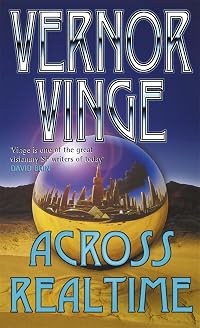
Encompassing time-travel, powerful mystery and the future history of humanity to its last handful of survivors, Across Realtime spans millions of years and is an utterly engrossing SF classic.Tags
Recommendations






Member Reviews
Using a self-defense weapon (a 'bobble') the bad guys conquer the world and cause quality of life to stagnate, causing a counter-cabal to form, develop improvements in the bobble and all but lose it to the bad guys. With a lot of tension and incredibly smart thinking on both sides—it was a pleasure to follow the thoughts of very prescient people, on both sides—it took a child prodigy, cybernetically linked to a super-computer, to save the day.
My thanks to ‘felius’ for summarizing the plot with enough detail so that I don’t have to. Instead, I’d like to mention the effect that the character developments of various personalities had on me. Forgive me for not going into a more detailed explanation (time & energy restrictions), show more but I was especially impressed by the nuanced handling of both the good-guys—several of whom grew in complexity as they’re involvement in the leading of the revolt progressed; and the bad-guys, who turned out to have larger dreams than we expected; and the bad-guys (woman, actually) who thought on a completely different level than the rest of them—and me—and switched sides until she became completely incomprehensible.
The first story was entertaining as a shoot-‘em-up revolution with high-tech weapons (human-computer interfaces) and the unexplained abilities of the bobble concept. The second story was, on one level, a murder mystery where the murdered woman lived close to one hundred years more before she finally died—leaving clues behind her to whom it was that killed her. She was marooned on an Earth where all other humans have been completely eliminated.
That’s the overriding murder mystery of the book. But the background sudden absence of all humans, except for the few hundreds who were contained (protected) inside of various bobbles, creates a massive question mark that flavors everything else that happens in the final book. The only reason that Vinge gets away with this ‘almost deus ex machina’ disappearance is just that he does include it in the plot line as part of the rationale for much of the character motivation we discover in all the main characters. The challenges are: Why did humans disappear? Can it happen again? And can we bring together all the disparate ideologies of the groups that have survived in order to ‘recreate’ humanity?
And this is something that has never been addressed in all of the Sci-Fi tales of “re-establishing” the human race after a cataclysm: if you don’t have a large enough “seed” population base (variety!) to start with then the humans who are left, no matter how many babies they can make, will ultimately die from in-breeding. The big question is “why” this ‘murder’ was carried out, considering the almost destined ultimate death of everyone anyway?
In these stories, Vinge delved into the thoughts and emotions of the different protagonists—and some of the antagonists—and gave me enough information that I could see/feel their inner tensions while I followed their reasoning. This is why I really liked the two books…and why I’m saddened that the only other story in the series, “The Ungoverned”, is a novelette (contained in a short story collection), costs over $17 for the Mass Market Paperback, was read by only 9 other members here and was given 3-stars by the one person who rated it. Someday, I may get interested enough to buy it…but. But then, I really did enjoy Vinge’s “Zones of Thought” stories! show less
My thanks to ‘felius’ for summarizing the plot with enough detail so that I don’t have to. Instead, I’d like to mention the effect that the character developments of various personalities had on me. Forgive me for not going into a more detailed explanation (time & energy restrictions), show more but I was especially impressed by the nuanced handling of both the good-guys—several of whom grew in complexity as they’re involvement in the leading of the revolt progressed; and the bad-guys, who turned out to have larger dreams than we expected; and the bad-guys (woman, actually) who thought on a completely different level than the rest of them—and me—and switched sides until she became completely incomprehensible.
The first story was entertaining as a shoot-‘em-up revolution with high-tech weapons (human-computer interfaces) and the unexplained abilities of the bobble concept. The second story was, on one level, a murder mystery where the murdered woman lived close to one hundred years more before she finally died—leaving clues behind her to whom it was that killed her. She was marooned on an Earth where all other humans have been completely eliminated.
That’s the overriding murder mystery of the book. But the background sudden absence of all humans, except for the few hundreds who were contained (protected) inside of various bobbles, creates a massive question mark that flavors everything else that happens in the final book. The only reason that Vinge gets away with this ‘almost deus ex machina’ disappearance is just that he does include it in the plot line as part of the rationale for much of the character motivation we discover in all the main characters. The challenges are: Why did humans disappear? Can it happen again? And can we bring together all the disparate ideologies of the groups that have survived in order to ‘recreate’ humanity?
And this is something that has never been addressed in all of the Sci-Fi tales of “re-establishing” the human race after a cataclysm: if you don’t have a large enough “seed” population base (variety!) to start with then the humans who are left, no matter how many babies they can make, will ultimately die from in-breeding. The big question is “why” this ‘murder’ was carried out, considering the almost destined ultimate death of everyone anyway?
In these stories, Vinge delved into the thoughts and emotions of the different protagonists—and some of the antagonists—and gave me enough information that I could see/feel their inner tensions while I followed their reasoning. This is why I really liked the two books…and why I’m saddened that the only other story in the series, “The Ungoverned”, is a novelette (contained in a short story collection), costs over $17 for the Mass Market Paperback, was read by only 9 other members here and was given 3-stars by the one person who rated it. Someday, I may get interested enough to buy it…but. But then, I really did enjoy Vinge’s “Zones of Thought” stories! show less
I remembered loving this, but I didn't remember the book well enough to review it without a reread. A lot did come back once into the stories though, and I fell right back in love with it. This has so much that made me love the genre. Especially Big Ideas, playing with very large scales of space and time and loads of imagination--but without the drawbacks I often find in Golden Age Science Fiction. I love the big three of Asimov, Heinlein and Clarke, goodness knows I do, but so often their women didn't read as real to me, and though this is going to sound nauseatingly politically correct, too often they imagined a future that was just too white for my tastes--when they weren't presenting racial stereotypes that were cringe-worthy show more (Clarke less so than the others, and the others got better over the decades--their hey day after all was the forties and fifties.) The point is, I don't have to make allowances for these 1980s books in either respect.
That doesn't mean the politically correct crowd would necessarily love this book. The book is a cult classic among libertarians for good reason, but it's not libertarian porn like say L. Neil Smith's novels. If any of the three connected stories read that way, it's the shortish novella bridge story, "The Ungoverned." It was a self-styled "anarcho-capitalist" who first pointed me to that story and to Vinge. But if you can look beyond that, what you find is a overall story that transcends that, with yes, some of the individualism and faith in freedom of Robert Heinlein, with some of the visionary apotheosis of Arthur C. Clarke. And I liked and cared about the characters. Della Lu and Wil Brierson may not be as complex or vivid as classic characters, but they work for me. And while the style won't be mistaken for literary, it does it's job. I liked the first short novel, The Peace War more than Marooned in Realtime, which I found a bit depressing, at least at first. But satisfying reads? Yup. show less
That doesn't mean the politically correct crowd would necessarily love this book. The book is a cult classic among libertarians for good reason, but it's not libertarian porn like say L. Neil Smith's novels. If any of the three connected stories read that way, it's the shortish novella bridge story, "The Ungoverned." It was a self-styled "anarcho-capitalist" who first pointed me to that story and to Vinge. But if you can look beyond that, what you find is a overall story that transcends that, with yes, some of the individualism and faith in freedom of Robert Heinlein, with some of the visionary apotheosis of Arthur C. Clarke. And I liked and cared about the characters. Della Lu and Wil Brierson may not be as complex or vivid as classic characters, but they work for me. And while the style won't be mistaken for literary, it does it's job. I liked the first short novel, The Peace War more than Marooned in Realtime, which I found a bit depressing, at least at first. But satisfying reads? Yup. show less
The book is actually a compilation of what was originally two separate novels: "The Peace War" & "Marooned in Real Time.
I thoroughly enjoyed "The Peace War." It's pretty straight-forward, but always enjoyable, time travelling science fiction. Always enjoy seeing how a particular author copes with time travel & the issues it causes. I would certainly rate this novel 5*.
Can't say the same, however, for the second, related story: "Marooned in Realtime." There is a loose connection between the two novels. Without giving away too much, the protagonist of the second story is a descendant of the protagonist in the first; some of the characters are the same.
To me, the best science fiction is either so far removed from our reality that you show more don't spend time wondering if it's possible, whether the described events might actually occur, or it's close enough, but just beyond our reality that you keep thinking, may be, just maybe. My problem with the "Marooned in Realtime" is that it fit neither of these and consequently became actually somewhat hard to follow.
My recommendation - read the first novel; don't waste your time on the second one. show less
I thoroughly enjoyed "The Peace War." It's pretty straight-forward, but always enjoyable, time travelling science fiction. Always enjoy seeing how a particular author copes with time travel & the issues it causes. I would certainly rate this novel 5*.
Can't say the same, however, for the second, related story: "Marooned in Realtime." There is a loose connection between the two novels. Without giving away too much, the protagonist of the second story is a descendant of the protagonist in the first; some of the characters are the same.
To me, the best science fiction is either so far removed from our reality that you show more don't spend time wondering if it's possible, whether the described events might actually occur, or it's close enough, but just beyond our reality that you keep thinking, may be, just maybe. My problem with the "Marooned in Realtime" is that it fit neither of these and consequently became actually somewhat hard to follow.
My recommendation - read the first novel; don't waste your time on the second one. show less
Apparently some editions of this work contain three stories - mine only contains the two novels "The Peace War" and "Marooned in Realtime".
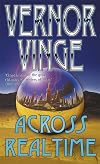
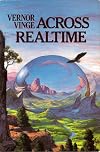
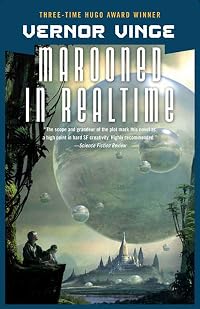
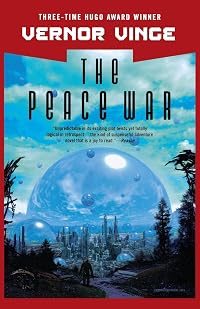
Both stories are centered around the idea of a technology which can created isolated spherical regions of space/time, called "bobbles". A bobble appears as a mirrored sphere enclosing the region of space around which it was created. It has the same mass as its contents, can be moved around like any other object in space, and is absolutely indestructible.
The first story takes place about 50 years after the discovery of bobbles, describing how they were used in a surprise attack by a group determined to end all warfare. The result is a tyrannical "peace" with heavy restrictions on the development and show more use of many kinds of technology. Naturally, groups opposed to this kind of "peace" fight to overthrow the Peace Authority.
Restrictions on technology have backfired on the oppressors, as their own technology has been held back while underground development in a resistance movement has leapfrogged them in several key areas. The breakthrough comes when the resistance is able to develop their own technology to manipulate bobbles, and an interesting confrontation results as old military tactics are thrown out the window.
The second story takes place on a post-singularity earth. The events of the singularity itself are a mystery to all - the human race appears to have just disappeared, and the only survivors are those who were inside bobbles at the time. Bobbles effectively provide a form of one-way time travel, and so eventually over millennia groups of survivors band together until the last 300 or so humans are in one place preparing to form a colony to restart the human race.
The colonists are divided into the "low-tech" and "hi-tech". The hi-tech colonists are those who have access to technology from just prior to the singularity, and the difference is so substantial that they're basically all trans-human entities heavily augmented by their technology. When one of the key hi-tech colonists is murdered through a subtle but malicious corruption of their systems, it becomes a race to find the murderer before the human race dwindles into extinction.
I enjoyed the first of these stories much more than the second, though both were good reading. This is a prime example of the kind of science fiction which takes a single simple idea and follows it through in a series of mind-bending "what-ifs". The means by which bobbles might be created is never discussed, and is unimportant to the story. The question of what it might mean if they could be created is the important one, and the two stories here do a very good job at exploring the possibilities. show less
Both stories are centered around the idea of a technology which can created isolated spherical regions of space/time, called "bobbles". A bobble appears as a mirrored sphere enclosing the region of space around which it was created. It has the same mass as its contents, can be moved around like any other object in space, and is absolutely indestructible.
The first story takes place about 50 years after the discovery of bobbles, describing how they were used in a surprise attack by a group determined to end all warfare. The result is a tyrannical "peace" with heavy restrictions on the development and show more use of many kinds of technology. Naturally, groups opposed to this kind of "peace" fight to overthrow the Peace Authority.
Restrictions on technology have backfired on the oppressors, as their own technology has been held back while underground development in a resistance movement has leapfrogged them in several key areas. The breakthrough comes when the resistance is able to develop their own technology to manipulate bobbles, and an interesting confrontation results as old military tactics are thrown out the window.
The second story takes place on a post-singularity earth. The events of the singularity itself are a mystery to all - the human race appears to have just disappeared, and the only survivors are those who were inside bobbles at the time. Bobbles effectively provide a form of one-way time travel, and so eventually over millennia groups of survivors band together until the last 300 or so humans are in one place preparing to form a colony to restart the human race.
The colonists are divided into the "low-tech" and "hi-tech". The hi-tech colonists are those who have access to technology from just prior to the singularity, and the difference is so substantial that they're basically all trans-human entities heavily augmented by their technology. When one of the key hi-tech colonists is murdered through a subtle but malicious corruption of their systems, it becomes a race to find the murderer before the human race dwindles into extinction.
I enjoyed the first of these stories much more than the second, though both were good reading. This is a prime example of the kind of science fiction which takes a single simple idea and follows it through in a series of mind-bending "what-ifs". The means by which bobbles might be created is never discussed, and is unimportant to the story. The question of what it might mean if they could be created is the important one, and the two stories here do a very good job at exploring the possibilities. show less
This is very early Vinge, much less complicated, and shorter than his later books, but still excellent. This is actually 2 novels in one book. Something about these novels has always stayed in my mind, some combination of the technology and personalities is memorable.
Science fiction collection containing The Peace War, The Ungoverned, and Marooned in Realtime. It centers on bobbles, indestructible, time-stopping force fields, invented by a military contractor to enforce, then rule, a post-WWIII world.
Set decades after the war, the tyrannical Peace Authority controls the world with bobbles, while rebel Paul Naismith plots a revolution using advanced technology.
Marooned in Realtime: Humanity has disappeared, leaving a tiny group of survivors. A murder mystery unfolds 50 million years in the future, with the culprit using bobbler technology. Bobbles act as stasis fields, trapping objects in an indestructible, reflective sphere for any duration.
Set decades after the war, the tyrannical Peace Authority controls the world with bobbles, while rebel Paul Naismith plots a revolution using advanced technology.
Marooned in Realtime: Humanity has disappeared, leaving a tiny group of survivors. A murder mystery unfolds 50 million years in the future, with the culprit using bobbler technology. Bobbles act as stasis fields, trapping objects in an indestructible, reflective sphere for any duration.
This short SF novella is probably the best description (sort of a caricature, but still accurate) of a Hoppean libertarian social order/ancapistan.
Members
- Recently Added By
Lists

Best Military Science Fiction
57 works; 26 members

SWORDS GUNS BATTLES
30 works; 3 members
Author Information

58+ Works 23,271 Members
Some Editions
Series

Work Relationships
Contains
Common Knowledge
- Canonical title
- Across Realtime
- Original publication date
- 1984 (The Peace War) (The Peace War); 1986 (Marooned in Realtime) (Marooned in Realtime)
- People/Characters
- Captain Allison Parker, USAF; Paul Naismith; Wili Wachendon; Wil Brierson; Della Lu
- Important places
- Vandenberg Air Force Base, California, USA; Livermore National Laboratory, Livermore, California, USA
- Epigraph
- I am grateful to Chuck Glines and Bil Townsend of the US Forest Service for talking to me about Los Padres National Forest; Jim Concannon and Concannon Winery of Livermore, California, for their hospitality and a very interes... (show all)ting tour of the Concannon Winery; Lea Braff, Jim Frenkel, Mike Cannis, Sharon Jarvis, and Joan D. Vinge for all their help and ideas. (The Peace War)
I am grateful to: Mike Gannis for many super ideas related to this story; Sara Baase, John L. Carroll, Howard Davidson, Jim Frenkel, Dipak Gupta, Jay Hill, Sharon Jarvis, and Joan D. Vinge for all their help and suggestions. ... (show all)Other people have created zoologies and/or geographies of the future. Though they are different from what is described in this story, they are wonderfully interesting: Dougal Dixon, "After Man, St. Martin's Press, New York, 1981. Christopher Scotese and Alfred Ziegler, as described in "The Shape of Tomorrow," by Dennis Overbye, "Discover," November, 1982, pp. 20-25. (Marooned in Realtime) - Dedication
- To my parents, Clarence L. Vinge and Ada Grace Vinge, with Love. (The Peace War)
To all those Marooned without hope of rescue (Marooned in Realtime) - First words
- One hundred kilometers below and nearly two hundred away, the shore of Beaufort Sea didn't look much like the common image of the arctic: Summer was far advanced in the Northern Hemisphere, and a pale green spread across the ... (show all)land, shading here and there to the darker tones of grass. (The Peace War)
On the day of the big rescue, Wil Brierson took a walk on the beach. (Marooned in Realtime) - Last words
- (Click to show. Warning: May contain spoilers.)The one who lives, the one who has not said goodbye. (Marooned in Realtime)
(Click to show. Warning: May contain spoilers.)And if Allison's fears about the next few years turned out to be true, he would be around to help out on that, too. (The Peace War) - Disambiguation notice
- Do not combine the Baen Books edition of Across Realtime with other editions with the same title. The Baen Books edition includes the novelette "The Ungoverned" not found in other editions.
Classifications
Statistics
- Members
- 735
- Popularity
- 38,627
- Reviews
- 10
- Rating
- (4.13)
- Languages
- English, Spanish
- Media
- Paper
- ISBNs
- 4
- ASINs
- 6