
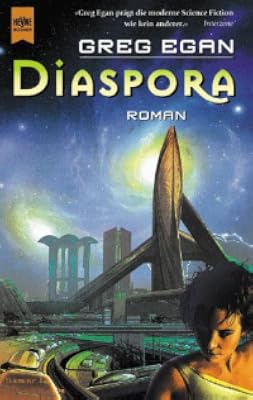
Diaspora
by Greg Egan
On This Page
Description
A quantum Brave New World from the boldest and most wildly speculative writer of his generation. Since the Introdus in the twenty-first century, humanity has reconfigured itself drastically. Most chose immortality, joining the polises to become conscious software. Others opted for gleisners: disposable, renewable robotic bodies that remain in contact with the physical world of force and friction. Many of these have left the solar system forever in fusion-drive starships. And there are the show more holdouts: the fleshers left behind in the muck and jungle of Earth-some devolved into dream apes, others cavorting in the seas or the air-while the statics and bridgers try to shape out a roughly human destiny. But the complacency of the citizens is shattered when an unforeseen disaster ravages the fleshers and reveals the possibility that the polises themselves might be at risk from bizarre astrophysical processes that seem to violate fundamental laws of nature. The orphan Yatima, a digital being grown from a mind seed, joins a group of citizens and flesher refugees in a search for the knowledge that will guarantee their safety-a search that puts them on the trail of the ancient and elusive Transmuters, who have the power to reshape subatomic particles, and to cross into the macrocosmos, where the universe we know is nothing but a speck in the higher-dimensional vacuum. show lessTags
Recommendations




Member Reviews
This novel is full of fascinating consequences of post-corporeal humanity, and rigorously pushes ideas to extremes that few authors are willing to extend. For that reason, it can become daunting at moments for some as distances stretch into cosmic scales and time is examined and experienced at epochal durations. An unprecedented and unexplained disaster drives the software descendants of extinct humanity to seek reassurance and safety from any future re-occurrence to lengths unforeseen and wondrous. Within the first few pages, Egan outlines a feasible process for ‘psychogenesis’, the creation of digital sapience in a manner parallel to Nature’s own analog method, setting the tone for both the direction the novel will go, and how show more deliberately the author will take us there. Like Egan’s other work, there is a profound appreciation for the discipline and history of mathematics, and quite a few of the pages here are given over to outlining the fictitious discovery of new mathematical landscapes, which are difficult enough to visualize with animations and diagrams, let alone text on a page. However, the payoff is a truly jaw-dropping adventure that spans multiple universes, and describes additional dimensions with the respect they deserve- not with hand-waving and magical ‘almost-just-like-our-world’ typically seen in SF. The reader is invited to reel in disorientation along with the characters who are suddenly dropped into worlds as different from our own 3D perspective as ours would be to a 2D paper doll. Along the way, questions of social etiquette in VR communities, morality of preserving life by destructively transcribing it, speeding, slowing, inverting, amending, cloning, and re-merging one’s own mind are all considered. Really, besides my finding the mathematical exposition to be get a little heavy at times, my only complaints here was with a fairly anti-climatic ending that didn’t seem to do justice to the journey preceding, and many of the characters felt unceremoniously discarded as needed by the narrative. show less
I am very safe in saying that this is one hell of an ambitious, dense, and thoroughly grounded novel of mind-blowing physics housed in one of the most hardcore hard-SF frames I've ever seen.
That's including Cixin Liu's recent trilogy.
I've read a lot of physics books for the sheer pleasure of it and I have a pretty good imagination, but when I was reading this particular novel, I was hard-pressed to keep up with the wall of information, exposition, and detailed descriptions of particle and quantum physics, theoretical frameworks, then more theoretical frameworks branching off the first, and then yet more in case we might have been getting used to the previously heavy load. :)
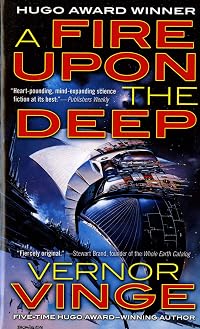
Am I complaining? No. Hell no. In fact, I'm frankly amazed and show more thrilled. The underlying story feels like a MORE coherent and theoretical run on Vinge's [b:A Fire Upon the Deep|77711|A Fire Upon the Deep (Zones of Thought, #1)|Vernor Vinge|https://images.gr-assets.com/books/1333915005s/77711.jpg|1253374], delving much deeper into the possibilities brought up by [b:Contact|61666|Contact|Carl Sagan|https://images.gr-assets.com/books/1408792653s/61666.jpg|2416056], and it goes just about as far as you can go in transhumanism, ranging widely between regular humans, purely software/robot humans, and virtual polities within wide-umbrella AIs housing vast numbers of uploaded personalities.
The center of the galaxy went boom. It's the end of all life. Run. Run! Run!!!!! :) Vast number of years and high tech isn't enough to escape this.
What we have here is a full and vast adventure of exploration, discovery, and a mind-blowing physics reveal that not only lets the reader fall sideways through the universe and multiple dimensions, but it does it in an excellently ACCURATE direction (at least as far as we understand current physics).
The added realism is bolstered by a very excellent bibliography at the end and I can attest to the quality of at least three-quarters of them. :)
While this novel is NOT all that accessible to casual readers of SF, it IS extremely rewarding to those who are willing to sit through long theoretical (and not so theoretical) modern mind-blowing physics lessons. Is all the science necessary?
Hell yes, at least the way the plot requires them. :) This novel will not hand-hold anyone. And for that, my hat goes off. Much, much respect. :)
Oh, the novel makes me feel stupid, too. :) But that's okay. I've already sealed away a copy of it in a time capsule that will open in a thousand years for the enjoyment of our machine children with brains made of neutrinos who will have all the underpinning physics written into their bones.
:) show less
That's including Cixin Liu's recent trilogy.
I've read a lot of physics books for the sheer pleasure of it and I have a pretty good imagination, but when I was reading this particular novel, I was hard-pressed to keep up with the wall of information, exposition, and detailed descriptions of particle and quantum physics, theoretical frameworks, then more theoretical frameworks branching off the first, and then yet more in case we might have been getting used to the previously heavy load. :)
Am I complaining? No. Hell no. In fact, I'm frankly amazed and show more thrilled. The underlying story feels like a MORE coherent and theoretical run on Vinge's [b:A Fire Upon the Deep|77711|A Fire Upon the Deep (Zones of Thought, #1)|Vernor Vinge|https://images.gr-assets.com/books/1333915005s/77711.jpg|1253374], delving much deeper into the possibilities brought up by [b:Contact|61666|Contact|Carl Sagan|https://images.gr-assets.com/books/1408792653s/61666.jpg|2416056], and it goes just about as far as you can go in transhumanism, ranging widely between regular humans, purely software/robot humans, and virtual polities within wide-umbrella AIs housing vast numbers of uploaded personalities.
The center of the galaxy went boom. It's the end of all life. Run. Run! Run!!!!! :) Vast number of years and high tech isn't enough to escape this.
What we have here is a full and vast adventure of exploration, discovery, and a mind-blowing physics reveal that not only lets the reader fall sideways through the universe and multiple dimensions, but it does it in an excellently ACCURATE direction (at least as far as we understand current physics).
The added realism is bolstered by a very excellent bibliography at the end and I can attest to the quality of at least three-quarters of them. :)
While this novel is NOT all that accessible to casual readers of SF, it IS extremely rewarding to those who are willing to sit through long theoretical (and not so theoretical) modern mind-blowing physics lessons. Is all the science necessary?
Hell yes, at least the way the plot requires them. :) This novel will not hand-hold anyone. And for that, my hat goes off. Much, much respect. :)
Oh, the novel makes me feel stupid, too. :) But that's okay. I've already sealed away a copy of it in a time capsule that will open in a thousand years for the enjoyment of our machine children with brains made of neutrinos who will have all the underpinning physics written into their bones.
:) show less
Ever since I read Permutation City, Egan has been one of my favorite hard sci-fi authors, and when I cracked open this book and saw that the first forty pages were a hardcore blow-by-blow of an AI becoming self- aware that would do Marvin Minsky proud, I knew that I would love it too. Brief plot synopsis: in the near future where humanity has trifurcated into AIs, sentient robots, and flesh-bound transhumans, an unexplained binary neutron star collision and subsequent gamma ray burst forces the remnants of civilization to colonize the galaxy in order to prevent such an extinction event from ever happening again. While Diaspora is of course filled with laugh-out-loud clumsy infodumps ("Say, can you tell me about your trans-universal show more particle physics model?" "Not until I brief you on hyperdimensional topology!"), it was also a surprisingly strong exploration of how humans – no matter if they're flesh and blood or sentient programs – cope with death and loss. I suppose that this is a common theme in Egan's works, and some of the AI characters do seem somewhat reprised from Permutation City, but Diaspora connects the deaths of individuals to the extinction of human life in a clever and meaningful way, and also ties that into personal and societal maturity (what happens when you want to simply stop exploring?) in a way that reminded me of Stanislaw Lem's Cyberiad, which is high praise. Science fiction at its best uses both existing and imaginary technology to explore old human issues in new ways, and it's a shame Egan isn't more famous because he does that as well as anyone. show less
A brilliant, but mentally demanding SF that pushes contemporary physics to its conceptual limits. To fully appreciate the book, one needs a solid grounding in quantum physics. The early sections are beautifully compelling, exploring contrasts between digital, biological, and hybrid forms of existence with intellectual rigor. However, as the narrative progresses and shifts focus almost entirely to digital beings, it becomes increasingly difficult to engage with on an emotional level. The digital entities grow so abstract that relating to them as characters becomes a challenge. Also, the extent to which purely digital minds can manipulate and construct the physical world stretches what I'd consider plausible. The novel is exceptionally show more intelligent and ambitious throughout, but by the end it drifts into an uncanny territory, losing emotional connection and failing to be a fully satisfying hard SF. show less
Hablar de Greg Egan, es hablar de la ciencia ficción más hard que se pueda encontrar en nuestros días. Cuando Egan pone su imaginación en marcha es difícil de igualar. ‘Diáspora’ es una de las novelas más duras a las que me he enfrentado, no tanto por el argumento, sino por el lenguaje científico que maneja, que abarca matemáticas, física, biología, metafísica, cosmología, astrofísica o química. Egan no dibuja en profundidad a sus personajes, son meras piezas en su desfile de teorías, a cual más increíble. Egan es un escritor que sabe poner en liza ideas y pensamientos que inquietan, o deberían inquietar, a todo el género humano.
Desde el primer capítulo, Egan empieza fuerte, sin concesiones al lector, con la show more descripción minuciosa del nacimiento de Yatima, una personalidad artificial consciente dentro de la Polis Konishi. Tras ese gran comienzo, iremos conociendo en qué consiste las Polis y cómo viven sus habitantes. En el año 3000 existen tres tipos diferentes de habitantes en la Tierra: los carnosos, que todavía mantienen sus cuerpos biológicos, dividiéndose a su vez en dos clases, los que han sufrido modificaciones genéticas y los que no; los gleisners, que son entidades robóticas que contienen una inteligencia artificial consciente; y los habitantes de las Polis, que son entidades incorpóreas que viven dentro de ordenadores.
La trama de ’Diáspora’ transcurre en las Polis, con su propio espacio y tiempo, donde sus habitantes viven dedicados a construir sus propios entornos virtuales, generando modelos matemáticos para demostrar sus propias teorías, por ejemplo. En este mundo tan particular, es posible copiarse a sí mismo, con las diferencias entre el “yo” y la copia que esto suscita. Todo parece transcurrir pacíficamente para los distintos habitantes, hasta que se descubre que la Tierra se va a ver amenazada seriamente. Ante una amenaza inminente, estos post-humanos se embarcan en una búsqueda de respuestas por la galaxia, respuestas que tal vez conozcan los llamados Transmutadores.
’Diáspora’ no es una novela fácil, pero sí es muy satisfactoria en muchos niveles. Las ideas y teorías que maneja Egan son apabullantes. Egan es capaz de imaginar desde una vida dentro de una Inteligencia Artificial, hasta plantearte un universo de 6 dimensiones, o el encuentro con una entidad extraterrestre de lo más impredecible.
Recomendaría esta novela únicamente a lectores muy aficionados a la ciencia ficción más dura. Los fans de Greg Egan no se verán defraudados, aunque personalmente prefiero sus relatos. show less
Desde el primer capítulo, Egan empieza fuerte, sin concesiones al lector, con la show more descripción minuciosa del nacimiento de Yatima, una personalidad artificial consciente dentro de la Polis Konishi. Tras ese gran comienzo, iremos conociendo en qué consiste las Polis y cómo viven sus habitantes. En el año 3000 existen tres tipos diferentes de habitantes en la Tierra: los carnosos, que todavía mantienen sus cuerpos biológicos, dividiéndose a su vez en dos clases, los que han sufrido modificaciones genéticas y los que no; los gleisners, que son entidades robóticas que contienen una inteligencia artificial consciente; y los habitantes de las Polis, que son entidades incorpóreas que viven dentro de ordenadores.
La trama de ’Diáspora’ transcurre en las Polis, con su propio espacio y tiempo, donde sus habitantes viven dedicados a construir sus propios entornos virtuales, generando modelos matemáticos para demostrar sus propias teorías, por ejemplo. En este mundo tan particular, es posible copiarse a sí mismo, con las diferencias entre el “yo” y la copia que esto suscita. Todo parece transcurrir pacíficamente para los distintos habitantes, hasta que se descubre que la Tierra se va a ver amenazada seriamente. Ante una amenaza inminente, estos post-humanos se embarcan en una búsqueda de respuestas por la galaxia, respuestas que tal vez conozcan los llamados Transmutadores.
’Diáspora’ no es una novela fácil, pero sí es muy satisfactoria en muchos niveles. Las ideas y teorías que maneja Egan son apabullantes. Egan es capaz de imaginar desde una vida dentro de una Inteligencia Artificial, hasta plantearte un universo de 6 dimensiones, o el encuentro con una entidad extraterrestre de lo más impredecible.
Recomendaría esta novela únicamente a lectores muy aficionados a la ciencia ficción más dura. Los fans de Greg Egan no se verán defraudados, aunque personalmente prefiero sus relatos. show less
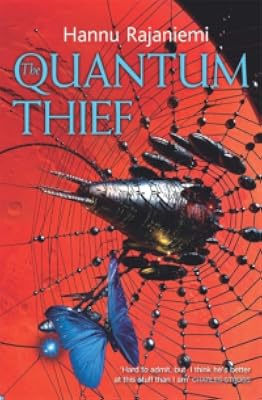
I may be out of practise at reading hard sci-fi, as I found ‘Diaspora’ both fit that term and was a very challenging read. It broadly follows the life story of Yatima, a disembodied being born through psychogenesis into the Polis, a society of disembodied beings. I slowly struggled through the first chapter, which describes Yatima gaining consciousness in what felt like excessive detail. In the late 21st century setting, humanity has diverged into three sub-species: the Polis, a society of space-faring robots, and a relatively small number of traditionalists with flesh bodies. The narrative focuses on the Polis, the strangest of the three, who live in a world of mathematical abstractions. Indeed, this is a novel dominated by show more explanations of theoretical mathematics and physics, which I found very difficult to understand as I haven’t studied either since I was 16. Reading hard sci-fi, though, has taught me to treat such info-dumps rather like poetry: if I cannot interpret them, I stop trying and simply enjoy their shapes and rhythms. This was my approach with [b:The Quantum Thief|7562764|The Quantum Thief (Jean le Flambeur, #1)|Hannu Rajaniemi|https://images.gr-assets.com/books/1327950631s/7562764.jpg|9886333] and sequels, for instance.
'Diaspora' contains a great deal of discussion about elementary particles, wormholes, and dimensions beyond the usual four. Personally, I preferred the application of these concepts to the residual problems of humanity and the search for alien life. I like hard sci-fi when it imaginatively extrapolates the wider consequences of abstractions, rather than wallowing in the abstractions themselves. Perhaps what I interpreted as wallowing was necessary to the extrapolation part? In any case, it went way over my head. The best parts of ‘Diaspora’ involved Yatima and a companion confronting how far they had diverged from embodied humanity, the discovery of incredibly complex carpet-like aquatic aliens, and the final revelation that the vanished Transmuters had left a multi-dimensional sculpture to say ‘Hello there’ . Thus some scenes fascinated me and I found the overall scope of the novel impressive and mind-expanding, while letting the many info-dumps gently wash over me. Egan is an excellent writer, but I prefer his more social science-inflected sci-fi: [b:Distress|156781|Distress (Subjective Cosmology #3)|Greg Egan|https://images.gr-assets.com/books/1223643478s/156781.jpg|151293] is incredible. show less
'Diaspora' contains a great deal of discussion about elementary particles, wormholes, and dimensions beyond the usual four. Personally, I preferred the application of these concepts to the residual problems of humanity and the search for alien life. I like hard sci-fi when it imaginatively extrapolates the wider consequences of abstractions, rather than wallowing in the abstractions themselves. Perhaps what I interpreted as wallowing was necessary to the extrapolation part? In any case, it went way over my head. The best parts of ‘Diaspora’ involved Yatima and a companion confronting how far they had diverged from embodied humanity
My memories of when I used to subscribe to the science fiction magazine Interzone in the 80s and 90s are largely of two types of stories. The magazine had a penchant for a brand of rather gloomy anti-cyberpunk futurism (especially in the 80s, with Britain under Thatcher's iron heel when everything looked bleak, and era which also gave rise to such wonderfully dark comics as V for Vendetta and Crisis) of a sort that made Jeff Noon's books look positively utopian (I'm sure Noon must have had stories in IZ, come to think of it, but I can't remember any). The second sort were dazzlingly high-concept explorations of the interface between technology and society, and where ever hastening scientific and technological progress might be taking show more us as a species.
This is where I first came into contact with Australian author Greg Egan, an Interzone regular and prime purveyor of this latter type of story. Egan's 1997 novel Diaspora is a superb example of his work. It starts toward the end of the 30th century when humanity has split into different strains – as software entities living rapid yet immortal lives in virtual reality, or interacting with the physical world inhabiting robotic bodies, or a few 'fleshers', humans who doggedly remain attached to their biological reality. An unforeseen astrophysical disaster causes some of the digital personalities to send out copies of themselves to explore the universe in search of somewhere safe from potential annihilation from cosmic accidents.
This is not just an updating of Stapledon's [b:Last and First Men|2749148|Last and First Men|Olaf Stapledon|http://photo.goodreads.com/books/1267242376s/2749148.jpg|1631490] or Wells' [b:The Time Machine|2493|The Time Machine|H.G. Wells|http://photo.goodreads.com/books/1285304288s/2493.jpg|3234863] to the information age, where biological evolution continues seamlessly into electronic, but an exploration of what it means to be human, to be conscious, to be intelligent. Is the only way to be human to remain in direct contact with the physical world and live a life measured in decades, or can a piece of software that is at least as complex and possessed of its own drives and personality and autonomy, that wants to survive and learn and has morals and ethics be also considered human? As the environments in which humans live are artificial anyway, is living in an entirely virtual world any less valid?
Along with a story that presents these issues, Egan takes us into areas of multi-dimensional maths and wormhole physics that stretch the readers' minds just as much, all told with a clarity and skill that makes Egan one of the finest and most important writers working in SF today.
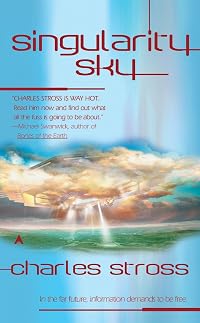
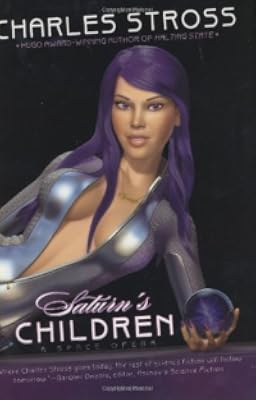
Read this if you like [a:Neal Stephenson|545|Neal Stephenson|http://photo.goodreads.com/authors/1192826259p2/545.jpg] and [a:Charles Stross|8794|Charles Stross|http://photo.goodreads.com/authors/1218218373p2/8794.jpg]. Other books on a similar theme include Stross' [b:Saturn's Children|2278387|Saturn's Children|Charles Stross|http://photo.goodreads.com/books/1266693988s/2278387.jpg|2284499] and the wonderful [b:Natural History|735504|Natural History|Justina Robson|http://photo.goodreads.com/books/1298634251s/735504.jpg|1125408] by [a:Justina Robson|224518|Justina Robson|http://www.goodreads.com/images/nophoto/nophoto-F-50x66.jpg] (both of whom are from Leeds, which is an interesting coincidence). show less
Members
- Recently Added By
Lists

Best Science Fiction Novels
816 works; 430 members

Schisms in transhumanity - SF
34 works; 1 member

Wishlist
50 works; 1 member

Top Five Books of 2016
795 works; 229 members

Books Tagged Clones
14 works; 6 members

Simulated Reality in Fiction
124 works; 7 members

Books Read in 2017
4,249 works; 130 members

Books recommended in the history category on FiveBooks.com
329 works; 4 members
Author Information

129+ Works 13,910 Members
Some Editions
Awards and Honors
Awards
Series
Belongs to Publisher Series
ハヤカワ文庫 SF (1531)
Common Knowledge
- Alternate titles
- Diáspora
- Original publication date
- 1997
- First words
- Yatima surveyed the Doppler-shifted stars around the polis, following the frozen, concentric waves of colour across the sky from expansion to convergence.
- Last words
- (Click to show. Warning: May contain spoilers.)It would be a long, hard journey to the coal face, but this time there'd be no distractions.
Classifications
Statistics
- Members
- 2,091
- Popularity
- 9,849
- Reviews
- 55
- Rating
- (3.95)
- Languages
- 8 — Czech, English, French, German, Hungarian, Japanese, Polish, Spanish
- Media
- Paper, Audiobook, Ebook
- ISBNs
- 21
- UPCs
- 1
- ASINs
- 13