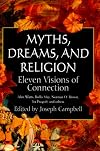
Myths, Dreams, Religions
by Joseph Campbell
On This Page
Description
A collection of essays on themes of mythology, religion, and the human psyche.Tags
Recommendations























Member Reviews
This was interesting. I did not know Joseph Campbell started The Society for the Arts, Religion and Contemporary Culture. This "are" essays sponsored by that eminent society. Nicely, there are mini bios at the end which help know the author's background and direction.
I don't remember who formulated it. I think it was Bertrand Russell, but I haven't been able to verify it. However, the idea is that at the highest levels of science/philosophy/whatever-ology there is an inpenetrable language that can't be used to explain anything to those on the outside. That is true about a lot of these pieces. However, some of it is quite stunning on the potency of individual dreams (quoting I. Bergman on the dream-borne creative process) and mythology show more as the dreams of society, tieing together the disrupting "daimons" of Rollo May. show less
I don't remember who formulated it. I think it was Bertrand Russell, but I haven't been able to verify it. However, the idea is that at the highest levels of science/philosophy/whatever-ology there is an inpenetrable language that can't be used to explain anything to those on the outside. That is true about a lot of these pieces. However, some of it is quite stunning on the potency of individual dreams (quoting I. Bergman on the dream-borne creative process) and mythology show more as the dreams of society, tieing together the disrupting "daimons" of Rollo May. show less
LOC Notes: "Series of lectures sponsored by the Society for the Arts, Religion and Contemporary Culture."
"2012-10-26 12:00:00"
NAS ARTES, NA FILOSOFIA E NA VIDA COMTEMPORANEA
Dec 22, 2021Portuguese (Brazil)
Ratings
Members
- Recently Added By
Author Information

201+ Works 41,643 Members
Joseph Campbell was born in White Plains, New York on March 26, 1904. He received a B.A. in English literature in 1925 and an M.A. in Medieval literature in 1927 from Columbia University. He was awarded a Proudfit Traveling Fellowship to continue his studies at the University of Paris. After he had received and rejected an offer to teach at his show more high school alma mater, his Fellowship was renewed, and he traveled to Germany to resume his studies at the University of Munich. During the year he was housemaster of Canterbury School, he sold his first short story, Strictly Platonic, to Liberty magazine. In 1934, he accepted a position in the literature department at Sarah Lawrence College, a post he would retain until retiring in 1972. During his lifetime, he wrote more than 40 books including The Hero with a Thousand Faces, The Mythic Image, the four-volume The Masks of God, and The Power of Myth with Bill Moyers. During the 1940s and 1950s, he collaborated with Swami Nikhilananda on translations of the Upanishads and The Gospel of Sri Ramakrishna. He received several awards including National Institute of Arts and Letters Award for Contributions to Creative Literature and the 1985 National Arts Club Gold Medal of Honor in Literature. He died after a brief struggle with cancer on October 30, 1987. (Bowker Author Biography) show less
Common Knowledge
- First words
- When at the service of morning prayer a priest of the Church of England addresses himself to the origin and foundation of the Universe, he will usually make the following statement: Almighty and Everlasting God, King of Kings... (show all), Lord of Lords, the only ruler of Princes, Who dost from Thy Throne behold all the dwellers upon Earth, most heartily we beseech Thee with Thy favor to behold our sovereign lady Elizabeth the Queen and all the royal family.
- Last words
- (Click to show. Warning: May contain spoilers.)The concluding point of our reflections is simply this: contemporary philosophy, seeking to fulfill what we have called the mythic function, needs to see myth and dream as signs that point the way to the possibility of knowing who we really are.
Classifications
- Genres
- Nonfiction, Religion & Spirituality, Philosophy
- DDC/MDS
- 291.1 — Religion Other religions [Formerly: General Religious Topics] [formerly: Religious mythology, general classes of religion, interreligious relations and attitudes, social theology. Relocated to 201]
- LCC
- BL304 .M93 — Philosophy, Psychology and Religion Religions. Mythology. Rationalism Religions. Mythology. Rationalism The myth. Comparative mythology
- BISAC
Statistics
- Members
- 249
- Popularity
- 130,746
- Reviews
- 4
- Rating
- (3.75)
- Languages
- English, Portuguese (Portugal)
- Media
- Paper, Ebook
- ISBNs
- 6
- ASINs
- 4