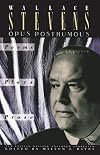
Opus Posthumous: Poems, Plays, Prose
by Wallace Stevens
On This Page
Description
When Opus Posthumous first appeared in 1957, it was an appropriate capstone to the career of one of the most important writers of the twentieth century. It included many poems missing from Stevens's Collected Poems, along with Stevens's characteristically inventive prose and pieces for the theater. Now Milton J. Bates, the author of the acclaimed Wallace Stevens: A Mythology of Self, has edited and revised Opus Posthumous to correct the previous edition's errors and to incorporate material show more that has come to light since original publication. A third of the poems and essays in this edition are new to the volume. The resulting book is an invaluable literary document whose language and insights are fresh, startling, and eloquent. show lessTags
Recommendations








Member Reviews
This was actually my first experience with Stevens. I came by him from a poet friend of mine who admired him and given his being a contemporary with writers such as Crane, Pound, and Williams, I wanted to take a look; with this collection being the first one I came across at a used bookstore.
As far as this book goes, I found it a bit wanting. Some of the poems in this collection are real gems, but others seem purely academic and lacking vitality. As a poet though, I felt that his strongest piece was actually the play "Carlos among the Candles." As a scholar he also had some rather strong aphorisms in a time when such things are simply not written anymore. To speak of the poetry though, I would have to say that his style is very show more reminiscent of Apollinaire (which would justify my friend’s fondness for Stevens given that Apollinaire is probably his (my friends) greatest influence in his own writing). The problem is, Apollinaire was only, in my opinion, marginally revolutionary in poetics. For his time it was and is incredible work and he is a poet whom I highly admire, but this style by Stevens’ time had been far transcended. It’s almost as if Stevens attempted to assimilate the American Whitman tradition with an early avant-garde writer (one also thinks of Nerval) in his own composition. Due to this the actual form becomes anticipated before the poem and only churns out one significant piece out of a dozen in which his vision matches the execution. That’s not to say he didn’t contribute to American letters, for he definitely deserves his place in the opus of American poets, but I don’t attribute nearly as much esteem to him as I would someone like Hart Crane or even (despite my own reservations in admitting this) T.S. Eliot.
The worst part though, and which was what made me take this book down an extra star, was his essays. His personal one’s are insightful, as well as the short pieces used as addendum to editions of other books. But his attempts at aesthetic theory were painful. It’s almost as if he was particularly trying to “keep up” with Eliot and venture into things that he even admits in the essays themselves are out of his expertise. His modesty between the philosopher and the poet is digestible, but he only comes to these conclusion through hearsay. He references philosophies of art and phenomenology by quoting them out of books which merely summarize the aesthetic theories and so through his progression he completely diverges from the initial passion that inaugurated the work to a resignation of his own ill formed conception by concluding his work with simply agreeing with the one or two other critics he cites – all of whom rely primarily on Mallarmé and so really tells us nothing new about poetry for almost 100 years of advancement (almost to his discredit, given that this is his posthumous work and constitutes a reflection on his own ars poetica in a way that, for me, took some of the value away from his own works).
Regardless, as with any book, it is well worth the read. It is of value for its exemplifying Stevens’ output, while at the same time giving an almost biographical take on himself as a writer. For the generation of poets in which he belonged that inaugurated the “Death of the Author” one does get to see both author and reader, and so overall it works well for a meditation on the postmodern transformation of literature – with poetry being one of the only untarnished area (except for maybe in theatre and dance) of the arts in which one can still experience/feel the philosophical and social transformations of the literary world in which we now live. show less
As far as this book goes, I found it a bit wanting. Some of the poems in this collection are real gems, but others seem purely academic and lacking vitality. As a poet though, I felt that his strongest piece was actually the play "Carlos among the Candles." As a scholar he also had some rather strong aphorisms in a time when such things are simply not written anymore. To speak of the poetry though, I would have to say that his style is very show more reminiscent of Apollinaire (which would justify my friend’s fondness for Stevens given that Apollinaire is probably his (my friends) greatest influence in his own writing). The problem is, Apollinaire was only, in my opinion, marginally revolutionary in poetics. For his time it was and is incredible work and he is a poet whom I highly admire, but this style by Stevens’ time had been far transcended. It’s almost as if Stevens attempted to assimilate the American Whitman tradition with an early avant-garde writer (one also thinks of Nerval) in his own composition. Due to this the actual form becomes anticipated before the poem and only churns out one significant piece out of a dozen in which his vision matches the execution. That’s not to say he didn’t contribute to American letters, for he definitely deserves his place in the opus of American poets, but I don’t attribute nearly as much esteem to him as I would someone like Hart Crane or even (despite my own reservations in admitting this) T.S. Eliot.
The worst part though, and which was what made me take this book down an extra star, was his essays. His personal one’s are insightful, as well as the short pieces used as addendum to editions of other books. But his attempts at aesthetic theory were painful. It’s almost as if he was particularly trying to “keep up” with Eliot and venture into things that he even admits in the essays themselves are out of his expertise. His modesty between the philosopher and the poet is digestible, but he only comes to these conclusion through hearsay. He references philosophies of art and phenomenology by quoting them out of books which merely summarize the aesthetic theories and so through his progression he completely diverges from the initial passion that inaugurated the work to a resignation of his own ill formed conception by concluding his work with simply agreeing with the one or two other critics he cites – all of whom rely primarily on Mallarmé and so really tells us nothing new about poetry for almost 100 years of advancement (almost to his discredit, given that this is his posthumous work and constitutes a reflection on his own ars poetica in a way that, for me, took some of the value away from his own works).
Regardless, as with any book, it is well worth the read. It is of value for its exemplifying Stevens’ output, while at the same time giving an almost biographical take on himself as a writer. For the generation of poets in which he belonged that inaugurated the “Death of the Author” one does get to see both author and reader, and so overall it works well for a meditation on the postmodern transformation of literature – with poetry being one of the only untarnished area (except for maybe in theatre and dance) of the arts in which one can still experience/feel the philosophical and social transformations of the literary world in which we now live. show less
I lightly skimmed the plays, did not read the prose, and just read the poems without trying to make sense of them. ?áStevens' work is way out of my league. ?áOr he's a humbug on acid, but since other ppl admire him so much I'm guessing it's just me. ?áHe does seem racist, throwing around words like Dago and stereotypes about Negroes. ?áBut then, I could be totally misunderstanding. ?áWhat I get out of Stevens' poetry is music & bright imagery. ?áI need to find an audiobook collection of his work, read by someone who has more of a clue than I, of course.
Solitaire Under the Oaks
In the oblivion of cards
One exists among pure principles.
Neither the cards nor the trees nor the air
Persist as facts. ?áThis is an escape
To show more principium, to meditation.
One knows at last what to think about
And thinks about it without consciousness,
Under the oak trees, completely released.
(This is exactly how I feel when playing a Match 3 or Hidden Object game!)
Banjo Boomer
The mulberry is a double tree.
Mulberry, shade me, shade me awhile.
A white, pink, purple berry tree,
A very dark-leaved berry tree.
Mulberry, shade me, shade me awhile.
A churchyard kind of bush as well,
A silent sort of bush, as well,
Mulberry, shade me, shade me awhile.
It is a shape of life described
By another shape without a word.
Mulberry, shade me, shade me awhile--
With nothing fixed by a single word.
Mulberry, shade me, shade me awhile.
from Memorandum
Say this to Pravda, tell the damned rag
That the peaches are slowly ripening.
...
Say that in the clear Atlantic night
The plums are blue on the trees. ?áThe katy-dids
Bang cymbals as they used to do.
Millions hold millions in their arms.
" show less
Solitaire Under the Oaks
In the oblivion of cards
One exists among pure principles.
Neither the cards nor the trees nor the air
Persist as facts. ?áThis is an escape
To show more principium, to meditation.
One knows at last what to think about
And thinks about it without consciousness,
Under the oak trees, completely released.
(This is exactly how I feel when playing a Match 3 or Hidden Object game!)
Banjo Boomer
The mulberry is a double tree.
Mulberry, shade me, shade me awhile.
A white, pink, purple berry tree,
A very dark-leaved berry tree.
Mulberry, shade me, shade me awhile.
A churchyard kind of bush as well,
A silent sort of bush, as well,
Mulberry, shade me, shade me awhile.
It is a shape of life described
By another shape without a word.
Mulberry, shade me, shade me awhile--
With nothing fixed by a single word.
Mulberry, shade me, shade me awhile.
from Memorandum
Say this to Pravda, tell the damned rag
That the peaches are slowly ripening.
...
Say that in the clear Atlantic night
The plums are blue on the trees. ?áThe katy-dids
Bang cymbals as they used to do.
Millions hold millions in their arms.
" show less
Ratings
Members
- Recently Added By
Lists

Harold Bloom - The Western Canon: D. The Chaotic Age
833 works; 24 members

Tom's Bookstore
346 works; 2 members
Author Information

109+ Works 6,429 Members
Some Editions
Awards and Honors
Awards
Classifications
Statistics
- Members
- 289
- Popularity
- 111,669
- Reviews
- 3
- Rating
- (4.26)
- Languages
- English, Finnish, German
- Media
- Paper, Ebook
- ISBNs
- 8
- ASINs
- 7