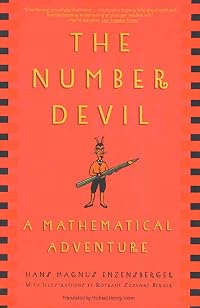
The Number Devil: A Mathematical Adventure
by Hans Magnus Enzensberger
On This Page
Description
Annoyed with his math teacher who assigns word problems and won't let him use a calculator, twelve-year-old Robert finds help from the number devil in his dreams.Tags
Recommendations



















Member Recommendations

Member Reviews
Book Review: The Number Devil
My first encounter with this book was the jacket, with a cartoon devil and a quote describing The Number Devil as a cross between Alice and Wonderland and Flatland. Having never read Flatland, but being familiar with Alice in Wonderland, I was intrigued, and indeed there were many aspects of the novel which invoked an Alice in Wonderland feel. Robert finds himself being guided through an imaginary mathematical universe, much as Alice was led through Wonderland; however, the major similarity ends there as Hans Enzensberger reveals a handful of the most fascinating mathematical concepts with comical prose and lively illustration. A reader of any age and mathematical competence is confronted with the vastness show more of numbers and math through the eyes of Robert and his guide.
The first feature of the book which I enjoyed was the simplicity of the presentation of complex mathematical ideas. The Number Devil begins by showing Robert basic operations with 1’s, and each subsequent dream/chapter expands on the ideas behind it. The building up of complicated ideas with numbers from very small and simple building blocks is a central tenet in the study of mathematics, and this structure encourages young readers to think about the math they have been acquainted with and consider how they might expound on those concepts. The section devoted to place value strikes a good balance between the history of math, which is delivered through the demonstration of Roman numerals, and teaching the concept and necessity of place value in larger mathematical systems. Students are presented math they have likely seen before in elementary grades, and asked to consider how difficult it would be to work with numbers without zero. Since the chapters are relatively short and interspersed with illustrations and calculations, young readers are afforded the opportunity to dive into the topic without being overwhelmed.
A second feature of the novel that I appreciated was the mixture of whimsical and technical terminology for the topics discussed. For example, the Number Devil calls prime numbers, “prima donnas;” square roots, “rutabagas;” factorial, “vroom;” units, “quang” and so on. As an adult reader, I chuckled at the author’s choices for these math vocabulary terms, because many are tangentially related to the official term. By doing so, the author demonstrates to young students the human side of mathematics, a subject that many view as boring or uninspired. In reality, the mathematical concepts, terms, and processes of thinking have been passed down through the centuries like many other academic traditions. Enzensberger also makes a modest attempt to showcase the diverse range of people what have contributed to the development of math through the ages. Balancing this with the pure mathematics opens the door for students with varying interests to engage with the novel.
The close of the book is one of the finest parts, and does an even better job of emphasizing the fluidity of mathematical knowledge than changing a few terms. In language that is accessible to many ages, the author introduces the idea of mathematical proof and the curiosity to know not just “how” numbers work, but “why” as well. Robert’s desire for proof is ultimately what leads him to a seat at the table with the great mathematicians of the ages, and is a trait that all math teachers should cultivate in their students. Importantly, the character of the Number Devil confesses that not even the smartest mathematician, teacher, or mentor knows all the answers, a fact that can be both disappointing and exhilarating. By addressing these topics early in a student’s mathematical journey, this book can serve as a valuable tool for teachers to build mathematical literacy and understanding. show less
My first encounter with this book was the jacket, with a cartoon devil and a quote describing The Number Devil as a cross between Alice and Wonderland and Flatland. Having never read Flatland, but being familiar with Alice in Wonderland, I was intrigued, and indeed there were many aspects of the novel which invoked an Alice in Wonderland feel. Robert finds himself being guided through an imaginary mathematical universe, much as Alice was led through Wonderland; however, the major similarity ends there as Hans Enzensberger reveals a handful of the most fascinating mathematical concepts with comical prose and lively illustration. A reader of any age and mathematical competence is confronted with the vastness show more of numbers and math through the eyes of Robert and his guide.
The first feature of the book which I enjoyed was the simplicity of the presentation of complex mathematical ideas. The Number Devil begins by showing Robert basic operations with 1’s, and each subsequent dream/chapter expands on the ideas behind it. The building up of complicated ideas with numbers from very small and simple building blocks is a central tenet in the study of mathematics, and this structure encourages young readers to think about the math they have been acquainted with and consider how they might expound on those concepts. The section devoted to place value strikes a good balance between the history of math, which is delivered through the demonstration of Roman numerals, and teaching the concept and necessity of place value in larger mathematical systems. Students are presented math they have likely seen before in elementary grades, and asked to consider how difficult it would be to work with numbers without zero. Since the chapters are relatively short and interspersed with illustrations and calculations, young readers are afforded the opportunity to dive into the topic without being overwhelmed.
A second feature of the novel that I appreciated was the mixture of whimsical and technical terminology for the topics discussed. For example, the Number Devil calls prime numbers, “prima donnas;” square roots, “rutabagas;” factorial, “vroom;” units, “quang” and so on. As an adult reader, I chuckled at the author’s choices for these math vocabulary terms, because many are tangentially related to the official term. By doing so, the author demonstrates to young students the human side of mathematics, a subject that many view as boring or uninspired. In reality, the mathematical concepts, terms, and processes of thinking have been passed down through the centuries like many other academic traditions. Enzensberger also makes a modest attempt to showcase the diverse range of people what have contributed to the development of math through the ages. Balancing this with the pure mathematics opens the door for students with varying interests to engage with the novel.
The close of the book is one of the finest parts, and does an even better job of emphasizing the fluidity of mathematical knowledge than changing a few terms. In language that is accessible to many ages, the author introduces the idea of mathematical proof and the curiosity to know not just “how” numbers work, but “why” as well. Robert’s desire for proof is ultimately what leads him to a seat at the table with the great mathematicians of the ages, and is a trait that all math teachers should cultivate in their students. Importantly, the character of the Number Devil confesses that not even the smartest mathematician, teacher, or mentor knows all the answers, a fact that can be both disappointing and exhilarating. By addressing these topics early in a student’s mathematical journey, this book can serve as a valuable tool for teachers to build mathematical literacy and understanding. show less
There aren't a lot of entertaining stories about math, which already sets this little jewel of a book apart. Yes, plenty of books for kids think they are going to teach you something. And some of them even do, sort of. But most of those are setting out to teach you something you will come across in elementary school. This book doesn't teach you any old math. It goes all the way to COLLEGE math-- and yet it remains not only easy to understand, but entertaining and *funny*. I guarantee, if you read it and enjoy it, you will be able to blow away your math teacher. The author, Hans Magnus Enzensberger, is considered one of the great writers of the German language writing today, but this is one of his only books for kids. If you read it, show more you'll see why he's considered a fine writer. And maybe you'll be interested in some of his 'grown-up' works as well. show less
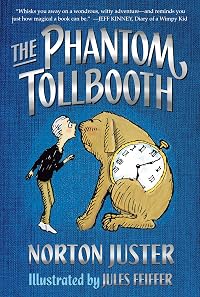
Very interesting concept. I was expecting something along the lines of The Phantom Tollbooth but this book doesn't even come close to that level of whimsical profoundness. I was definitely disappointed. The encounters between the dreaming child Robert and the Number Devil quickly become repetitive and stale. The author is trying to make children realize for themselves that mathematics are beautiful but the execution of this goal is actually quite ordinary. This book is recommended for kids 10 but I think it's more appropriate for an even younger audience. When I was 10, I was reading A Wrinkle in Time and its sequels... The Number Devil would have bored me to tears.
This is a book about maths brought alive in the dreams of a boy. Initially overwhelmed by the apparent complexity of manipulating numbers, he learns how simple and beautiful mathematics can be. I love it because it’s such a fun approach. ‘Scary’ mathematical terms translated into words you actually want to say and with beautifully illustrations. If you have children, I suggest you read it to them. Slowly, pausing to grasp the mathematics involved and with a pen and paper by your side.
The Number Devil follows a young boy named Robert, who is terrified of math until he begins having strange dreams where he meets the Number Devil, a whimsical character who teaches him about the wonders of numbers. Through a series of dream-like adventures, the Number Devil introduces Robert to fascinating mathematical concepts from prime numbers to the Fibonacci sequence.
The Number Devil is an excellent resource for introducing middle school students to basic math concepts in a non-intimidating way. The book’s creative narrative makes abstract mathematical ideas feel more accessible and fun, which can help students build confidence when they might otherwise feel anxious about math.
The Number Devil is an excellent resource for introducing middle school students to basic math concepts in a non-intimidating way. The book’s creative narrative makes abstract mathematical ideas feel more accessible and fun, which can help students build confidence when they might otherwise feel anxious about math.
Hans Enzensberger's novel presents the amazing qualities of mathematics in a fun way - through dreams! For people who have a good grasp on mathematical concepts, this book is a great read to bring you back to basics and perhaps spark interest in the reasons behind why certain principles work. For readers who might not have such a strong relationship with mathematics, the story can definitely spark a sense of intrigue as the standard-boring-presented math we see in many school classrooms is explained in fun and unusual ways. From a literature perspective, the plot is sort of weak as we simply see Robert learning new things to do with math during his dreams. From a teacher's perspective the only issue I had with the novel is the use of show more childish terms for real mathematical vocabulary. The author mentions this in the end of the story, but reinforcing these words throughout the plot could lead to confusion when these topics are discussed in a physical classroom. Overall I would suggest this book for anyone interested in the amazing qualities math has to offer. show less
This is a great book for students who do not like Math. This book does a great job of creating a fun imaginative story while also teaching main topics like prime numbers.
Members
- Recently Added By
Lists

Fiction for Readers Who Love Science and Math
57 works; 13 members

Robin
21 works; 2 members

HS Mathematics class library
79 works; 6 members

GCS 6th grade summer reading list
171 works; 4 members

Childhood: Books for or about children in different cultures around the wor
345 works; 17 members

Reading Glasses Podcast
410 works; 3 members
Author Information

295+ Works 5,877 Members
Hans Magnus Enzensberger is internationally known as an essayist, journalist, and poet
All Editions
Some Editions
Awards and Honors
Awards
Distinctions
Series
Belongs to Publisher Series
dtv (62015)
Common Knowledge
- Canonical title*
- De telduivel
- Original title
- Der Zahlenteufel
- Original publication date
- 1997
- People/Characters
- Robert
- Dedication
- For Theresia
- Original language
- German
*Some information comes from Common Knowledge in other languages. Click "Edit" for more information.
Classifications
Statistics
- Members
- 2,206
- Popularity
- 9,172
- Reviews
- 40
- Rating
- (3.84)
- Languages
- 15 — Catalan, Danish, Dutch, English, Estonian, Finnish, French, German, Hungarian, Italian, Japanese, Norwegian (Bokmål), Portuguese, Spanish, Swedish
- Media
- Paper, Audiobook, Ebook
- ISBNs
- 62
- UPCs
- 1
- ASINs
- 7