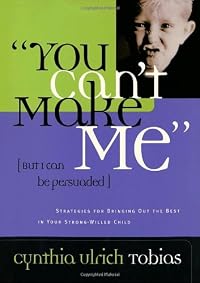
You Can't Make Me (But I Can Be Persuaded): Strategies for Bringing Out the Best in Your Strong-Willed Child
by Cynthia Ulrich Tobias
On This Page
Description
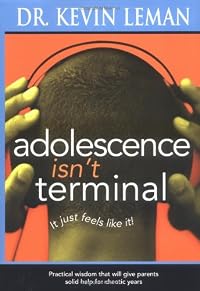
“I love the practical strategies and valuable insights from the hearts and lives of strong-willed kids.… You’ll defi nitely want to make this book part of your parenting library.”—Dr. Kevin Leman, New York Times best-selling author of Have a New Kid by Friday
Turn Conflict into Cooperation
Many parents suspect their strong-willed child is deliberately trying to drive them crazy. Difficult to discipline and seemingly impossible to motivate, these children present unique, show more exhausting, and often-frustrating challenges to the those who love them.
But strong will is not a negative trait. These same children have firm convictions, high spirits, a sense of adventure—all the makings of a great adult. In this book you’ll discover how to channel that passion and determination in positive ways as you build a healthy relationship. Through insights gained from strong-willed people of all ages, you’ll…
· better understand how their minds really work.
· discover positive ways to motivate your strong-willed child.
· learn how to share control without compromising parental authority.
· apply key tactics to survive a meltdown.
· get practical tips for parents who disagree, blended families, and single parents.
Packed with immediately useful strategies to drastically reduce the level of tension in the home (or in the classroom), You Can’t Make Me shows how you can start today to build a stronger, more positive relationship with your strong-willed child.
Includes…
· Top Ten Tips for Bringing Out the Best in a Strong-Willed Child of Any Age
· A Strong-Willed Child Emergency Kit. show less
Tags
Recommendations






Member Reviews
This book made me laugh, and gave me the strength to appreciate a particular argumentative child for who she was, without giving her her way all the time. It helps that Ms. Tobias was that sort of child herself, so she's good at explaining what makes the strong will tick. And for Christians, it explains why the will isn't always a bad thing. A light-hearted, practical book for parents in the trenches.
It was too churchy/christiany and self-congratulatory for me, didn't finish. Seemed like some fairly standard and reasonable advice about letting kids be people and letting them set their own goals (but only if they're "strong-willed"? I guess you can go ahead and walk all over all the other kids if you want and that's fine because they don't push back?) but wrapped in very unpleasant wrapper.
“You Can’t Make Me” (But I Can Be Persuaded) by Cynthia Ulrich Tobias. Epiphany library section: 8 J: Life Skills, General Parenting. This book tells parents how to deal with strong-willed children (SWCs). This need not be a negative trait – it is great to have a child with firm convictions, high spirits and a sense of adventure. However, parents need creative strategies to deal with SWCs. Strict “military” discipline seems to work least well. Any kid, even a biddable one, will rebel to orders without choices.
The author, once an SWC herself, recommends discipline strategies that offer SWCs choices, options, and requests for input. She coaches readers how to talk so their kids will listen and listen so their kids will talk. show more While still in elementary school, it can be helpful to these kids to make some of their own choices and to live with them for a bit – when the choices are not so important as later on.
A later chapter deals with strong-willed children and God, especially in fundamentalist Christian families that consider obedience to God as a model for children’s obedience to parents. Another later chapter discusses what to do if parents reach the end of their rope in dealing with their SWC.
After reading this book I wondered what the difference is between a strong-willed child and a child with oppositional-defiant disorder (ODD). While this author does not mention this disorder (she’s an educator, not a psychologist or psychiatrist), a quick check on google seemed to say that it’s a matter of degree. While most kids have on and off periods when they seem defiant, kids with ODD have persistent (6 months +) problems with aggression, vindictiveness, temper tantrums, argumentativeness, lack of self-esteem, and academic problems. This level of disruption needs ongoing professional help. Most of all, SWCs – and all children – want parents to love them unconditionally – one of the many challenges of parenthood! show less
The author, once an SWC herself, recommends discipline strategies that offer SWCs choices, options, and requests for input. She coaches readers how to talk so their kids will listen and listen so their kids will talk. show more While still in elementary school, it can be helpful to these kids to make some of their own choices and to live with them for a bit – when the choices are not so important as later on.
A later chapter deals with strong-willed children and God, especially in fundamentalist Christian families that consider obedience to God as a model for children’s obedience to parents. Another later chapter discusses what to do if parents reach the end of their rope in dealing with their SWC.
After reading this book I wondered what the difference is between a strong-willed child and a child with oppositional-defiant disorder (ODD). While this author does not mention this disorder (she’s an educator, not a psychologist or psychiatrist), a quick check on google seemed to say that it’s a matter of degree. While most kids have on and off periods when they seem defiant, kids with ODD have persistent (6 months +) problems with aggression, vindictiveness, temper tantrums, argumentativeness, lack of self-esteem, and academic problems. This level of disruption needs ongoing professional help. Most of all, SWCs – and all children – want parents to love them unconditionally – one of the many challenges of parenthood! show less
Ratings
Members
- Recently Added By
Author Information

20 Works 2,066 Members
Cynthia Ulrich Tobias is founder and CEO of Apple St. (Applied Learning Styles) and the best-selling author of 11 books, including the Way They Learn and Every Child Can Succeed. Sue Acua has loved being a middle school teacher for over 20 years-and her students openly and honestly share their world with her every day.
Work Relationships
Classifications
- Genre
- Nonfiction
- DDC/MDS
- 649.64 — Applied science & technology Home economics & family management Child rearing; home care of people with illnesses and disabilities by family and friends Discipline, Homeschool, and Toilet Training Discipline
- LCC
- HQ773 .T63 — Social sciences The family. Marriage, Women and Sexuality The Family. Marriage. Women The family. Marriage. Home Children. Child development
- BISAC
Statistics
- Members
- 250
- Popularity
- 129,349
- Reviews
- 3
- Rating
- (3.91)
- Languages
- English
- Media
- Paper, Audiobook
- ISBNs
- 4