A Christmas Cornucopia: The Hidden Stories Behind Our Yuletide Traditions
by Mark Forsyth
On This Page
Description
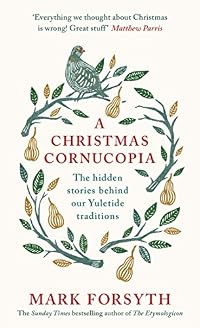
The unpredictable origins and etymologies of our cracking Christmas customs. For something that happens every year of our lives, we really don't know much about Christmas. We don't know that the date we celebrate was chosen by a madman, or that Christmas, etymologically speaking, means 'Go away, Christ'. Nor do we know that Christmas was first celebrated in 243 AD on 28 March - and only moved to 25 December in 354 AD. We're oblivious to the fact that the advent calendar was actually invented show more by a Munich housewife to stop her children pestering her for a Christmas countdown. And we would never have guessed that the invention of crackers was merely a way of popularising sweet wrappers. Luckily, like a gift from Santa himself, Mark Forsyth is here to unwrap this fundamentally funny gallimaufry of traditions and oddities, making it all finally make sense - in his wonderfully entertaining wordy way. show lessTags
Recommendations





Member Reviews
''There's a lovely story about a Tokyo department store, back in the days when Christmas was unknown in Japan. The head of this store had heard rumours of a Western tradition that involved a massive shopping spree and he wanted to introduce it to Tokyo. So he sent some of his stuff to investigate, and the result was that on Christmas Eve the shop's main window was decorated with a huge Santa Claus nailed to a cross.''
What is the evolution of the Christmas Dinner throughout History? What is the actual (and rather complicated...) reason we celebrate Christmas on the 25th of December? How did the Christmas Tree manage to invade our households? How fed-up could a mother be to invent the Advent countdown? What is the big deal with carols? show more What prompted the transition from St Nickolas to Santa Claus? And what exactly is the significance of Boxing Day for those of us who aren't British?
With honest and accurate remarks and a few snarky but well-meant and elegant comments, Mark Forsyth writes about misconceptions, misunderstandings, confusion, strange customs and the ever-lasting warmth of Christmas, no matter the era or the increasingly absurd marketing.
''If you ask me any simple question - 'What's the capital of France?', 'When does the last train leave?', 'Would you like a drink?' - I can answer Paris, midnight and whiskey. But that is all dross. There is Something Else, something much more important, and I cannot tell you what that Something Else is; and if I could tell you, it would not be worth the telling. We cannot say it, but we can, somehow, do it. And we do it at Christmas.''
My reviews can also be found on https://theopinionatedreaderblog.wordpress.com/ show less
What is the evolution of the Christmas Dinner throughout History? What is the actual (and rather complicated...) reason we celebrate Christmas on the 25th of December? How did the Christmas Tree manage to invade our households? How fed-up could a mother be to invent the Advent countdown? What is the big deal with carols? show more What prompted the transition from St Nickolas to Santa Claus? And what exactly is the significance of Boxing Day for those of us who aren't British?
With honest and accurate remarks and a few snarky but well-meant and elegant comments, Mark Forsyth writes about misconceptions, misunderstandings, confusion, strange customs and the ever-lasting warmth of Christmas, no matter the era or the increasingly absurd marketing.
''If you ask me any simple question - 'What's the capital of France?', 'When does the last train leave?', 'Would you like a drink?' - I can answer Paris, midnight and whiskey. But that is all dross. There is Something Else, something much more important, and I cannot tell you what that Something Else is; and if I could tell you, it would not be worth the telling. We cannot say it, but we can, somehow, do it. And we do it at Christmas.''
My reviews can also be found on https://theopinionatedreaderblog.wordpress.com/ show less
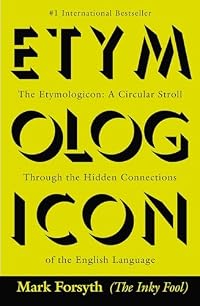
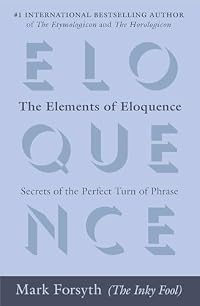
I'm a huge fan of Mark Forsyth's books: The Etymologicon and The Elements of Eloquence being just two examples of his excellent writing on language. When he announced he'd be writing this small tome about the history of Christmas, I pre-ordered it, and I've been sitting on it all year, waiting for the Christmas season's approach to read it.
I needed something light after my last read, and this was perfect. It's written in Forsyth's usual dryly hilarious style and for such a small volume (171 pages including the index) it's chock full of Christmas facts. Spoiler alert: almost none of the Christmas traditions we know and love today are tied to paganism. If you want to know how this can be true, read the book. It won't be a waste of your show more time, and you'll probably laugh at least once along the way.
If you do read it, make sure you skim the index at the end. It might be the funniest index I've ever read (and I've been known to skim more than a few).
Pagan myths: see
Hogwash show less
I needed something light after my last read, and this was perfect. It's written in Forsyth's usual dryly hilarious style and for such a small volume (171 pages including the index) it's chock full of Christmas facts. Spoiler alert: almost none of the Christmas traditions we know and love today are tied to paganism. If you want to know how this can be true, read the book. It won't be a waste of your show more time, and you'll probably laugh at least once along the way.
If you do read it, make sure you skim the index at the end. It might be the funniest index I've ever read (and I've been known to skim more than a few).
Pagan myths: see
Hogwash show less
Mark Forsyth is a capable writer with a good eye for trivia, and he makes a decent fist here of trying to make Christmas interesting and tolerable. Delving into the origins of some of our seasonal traditions reveals some interesting titbits (for example, the Christmas tree is based on the Garden of Eden (pg. 26)) but for the most part the revelations just evoke a mild 'oh, that's interesting'. By busting some myths and focusing on what we can verifiably source about the origins of the festivities, Forsyth ends up playing it safe.
There's a sense of familiarity which is not always welcome; the writer doesn't need to provide any background or set-up on the topics discussed because we know them all ad nauseam. By pointing out that the show more argument that Christmas has 'lost its true meaning' has been put forward by various groups for about 1,600 years (pg. 19), Forsyth is inadvertently reminding us that it's the same old stuff year after year. Old songs, old jumpers, old decorations, old TV shows are all trotted out with the same regularity and people who find this monotonous cycle of kitsch boring are labelled 'scrooges'. Even those who don't broadcast their distaste are questioned and cajoled and treated like stamp-collectors when they say they're not 'doing anything for Christmas'. The same conversations every year. For a month (and growing increasingly longer) people are submitted to an unbreakable cell of forced 'fun', syrupy music and an assault on the wallet; for a month there is no not a crumb of wit, variety, colour or inspiration to be found in any reactions with those other people who succumb to the plague of drivel that afflicts December.
Forsyth's mischievous and ironic writing style manages to refrain from real cynicism and he manages to fuse the book with his usual amiability. But the subject matter itself is incredibly dreary and boring, so there's a limit to what you can do to make it readable. Through no fault of his own, Forsyth's book is a bit like Christmas itself, in that you're not sorry when it's over. show less
There's a sense of familiarity which is not always welcome; the writer doesn't need to provide any background or set-up on the topics discussed because we know them all ad nauseam. By pointing out that the show more argument that Christmas has 'lost its true meaning' has been put forward by various groups for about 1,600 years (pg. 19), Forsyth is inadvertently reminding us that it's the same old stuff year after year. Old songs, old jumpers, old decorations, old TV shows are all trotted out with the same regularity and people who find this monotonous cycle of kitsch boring are labelled 'scrooges'. Even those who don't broadcast their distaste are questioned and cajoled and treated like stamp-collectors when they say they're not 'doing anything for Christmas'. The same conversations every year. For a month (and growing increasingly longer) people are submitted to an unbreakable cell of forced 'fun', syrupy music and an assault on the wallet; for a month there is no not a crumb of wit, variety, colour or inspiration to be found in any reactions with those other people who succumb to the plague of drivel that afflicts December.
Forsyth's mischievous and ironic writing style manages to refrain from real cynicism and he manages to fuse the book with his usual amiability. But the subject matter itself is incredibly dreary and boring, so there's a limit to what you can do to make it readable. Through no fault of his own, Forsyth's book is a bit like Christmas itself, in that you're not sorry when it's over. show less
It only took me forever to finish this. Not because it was bad but because I put it down and forgot about it.
This was filled with humor, obscure facts and some interesting history. Not a bad read at all.
This was filled with humor, obscure facts and some interesting history. Not a bad read at all.
At-times hysterically funny but always engaging, interesting, and full of holiday insight. Highly recommended!
Interesting and informative, ireeverant but not insulting, but I would have liked more.
This was written as humor I hope. As even a semi-scholarly is falls flat...very flat.
Members
- Recently Added By
Lists

Christmas Reading
142 works; 5 members
Author Information

13 Works 4,235 Members
Mark Forsyth is the proprietor of the popular blog The Inky Fool.
Common Knowledge
- Canonical title*
- Noël, une histoire de dingues
- Original title
- A Christmas cornucopia : the hidden stories behind our Yuletide traditions
*Some information comes from Common Knowledge in other languages. Click "Edit" for more information.
Classifications
- Genres
- Nonfiction, General Nonfiction, History, Reference
- DDC/MDS
- 394.2663 — Society, government, & culture Customs, etiquette & folklore General customs Special Occasions Holidays Christian holidays Christmas
- LCC
- GT4985 .F673 — Geography, Anthropology and Recreation Manners and customs (General) Manners and customs (General) Customs relative to public and social life
- BISAC
Statistics
- Members
- 106
- Popularity
- 304,748
- Reviews
- 7
- Rating
- (3.74)
- Languages
- English, French
- Media
- Paper, Ebook
- ISBNs
- 4
- ASINs
- 1