On This Page
Description
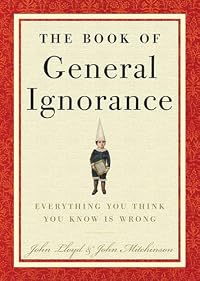
NEW YORK TIMES BESTSELLER • Misconceptions, misunderstandings, and flawed facts finally get the heave-ho in this humorous, downright humiliating book of reeducation based on the phenomenal British bestseller.Challenging what most of us assume to be verifiable truths in areas like history, literature, science, nature, and more,The Book of General Ignorance is a witty “gotcha” compendium of how little we actually know about anything. It’ll have you scratching your head wondering why show more we even bother to go to school.
Think Magellan was the first man to circumnavigate the globe, baseball was invented in America, Henry VIII had six wives, Mount Everest is the tallest mountain? Wrong, wrong, wrong, and wrong again. You’ll be surprised at how much you don’t know! Check out The Book of General Ignorance for more fun entries and complete answers to the following:
How long can a chicken.... show less
Tags
Recommendations


















Member Recommendations

Member Reviews
Il problema di questo libro è smettere di leggerlo. Idealmente, andrebbe a fianco de "L'originale miscellanea di Schott", per la cacofonia di informazioni condensate a volte in una unica risposta a domande assolutamente banali e scontate. E' curioso, documentato, insolito, utile. Ogni tanto bisogna mettere i puntini sulle "i", e questo libro lo fa, scardinando i luoghi comuni che - tra le altre cose - fanno di Amerigo Vespucci il navigatore da cui prese nome l'America, identificano lo struzzo come l'animale che mette la testa sotto la sabbia, e identificano la Svezia come una nazione ad alto tasso di suicidi.
Lots of interesting factoids; I did know a lot of these while some surprised and others made me openly wonder what their source was for their statements. Which is a bit of a problem as they do not list their sources.
Still, any book where you can open to a random page and find out that European earwigs carry around a spare penis in case of an emergency, cannot help but amuse.
Still, any book where you can open to a random page and find out that European earwigs carry around a spare penis in case of an emergency, cannot help but amuse.
IN THE past year there have been a plethora of books which ask and answer those niggling little questions: Why don't penguins’ feet freeze? Can cows walk down stairs? And the origins of everyday things.
These excellent works give answers to a host of issues that might have perplexed you, as well as a host of others that never occurred to you, but are intriguing nonetheless.
The Book of General Ignorance is somewhat different: it corrects the answers to questions you thought you already knew. For example, how many wives did King Henry VIII have? No, not six — two, because he had four of his marriages annulled.
James Bond's preferred drink? Not a vodka martini but whisky. And the good news for him and everyone else who enjoys a tipple show more is that there is no scientific evidence that alcohol destroys brain cells. That was a story put about by 19th-century temperance propagandists, though booze does cause new cells to grow more slowly.
In fact, much that we believe implicitly today originates in the imaginations of devious Victorians; the idea of a flat earth was not really posited until the 19th century, “since around the 4th century BC almost no-one, anywhere, has believed that the earth is flat".
The Victorians also invented the myth of the Noble Lord Nelson’s eye patch — but on which eye did he wear that patch? Neither. Nelson never wore an eye patch because, although his right eye was damaged, it was not blind.
His lordship was vain, cruel and ruthless, and 19 admirals of the British Navy refused to attend his funeral.
And what about the Duke of Wellington, revered as one of England's greatest generals? Actually, he was Irish, serving in the Irish Parliament in 1790 and playing for the all-Ireland team in the first recorded game of cricket played in Ireland in 1792.
Then we have indoor sanitation: Thomas Crapper was happy to accept acclaim for the invention of the WC in the mid-19th century, but actually the first flush lavatory we know of dates back to 206 BC, and was found in China.
In an age when prostitution and paedophilia flourished on a grand scale, the Victorians are notorious for their strange attitude to sex, and more or less reinvented the chastity belt, which was used not to protect maidenly virtue but to prevent boys “defiling” themselves, since everybody knew indulgence in the “solitary vice” caused blindness and lunacy.
While there are many devices claiming to be medieval chastity belts (and/or instruments of torture), the majority have been removed from museums after being discovered to be of 19th- century manufacture.
The mass suicide of Lemmings? The theory originated in the sloppy observations of 19th-century naturalists. The clan tartans of Scotland? A romantic myth of the 19th century. And St Bernards never, ever carried a cask of brandy around their necks: in 1831 Landseer painted a scene featuring two St Bernards, one of whom he adorned with a cask “for interest”, and so the legend began.
The 20th century has spawned myths of its own: Hitler was a vegetarian — no, he wasn't. Concentration camps were invented by the British — no they weren't, those laurels belong to the Spanish in their 1895 struggle to retain Cuba. And Teflon was not a by-product of the space programme, but discovered back in 1938.
We know now, in the 21st century, that “work is a bigger killer than drink, drugs or war. About two million people die every year from work-related accidents or diseases", yet stomach ulcers are caused not by stress or diet but bacteria. Other interesting tit-bits include the fact that the Universe is beige, Nero invented ice cream, the Number of the Beast is 616, baseball was invented in England, and that George Washington's ill-fitting dentures were made not of wood but of hippopotamus and elephant ivory.
In his foreword the delightful British playwright and novelist Stephen Fry warns: “It's the ones who think they know what there is to be known that we have to look out for."
If your answer to “who said ‘let them eat cake'" is Marie Antoinette, if you didn't know the first man-made invention to break the sound barrier was the whip, if you thought the guillotine was invented in 1789 by Dr Joseph Guillotine, or that the French were the first to make champagne, I'm afraid you might be one of those people Fry is referring to.
John Lloyd observes in his introduction: “Biologists say our primal drives are food, sex and shelter, no different from the animals. We say there is a fourth drive that makes us uniquely human — curiosity."
As an unashamed devotee of that fourth drive in all its many forms, I urge everyone with an inquiring mind and all fans of trivia to read this book . show less
These excellent works give answers to a host of issues that might have perplexed you, as well as a host of others that never occurred to you, but are intriguing nonetheless.
The Book of General Ignorance is somewhat different: it corrects the answers to questions you thought you already knew. For example, how many wives did King Henry VIII have? No, not six — two, because he had four of his marriages annulled.
James Bond's preferred drink? Not a vodka martini but whisky. And the good news for him and everyone else who enjoys a tipple show more is that there is no scientific evidence that alcohol destroys brain cells. That was a story put about by 19th-century temperance propagandists, though booze does cause new cells to grow more slowly.
In fact, much that we believe implicitly today originates in the imaginations of devious Victorians; the idea of a flat earth was not really posited until the 19th century, “since around the 4th century BC almost no-one, anywhere, has believed that the earth is flat".
The Victorians also invented the myth of the Noble Lord Nelson’s eye patch — but on which eye did he wear that patch? Neither. Nelson never wore an eye patch because, although his right eye was damaged, it was not blind.
His lordship was vain, cruel and ruthless, and 19 admirals of the British Navy refused to attend his funeral.
And what about the Duke of Wellington, revered as one of England's greatest generals? Actually, he was Irish, serving in the Irish Parliament in 1790 and playing for the all-Ireland team in the first recorded game of cricket played in Ireland in 1792.
Then we have indoor sanitation: Thomas Crapper was happy to accept acclaim for the invention of the WC in the mid-19th century, but actually the first flush lavatory we know of dates back to 206 BC, and was found in China.
In an age when prostitution and paedophilia flourished on a grand scale, the Victorians are notorious for their strange attitude to sex, and more or less reinvented the chastity belt, which was used not to protect maidenly virtue but to prevent boys “defiling” themselves, since everybody knew indulgence in the “solitary vice” caused blindness and lunacy.
While there are many devices claiming to be medieval chastity belts (and/or instruments of torture), the majority have been removed from museums after being discovered to be of 19th- century manufacture.
The mass suicide of Lemmings? The theory originated in the sloppy observations of 19th-century naturalists. The clan tartans of Scotland? A romantic myth of the 19th century. And St Bernards never, ever carried a cask of brandy around their necks: in 1831 Landseer painted a scene featuring two St Bernards, one of whom he adorned with a cask “for interest”, and so the legend began.
The 20th century has spawned myths of its own: Hitler was a vegetarian — no, he wasn't. Concentration camps were invented by the British — no they weren't, those laurels belong to the Spanish in their 1895 struggle to retain Cuba. And Teflon was not a by-product of the space programme, but discovered back in 1938.
We know now, in the 21st century, that “work is a bigger killer than drink, drugs or war. About two million people die every year from work-related accidents or diseases", yet stomach ulcers are caused not by stress or diet but bacteria. Other interesting tit-bits include the fact that the Universe is beige, Nero invented ice cream, the Number of the Beast is 616, baseball was invented in England, and that George Washington's ill-fitting dentures were made not of wood but of hippopotamus and elephant ivory.
In his foreword the delightful British playwright and novelist Stephen Fry warns: “It's the ones who think they know what there is to be known that we have to look out for."
If your answer to “who said ‘let them eat cake'" is Marie Antoinette, if you didn't know the first man-made invention to break the sound barrier was the whip, if you thought the guillotine was invented in 1789 by Dr Joseph Guillotine, or that the French were the first to make champagne, I'm afraid you might be one of those people Fry is referring to.
John Lloyd observes in his introduction: “Biologists say our primal drives are food, sex and shelter, no different from the animals. We say there is a fourth drive that makes us uniquely human — curiosity."
As an unashamed devotee of that fourth drive in all its many forms, I urge everyone with an inquiring mind and all fans of trivia to read this book . show less
I've had this book on my Kindle for ages, but without a particular plan for reading it (anytime soon). It was one of those books, that I categorized as "has an interesting title and summary, buuuuuuuut I don't feel like reading it right now".
Then I had to spend some 8 hours in a Parisian train station, at night, after not having managed to sleep a wink the previous night... and Judassohn was proving to be much too difficult for my sleep-deprived brain; long story short, The Book of General Ignorance was the first "friendly" title I've stumbled on.
There's not much to be said about the content, other than "man I am so ignorant!". It's basically a collection of facts that the vast majority of people get wrong, some with related "FYI"s show more tacked on as a bonus.
Given my above mentioned circumstances, it was interesting enough to keep me awake, make me feel bad about my ignorance aaaaaand make me feel somewhat better that I at least had heard of most things mentioned (even if my "intel" was woefully wrong). The suitably humorous manner of the author helped my ego keep at least a shred of its dignity... even if just barely. show less
Then I had to spend some 8 hours in a Parisian train station, at night, after not having managed to sleep a wink the previous night... and Judassohn was proving to be much too difficult for my sleep-deprived brain; long story short, The Book of General Ignorance was the first "friendly" title I've stumbled on.
There's not much to be said about the content, other than "man I am so ignorant!". It's basically a collection of facts that the vast majority of people get wrong, some with related "FYI"s show more tacked on as a bonus.
Given my above mentioned circumstances, it was interesting enough to keep me awake, make me feel bad about my ignorance aaaaaand make me feel somewhat better that I at least had heard of most things mentioned (even if my "intel" was woefully wrong). The suitably humorous manner of the author helped my ego keep at least a shred of its dignity... even if just barely. show less
Ah, The Book of General Ignorance, also known as the companion volume for the hysterical and informative British quiz show QI. A gold mine for trivia buffs, in which you can learn that everything you think you know is wrong.
For instance: chameleons do not change color to match their surroundings. Sea captains cannot perform weddings. You can't slide down a bannister. And the earth does not, by several rational measures, have one moon.
The book will explain why not, but really the best reason to read it is to discover the hilarious story of the time Napoleon ran in terror from a battallion of...bunnies. Oh yes, it's true.
For instance: chameleons do not change color to match their surroundings. Sea captains cannot perform weddings. You can't slide down a bannister. And the earth does not, by several rational measures, have one moon.
The book will explain why not, but really the best reason to read it is to discover the hilarious story of the time Napoleon ran in terror from a battallion of...bunnies. Oh yes, it's true.
This is a really interesting book. In my experience, there aren't many such general Q&A books that are fully accurate. I haven’t found this book to be so either, but it was the best of its kind that I've come across. Of course, I haven’t checked all the information in it, but I did try to check the most surprising answers. Here are some of the most interesting facts I’ve gleaned from this book:
Contrary to what I had assumed, not all of Antarctica is covered with snow and ice. There are areas there called the Dry Valleys which haven’t seen any precipitation whatsoever for 2 million years, due to winds reaching 200 mph which evaporate all moisture from the air. NASA tested their equipment for a Mars probe there.
All the plague show more epidemics that came to Europe from Asia started with a Mongolian species of marmots which is particularly susceptible to this bacteria. They give the disease to fleas which give it to rats which give it to humans. Actually, just a year ago there was a case of a Chinese road construction worker who shot, cooked and ate a marmot, soon felt ill and was rushed to the hospital where he died from plague – not being a local he didn’t know about the dangers of marmots. What most surprised me is that apparently nobody there is calling for the wholesale extermination of marmots. Here, in the US, the far more harmless wolves, coyotes and black bears are treated like public enemies, and in China and Mongolia apparently people are content just to try to be careful with the animals that can give them the plague!
The first steam engine in the world was invented by an Alexandrian called Heron or Hero in 62 CE. His contemporaries viewed it as an amusing, but useless novelty. (He also discovered the formulas to calculate the area of a triangle and other 2- and 3-dimensional figures).
The telephone was apparently invented by an Italian-American Antonio Meucci in 1860. He couldn’t afford to pay for a definitive patent and filed a one-year renewable notice of an impending patent, but later on, badly injured when a ferry’s boiler exploded and living on charity, he couldn’t afford even to renew that. He sent sketches and working models to the Western Union telegraph company, but didn’t get a response from them and was later told that they had been lost. When Bell, who had shared a laboratory with him, filed a patent for a telephone, Meucci sued, and fraud charges were initiated against Bell, but then Meucci died and the lawsuit was dropped. In 2002 a vote in the US House of Representatives declared Meucci the inventor of the telephone. (However, this book says that the vote took place in 2004, and implies that Bell worked in the Western Union lab where Meucci sent his documents and from where they “mysteriously disappeared.”)
Penicillin was first discovered by a French army doctor Ernest Duchesne in 1897. He saw Arab stable boys deliberately trying to cultivate mold on saddles, and they explained that it helps cure horses’ sores. Duchesne conducted research, identified the mold as Penicillum glaucum, and used it to cure typhoid in guinea pigs and kill colonies of E.coli. He wrote a report to Institut Pasteur which ignored it (Pasteur himself had died 2 years previously). Military duties prevented Duchesne from promoting his discoveries more vigorously, and then he died at 28 from tuberculosis – an illness later cured with antibiotics! When Alexander Fleming had rediscovered penicillin in 1928, his findings were also ignored till World War II started, and the pressing need for antibacterial drugs prompted Ernst Chain and Howard Florey to work to isolate the active compound within the mold (which Fleming had been unable to do). Production of penicillin began in 1942; in 1945 Fleming, Chain and Florey received the Nobel Prize. In 1949 Duchesne was honored posthumously, but remained in obscurity.
There are 3,000-4,700 tigers in India and 12,000 tigers kept as private pets in the USA, with 4,000 living in captivity in Texas alone (both in zoos and as pets), and 500 tigers, lions and other big cats “in private ownership” just in the Houston area. Apparently, the success of zoo and circus breeding programs has brought the price of tigers down to $1,000 per cub which has placed them within reach of an average American pet owner! Only 17 states don’t allow private ownership of tigers. But on the bright side of things, if tigers become extinct in the wild (as the authors expect they will), there’ll be enough stock in the US to restore them to the jungles once/if people wise up.
And speaking of humans’ impact on the planet, the single largest man-made structure is now a rubbish dump in Staten Island, NY, which trumps by volume the Great Wall of China and at its peak was higher than the Statue of Liberty by more than 80 feet. It was closed in 2001 and is “being flattened and landscaped into parkland and a wildlife facility.” (The dump’s area is 4.6 square miles, and it’s called Fresh Kills, after the Dutch word kil for “small river.”)
In ecological good news, it looks like cotton clothes may be replaced by nettle ones in the not-so-far future. Nettles don’t require the massive watering that cotton does and can grow in any climate and without pesticides. Apparently, nettles were widely used to make cloth in Europe before the 16th century, when they were eclipsed by cotton because cotton was easier to harvest and spin, but today’s technology has evolved enough to make fibers from nettles without too much trouble.
If some species of ribbon worms get fragmented into small pieces, each piece becomes a new worm, and a species of freshwater flatworm regenerates into two full-sized worms if split lengthwise or crosswise. And speaking of curious methods of reproduction, I knew that hens can lay eggs without roosters, albeit unfertilized eggs from which no chicks will emerge, but now I’ve learnt that there are turkeys which lay eggs and have chicks without males. Apparently, usually unfertilized eggs have only half the chromosomes (from the mother) and don’t develop into chicks, but in some turkeys the chromosomes in such a case sometimes double themselves, and then a chick does develop. Turkeys which have such a proclivity have been bred to the point that it has become their stable characteristic. The resulting chicks are only half-clones of their mothers, because they’ve only got a half of their mothers’ genes (multiplied by two). In fact, they are all (infertile) males, because in turkeys it’s the males who have the same gender chromosomes (ZZ).
The authors of this book also claim that the first modern Olympics took place in Much Wenlock, Shropshire, in 1850, under the initiative of a surgeon William Penny Brookes, and quickly attracted athletes from all over the country. In 1865, Brookes helped establish the National Olympian Association which held its first Olympic Games in 1866 at the Crystal Palace in London, but his attempts to organize an international Olympian Festival in Athens in 1881 failed. In 1889, he invited Baron Pierre de Coubertin, the organizer of an International Congress on Physical Education, to see the Games in Much Wenlock and thus inspired him to start a global Olympic movement. Much of this is confirmed in the 2010 edition of Britannica and elsewhere, although in 1859 the first international Olympic Games were held in Athens, while all the Games organized by Brookes were of national character. (The 1896 Athens Olympics was the first one organized by IOC, and thus the first official one.)
Lloyd and Mitchinson further maintain that America was really named after Richard Ameryck from Bristol who was the chief investor of John Cabot’s second transatlantic voyage because there’s a reference to the continent in the Bristol calendar of that year where the name America was first used; no copies of this calendar survived, but “there are a number of references to it in other contemporary documents.” However, there’s no bibliography in this book, and personally I couldn’t find any confirmation of this. So whether Martin Waldseemüller was mistaken in attributing the name to Vespucci on his map – the first one ever to use it – remains to be seen.
They also write that Aristarchus of Samos, born in 310 BCE, was the first person to embrace the heliocentric system, which he did, and that “he also calculated the relative sizes and distances of the earth, moon, and sun,” which he also did, except that his calculations were (very) incorrect, which they don’t mention.
There’s also a curious statement in this book that “the fumes from your car’s exhaust (when combined with sunlight) create far more ozone than anything on the beach.” I didn’t know what to make of this, since all the references to car exhaust and ozone I could find on the Internet implied the opposite relationship, as one would expect. They also claim that the Theory of Relativity was discovered by Galileo rather than Einstein, without offering any evidence, aside form the fact that Galileo was a proponent of heliocentric system. And they say that Henry VIII didn't really have 6 wives because he annulled his marriages with some of them instead of divorcing them, which means that from the legal point of view these marriages never happened, rather than that they were terminated, but that's just splitting hairs, in my opinion.
Still, inaccuracies in this book seem to be rare, and I did learn lots of interesting information from it which I wouldn’t have been likely to find out otherwise. show less
Contrary to what I had assumed, not all of Antarctica is covered with snow and ice. There are areas there called the Dry Valleys which haven’t seen any precipitation whatsoever for 2 million years, due to winds reaching 200 mph which evaporate all moisture from the air. NASA tested their equipment for a Mars probe there.
All the plague show more epidemics that came to Europe from Asia started with a Mongolian species of marmots which is particularly susceptible to this bacteria. They give the disease to fleas which give it to rats which give it to humans. Actually, just a year ago there was a case of a Chinese road construction worker who shot, cooked and ate a marmot, soon felt ill and was rushed to the hospital where he died from plague – not being a local he didn’t know about the dangers of marmots. What most surprised me is that apparently nobody there is calling for the wholesale extermination of marmots. Here, in the US, the far more harmless wolves, coyotes and black bears are treated like public enemies, and in China and Mongolia apparently people are content just to try to be careful with the animals that can give them the plague!
The first steam engine in the world was invented by an Alexandrian called Heron or Hero in 62 CE. His contemporaries viewed it as an amusing, but useless novelty. (He also discovered the formulas to calculate the area of a triangle and other 2- and 3-dimensional figures).
The telephone was apparently invented by an Italian-American Antonio Meucci in 1860. He couldn’t afford to pay for a definitive patent and filed a one-year renewable notice of an impending patent, but later on, badly injured when a ferry’s boiler exploded and living on charity, he couldn’t afford even to renew that. He sent sketches and working models to the Western Union telegraph company, but didn’t get a response from them and was later told that they had been lost. When Bell, who had shared a laboratory with him, filed a patent for a telephone, Meucci sued, and fraud charges were initiated against Bell, but then Meucci died and the lawsuit was dropped. In 2002 a vote in the US House of Representatives declared Meucci the inventor of the telephone. (However, this book says that the vote took place in 2004, and implies that Bell worked in the Western Union lab where Meucci sent his documents and from where they “mysteriously disappeared.”)
Penicillin was first discovered by a French army doctor Ernest Duchesne in 1897. He saw Arab stable boys deliberately trying to cultivate mold on saddles, and they explained that it helps cure horses’ sores. Duchesne conducted research, identified the mold as Penicillum glaucum, and used it to cure typhoid in guinea pigs and kill colonies of E.coli. He wrote a report to Institut Pasteur which ignored it (Pasteur himself had died 2 years previously). Military duties prevented Duchesne from promoting his discoveries more vigorously, and then he died at 28 from tuberculosis – an illness later cured with antibiotics! When Alexander Fleming had rediscovered penicillin in 1928, his findings were also ignored till World War II started, and the pressing need for antibacterial drugs prompted Ernst Chain and Howard Florey to work to isolate the active compound within the mold (which Fleming had been unable to do). Production of penicillin began in 1942; in 1945 Fleming, Chain and Florey received the Nobel Prize. In 1949 Duchesne was honored posthumously, but remained in obscurity.
There are 3,000-4,700 tigers in India and 12,000 tigers kept as private pets in the USA, with 4,000 living in captivity in Texas alone (both in zoos and as pets), and 500 tigers, lions and other big cats “in private ownership” just in the Houston area. Apparently, the success of zoo and circus breeding programs has brought the price of tigers down to $1,000 per cub which has placed them within reach of an average American pet owner! Only 17 states don’t allow private ownership of tigers. But on the bright side of things, if tigers become extinct in the wild (as the authors expect they will), there’ll be enough stock in the US to restore them to the jungles once/if people wise up.
And speaking of humans’ impact on the planet, the single largest man-made structure is now a rubbish dump in Staten Island, NY, which trumps by volume the Great Wall of China and at its peak was higher than the Statue of Liberty by more than 80 feet. It was closed in 2001 and is “being flattened and landscaped into parkland and a wildlife facility.” (The dump’s area is 4.6 square miles, and it’s called Fresh Kills, after the Dutch word kil for “small river.”)
In ecological good news, it looks like cotton clothes may be replaced by nettle ones in the not-so-far future. Nettles don’t require the massive watering that cotton does and can grow in any climate and without pesticides. Apparently, nettles were widely used to make cloth in Europe before the 16th century, when they were eclipsed by cotton because cotton was easier to harvest and spin, but today’s technology has evolved enough to make fibers from nettles without too much trouble.
If some species of ribbon worms get fragmented into small pieces, each piece becomes a new worm, and a species of freshwater flatworm regenerates into two full-sized worms if split lengthwise or crosswise. And speaking of curious methods of reproduction, I knew that hens can lay eggs without roosters, albeit unfertilized eggs from which no chicks will emerge, but now I’ve learnt that there are turkeys which lay eggs and have chicks without males. Apparently, usually unfertilized eggs have only half the chromosomes (from the mother) and don’t develop into chicks, but in some turkeys the chromosomes in such a case sometimes double themselves, and then a chick does develop. Turkeys which have such a proclivity have been bred to the point that it has become their stable characteristic. The resulting chicks are only half-clones of their mothers, because they’ve only got a half of their mothers’ genes (multiplied by two). In fact, they are all (infertile) males, because in turkeys it’s the males who have the same gender chromosomes (ZZ).
The authors of this book also claim that the first modern Olympics took place in Much Wenlock, Shropshire, in 1850, under the initiative of a surgeon William Penny Brookes, and quickly attracted athletes from all over the country. In 1865, Brookes helped establish the National Olympian Association which held its first Olympic Games in 1866 at the Crystal Palace in London, but his attempts to organize an international Olympian Festival in Athens in 1881 failed. In 1889, he invited Baron Pierre de Coubertin, the organizer of an International Congress on Physical Education, to see the Games in Much Wenlock and thus inspired him to start a global Olympic movement. Much of this is confirmed in the 2010 edition of Britannica and elsewhere, although in 1859 the first international Olympic Games were held in Athens, while all the Games organized by Brookes were of national character. (The 1896 Athens Olympics was the first one organized by IOC, and thus the first official one.)
Lloyd and Mitchinson further maintain that America was really named after Richard Ameryck from Bristol who was the chief investor of John Cabot’s second transatlantic voyage because there’s a reference to the continent in the Bristol calendar of that year where the name America was first used; no copies of this calendar survived, but “there are a number of references to it in other contemporary documents.” However, there’s no bibliography in this book, and personally I couldn’t find any confirmation of this. So whether Martin Waldseemüller was mistaken in attributing the name to Vespucci on his map – the first one ever to use it – remains to be seen.
They also write that Aristarchus of Samos, born in 310 BCE, was the first person to embrace the heliocentric system, which he did, and that “he also calculated the relative sizes and distances of the earth, moon, and sun,” which he also did, except that his calculations were (very) incorrect, which they don’t mention.
There’s also a curious statement in this book that “the fumes from your car’s exhaust (when combined with sunlight) create far more ozone than anything on the beach.” I didn’t know what to make of this, since all the references to car exhaust and ozone I could find on the Internet implied the opposite relationship, as one would expect. They also claim that the Theory of Relativity was discovered by Galileo rather than Einstein, without offering any evidence, aside form the fact that Galileo was a proponent of heliocentric system. And they say that Henry VIII didn't really have 6 wives because he annulled his marriages with some of them instead of divorcing them, which means that from the legal point of view these marriages never happened, rather than that they were terminated, but that's just splitting hairs, in my opinion.
Still, inaccuracies in this book seem to be rare, and I did learn lots of interesting information from it which I wouldn’t have been likely to find out otherwise. show less
I seem to be on a bit of a trivia book kick, which is at least partially motivated by getting through all my Christmas presents so I can pack them into a box and move to a different country. This book was written as part of the production of the very excellent BBC quiz show Quite Interesting and is quite a contrast from the extremely average Why Do Men Have Nipples that I just finished reading. This book feels well researched, and is on par with Why Don't Penguin's Feet Freeze, although the style is quite different (the New Scientist book offers multiple answers for each question, and is written by real scientists in the fields discussed, this book flows as one manuscript). I suspect it helps here to have seen the quiz show, because show more many of the other reviews I have seen online complain about the style of the book, which reads in much the same manner as Stephen Fry's commentary during the program. If you're familiar with the format, then the book flows quite nicely (whereas if you haven't, you might end up why the book jumps around so much). I really liked this book.
http://www.stillhq.com/book/John_Lloyd_and_John_Hitchinson/The_Book_of_General_I... show less
http://www.stillhq.com/book/John_Lloyd_and_John_Hitchinson/The_Book_of_General_I... show less
Members
- Recently Added By
Lists

Books Read in 2013
1,629 works; 51 members

Books Read in 2016
4,666 works; 197 members
Author Information

55+ Works 10,666 Members
John Lloyd produced Not the Nine O'Clock New, the Blackadders, and Spitting Image. (Publisher Provided)

15 Works 6,206 Members
All Editions
Some Editions
Awards and Honors
Distinctions
Series

Belongs to Publisher Series
Work Relationships
Is contained in
Is expanded in
Common Knowledge
- Canonical title
- The Book of General Ignorance
- Original title
- The Book of General Ignorance
- Alternate titles
- The QI Book of General Ignorance [Pocket Edition]
- Original publication date
- 2006
- Related movies
- QI (2003 | IMDb)
- First words
- People sometimes accuse me of knowing a lot. (Foreword)
There's an idea going about that the human race basically understands how the universe works. - Quotations
- The term "smoking" is a late seventeen-century coinage; until then it was referred to "drinking smoke".
- Last words
- (Click to show. Warning: May contain spoilers.)She visited court often, swapping cooks, recipes, and household gadgets with the man who had never been her husband.
- Canonical DDC/MDS
- 032.02
Classifications
- Genres
- Reference, Nonfiction, General Nonfiction
- DDC/MDS
- 032.02 — Computer science, information & general works Encyclopedias & books of facts General encyclopedic works in English Miscellanies and Factbooks
- LCC
- AG195 .M58 — General Works Dictionaries and other general reference works Dictionaries and other general reference works
- BISAC
Statistics
- Members
- 2,732
- Popularity
- 6,718
- Reviews
- 42
- Rating
- (3.71)
- Languages
- 14 — Czech, Dutch, English, Finnish, French, German, Greek, Italian, Norwegian (Bokmål), Norwegian, Portuguese, Russian, Spanish, Turkish
- Media
- Paper, Audiobook, Ebook
- ISBNs
- 40
- ASINs
- 18