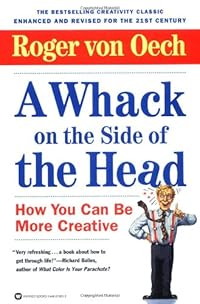
A Whack on the Side of the Head
by Roger von Oech
On This Page
Description
Over the years, A WHACK ON THE SIDE OF THE HEAD has been praised by business people, educators, scientists, homemakers, artists, youth leaders, and many more. The book has been stimulating creativity in millions of readers, translated into eleven languages, and used in seminars around the world. Now Roger von Oech's fully illustrated and updated volume is filled with even more provocative puzzles, anecdotes, exercises, metaphors, cartoons, questions, quotations, stories, and tips designed to show more systematically break through your mental blocks and unlock your mind for creative thinking. This new edition will attract an entire new generation of readers with updated and mind-stretching material. show lessTags
Recommendations




Member Reviews
Note: I read the 1990 version of this book.
I learned about this book in the bibliography section of Seth Godin's Linchpin. It's aim is to stimulate you to be more creative. I found it very helpful.
What is the point, you may ask of being creative? Creative people stand out from the crowd, sometimes make things possible that didn't seem so, may increase productivity, or maybe just make life more enjoyable. Some examples are Albert Einstein, Johann Gutenberg, Isaac Newton, and William Shakespeare.
What happens if you're not at all interested in being creative? This quote (in the book) from physicist Tom Hirshfield summarizes it well: If you don't ask "Why this?" often enough, somebody will ask "Why you?".
My favorite quotes from this show more book:
The best way to get a good idea is to get a lot of ideas. (pg 28)
The metaphor is probably the most fertile power possessed by man. (Ortega y Gasset, pg 44)
Some people are so closely married to their ideas that they put them up on a pedestal. It's difficult to be creative when you have that much ego tied up in your idea. (pg 94)
A man's errors are his portals of discovery. (James Joyce, pg 154)
...two benefits of failure. First, if you do fail, you learn what doesn't work. Second, the failure gives you an opportunity to try a new approach. (pg 160)
What concerns me is not the way things are, but rather the way people think things are. (Epictetus, pg 162) show less
I learned about this book in the bibliography section of Seth Godin's Linchpin. It's aim is to stimulate you to be more creative. I found it very helpful.
What is the point, you may ask of being creative? Creative people stand out from the crowd, sometimes make things possible that didn't seem so, may increase productivity, or maybe just make life more enjoyable. Some examples are Albert Einstein, Johann Gutenberg, Isaac Newton, and William Shakespeare.
What happens if you're not at all interested in being creative? This quote (in the book) from physicist Tom Hirshfield summarizes it well: If you don't ask "Why this?" often enough, somebody will ask "Why you?".
My favorite quotes from this show more book:
The best way to get a good idea is to get a lot of ideas. (pg 28)
The metaphor is probably the most fertile power possessed by man. (Ortega y Gasset, pg 44)
Some people are so closely married to their ideas that they put them up on a pedestal. It's difficult to be creative when you have that much ego tied up in your idea. (pg 94)
A man's errors are his portals of discovery. (James Joyce, pg 154)
...two benefits of failure. First, if you do fail, you learn what doesn't work. Second, the failure gives you an opportunity to try a new approach. (pg 160)
What concerns me is not the way things are, but rather the way people think things are. (Epictetus, pg 162) show less
This book opened up my eyes to being more creative and thinking in a more creative way. von Oech brings forth a bunch of rules of business that stifle creativity, and one by one, he tears them down and shows how they do more harm than good when trying to be innovative (but hold an important place when it comes to critical systems).
Did you know that you're more likely to be creative if you consider yourself creative?
Did you know that the QWERTY keyboard was designed to slow down your typing speed?
Did you know that the Fool of the ruler was put in place to let the king hear something from someone who wasn't a "yes man"?
Applying the knowledge gleaned from this book, you too could be just a bit more creative, and get your process out of the show more dark ages and into the next century.
Recommended for people who need a little help being creative (though, in the end, the thing that makes one more creative is yourself). show less
Did you know that you're more likely to be creative if you consider yourself creative?
Did you know that the QWERTY keyboard was designed to slow down your typing speed?
Did you know that the Fool of the ruler was put in place to let the king hear something from someone who wasn't a "yes man"?
Applying the knowledge gleaned from this book, you too could be just a bit more creative, and get your process out of the show more dark ages and into the next century.
Recommended for people who need a little help being creative (though, in the end, the thing that makes one more creative is yourself). show less
Roger von Oech takes the premise that our educational system and business environment stifle creativity. Through this book, von Oech provides illustrations, puzzles, inspirational quotes, and exercises to help us adults rediscover our creativity.
Von Oech points out that solving a problem requires "soft thinking", which is imagination and creativity, and "hard thinking", which is the practical phase of decision making. Both "soft thinking" and "hard thinking" have their place. When tackling a problem, we should start off like an artist, using "soft thinking" skills to realize there's more than one idea. We can then convert to being a judge, using "hard thinking" skills" to decide which ideas are acceptable and practical to implement.
A show more Whack on the Side of the Head provides numerous examples and great lessons to improve creativity. The book provides great information about where and how to use "soft skills" to look at a problem from a different perspective.
www.ResolvingConflictsNow.com show less
Von Oech points out that solving a problem requires "soft thinking", which is imagination and creativity, and "hard thinking", which is the practical phase of decision making. Both "soft thinking" and "hard thinking" have their place. When tackling a problem, we should start off like an artist, using "soft thinking" skills to realize there's more than one idea. We can then convert to being a judge, using "hard thinking" skills" to decide which ideas are acceptable and practical to implement.
A show more Whack on the Side of the Head provides numerous examples and great lessons to improve creativity. The book provides great information about where and how to use "soft skills" to look at a problem from a different perspective.
www.ResolvingConflictsNow.com show less
Be foolish! Expect the unexpected! Break the rules! Ask what if …! Make mistakes! Follow your intuition! Take risks! See the big picture!
The secret of being more creative is to be able to look at the world in a different way. This book, an international bestseller, will ""whack"" you out of your traditional thought patterns and set your creative self free.
Fully illustrated, filled with provocative puzzles, anecdotes, exercises, cartoons, quotations, questions, stories and tips.... you can learn how to refresh your outlook and start thinking in new, creative ways.
The secret of being more creative is to be able to look at the world in a different way. This book, an international bestseller, will ""whack"" you out of your traditional thought patterns and set your creative self free.
Fully illustrated, filled with provocative puzzles, anecdotes, exercises, cartoons, quotations, questions, stories and tips.... you can learn how to refresh your outlook and start thinking in new, creative ways.
I must say that intitally this book did not appeal to me. But after conversing with the author, I was forced to take a second look. While it may not be the right book at this stage of my creative development, I will definitely add it to my creative library for future reference. It includes many creative exercises and inspiring quotes.
I had to read this book for my class, it was alright, I really liked some of the points he made but overall it was just an okay book.
An amazing book about how to become more creative. Roger von Oech is clearly a master of creativity and litters this books with many exciting tales of innovation. I'm definitely going to reread this book and make notes that I can quickly refer back to daily. Highly recommended.
Members
- Recently Added By
Lists

Wisdom
31 works; 5 members

Creating Possibilities
10 works; 1 member

Books Read in 2009
464 works; 11 members
Author Information

26 Works 1,926 Members
Roger von Oech's seminars and presentations have enhanced the creative skills of many millions around the world. He has worked with such companies as Disney, Intel, NBC, MTV, Coca-Cola, Sony, Microsoft, Ford, IBM, Cartier, CBS, CitiBank, Procter and Gamble, and the United States Olympic Committee. He earned his Ph.D. from Stanford University in show more the "History of Ideas." He lives in Atherton, California, with his wife, Wendy, and their two children, Athena and Alex. show less
Common Knowledge
- Canonical title
- A Whack on the Side of the Head
- Original publication date
- 1990 (Revised Edition) (Revised Edition)
- Dedication
- To Wendy, Athena, and Alex
Classifications
Statistics
- Members
- 1,262
- Popularity
- 19,329
- Reviews
- 9
- Rating
- (3.58)
- Languages
- Dutch, English, Hungarian, Portuguese (Portugal)
- Media
- Paper, Audiobook, Ebook
- ISBNs
- 22
- ASINs
- 6