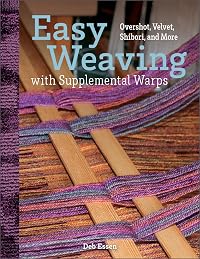
Easy Weaving with Supplemental Warps: Overshot, Velvet, Shibori, and More
by Deb Essen
On This Page
Description
Imagine being able to weave overshot along the length of your cloth with just one shuttle or being able to weave terry cloth towels for your bath. All this and more is possible on just four shafts by using a supplementary warp. Back by popular demand, this sought-after book hasn't been available for a long time. The revised and expanded edition features nearly twice as many projects as the original book, with five all-new projects and a new weaving structure. Handweavers will learn weaving show more expert Deb Essen's easy warping method, how to turn drafts for one-shuttle weaving, and Deb's tips and techniques for warping a supplementary draft successfully. Once you have the warping down, weave any of the projects using the weave structures Deb teaches you. Each project explores a different supplemental warp structure, from turned overshot and monk's belt to Bedford cord and even velvet. And no second back beam is required for your loom! show lessTags
Recommendations




















Member Reviews
This is a nice, hardbound book, with lots of information on how and why to incorporate supplemental warps in your woven projects. The introduction speaks to turning drafts to make supplemental wefts into supplemental warps. This often makes a structure a one shuttle weave. Time saved in weaving, but a bit more time in warping. The beginning chapters use monks belt and overshot as two examples of how this is achieved.
The next explains two ways to turn your drafts. A low tech and a high tech version meaning in one scenario you photocopy your draft and then pull it apart using scissors and glue to change the orientation of the draft. The high tech solution uses the power of weaving software to do the whole process with one click of your show more mouse. After you have your draft ready, you will find a variety of ways to wind your two warps, beam on, tension and weight your additional warp threads. Lots of examples are given so that you have choices – particularly if you don't have two warp beams on your loom. There are also examples given of why one method may serve you better than another method, depending on the structure and how it is woven.
A word here about the drafts in the book. I find them a bit small. I realize that making them larger would require more pages and make a more expensive book, but my older eyes need a bit of help to read them clearly. However, the drafts for the projects are pretty reasonably sized and some show you the colors in the threading which is nice.
There is a section on project planning which gives suggestions on the types of yarns suitable and that you might enjoy using as supplemental warps. Here is where some of those exotic knitting yarns can really shine as long as they are strong.
The rest of the book is devoted to supplemental warps. Most are fairly straight forward, but there are some more complex drafts that may interest the weaver. Overshot, monk's belt, velvet, woven shibori and terry cloth on four and six shafts. Bedford Cord, piqué and turned Summer and Winter on six and eight shafts.
It's a grand book with lots and lots of color photos. It's also a book that lends itself to learning a new technique, but also to future projects in which you would like to showcase some decorative yarns against a more humble background. show less
The next explains two ways to turn your drafts. A low tech and a high tech version meaning in one scenario you photocopy your draft and then pull it apart using scissors and glue to change the orientation of the draft. The high tech solution uses the power of weaving software to do the whole process with one click of your show more mouse. After you have your draft ready, you will find a variety of ways to wind your two warps, beam on, tension and weight your additional warp threads. Lots of examples are given so that you have choices – particularly if you don't have two warp beams on your loom. There are also examples given of why one method may serve you better than another method, depending on the structure and how it is woven.
A word here about the drafts in the book. I find them a bit small. I realize that making them larger would require more pages and make a more expensive book, but my older eyes need a bit of help to read them clearly. However, the drafts for the projects are pretty reasonably sized and some show you the colors in the threading which is nice.
There is a section on project planning which gives suggestions on the types of yarns suitable and that you might enjoy using as supplemental warps. Here is where some of those exotic knitting yarns can really shine as long as they are strong.
The rest of the book is devoted to supplemental warps. Most are fairly straight forward, but there are some more complex drafts that may interest the weaver. Overshot, monk's belt, velvet, woven shibori and terry cloth on four and six shafts. Bedford Cord, piqué and turned Summer and Winter on six and eight shafts.
It's a grand book with lots and lots of color photos. It's also a book that lends itself to learning a new technique, but also to future projects in which you would like to showcase some decorative yarns against a more humble background. show less
Ratings
Members
- Recently Added By
Lists

Handweavers Classics
50 works; 2 members
Author Information
9 Works 181 Members
Classifications
Statistics
- Members
- 90
- Popularity
- 356,488
- Reviews
- 1
- Rating
- (4.50)
- Languages
- English
- Media
- Paper
- ISBNs
- 2