Notes of a Crocodile
by Miaojin Qiu
On This Page
Description
"Set in the post-martial-law era of 1990s Taipei, Notes of a Crocodile depicts the coming-of-age of a group of queer misfits discovering love, friendship, and artistic affinity while hardly studying at Taiwan's most prestigious university. Told through the eyes of an anonymous lesbian narrator nicknamed Lazi, Qiu Miaojin's cult classic novel is a postmodern pastiche of diaries, vignettes, mash notes, aphorisms, exegesis, and satire by an incisive prose stylist and countercultural icon. show more Afflicted by her fatalistic attraction to Shui Ling, an older woman who is alternately hot and cold toward her, Lazi turns for support to a circle of friends that includes the devil-may-care, rich-kid-turned-criminal Meng Sheng and his troubled, self-destructive gay lover Chu Kuang, as well as the bored, mischievous overachiever Tun Tun and her alluring slacker artist girlfriend Zhi Rou. Bursting with the optimism of newfound liberation and romantic idealism despite corroding innocence, Notes of a Crocodile is a poignant and intimate masterpiece of social defiance by a singular voice in contemporary Chinese literature"-- show lessTags
Recommendations












































Member Recommendations
wandering_star similarly elliptical, sideways on look at the world through the eyes of someone who doesn't quite fit in
Member Reviews
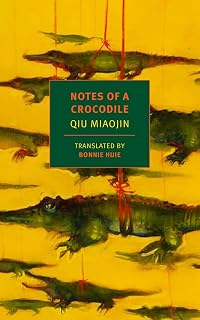
I'd never heard of this book before, but bought it based on NYRB classics, translated fiction, queer misfits, and I don't think I've read any authors from Taiwan before. Plus this cover is just fantastic. Still, I had very little in the way of expectations going in.
Now I am struggling to find a way to talk about it. Central to the story is the narrator, known to us only by the nickname Lazi, and her on-again off-again love with Shui Ling. Told from excerpts from ten notebooks Lazi wrote over a period encompassing what seems to be the last few years of high school (except she is no longer living at home?) through what seems to be a prestigious college -- as she struggles to figure out life and love (mostly love) with the help of a few show more other queer kids who all seem to be cut off from any larger, established LGBTQIA+ community and so are figuring things out in a vacuum with mostly only their self-doubts, fleeting obsessions, and the judgements of society at large to guid them. The fragmented run-on sentence above is somewhat indicative of the fragmented nature of the text, which sometimes shifts backwards and forwards in time and also sideways to a crocodile analogy in a way that is sometimes bewildering but no more so than it would be to live that way. Most of the characters involved seem to be academically gifted, analytical, obscure-reference making types instantly familiar to anyone who's ever been on a college campus. I couldn't help but love them all and fiercely wish for them to be scooped up by queer elders to share with them joy and radical acceptance.
Have already acquired her other novel. show less
Now I am struggling to find a way to talk about it. Central to the story is the narrator, known to us only by the nickname Lazi, and her on-again off-again love with Shui Ling. Told from excerpts from ten notebooks Lazi wrote over a period encompassing what seems to be the last few years of high school (except she is no longer living at home?) through what seems to be a prestigious college -- as she struggles to figure out life and love (mostly love) with the help of a few show more other queer kids who all seem to be cut off from any larger, established LGBTQIA+ community and so are figuring things out in a vacuum with mostly only their self-doubts, fleeting obsessions, and the judgements of society at large to guid them. The fragmented run-on sentence above is somewhat indicative of the fragmented nature of the text, which sometimes shifts backwards and forwards in time and also sideways to a crocodile analogy in a way that is sometimes bewildering but no more so than it would be to live that way. Most of the characters involved seem to be academically gifted, analytical, obscure-reference making types instantly familiar to anyone who's ever been on a college campus. I couldn't help but love them all and fiercely wish for them to be scooped up by queer elders to share with them joy and radical acceptance.
Have already acquired her other novel. show less
I picked this novel up at random in the library, knowing nothing about it beyond the blurb. Having read it, I wish there had been an afterword to tell me more about the author and cultural context in which it was written. Without that, I found it atmospheric yet oblique. The format is of a diary or set of reflections written by Lazi, a emotionally turbulent and self-destructive undergraduate student. She’s attracted to women and troubled by it, as her social milieu is implied to be very homophobic. Her friendships and romantic entanglements are all terribly overwrought, which reminded me of the emotional dramas I observed during my own undergraduate years. The chaotic nature of all this drama can become a bit wearing, though. I wanted show more more context for it, as I have no idea about what late 1980s Taiwan was like. My favourite element of the book was the interjection of allegorical chapters about a crocodile, clearly a metaphor for being queer. These were slyly witty, implying a voyeuristic fascination with and fear of LGBTQ people in popular culture:
Such deadpan chapters provide a striking contrast the very messy reality of Lazi’s life and those of her friends. The three stars I’m giving ‘Notes of a Crocodile’ reflect a lack of contextual knowledge on the part of the reader, rather than the book as such. A translator’s note, or similar, would have been very helpful. show less
From the standpoint of developmental psychologists, crocodiles were an aberrant species. In accordance with their discipline’s understanding of crocodile families, their research indicated distinct differences from humans at every stage of development from birth to puberty as well as in maturity, though details had yet to be ascertained. There was a general consensus, however, that up the age of fourteen, crocodiles a homemade ‘human suit’ before running away from home. While exact causes remained unknown, scholars cited societal attitudes as a factor in crocodile mutation, suggesting that there was no means of preventing an increase in the number of emergent crocodiles, which would ultimately contribute to a broader societal trend toward a full-fledged crocodile ecology and genetic mutation.
Such deadpan chapters provide a striking contrast the very messy reality of Lazi’s life and those of her friends. The three stars I’m giving ‘Notes of a Crocodile’ reflect a lack of contextual knowledge on the part of the reader, rather than the book as such. A translator’s note, or similar, would have been very helpful. show less
Those who follow my reviews know that translated fiction is one of my obsessions, so I was delighted to discover NYRB's reissue of the Taiwanese cult classic of queer literature, Notes of a Crocodile. Described by its translator Bonnie Huie as a "survival manual for teenagers, for a certain age when reading the right book can save your life," Notes of a Crocodile nevertheless has much to offer adults, particularly those who are cisgendered.
I must confess to being confused by the book's structure for a large chunk of its relatively modest length. Qiu Miaojin moves back and forth between two narratives, with their only connection being thematic. The first story is the one I was expecting from the publisher's description: that of "the show more coming-of-age of a group of queer misfits discovering love, friendship, and artistic affinity while hardly studying at Taiwan's most prestigious university." The second story provides the novel's title: a crocodile wearing a human suit, à la the dinosaurs in Eric Garcia's Anonymous Rex series, muses on how people vehemently advocate both for and against crocodiles, despite knowing nothing about them and not even realizing that at least one crocodile lives and works among them. At the risk of stating the obvious, the common theme is separation, isolation, and the tendency of some people to make authoritative statements about a group whose experiences they do not share:
"In the final analysis, our knowledge and understanding of crocodiles is but a microorganism on a fingernail. But in the customary practice of advanced nations, we will safeguard information within the grip of our metal jaws, holding on as if our lives depended on it."
Sound familiar?
Notes of a Crocodile concludes with a message which should be emblazoned on the blackboard in every classroom in the world, from preschool to university:
"The deeper you love, the deeper your compassion grows and the more you realize that the other suffers just as you do. When all is said and done, human civilization is ugly and cruel, and the only thing to do is to raze it to the ground so it becomes visible that kindredness is the one true constant in relationships."
Just imagine the world that might result.
This review was based on a free ARC provided by the publisher. show less
I must confess to being confused by the book's structure for a large chunk of its relatively modest length. Qiu Miaojin moves back and forth between two narratives, with their only connection being thematic. The first story is the one I was expecting from the publisher's description: that of "the show more coming-of-age of a group of queer misfits discovering love, friendship, and artistic affinity while hardly studying at Taiwan's most prestigious university." The second story provides the novel's title: a crocodile wearing a human suit, à la the dinosaurs in Eric Garcia's Anonymous Rex series, muses on how people vehemently advocate both for and against crocodiles, despite knowing nothing about them and not even realizing that at least one crocodile lives and works among them. At the risk of stating the obvious, the common theme is separation, isolation, and the tendency of some people to make authoritative statements about a group whose experiences they do not share:
"In the final analysis, our knowledge and understanding of crocodiles is but a microorganism on a fingernail. But in the customary practice of advanced nations, we will safeguard information within the grip of our metal jaws, holding on as if our lives depended on it."
Sound familiar?
Notes of a Crocodile concludes with a message which should be emblazoned on the blackboard in every classroom in the world, from preschool to university:
"The deeper you love, the deeper your compassion grows and the more you realize that the other suffers just as you do. When all is said and done, human civilization is ugly and cruel, and the only thing to do is to raze it to the ground so it becomes visible that kindredness is the one true constant in relationships."
Just imagine the world that might result.
This review was based on a free ARC provided by the publisher. show less
DNF. A unique writing style, insight into a smart and very depressed mind, and I found it insufferable. I'm not saying objectively bad, just that I cannot spend another moment mired in the destructive self-obsessed overly philosophical mind of an early adult trying to figure out some very dysfunctional relationships. I felt in danger of sympathetic depression. Yet I can see moments of what might make this the cult classic I'm told that it is; I just need more context to connect - maybe if I read this at a much younger age or had different life experiences. Truly glad it exists for the readers that do connect to it.
show more
Miaojin is able to draw on the particularities of their individual dispositions without making the impossibility of queer relationships, at that precise historical moment in Taiwan, seem like the result of mere problems with individuals. In fact, all of these unhappy queer people in love with people they can’t be with begin to add up to a problem that is more than just personal failings. “I remember back in high school, we were a bunch of misfits, always having fun. There was something going on every day. We were part of a community. Now life’s all about being tied down by a man,” says Tun Tun, summing up the central issue of the book: how to live a life of queer imaginaries outside of the strictures of heteronormative society.
In another conversation that Lazi has with Chu Kuang about his relationship with Meng Sheng, he tells her, “How about if the three of us agree to have post-gender relations? I’m done talking about it. In the end, all three of us have been seriously warped by gender labels.”
An excerpt from my review, available in full here: http://www.popmatters.com/column/notes-of-a-crocodile-qiu-miaojin-taiwanese-quee... show less
notes of a crocodile by qiu miaojin was a book i was hugely excited for, and it had amazing flashes of brilliance, but some elements fell flat. however, i think that was my fault because i tried to read it while i was commuting and my attention was not what it should have been.
.
the story of Lazi, a lesbian in post-martial law Taiwan, is told through diary entries interspersed with elements of what i believe to be excerpts from the narrator’s novel about crocodiles which serves as an allegory for being a closeted person in Taiwan. Lazi goes through a failed romance that never leaves her, and influences all other relationships in her life. honestly? i almost preferred the parts about the crocodiles. this is a great book, but you need to show more be prepared to pay attention and maybe even take notes. i would say while it is a very important book, it was not my favorite book show less
.
the story of Lazi, a lesbian in post-martial law Taiwan, is told through diary entries interspersed with elements of what i believe to be excerpts from the narrator’s novel about crocodiles which serves as an allegory for being a closeted person in Taiwan. Lazi goes through a failed romance that never leaves her, and influences all other relationships in her life. honestly? i almost preferred the parts about the crocodiles. this is a great book, but you need to show more be prepared to pay attention and maybe even take notes. i would say while it is a very important book, it was not my favorite book show less
This book provides a very introspective look into the life of a college student who seems to suffer from depression and a lot of guilt over her sexuality. She struggles over her love for a woman who is very unreliable and is tormented by this. In the way of the very young, she can often come across as whiny or melodramatic. Still, this was an interesting look at how homosexual students in Taiwan in the late 80s dealt with societal pressures.
Members
- Recently Added By
Lists

Asia
178 works; 7 members

Books from around the world: Asia
11 works; 1 member
Author Information

10+ Works 968 Members
Awards and Honors
Awards
Series
Belongs to Publisher Series
Work Relationships
Is contained in
Common Knowledge
- Canonical title
- Notes of a Crocodile
- Original title
- 鱷魚手記
- Original publication date
- 1994
- People/Characters
- Lazi; Shui Ling; Meng Sheng; Chu Kuang; Zhi Rou; Tun Tun (show all 7); Xiao Fan
- Important places
- Taiwan
- First words
- July 20, 1991. Picked up my college diploma at the service window of the registrar's office.
- Quotations
- I'd always been surrounded by people who cared for me, but no matter how much they loved me, they couldn't save me: It just wasn't me. I never let others get too close and simply paraded a fake me that resembled their ... (show all)image of me. Sweeping that other me into their arms, they led me in a dance within societal norms, along a trajectory based on a delusion. (Though I couldn't define what I was, I knew what I wasn't.) I was shown the limits, and being confined within a set of walls tormented me and drained me of life, for the real me spanned multitudes, stretching far beyond the bounds of normality encircling ninety percent of the human race.
- Last words
- (Click to show. Warning: May contain spoilers.)Note: As Jarman said, "I have nothing more to say....I wish you all the best!"
- Original language
- Chinese
Classifications
- Genres
- LGBTQ+, Fiction and Literature, General Fiction
- DDC/MDS
- 895.13 — Literature & rhetoric Literatures of other languages Literatures of East and Southeast Asia Chinese Chinese fiction
- LCC
- PL2892.5 .U65 .E913 — Language and Literature Languages and literatures of Eastern Asia, Africa, Oceania Languages of Eastern Asia, Africa, Oceania Chinese language and literature Chinese literature Individual authors and works
- BISAC
Statistics
- Members
- 630
- Popularity
- 46,310
- Reviews
- 15
- Rating
- (3.57)
- Languages
- 5 — Chinese, English, French, German, Spanish
- Media
- Paper, Audiobook, Ebook
- ISBNs
- 12
- ASINs
- 5