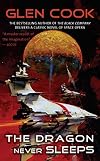
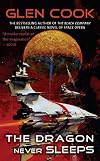
The Dragon Never Sleeps
by Glen Cook
On This Page
Description
Fiction. Science Fiction. HTML:For four thousand years, the Guardships have ruled Canon Space—immortal ships with an immortal crew, dealing swiftly and harshly with any mercantile houses or alien races that threaten the status quo.But now the House Tregesser has an edge: a force from outside Canon Space offers them the resources to throw off Guardship rule. This precipitates an avalanche of unexpected outcomes, including the emergence of Kez Maefele, one of the few remaining generals of show more the Ku Warrior race-the only race to ever seriously threaten Guardship hegemony. Kez Maefele and a motley group of aliens, biological constructs, an scheming aristocrats find themselves at the center of the conflict. Maefele must chose which side he will support: the Guardships, who defeated and destroyed his race, or the unknown forces outside Canon Space that promise more death and destruction. show less
Tags
Recommendations









Member Reviews
This is one of those novels that has a plot and world with so much freaking potential. A grand, sweeping space opera with immortals, cloning, ancient races/tech, aliens, etc... The human dominated territory in the galaxy is patrolled by enormous, semi-sentient "Guardships", crewed by clones of the humans who started the empire thousands of years ago. They maneuver on a system of faster-than-light way points whose origin remain unclear to all the players involved. The "Canon", as the empire is called, has never seriously been challenged for supremacy.
But the area that Canon controls has evolved over the millennium, while the Guardships remain much the same. Sentient species have diversified, technology has advanced, and the minor Houses show more under the Canon are tired of tasting the boot of oppression. With the help of ancient Canon enemies, multiple factions are set to test the status-quo of the known universe.
Though I think it would be silly to say that Cook's goal strayed far from writing an adventurous space opera, much of The Dragon Never Sleeps could be interpreted as an analogy for the relationship between organized religion and the modern world. How we engage with and struggle against the status quo of our own lives and world is at the core of most character's struggles. Cook keeps these characters and their choices refreshingly morally grey.
Cook is loathe to explain anything outright to the reader. The Dragon Never Sleeps has one of the highest 'learning curves' of any SF work that I've read. I really didn't have my feet under me until around forty percent of the way though. I'm usually one to love that style of writing. I appreciate the author respecting my intelligence: though, I really can't help but think that Cook's opaqueness serves little purpose here. Cook's prose is uninspiring and lacking of any descriptions whatsoever, the enormous stakes of the plot carried little actual gravity, and the ending is oddly saccharine compared to the rest of the story. I was also not a fan of the rapid-fire changes in perspective that made it hard to connect with and care for any character in particular.
I simply can't rank it higher because the terrible reading experience. I often found myself trudging back to the pages as one would a date with the gallows. There were moments where I was more engaged than others, but certainly most of the book I found myself begging for it to be over. It seems to me that Cook bit off more than he could reasonably chew. While this semi-mangled mess of a space opera has strengths, it ultimately was not for me. show less
But the area that Canon controls has evolved over the millennium, while the Guardships remain much the same. Sentient species have diversified, technology has advanced, and the minor Houses show more under the Canon are tired of tasting the boot of oppression. With the help of ancient Canon enemies, multiple factions are set to test the status-quo of the known universe.
Though I think it would be silly to say that Cook's goal strayed far from writing an adventurous space opera, much of The Dragon Never Sleeps could be interpreted as an analogy for the relationship between organized religion and the modern world. How we engage with and struggle against the status quo of our own lives and world is at the core of most character's struggles. Cook keeps these characters and their choices refreshingly morally grey.
Cook is loathe to explain anything outright to the reader. The Dragon Never Sleeps has one of the highest 'learning curves' of any SF work that I've read. I really didn't have my feet under me until around forty percent of the way though. I'm usually one to love that style of writing. I appreciate the author respecting my intelligence: though, I really can't help but think that Cook's opaqueness serves little purpose here. Cook's prose is uninspiring and lacking of any descriptions whatsoever, the enormous stakes of the plot carried little actual gravity, and the ending is oddly saccharine compared to the rest of the story. I was also not a fan of the rapid-fire changes in perspective that made it hard to connect with and care for any character in particular.
I simply can't rank it higher because the terrible reading experience. I often found myself trudging back to the pages as one would a date with the gallows. There were moments where I was more engaged than others, but certainly most of the book I found myself begging for it to be over. It seems to me that Cook bit off more than he could reasonably chew. While this semi-mangled mess of a space opera has strengths, it ultimately was not for me. show less
I’ve generally enjoyed Cook’s Black Company books (with a couple of notable exceptions). This is my first foray into his science fiction, and it left me with mixed feelings.
Much of the first half of the book left me thinking “poor man’s version of 'The Culture'” (indeed the book originally appeared the year after Consider Phlebas). But then, about 200 pages in, the story starts to come together in a surprisingly compelling way. By then Cook has killed off many of the myriad characters who inhabit the early sections of the book, and those who are left are generally well-defined, interesting, and going through transforming experiences en route to a perilous future. This is space opera with characters drawn in shades of gray… show more no Jedi Knights against the villains of the Dark Side here.
But then, after all that, the climax and denouement all felt like a bit of a let-down. After having been kept guessing about Kez Maefele’s goals and motivations for most of the book, his actions during the climactic scenes of the book felt fairly random to me.
Don’t expect even remotely convincing aliens, or economics, or politics…This is one of those books that is just supposed to entertain and amuse, and for the most part it delivers. The implications of the cloning and regeneration aspects of certain societies in the book were completely ignored. And I missed the dark humor which pervades the Black Company books.
Still, all in all, worth your time. show less
Much of the first half of the book left me thinking “poor man’s version of 'The Culture'” (indeed the book originally appeared the year after Consider Phlebas). But then, about 200 pages in, the story starts to come together in a surprisingly compelling way. By then Cook has killed off many of the myriad characters who inhabit the early sections of the book, and those who are left are generally well-defined, interesting, and going through transforming experiences en route to a perilous future. This is space opera with characters drawn in shades of gray… show more no Jedi Knights against the villains of the Dark Side here.
But then, after all that, the climax and denouement all felt like a bit of a let-down. After having been kept guessing about Kez Maefele’s goals and motivations for most of the book, his actions during the climactic scenes of the book felt fairly random to me.
Don’t expect even remotely convincing aliens, or economics, or politics…This is one of those books that is just supposed to entertain and amuse, and for the most part it delivers. The implications of the cloning and regeneration aspects of certain societies in the book were completely ignored. And I missed the dark humor which pervades the Black Company books.
Still, all in all, worth your time. show less
This was quite a departure for Glen Cook, and for me as a reader. While there were certainly departures from "average" sci fi writing (the characters are always colored in layers of grey, no straight black and white), it did fall prey to a common failing - thousands of invented character names that are completely convoluted and nonsensical. It took me nearly half the book to be able to keep them all straight, and that was probably because they were starting to die off by then. Yet, it was still Glen-Cookian enough to keep me there, turning the pages long after I should have been asleep. Mr. Cook can tell a rollicking tale better than just about anyone else I know. While not Black Company or Garrett Files, it was still a good story.
A distant future of a civilization so old that it has stratified and calcified into static heirarchies. Over it all, a tyrannical force of super-ships police Canon-space, ruthlessly maintaining Humanity's hold on the worlds therein.
This is really the story of the missions of One of the Guardships, the VII-Gemina, and her crew: a Crew that has been its crew for so long, recreated/reborn over and over such that they don't even know of any time BEFORE they were crew.
The Story starts off with a focus-- but halfway thru the book and several outrageous plot characters too many and you are just taking the ride through a very colorful universe where ancient superships maintain a Law that No-one remembers who first imposed it, fighting against show more ancient alien rebels who never die. The Plot just kinda spirals off into dark and there's no point in chasing it. That's the main negative of this book.
And then you hit the part where it seems that the Superships have minds of their own, mixed in with the uploaded consciousnesses of dead commanders-- and the whispered thought that NO LAWS govern them in the end.
A Weird, Strange future that I found entrancing to contemplate. If only the author had been disciplined to stay inside a more cohesive plot structure. show less
This is really the story of the missions of One of the Guardships, the VII-Gemina, and her crew: a Crew that has been its crew for so long, recreated/reborn over and over such that they don't even know of any time BEFORE they were crew.
The Story starts off with a focus-- but halfway thru the book and several outrageous plot characters too many and you are just taking the ride through a very colorful universe where ancient superships maintain a Law that No-one remembers who first imposed it, fighting against show more ancient alien rebels who never die. The Plot just kinda spirals off into dark and there's no point in chasing it. That's the main negative of this book.
And then you hit the part where it seems that the Superships have minds of their own, mixed in with the uploaded consciousnesses of dead commanders-- and the whispered thought that NO LAWS govern them in the end.
A Weird, Strange future that I found entrancing to contemplate. If only the author had been disciplined to stay inside a more cohesive plot structure. show less
I came across Glen Cook's works by pure chance. After reading some Black Company novels I went after his SF titles :)
Story is about conflict taking place in a (very) distant future where Canon space (known space) is controlled by infamous Guardships. Guardships are sort of a "living" ships - they are powered by ever-evolving AI that keeps record of all past battles [which makes them very very difficult to destroy] and are commanded by (human) immortal crew. They rule with the iron fist and usually follow the policy of shoot first ask questions later (if anybody is left standing). Main role for this war machines is to keep status quo in Canon space and to prevent any side (human or not) of taking the upper hand. But now they are facing show more unknown and known enemy (one they believed to be exterminated), weird aliens from unknown regions and nobles ready to do anything it is required to reach the halls of power (by anything I mean anything).
This book has more twists and turns than any other book I have ever read. It is listed under military sf but it is more, much more. Battles are described in short - few sentences, paragraph or [in some] cases entire [albeit small] chapters. Story is fast paced and very interesting but some parts are chaotic (to say the least) - you are truly left wondering what happened to some characters, are they alive or not (and even you when see/read them in following chapter you still won't be 100% sure what happened to them). I think this is an element that many readers will have problems with, which is a shame because [I will repeat myself] this one is a great story.
Recommended. show less
Story is about conflict taking place in a (very) distant future where Canon space (known space) is controlled by infamous Guardships. Guardships are sort of a "living" ships - they are powered by ever-evolving AI that keeps record of all past battles [which makes them very very difficult to destroy] and are commanded by (human) immortal crew. They rule with the iron fist and usually follow the policy of shoot first ask questions later (if anybody is left standing). Main role for this war machines is to keep status quo in Canon space and to prevent any side (human or not) of taking the upper hand. But now they are facing show more unknown and known enemy (one they believed to be exterminated), weird aliens from unknown regions and nobles ready to do anything it is required to reach the halls of power (by anything I mean anything).
This book has more twists and turns than any other book I have ever read. It is listed under military sf but it is more, much more. Battles are described in short - few sentences, paragraph or [in some] cases entire [albeit small] chapters. Story is fast paced and very interesting but some parts are chaotic (to say the least) - you are truly left wondering what happened to some characters, are they alive or not (and even you when see/read them in following chapter you still won't be 100% sure what happened to them). I think this is an element that many readers will have problems with, which is a shame because [I will repeat myself] this one is a great story.
Recommended. show less
This review is written with a GPL 4.0 license and the rights contained therein shall supersede all TOS by any and all websites in regards to copying and sharing without proper authorization and permissions. Crossposted at WordPress, Blogspot, Librarything & by Bookstooge’s Exalted Permission
Title: The Dragon Never Sleeps
Series: ----------
Author: Glen Cook
Rating: 3.5 of 5 Stars
Genre: SF
Pages: 449
Format: Digital edition
Synopsis:
Humanity rules their part of space, The Canon. With the unstoppable force of the Guardships behind them, Canon forces enforce peace, their peace, whereever they go.
One House wants to stop that. One alien wants to stop that. One other branch of Humanity wants to stop that. But that House is ruled by a show more megolomaniac who wants to live forever through his forbidden clones. But that alien lives by a code of honor that is unbreakable. But that branch of humanity is enslaved to psychic mind leeches.
On the Guardship side of things, you have insane Guardships. You have nascent sentient Guardships. You have humans who live their lives over and over through cloning without ever remembering their past. You have a Humanity that is stagnating and possibling beginning the long road to its twilight.
And the stories take place with all of those characters and characteristics. Greed, War, Peace and Survival.
My Thoughts:
I had no idea of the background for 99/100ths of the time. I really enjoyed my time, but if you try to figure out the backstory or the history, you're sunk. It doesn't exist except in Cook's mind and he doesn't let slip hardly anything. This is a very “here and now” kind of story, even while taking years in story time.
I thoroughly enjoyed myself while reading this. I didn't feel like I had to understand anything. I just sat back, let the story unfold and let it roll over me. It was extremely complicated but since I wasn't trying to disentangle anything, it was actually rather simple. I was along for the ride. If I had been in an investigative mood I'm sure this would have driven me bonkers. But I wasn't, so it didn't.
I don't know that I could have told you that this was the same Glen Cooke who wrote the Black Company novels. It was a standalone book and even its style seemed standalone. I will say that it was dense and while it claims to be only 449 pages, it felt like the longest 449 pages I've ever read. Not a bad thing, but it was a long read.
★★★☆½ show less
Title: The Dragon Never Sleeps
Series: ----------
Author: Glen Cook
Rating: 3.5 of 5 Stars
Genre: SF
Pages: 449
Format: Digital edition
Synopsis:
Humanity rules their part of space, The Canon. With the unstoppable force of the Guardships behind them, Canon forces enforce peace, their peace, whereever they go.
One House wants to stop that. One alien wants to stop that. One other branch of Humanity wants to stop that. But that House is ruled by a show more megolomaniac who wants to live forever through his forbidden clones. But that alien lives by a code of honor that is unbreakable. But that branch of humanity is enslaved to psychic mind leeches.
On the Guardship side of things, you have insane Guardships. You have nascent sentient Guardships. You have humans who live their lives over and over through cloning without ever remembering their past. You have a Humanity that is stagnating and possibling beginning the long road to its twilight.
And the stories take place with all of those characters and characteristics. Greed, War, Peace and Survival.
My Thoughts:
I had no idea of the background for 99/100ths of the time. I really enjoyed my time, but if you try to figure out the backstory or the history, you're sunk. It doesn't exist except in Cook's mind and he doesn't let slip hardly anything. This is a very “here and now” kind of story, even while taking years in story time.
I thoroughly enjoyed myself while reading this. I didn't feel like I had to understand anything. I just sat back, let the story unfold and let it roll over me. It was extremely complicated but since I wasn't trying to disentangle anything, it was actually rather simple. I was along for the ride. If I had been in an investigative mood I'm sure this would have driven me bonkers. But I wasn't, so it didn't.
I don't know that I could have told you that this was the same Glen Cooke who wrote the Black Company novels. It was a standalone book and even its style seemed standalone. I will say that it was dense and while it claims to be only 449 pages, it felt like the longest 449 pages I've ever read. Not a bad thing, but it was a long read.
★★★☆½ show less
A region of peace has come over the galaxy dictated and enforce by immortal Guardships run by humans. The Guardships travel on an artificial construct called the Web. However the population of humans is decreasing and Others are moving in. The Others at the periphery are looking to destroy the Guardships under the coercion of a an alien race with psychic powers and sadistic habits. The Others capture an ancient foe of the Guardships from a defeated warrior race. Meanwhile, a commercial House conspires against the Guardships and suffers from deadly internal politics.
I can understand why authors want to write a stand alone novel, but this book should have been at least two or three books. I loved the characters. I loved the premise and show more the plot, but the action was sometimes too fast and furious and sometimes much slower. If the book(s) had been longer, many of the passages that were rushed over in the first half would have been made much clearer. show less
I can understand why authors want to write a stand alone novel, but this book should have been at least two or three books. I loved the characters. I loved the premise and show more the plot, but the action was sometimes too fast and furious and sometimes much slower. If the book(s) had been longer, many of the passages that were rushed over in the first half would have been made much clearer. show less
Members
- Recently Added By
Author Information

117+ Works 36,038 Members
Series
Belongs to Publisher Series
Common Knowledge
- Original publication date
- 1988
- Original language
- English
Classifications
Statistics
- Members
- 510
- Popularity
- 58,597
- Reviews
- 11
- Rating
- (3.78)
- Languages
- English, French
- Media
- Paper, Audiobook, Ebook
- ISBNs
- 6
- ASINs
- 6