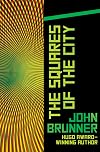
The squares of the city
by John Brunner
On This Page
Description
"One of the most important science fiction authors. Brunner held a mirror up to reflect our foibles because he wanted to save us from ourselves." —SF Site For each generation, there is a writer meant to bend the rules of what we know. Hugo Award winner (Best Novel, STAND ON ZANZIBAR) and British science fiction master John Brunner remains one of the most influential and respected authors of all time, and now E-Reads is pleased to re-introduce many of his classic works. For readers familiar show more with his vision, it's a chance to re-examine his thoughtful worlds and words, while for new readers, Brunner's work proves itself the very definition of timeless. In THE SQUARES OF THE CITY, Brunner takes the moves of a classic championship chess game and uses them as the structure to build a novel about a revolution in a South American country obsessed with chess and dominated by a dictator who sees people as pawns in his game of power and survival. Intriguing premise, dramatic story, future setting, great entertainment.. show less
Tags
Recommendations
















Member Reviews
The Sheep Look Up utterly devastated me when I read it for the first (and definitely not the last) time earlier this year, and I realized that John Brunner was a guy whose books I would definitely need to track down one by one until I had read them all.
Then a relatively new Twitter friend, Fred Kiesche, applauding my resolution, told me that if The Sheep Look Up was "death by pollution", The Squares of the City was "death by chess". As in the structure is modeled after a World Championship game in 1982 between Wilhelm Steinitz and Mikhail Chigorin. I thus knew that this one would have to be my next Brunner, because if there is one thing I love, utterly hopelessly*, it's chess. And people who are obsessed with chess.
And I also like a show more good jaw about urban planning and cities. So, um, as they say nowadays, hell yes.
The city in question here, Vados, is a relatively newly founded capital city in a ficticious South American Republic, Aguazul, to which our hero, the delightfully named Boyd Hakluyt,** has been summoned to help improve its traffic flows. Vados might be the most modern and well-planned city in the world, but the problem of moving people and goods around is never really solved, is it?
But of course, it's not really a traffic problem our hero has been brought in to solve. See, the circumstances behind the founding, just 20 years ago, of the city of Vados, are troublesome. Aguazul's president, Vados (yes), did not trust his people and their meager resources to create the perfect city he dreamed of, so he threw it open to the global elite as what amounted to an investment opportunity with big returns -- the biggest return being a place to live with a guaranteed high standard of living, elegance, order, and freedom from riff-raff. Yeah, he sort of built Galt's Gulch.
But wait! In order to assure the city had adequate water, most of the nation's water supply was diverted. Water that peasants and villagers and small farmers depended on. Water that said peasants etc. wound up having to follow to Vados, even though Vados had no place for the likes of them, resulting in unsightly slums and shanty towns and the general presence of riff-raff in this perfect city. Oh noes!
So what Hakluyt is really there to do is come up with a "traffic improvement plan" that requires the city to eliminate said slums and shanty towns, thus forcing the riff-raff back "onto to the land" where they belong. Any plan he might come up with that does not require this will be rejected; he is there to provide an excuse and act as a scapegoat.
It takes him a while to discover this, of course. And once he does...
Here is the source of the novel's real interest and tension (the chess plot is really just window dressing, though it's kind of fun to track plot developments -- deaths, arrests, kidnappings -- and see how they map onto the moves of the famous 1892 game): Hakluyt spends a lot of this novel trying to rationalize his presence in Vados, to justify to himself and a few key others his dogged determination to do some appoximation, at least, of what he's being paid for. Among those key others is one Maria Posador, leader of a small faction of native-born privilege who have taken up the cause of the slum-dwellers. If there is an opposite term for "femme fatale" that term would apply to Maria, who is constantly trying to get our hero to do the right thing and tell his employers to pound sand.
Lots of others would like him to do so as well, and many of them are less subtle than Maria, which means there are some decent action scenes, conspiracy elements, even a bit of a mystery plot woven in with this meditation on haves and have nots and what the former might be seen to owe to the latter. Which is to say that once again, Brunner showed a great deal of prescience -- but this time his work has not achieved anything like the status of self-denying prophecy that The Sheep Look Up has.
And of course it's a bit of a dig at the history of the New World in general, isn't it?
Well worth a read.
*As in I adore the game and never miss a chance to play but pretty much suck at it to a hilarious degree.
**I suspect his name is a nod to Richard Hakluyt, an Elizabethan era writer who promoted the settlement of North America in his work. show less
Then a relatively new Twitter friend, Fred Kiesche, applauding my resolution, told me that if The Sheep Look Up was "death by pollution", The Squares of the City was "death by chess". As in the structure is modeled after a World Championship game in 1982 between Wilhelm Steinitz and Mikhail Chigorin. I thus knew that this one would have to be my next Brunner, because if there is one thing I love, utterly hopelessly*, it's chess. And people who are obsessed with chess.
And I also like a show more good jaw about urban planning and cities. So, um, as they say nowadays, hell yes.
The city in question here, Vados, is a relatively newly founded capital city in a ficticious South American Republic, Aguazul, to which our hero, the delightfully named Boyd Hakluyt,** has been summoned to help improve its traffic flows. Vados might be the most modern and well-planned city in the world, but the problem of moving people and goods around is never really solved, is it?
But of course, it's not really a traffic problem our hero has been brought in to solve. See, the circumstances behind the founding, just 20 years ago, of the city of Vados, are troublesome. Aguazul's president, Vados (yes), did not trust his people and their meager resources to create the perfect city he dreamed of, so he threw it open to the global elite as what amounted to an investment opportunity with big returns -- the biggest return being a place to live with a guaranteed high standard of living, elegance, order, and freedom from riff-raff. Yeah, he sort of built Galt's Gulch.
But wait! In order to assure the city had adequate water, most of the nation's water supply was diverted. Water that peasants and villagers and small farmers depended on. Water that said peasants etc. wound up having to follow to Vados, even though Vados had no place for the likes of them, resulting in unsightly slums and shanty towns and the general presence of riff-raff in this perfect city. Oh noes!
So what Hakluyt is really there to do is come up with a "traffic improvement plan" that requires the city to eliminate said slums and shanty towns, thus forcing the riff-raff back "onto to the land" where they belong. Any plan he might come up with that does not require this will be rejected; he is there to provide an excuse and act as a scapegoat.
It takes him a while to discover this, of course. And once he does...
Here is the source of the novel's real interest and tension (the chess plot is really just window dressing, though it's kind of fun to track plot developments -- deaths, arrests, kidnappings -- and see how they map onto the moves of the famous 1892 game): Hakluyt spends a lot of this novel trying to rationalize his presence in Vados, to justify to himself and a few key others his dogged determination to do some appoximation, at least, of what he's being paid for. Among those key others is one Maria Posador, leader of a small faction of native-born privilege who have taken up the cause of the slum-dwellers. If there is an opposite term for "femme fatale" that term would apply to Maria, who is constantly trying to get our hero to do the right thing and tell his employers to pound sand.
Lots of others would like him to do so as well, and many of them are less subtle than Maria, which means there are some decent action scenes, conspiracy elements, even a bit of a mystery plot woven in with this meditation on haves and have nots and what the former might be seen to owe to the latter. Which is to say that once again, Brunner showed a great deal of prescience -- but this time his work has not achieved anything like the status of self-denying prophecy that The Sheep Look Up has.
And of course it's a bit of a dig at the history of the New World in general, isn't it?
Well worth a read.
*As in I adore the game and never miss a chance to play but pretty much suck at it to a hilarious degree.
**I suspect his name is a nod to Richard Hakluyt, an Elizabethan era writer who promoted the settlement of North America in his work. show less
I've read several less well known Brunner novels over the past couple of years. They've been a bit of a mixed bag, but if nothing else I can admire him as an author who wasn't afraid to come up with an out-of-the-box concept and run with it.
Perhaps this is a book that can only truly be appreciated by chess enthusiasts. To me, it felt like it had potential--especially given a narrator and setting that were both unusual and intriguing. But in the end the "gimmick" (and dare I say the gimmick within a gimmick?) too often took the plot into directions that felt contrived and didn't particularly build towards a compelling climax.
I am used to thinking that in a successful story of this ilk the trick only becomes obvious in retrospective. So show more Initially it felt strange for the trick to be revealed in the one page introduction to the novel. But as the story progressed through move and countermove, often resulting in the sudden death of a character, it eventually reached a point where this rhythm would have felt ridiculous in the absence of understanding the gimmick. At that point it ceased to be a story about what people might actually do in a certain situation in a certain setting. show less
Perhaps this is a book that can only truly be appreciated by chess enthusiasts. To me, it felt like it had potential--especially given a narrator and setting that were both unusual and intriguing. But in the end the "gimmick" (and dare I say the gimmick within a gimmick?) too often took the plot into directions that felt contrived and didn't particularly build towards a compelling climax.
I am used to thinking that in a successful story of this ilk the trick only becomes obvious in retrospective. So show more Initially it felt strange for the trick to be revealed in the one page introduction to the novel. But as the story progressed through move and countermove, often resulting in the sudden death of a character, it eventually reached a point where this rhythm would have felt ridiculous in the absence of understanding the gimmick. At that point it ceased to be a story about what people might actually do in a certain situation in a certain setting. show less
It's not as good as I remember it being, which is kind of a shame. I still like it for its differences - this is a strange book to have come from John Brunner if you look at the rest of his works. I appreciate that Boyd is not trying to be the hero, he's just along for this strange ride, first trying to do his job, and then trying to be a decent human being.
Set in the fictional South American capital of Vados, Boyd Hakluyt, a traffic analyst, discovers the city's political instability is controlled by a leader manipulating citizens as pawns in a real-life 1892 chess match.
A city planner hired by a seemingly benevolent Latin despot of a Brasilia-like city is drawn into a web of intrigue as he discovers the horrible secret behind the city's apparent stability. The convoluted and bizarre plot is based on something quite foreign to storytelling (I won't spoil it by revealing what it is), according to the author. It has moments of interest, but is ultimately unsatisfying, as the resolution winds down awkwardly.
Not one of Brunner's best works; but an entertaining read and an ambitious effort. The denouement I found to be satisfyingly cynical.
An interesting conglomeration of concepts...
The major premise of the book is that the characters are all chess pieces, and the events of the book play out the movements of a famous chess game from 1892.
The secondary premise is that the protagonist is a traffic flow consultant, trying to solve problems in a South American city that bears a remarkable resemblance to Brasilia, in being a capital city constructed into place. And the principles he works by seem interesting and relatively plausible.
The major premise of the book is that the characters are all chess pieces, and the events of the book play out the movements of a famous chess game from 1892.
The secondary premise is that the protagonist is a traffic flow consultant, trying to solve problems in a South American city that bears a remarkable resemblance to Brasilia, in being a capital city constructed into place. And the principles he works by seem interesting and relatively plausible.
Members
- Recently Added By
Lists

Books Read in 2022
5,226 works; 115 members
Author Information

290+ Works 24,612 Members
Legendary science fiction author John Brunner was the winner of the Hugo award and two-time winner of the British Science Fiction Award. He was perhaps the first science fiction author to predict the Internet and coined the term "worm" to descibe computer viruses. Mr. Brunner died in 1995
Some Editions
Awards and Honors
Awards
Series
Belongs to Publisher Series
Common Knowledge
- Canonical title
- The squares of the city
- Original title
- The squares of the city
- Original publication date
- 1965-12
- First words
- The story told by John Brunner in The Squares of the City held me spellbound from beginning to end. • • Introduction
On the flight down from Florida I talked with my seat companion--or, to be more exact, he talked at me. - Last words
- (Click to show. Warning: May contain spoilers.)Parli pure, l'ascolto.
(Click to show. Warning: May contain spoilers.)". . . I'm listening." - Original language
- English
Classifications
Statistics
- Members
- 641
- Popularity
- 45,497
- Reviews
- 11
- Rating
- (3.36)
- Languages
- 7 — Dutch, English, French, German, Italian, Lithuanian, Romanian
- Media
- Paper, Ebook
- ISBNs
- 17
- ASINs
- 12