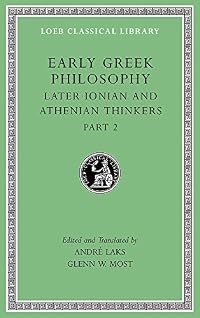
Early Greek Philosophy, Volume VII: Later Ionian and Athenian Thinkers, Part 2 (Loeb Classical Library)
by André Laks
On This Page
Description
The fragments and testimonia of the early Greek philosophers (often labeled the Presocratics) have always been not only a fundamental source for understanding archaic Greek culture and ancient philosophy but also a perennially fresh resource that has stimulated Western thought until the present day. This new systematic conception and presentation of the evidence differs in three ways from Hermann Diels's groundbreaking work, as well as from later editions: it renders explicit the material's show more thematic organization; it includes a selection from such related bodies of evidence as archaic poetry, classical drama, and the Hippocratic corpus; and it presents an overview of the reception of these thinkers until the end of antiquity. Volume I contains introductory and reference materials essential for using all other parts of the edition. Volumes II-III include chapters on ancient doxography, background, and the Ionians from Pherecydes to Heraclitus. Volumes IV-V present western Greek thinkers from the Pythagoreans to Hippo. Volumes VI-VII comprise later philosophical systems and their aftermath in the fifth and early fourth centuries. Volumes VIII-IX present fifth-century reflections on language, rhetoric, ethics, and politics (the so-called sophists and Socrates) and conclude with an appendix on philosophy and philosophers in Greek drama. show lessTags
Recommendations




Member Reviews
This seventh volume of the Loeb Classical Library's collection of Presocratic Greek philosophy is entirely dedicated to the original Atomists, Leucippus and Democritus. Practically, this means it's all Democritus, given that even among the ancients there was doubt whether or not Leucippus even existed; scholars today still debate this.
Regardless, Democritus's theory of Atomism is the closest the ancients got to our contemporary Western cosmology. His great innovation was to accept the Parmenidean challenge to the reliability of our senses by theorizing reality as a vast void filled with eternally moving particles, alternately bouncing off each other or catching hold of each other to generate gigantic aggregates that we sense show more (incorrectly) as the real world.
Democritus had no conception of atomic forces of attraction and repulsion, which gave the Aristotelians ground to bury his innovations beneath incisive criticisms of his inability to explain why anything happens. However, it's fascinating that despite the significant differences between ancient Atomism and modern physics, much of what Democritus wrote on the basis of sheer reason still resonates with our current conception of physical reality. His thought spawned the Epicureanism of the Hellenistic and Roman periods, as well as a vast pseudepigraphical literature; and his moral and political aphorisms still entertain 2,400 years after his death. There's ample reason to given over an entire volume solely to the remains of his writing. show less
Regardless, Democritus's theory of Atomism is the closest the ancients got to our contemporary Western cosmology. His great innovation was to accept the Parmenidean challenge to the reliability of our senses by theorizing reality as a vast void filled with eternally moving particles, alternately bouncing off each other or catching hold of each other to generate gigantic aggregates that we sense show more (incorrectly) as the real world.
Democritus had no conception of atomic forces of attraction and repulsion, which gave the Aristotelians ground to bury his innovations beneath incisive criticisms of his inability to explain why anything happens. However, it's fascinating that despite the significant differences between ancient Atomism and modern physics, much of what Democritus wrote on the basis of sheer reason still resonates with our current conception of physical reality. His thought spawned the Epicureanism of the Hellenistic and Roman periods, as well as a vast pseudepigraphical literature; and his moral and political aphorisms still entertain 2,400 years after his death. There's ample reason to given over an entire volume solely to the remains of his writing. show less
Ratings
Members
- Recently Added By
Author Information

23+ Works 490 Members
Series
Belongs to Publisher Series
Loeb Classical Library (530)
Classifications
Statistics
- Members
- 32
- Popularity
- 876,638
- Reviews
- 1
- Rating
- (4.75)
- Languages
- English
- Media
- Paper
- ISBNs
- 1