Little Pierre: A Cajun Story from Louisiana
by Robert D. San Souci
On This Page
Description
A very tiny but clever boy outwits his older brothers, an ogre, an alligator, and a giant catfish to rescue a rich man's daughter in this Cajun version of a French fairy tale.Tags
Recommendations

















Member Reviews
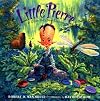
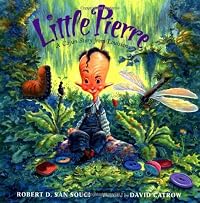
An enjoyable tale of a Cajun Tom Thumb, perfectly paired with Catrow's lush watercolor paintings. In a classic story of a triumphant underdog, Little Pierre is disparaged as a "runt" by his four older brothers but, of course, he is ultimately the one who figures out how to rescue Marie-Louise and effect the whole group's escape from the Swamp Ogre. San Souci may have done plenty of homework, referring to nearly a dozen sources he cites, but his use of dialect is inconsistent. The illustrations are superlative. Starting with the cover plate, Catrow's dense blending of color evokes the sticky humidity of the swamp scenes, with enough detail buried in the foliage to invite and reward close examination. The whimsical caricatures of Pierre show more and his brothers effectively portray their personalities and emotional reactions throughout the adventure, and the Swamp Ogre is perfectly disgusting and monstrous. show less
Of Pierre and Pierrette's five boys, only Little Pierre, the youngest, is the smartest, cleverest and hardest-working. When Marie-Louise, daughter of the richest man in town, is kidnapped by the swamp ogre, a big reward and her hand in marriage is offered to anyone who can rescue her. The older Pierres decide they could rescue Marie-Louise despite the work involved. "Seem a lotta trouble not to get what we already don't got." When Little Pierre hears of their plan he knows he'll end up helping them out of any hole they'd dig for themselves so he tags along despite their protests. Of course, Little Pierre is the one who outsmarts the ogre, saves his brothers' lives and gets the girl. Fun humor, great dialogue (wish I could do the show more accent), and characters. Outsized illustrations emphasize the outrageousness of the tale. "That's rit-ma-tick. And that's all." show less
The Little Bookworm
While I don't usually review picture books, I just loved this one. It is a Cajun version of Tom Thumb which is one of the reasons I had to have it for my boy. I'm from Louisiana and live in the heart of Cajun country and so I like to get books that are from here or about here. And also I love David Catrow's illustrations. He has illustrated some of my other favorite picture books, including Take Me Out of the Bathtub. Robert D. San Souci is the author and he does a pretty good job of getting the language right although I don't know if people who have never heard a real Cajun accent will get it right. I have a hard time with it and I'm from here! But you have to be a real Cajun and have grown up with it to understand show more it. Anyway, this was a very cute take on the Tom Thumb tale though I do wonder why it wasn't called T-Pierre instead of Little Pierre (if something is,like a boy, is small they are often called T, like T-boy means little boy). Maybe to appeal to a wider audience? I don't know. But I was glad to have added this to the little man's book collection. show less
While I don't usually review picture books, I just loved this one. It is a Cajun version of Tom Thumb which is one of the reasons I had to have it for my boy. I'm from Louisiana and live in the heart of Cajun country and so I like to get books that are from here or about here. And also I love David Catrow's illustrations. He has illustrated some of my other favorite picture books, including Take Me Out of the Bathtub. Robert D. San Souci is the author and he does a pretty good job of getting the language right although I don't know if people who have never heard a real Cajun accent will get it right. I have a hard time with it and I'm from here! But you have to be a real Cajun and have grown up with it to understand show more it. Anyway, this was a very cute take on the Tom Thumb tale though I do wonder why it wasn't called T-Pierre instead of Little Pierre (if something is,like a boy, is small they are often called T, like T-boy means little boy). Maybe to appeal to a wider audience? I don't know. But I was glad to have added this to the little man's book collection. show less
This is a Cajun folk tale of the Pierre brothers and their resourceful little brother Little Pierre. When an ogre steals the daughter of the richest man in town, he offers her hand in marriage and his money to anyone who can save her. The lazy brothers quest to find her, and much to their dismay, Little Pierre maneuvers his way into the search. After finding the ogre's house and being invited for the night, Little Pierre's smarts and ingenuity are called on to not only save the daughter's life, but his and his brothers'! This is a funny story that hails hard work and smarts over laziness and haughtiness.
Little Pierre was the smallest in his family, but he was also the brightest. Marie-Louise was taken by an Orge. Her father said whoever saved his daughter would be able to marry her. Little Pierre's four older brothers went out to find Marie-Louise but said Little Pierre could not go with them. He went anyway and left a trail of buttons to find his way back home. Once night came, Little Pierre's brothers realized they did not know their way home. Pierre said that he could help them with his trail if they let him tag along the next day. Throughout the story, Little Pierre comes up with clever ideas to get himself, his brothers, and Marie-Louise back home safely. I really like this story because the illustrations and cajun words used in show more the story represent Louisiana very well. I think this would be a great story to read to children to introduce them to the vocabulary used by Cajuns. show less
This Cajun style tale takes place in the deep swamps of Louisiana. A young boy, Little Pierre, is determined and a very hard worker despite his size. He has four older brothers: Big Pierre, Fat Pierre, Wise Pierre, and Foolish Pierre. None of the brothers work as hard as Little Pierre and they all seem to pick on him. Eventually as the story continues, the five come together to save the day, all thanks to Little Pierre. The language used here is very lively. Terms such as gators and rou garous really place me in the setting. I remember as a child being afraid of rou garous. The main theme that emerged was to never give up and always work hard no matter. In the end, hard work will pay off.
This story was a very whimsical tale that included an unlikely hero. You would not think that the smallest and youngest of the brothers would be able to out strength the beasts in the forest, yet he can out wit them. This heroic story shows that if you think carefully, you can accomplish anything.
Members
- Recently Added By
Author Information

79+ Works 12,244 Members
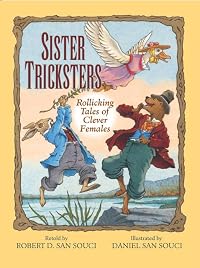
Robert D. San Souci was born on October 10, 1946 in San Francisco, California. He attended college at St. Mary's College in Moraga. After holding jobs in book stores and in publishing, he became a full-time author in 1974. He was best known for his adaptations of folklore for children. During his lifetime, he wrote more than 100 books for young show more readers including Song of Sedna, Kate Shelley: Bound for Legend, The Talking Eggs, Two Bear Cubs, Cendrillon: A Caribbean Cinderella, Brave Margaret: An Irish Tale, Robin Hood and the Golden Arrow, and Cinderella Skeleton. He wrote 12 books which were illustrated by his younger brother Daniel San Souci including The Legend of Scarface, Sister Tricksters: Rollicking Tales of Clever Females, and As Luck Would Have It: From The Brothers Grimm. He also wrote nonfiction works for children, several novels for adults, and the film story for Disney's Mulan. The Legend of Scarface won the Notable Children's Trade Book in the Social Studies, National Council for the Social Studies, and was a Horn Book honor list citation. Sukey and the Mermaid won the American Library Association's Notable Book citation in 1992 and Cut from the Same Cloth won an Aesop Award from the Children's Folklore Section of the American Folklore Society. He died on December 19, 2014 at the age of 68. (Bowker Author Biography) show less
Awards and Honors
Common Knowledge
- Important places
- Louisiana, USA
Classifications
Statistics
- Members
- 88
- Popularity
- 362,647
- Reviews
- 27
- Rating
- (3.73)
- Languages
- English, French
- Media
- Paper
- ISBNs
- 2
- ASINs
- 1