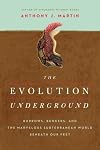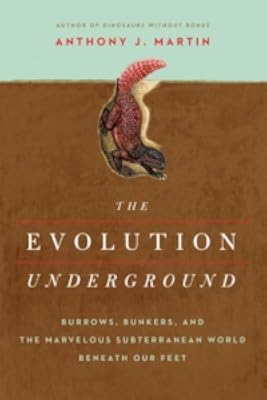
The Evolution Underground: Burrows, Bunkers, and the Marvelous Subterranean World Beneath our Feet
by Anthony J. Martin
On This Page
Description
"What is the best way to survive when the going gets tough? From dinosaurs to penguins, from trilobites to humans, discover the marvelous subterranean secret to survival. Humans have "gone underground" for survival for thousands of years, whether in ancient underground cities or Cold War-era bunkers. But our burrowing roots go back to the very beginnings of animal life on earth. Without burrowing, our planet would be very different today. Many animal lineages alive now--including our show more own--only survived a cataclysmic meteorite strike 65 million years ago because they went underground. On a grander scale, burrows have changed the chemistry of the planet itself, with whole ecosystems being altered by these animals. Every day we walk on an earth filled with an underground wilderness teeming with life. Most of this life stays hidden, yet these animals and their subterranean homes are ubiquitous, ranging from the deep sea to mountains, from the equator to the poles. Burrows are a refuge from predators, a safe home for raising young, or a tool to ambush prey. Burrows have protected animals against all types of natural disasters, be it volcanic eruptions, meteors, or global warmings and coolings. In a book filled with with spectacularly diverse fauna, acclaimed paleontologist and ichnologist Anthony Martin reveals this fascinating, hidden world that will continue to influence and transform life on this planet."--Jacket. show lessTags
Recommendations









Member Reviews
In this book, ichnologist Anthony J. Martin takes a look at how burrowing animals have evolved and influenced the ecology of this planet. Martin starts off with alligators and gopher tortoises, ancient subterranean human settlements in Turkey and more modern underground Cold War bunkers, then travels through time to see what trace evidence and fossils prehistoric animals have left for burrowing behaviour - everything from the first worms, the first vertebrates and invertebrates, insects, dinosaurs, birds, penguins, giant ground sloths, crabs, shrimp, moles, gophers, earthworms and more.
Martin shows that burrowing animals are ecosystem engineers that alter their habitats through burrowing action. He provides a fascinating eye-opening show more account of earth altering underground activities that effect the flora and fauna that exist on the surface of the planet.
Martin also theorises that burrowing strategies of prehistoric and contemporary animals help in their survival during catastrophes and the survival of their species, and thus their evolutionary development, after the catastrophes. Afterall, burrows provide shelter and protection, a reduction in extreme temperature fluctuations, minimized dessication during droughts, safe places to procreate and raise young, and on occassion food storage facilities. Martin compares the survivors of major prehistoric catastrophes with the survivors of minor modern catastrophes, using examples like the pocket gophers that were hibernating during the eruption of Mt St. Helens. The sleeping pocket gophers awoke to found an ash and lava covered landscape with minimal food, but due to a shortage in predators and a full storage larder, the gophers survived, prospered and also helped with seed dispersal and soil movement.
Martin is clearly passionate and knowledgeable about his subject. This book adds a new perspective to evolution, extinction and ecosystem engineering. There are 85 pages of note references, a whole wad of colour photographs/ illustrations, and a list of genera and species mentioned in the book. The writing style manages to lively, fun, on the odd occasion amusing, and informative at the same time. show less
really enjoyed. It's funny because the author obviously really wants to talk about trace and fossil burrows, but knows to lure generalists he needs to talk about living animals. Demonstrates clearly the impact they have on the environment and provides some interest and humor along the way
Ratings
Members
- Recently Added By
Lists

Science: Zoology
107 works; 1 member
Author Information
8 Works 307 Members
Anthony J. Martin, a professor at Emory University, is a paleontologist, a geologist, and one of the world's most accomplished ichnologists. He is the co-discoverer of the first known burrowing dinosaur, found the oldest dinosaur burrows in the geologic record, and documented the best assemblage of polar dinosaur tracks in the Southern Hemisphere. show more He is the author of two textbooks on dinosaurs, Life Traces of the Georgia Coast and Dinosaurs Without Bones. show less
Classifications
Statistics
- Members
- 67
- Popularity
- 466,257
- Reviews
- 2
- Rating
- (3.75)
- Languages
- English
- Media
- Paper, Ebook
- ISBNs
- 3
- ASINs
- 1