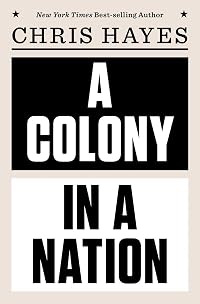
A Colony in a Nation
by Chris Hayes
On This Page
Description
Emmy Award-winning news anchor and New York Times best-selling author Chris Hayes argues that there are really two Americas: a Colony and a Nation. America likes to tell itself that it inhabits a post-racial world, but nearly every empirical measurewealth, unemployment, incarceration, school segregationreveals that racial inequality hasn't improved since 1968. With the clarity and originality that distinguished his prescient bestsellerTwilight of the Elites ("a stunning polemic," said show more Ta-Nehisi Coates), award-winning journalist Chris Hayes offers a powerful new framework in which to understand our current crisis. Hayes contends our country has fractured in two: the Colony and the Nation. In the Nation, we venerate the law. In the Colony, we obsess over order; fear trumps civil rights; and aggressive policing resembles occupation. How and why did Americans build a system where conditions in Ferguson and West Baltimore mirror those that sparked the American Revolution? Blending wide-ranging historical research with political, social, and economic analysis, A Colony in a Nation explains how a Nation founded on justice constructed the Colonyand how it threatens our democracy.. show less
Tags
Recommendations

Member Reviews
Riffing off a phrase from Richard Nixon's nomination speech, journalist Chris Hayes writes a series of essays about how African Americans have in fact become a "colony within a nation" in the decades since Nixon stressed the importance of law and order. The "colony" within the United States is denied the right people enjoy in the largely white "nation" and the nation is built on exploitation of the colony. Issues covered include police violence against Black Americans, and systems of police enforcement driven by drawing revenue from largely Black populations, the War on Drugs, the militarization of police, white fear, and Broken Windows ideology. Hayes notes that the "nation" requires that the "order" part of "law and order" be show more prioritized and thus law is often used as a blunt instrument rather than a tool of justice.
Hayes' strongest writing comes in the analogies he uses to explain his ideas. The life for Black Americans in the colony is similar to Colonial Americans who rebelled against British rule. While unjust taxation is often credited with starting the American Revolution, Hayes traces the history of excessive force used by the British in an attempt to stop smuggling and make the Colonials pay tariffs being the real source of division. White fear that drives police officers and white gun owners to shoot Black people without thinking is similar to the siege mentality of early colonists living among Native Americans and slave owners who lived in constant fear that they'd be victims of violence from Native Americans and enslaved Africans. The idea of how community policing may work in comparison with the increasingly militarized and punitive policing in America today is demonstrated by how college campuses are policed. Colleges have a considerable amount of disorder and a high level of law breaking that is tolerated and even encouraged in a way that is opposite of how a poor, urban neighborhood is treating.
This is a well-written and thoughtful book and a good one to read to reflect on current events and how we can change things for the better. show less
Hayes' strongest writing comes in the analogies he uses to explain his ideas. The life for Black Americans in the colony is similar to Colonial Americans who rebelled against British rule. While unjust taxation is often credited with starting the American Revolution, Hayes traces the history of excessive force used by the British in an attempt to stop smuggling and make the Colonials pay tariffs being the real source of division. White fear that drives police officers and white gun owners to shoot Black people without thinking is similar to the siege mentality of early colonists living among Native Americans and slave owners who lived in constant fear that they'd be victims of violence from Native Americans and enslaved Africans. The idea of how community policing may work in comparison with the increasingly militarized and punitive policing in America today is demonstrated by how college campuses are policed. Colleges have a considerable amount of disorder and a high level of law breaking that is tolerated and even encouraged in a way that is opposite of how a poor, urban neighborhood is treating.
This is a well-written and thoughtful book and a good one to read to reflect on current events and how we can change things for the better. show less
Well, colour me disappointed after reading this book. I was fully prepared to love it. I was fully prepared for it to make me think, to expand my horizons, to enrich my life. Instead, it gave me a headache.
I was first introduced to Chris Hayes when he would fill in for Rachel Maddow on her program (back when I still had cable and watched the news every night). This was, of course, before he had his own program, which I believe is right around Maddow's time slot (either directly before or directly after, I do believe). Of course, I was always a bit disappointed to discover that Rachel was out for the night (or the week, or whatever), because I am going to admit that I am shallow as hell and one of the reasons that I would watch Maddow's show more program every night (although not the only reason!!), at that time, was because I had a serious case of the hots for her (still do, by the way, haha, even though I have given up cable and being a news hound).
But Chris Hayes was a good fill in for her; he seemed a little...exuberant...at times, and he often looked smug. Maybe he just has Resting Smug Face (as I have Resting Bitch Face to Vivian Leigh levels, I can't really say much). But he was also thoughtful and engaging, for the most part, so I was hoping this book would be the same. (Spoiler: it's not.)
I always feel, before I review a book that has to do with race and colour, that I have the establish my own background. People often assume that I am "white" and "privileged" and, therefore, know nothing about racism, classism, the daily struggle to stay alive, etc. I do not consider myself to be "white," having grown up in an area where it was made quite clear that I was most definitely "other" on the checklist, although my skin is relatively pale. My "whiteness," or lack thereof, often depends on where I am. Am I considered "white" in New York City? Probably by most. In Appalachia? No, at least not where I am from - we were "kikes" instead (this was often said as a fact, with no malice, much as black people were called "coloured people" as a default where I'm from). Germany? Well, that depends on the era, but I can most assuredly tell you that my family in the 1930s and 1940s was not considered "white" or, really, even human.
And, according to Hayes' theory, I would argue that I grew up in the Colony, not the Nation.
The beginning of the book isn't really all that bad. Hayes endeavors to show that there are two separate societies in America - the Colony, where people are struggling and the police are often viewed as threats; and the Nation, which is the rest of the country, mostly white and middle-class or above, where the police are viewed as friends and everything is just hunky-dory all of the time (until the "Colony" comes creeping up, I guess).
And then, in what I would consider pretty shrewd, Hayes starts comparing the modern-day Colony to Colonial America. I've often remarked to friends that people who call themselves "patriots" today often bear little to no resemblance to the patriots of Revolutionary America (much as many "Christians" bear little to no resemblance to their Christ). Being a "patriot" today in 'Murica often means a conservative mindset, a desire to keep them damn "foreigners" out, being anti-abortion (but ironically calling themselves "pro-life," even though they don't give two squirts of piss about the lives of those children once they're born), being suspicious of "commies" and "libtards" and "snowflakes" (conveniently ignoring the fact, of course, that Drumpf is the biggest "snowflake" of them all), respective private property (coming back to this), and basically parroting everything that the Republican Party feeds them (there are, of course, Democrats who parrot everything that the Democratic Party feeds them, too; for the record, I am neither a Democrat nor a Republican).
But that isn't what the forefathers of America did. These crazy ass fuckers risked their own lives gambling on a future where the people were represented in their own government, with inalienable rights guaranteed because you are a human being (granted, at the time, "human" meant "white male" - women and people of colour were left out for a very long time, and in many ways are still trying to catch up).
There's not much funnier to me than a self-described "patriot" bitching about how protesters are "looting" and "trashing things" and how "unpatriotic" that is. I love to watch them squirm when I bring up the Boston Tea Party; it's really a thing of beauty as they try to wriggle their way off the hook that I have so carefully baited for them.
And that is, essentially, what Hayes is saying in the first part of the book, too. He likens protests from within the Colony to the acts that the Revolutionaries undertook, and it's pretty interesting. There are quite a few similarities, and I'd recommend the first chapter or two of this book to any "patriot" who has a problem with protesters (not that they're likely to change their minds, but I'd still recommend it).
But then the book kind of falls apart into disparate chapters about different "racial" topics, while Hayes futilely tries to corral the mass of fraying strings into his Colony-Nation dichotomy.
I would almost say here that it felt like Chris Hayes was trying to pad the book, but...there just isn't much in the first place to pad. The book is really short (223 pages) with a relatively sizable font and spacing between lines. Altogether, this feels more like a few essays that were strung together in a vain effort to make it a cohesive book.
One of the things that really takes the book off the rails for me is the amount of personal anecdotes that are somehow supposed to prove his points. They don't. The thing about personal anecdotes is that we all have them; I have plenty that would refute his points, and I have plenty that might confirm some of them in his mind, too. But you can't build arguments on how things play out solely in your life and then try to apply them to society as a whole, because it's going to be pretty easy for someone to come along and topple you over right quick.
For example, he talks about being maybe busted for having a little bit of marijuana in his backpack (I am uncertain if he was, indeed, busted) as a student going to a convention (the GOP one, if I am not mistaken). He spends pages on how scared he was, how he was sure that he would be arrested, how he could see himself being convicted of a crime. In the end, the officer apparently (if he did indeed see the marijuana) let it slide and didn't say a word to him. This proves, somehow, that Hayes lives in the Nation and not the Colony - had this occurred in the Colony to a person of colour, the result would have been quite different.
Go to the Colorado-Kansas border and watch how it plays out sometime. Although it's been ruled that they can no longer stop a car to search it simply because they have Colorado plates, it still happens (it happened once to me - fortunately, I am not a moron and keep my stores at home where they belong). Marijuana is legal in Colorado, but it's not in Kansas. And believe me, if you get pulled over in Kansas with pot on you, or even a bit of resin on a pipe, I do not give a shit how white you look or how privileged you think you are, you are going to come away in some legal trouble. But it shouldn't be like that, right? Because Colorado and Kansas are both in the Nation. Except that is exactly how it goes down - I know a couple of different people who were arrested in Kansas for this exact same reason, and they are ALL white. Kansas doesn't mess around. Don't take marijuana out of state, mmkay kids?
So if I used the same standard of evidence that Hayes does with his personal anecdotes, I guess I just blew the Colony-Nation dichotomy out of the water. Except I didn't, because it's a personal anecdote, and we all have them, and we all know that they're not very strong foundations to build arguments upon - which is why it absolutely baffles me that Hayes relies so much on his own personal experiences while trying to sketch out his argument.
Another thing that certainly doesn't help is when there are factual errors, as well. The one that really stuck out to me was Hayes' description of Michael Brown as a "seventeen-year-old black boy" (page 75). Except that Michael Brown was eighteen years old. And we can all quibble about how arbitrary the difference is between being seventeen and eighteen years old, how adolescence is a vague and confusing time frame that varies for all and it is society that states when it starts and when it ends, etc, etc. But the fact is, legally, Michael Brown was eighteen years old when he died and, legally, an adult.
He also tries to compare the police force of the United States with that of Finland and Japan (page 103). Finnish police only discharged their weapons six times in 2013, guys!!!! Yeah, and Finland and Japan are worlds different from the United States, and not just because we're bigger and have more access to guns. The author completely ignores societal reasons why the police forces in Finland and Japan would be SO INCREDIBLY DIFFERENT from American ones. Japan is a collectivist culture, for the most part, instead of individualistic (like America). Neither Japan nor Finland have such a tumultuous history as America, with multiple wars (including a very blood Civil War), uprisings, and episodes of civil unrest. Comparing these countries and acting like they should be similar, even though their histories are quite different, feels disingenuous to me.
I am not going to argue that people should have their own machine guns if they want (I find this ridiculous, to be honest), but Hayes then tries to segue into the "all guns are bad" trope. No. Do I believe in background checks and limitations on those who can own weapons? Sure. No one who makes multiple threats against his ex-wife, for example, should have ready access to guns; no one with a diagnosis of schizophrenia should, either. But I am a gun owner; I've been around guns for most of my life. Apparently I can't be a liberal and say that. ;) (It's okay, I already had to turn in my "liberal" card because I do not think that Ta-Nehisi Coates' book "Between the World and Me" is anything except crap.) And if you're living in the Colony, believe me, a gun can be a very good thing to have.
Another thing that pisses me off about books like these is that the authors tend to completely ignore class; instead, it's all about race. Ta-Nehisi Coates is excellent at this; in "Between the World and Me," he completely FAILS in this department, believing that all white children all have idealistic lives while all black children have shitty ones, all because of race. And while poverty and race can be linked, it isn't an absolute. I grew up poor and, according to Coates, who feels like he has the right to declare that all Jews are white (and has, multiple times, in multiple articles, completely IGNORING our complicated history - I wonder how he would feel if a "white" author spoke with such authority about people of colour's experiences?), "white," but it was no sitcom.
Poverty is grinding and colours every aspect of your life. People say that you're supposed to pull yourself up by your own bootstraps and go out there and make something of yourself. It's kind of hard to do when you're hungry all of the time, so you have a difficult time concentrating on schoolwork. No one at home can help you - most of my family, for example, was pretty useless when it came to schoolwork. My grandmother was smart, but her education had stopped when she'd graduated from eighth grade; my grandfather dropped out of school when he was eleven to help support his family; my father, when he was around and not drunk or high, was barely literate; my mother is a few fries short of a happy meal in the best of times. And every time you open your damned mouth to speak, your accent screams "uneducated" to people from outside of the area, because Appalachian hillbillies are a "joke." Poverty, I would argue, keeps people in a rut more than race. But classism is completely ignored in this book, as it is in many books on similar subjects, unless it can be conveniently tied to race.
Another thing that Hayes completely ignores - and, once again, this baffles me - is the hardship that convicted felons face once they are released. They are permanently marked as second-class citizens - it shows up in every background check, so many jobs won't hire them. The jobs that DO hire them are often poorly paying, which only causes more stress. There is little focus on helping offenders, especially young ones, better themselves - educational and technical programs are often cut when behind bars. It's a vicious cycle, and I really wish that Hayes had touched upon this - but, once again, ignored. It's all about race, and if a point doesn't fit into that neat little box, it's cast aside.
(There are, of course, people who are predators and cannot be helped - but throwing a young person into prison because he had a spliff on him is ridiculous and should not be LIFE ENDING or incredibly LIFE ALTERING, which it can often so many times be, because of the hardships that convicted criminals face once paroled, even if their crime was non-violent, such as drug possession.)
Hayes does have a fairly solid point about how European sentences for criminals have "leveled up" (as in, brought everyone to a higher standard of treatment) while American sentences have "leveled down" (as in, brought everyone to the lowest common denominator when it comes to treatment). American prisons are a scary ass place; I've never been in one and don't ever plan on being in one, but I feel like there has GOT to be a better way.
Hayes' way sounds okay - "leveling up" instead of down, making sure that a criminal conviction doesn't mean that a person's life is over, etc - until he brought up Brock Turner. Turner is, of course, the infamous rapist who was a swimmer at Stanford who got a slap on his wrist for sexually assaulting a woman behind a dumpster because he had such a bright and promising future.
At first, Hayes calls the rape "horrific" and states that all the "justice system" offers a victim is retribution. If you are "lucky" enough to have your rapist prosecuted and convicted (and that rate is not very high); if you survive the grueling trial in which you, more often than not, are put on trial more than the perpetrator - your clothes, your attitude about sex, whether you are a "good girl" or not; all you get in the end is some prison time. Counselling? Yeah, hope you have good insurance, because you're going to have to pay for that yourself. All the baggage that comes with being raped, the feeling that you are never safe again, that the world is all fucked up and not like how you thought it was? Hope you can work through that, maybe, someday. Some of us cannot.
And then the train skips the tracks. Because Hayes gets UNCOMFORTABLY CLOSE to arguing that instead of Brock Turner getting more time (which I believe he should have), every other rapist should have a lenient sentence similar to Turner's because it will affect their lives. If someone rapes you? You should remember that they are a human being, that they need to be given what will make them better, that their life is precious, that they made a mistake and shouldn't have to really pay for it because it's society's fault.
Oh fuck you, Chris Hayes.
TRIGGER WARNINGS
Maybe that makes me vindictive. Maybe I am too hurt inside to see past it. Maybe it's the fact that my perpetrator died in his own bed, young but by his own hand (drug overdose), getting away with everything he did to me. Maybe because, when I went to the police, they said that I had no evidence and because I am bipolar, it was probably all in my head anyway. Maybe it's the fact that, to this day, I am still sentenced to a lifetime of repercussions because of something that was DONE to me, not something that I did. I'm not getting better. I'm stuck. The pills prescribed to me; the parade of psychiatrists and specialists and doctors; the drugs that I have snorted and injected and smoked; the scars that I have carved into my skin because I was so dead inside that I just needed to feel SOMETHING, even if that something was pain; the nameless stream of faces that I just want to take the hurt away for a few minutes, just a few seconds...nothing has helped.
But you tell me to remember the perpetrator as someone who has made a "mistake" (a "mistake" repeated often over the span over a decade). Someone whose life was precious. Mine, of course, was something that could be conveniently thrown away and ruined without any regard, but I must remember HIS life. HIS value. HIS worth. Because it's all about him, right?
You have betrayed my tiny trust. :(
Also, at the end, Hayes relates an incident he saw occur at a park in New York City. A group of teenaged boys (who were of colour) were harassing people, cursing at them, etc. One of the boys stole a man's phone, and the man started chasing them to try to get his phone back. Hayes literally talks about just standing there, wondering if he should call the police, because he's sure that the person who called the cops on Tamir Rice felt like they were doing the wrong thing, and he doesn't want to see these kids end up dead because they're black.
What.
First off, Tamir Rice was just playing with a gun-shaped toy. He did not COMMIT a crime - and these kids DID. Stealing someone's cellphone is a CRIME and the police SHOULD be called. What, if he sees a crime going down in front of him now, he's not going to call the police if the perpetrator is black? Is that what we are supposed to pull from this incident? If I see someone committing a crime in front of me, you better believe that I am going to call the police, and I don't give a shit if the perpetrator is black, brown, white, purple, green, or polka-dotted. It's a ridiculous end to a, quite frankly, ridiculous book.
Basically, what I think Hayes wants us to think after reading this book is:
1) Guns are bad. But not the people who use them to commit crimes. Those people are good. It's guns that are 100% bad.
2) If you see a crime happening in front of you, if the perpetrator is black, don't call the cops, because that makes you a racist. Or something. I'm not sure what he's trying to drive at here, to be honest, because it was just slapped on at the end and makes absolutely no fucking sense. Don't question it. Just don't call the cops.
3) If you (or someone you love) is a victim of a violent crime, just remember - it's all about the perpetrator. You don't matter. At all. You need to be more focused on the perpetrator and making sure he or she gets the help he or she needs. You, on the other hand? Fuck you. show less
I was first introduced to Chris Hayes when he would fill in for Rachel Maddow on her program (back when I still had cable and watched the news every night). This was, of course, before he had his own program, which I believe is right around Maddow's time slot (either directly before or directly after, I do believe). Of course, I was always a bit disappointed to discover that Rachel was out for the night (or the week, or whatever), because I am going to admit that I am shallow as hell and one of the reasons that I would watch Maddow's show more program every night (although not the only reason!!), at that time, was because I had a serious case of the hots for her (still do, by the way, haha, even though I have given up cable and being a news hound).
But Chris Hayes was a good fill in for her; he seemed a little...exuberant...at times, and he often looked smug. Maybe he just has Resting Smug Face (as I have Resting Bitch Face to Vivian Leigh levels, I can't really say much). But he was also thoughtful and engaging, for the most part, so I was hoping this book would be the same. (Spoiler: it's not.)
I always feel, before I review a book that has to do with race and colour, that I have the establish my own background. People often assume that I am "white" and "privileged" and, therefore, know nothing about racism, classism, the daily struggle to stay alive, etc. I do not consider myself to be "white," having grown up in an area where it was made quite clear that I was most definitely "other" on the checklist, although my skin is relatively pale. My "whiteness," or lack thereof, often depends on where I am. Am I considered "white" in New York City? Probably by most. In Appalachia? No, at least not where I am from - we were "kikes" instead (this was often said as a fact, with no malice, much as black people were called "coloured people" as a default where I'm from). Germany? Well, that depends on the era, but I can most assuredly tell you that my family in the 1930s and 1940s was not considered "white" or, really, even human.
And, according to Hayes' theory, I would argue that I grew up in the Colony, not the Nation.
The beginning of the book isn't really all that bad. Hayes endeavors to show that there are two separate societies in America - the Colony, where people are struggling and the police are often viewed as threats; and the Nation, which is the rest of the country, mostly white and middle-class or above, where the police are viewed as friends and everything is just hunky-dory all of the time (until the "Colony" comes creeping up, I guess).
And then, in what I would consider pretty shrewd, Hayes starts comparing the modern-day Colony to Colonial America. I've often remarked to friends that people who call themselves "patriots" today often bear little to no resemblance to the patriots of Revolutionary America (much as many "Christians" bear little to no resemblance to their Christ). Being a "patriot" today in 'Murica often means a conservative mindset, a desire to keep them damn "foreigners" out, being anti-abortion (but ironically calling themselves "pro-life," even though they don't give two squirts of piss about the lives of those children once they're born), being suspicious of "commies" and "libtards" and "snowflakes" (conveniently ignoring the fact, of course, that Drumpf is the biggest "snowflake" of them all), respective private property (coming back to this), and basically parroting everything that the Republican Party feeds them (there are, of course, Democrats who parrot everything that the Democratic Party feeds them, too; for the record, I am neither a Democrat nor a Republican).
But that isn't what the forefathers of America did. These crazy ass fuckers risked their own lives gambling on a future where the people were represented in their own government, with inalienable rights guaranteed because you are a human being (granted, at the time, "human" meant "white male" - women and people of colour were left out for a very long time, and in many ways are still trying to catch up).
There's not much funnier to me than a self-described "patriot" bitching about how protesters are "looting" and "trashing things" and how "unpatriotic" that is. I love to watch them squirm when I bring up the Boston Tea Party; it's really a thing of beauty as they try to wriggle their way off the hook that I have so carefully baited for them.
And that is, essentially, what Hayes is saying in the first part of the book, too. He likens protests from within the Colony to the acts that the Revolutionaries undertook, and it's pretty interesting. There are quite a few similarities, and I'd recommend the first chapter or two of this book to any "patriot" who has a problem with protesters (not that they're likely to change their minds, but I'd still recommend it).
But then the book kind of falls apart into disparate chapters about different "racial" topics, while Hayes futilely tries to corral the mass of fraying strings into his Colony-Nation dichotomy.
I would almost say here that it felt like Chris Hayes was trying to pad the book, but...there just isn't much in the first place to pad. The book is really short (223 pages) with a relatively sizable font and spacing between lines. Altogether, this feels more like a few essays that were strung together in a vain effort to make it a cohesive book.
One of the things that really takes the book off the rails for me is the amount of personal anecdotes that are somehow supposed to prove his points. They don't. The thing about personal anecdotes is that we all have them; I have plenty that would refute his points, and I have plenty that might confirm some of them in his mind, too. But you can't build arguments on how things play out solely in your life and then try to apply them to society as a whole, because it's going to be pretty easy for someone to come along and topple you over right quick.
For example, he talks about being maybe busted for having a little bit of marijuana in his backpack (I am uncertain if he was, indeed, busted) as a student going to a convention (the GOP one, if I am not mistaken). He spends pages on how scared he was, how he was sure that he would be arrested, how he could see himself being convicted of a crime. In the end, the officer apparently (if he did indeed see the marijuana) let it slide and didn't say a word to him. This proves, somehow, that Hayes lives in the Nation and not the Colony - had this occurred in the Colony to a person of colour, the result would have been quite different.
Go to the Colorado-Kansas border and watch how it plays out sometime. Although it's been ruled that they can no longer stop a car to search it simply because they have Colorado plates, it still happens (it happened once to me - fortunately, I am not a moron and keep my stores at home where they belong). Marijuana is legal in Colorado, but it's not in Kansas. And believe me, if you get pulled over in Kansas with pot on you, or even a bit of resin on a pipe, I do not give a shit how white you look or how privileged you think you are, you are going to come away in some legal trouble. But it shouldn't be like that, right? Because Colorado and Kansas are both in the Nation. Except that is exactly how it goes down - I know a couple of different people who were arrested in Kansas for this exact same reason, and they are ALL white. Kansas doesn't mess around. Don't take marijuana out of state, mmkay kids?
So if I used the same standard of evidence that Hayes does with his personal anecdotes, I guess I just blew the Colony-Nation dichotomy out of the water. Except I didn't, because it's a personal anecdote, and we all have them, and we all know that they're not very strong foundations to build arguments upon - which is why it absolutely baffles me that Hayes relies so much on his own personal experiences while trying to sketch out his argument.
Another thing that certainly doesn't help is when there are factual errors, as well. The one that really stuck out to me was Hayes' description of Michael Brown as a "seventeen-year-old black boy" (page 75). Except that Michael Brown was eighteen years old. And we can all quibble about how arbitrary the difference is between being seventeen and eighteen years old, how adolescence is a vague and confusing time frame that varies for all and it is society that states when it starts and when it ends, etc, etc. But the fact is, legally, Michael Brown was eighteen years old when he died and, legally, an adult.
He also tries to compare the police force of the United States with that of Finland and Japan (page 103). Finnish police only discharged their weapons six times in 2013, guys!!!! Yeah, and Finland and Japan are worlds different from the United States, and not just because we're bigger and have more access to guns. The author completely ignores societal reasons why the police forces in Finland and Japan would be SO INCREDIBLY DIFFERENT from American ones. Japan is a collectivist culture, for the most part, instead of individualistic (like America). Neither Japan nor Finland have such a tumultuous history as America, with multiple wars (including a very blood Civil War), uprisings, and episodes of civil unrest. Comparing these countries and acting like they should be similar, even though their histories are quite different, feels disingenuous to me.
I am not going to argue that people should have their own machine guns if they want (I find this ridiculous, to be honest), but Hayes then tries to segue into the "all guns are bad" trope. No. Do I believe in background checks and limitations on those who can own weapons? Sure. No one who makes multiple threats against his ex-wife, for example, should have ready access to guns; no one with a diagnosis of schizophrenia should, either. But I am a gun owner; I've been around guns for most of my life. Apparently I can't be a liberal and say that. ;) (It's okay, I already had to turn in my "liberal" card because I do not think that Ta-Nehisi Coates' book "Between the World and Me" is anything except crap.) And if you're living in the Colony, believe me, a gun can be a very good thing to have.
Another thing that pisses me off about books like these is that the authors tend to completely ignore class; instead, it's all about race. Ta-Nehisi Coates is excellent at this; in "Between the World and Me," he completely FAILS in this department, believing that all white children all have idealistic lives while all black children have shitty ones, all because of race. And while poverty and race can be linked, it isn't an absolute. I grew up poor and, according to Coates, who feels like he has the right to declare that all Jews are white (and has, multiple times, in multiple articles, completely IGNORING our complicated history - I wonder how he would feel if a "white" author spoke with such authority about people of colour's experiences?), "white," but it was no sitcom.
Poverty is grinding and colours every aspect of your life. People say that you're supposed to pull yourself up by your own bootstraps and go out there and make something of yourself. It's kind of hard to do when you're hungry all of the time, so you have a difficult time concentrating on schoolwork. No one at home can help you - most of my family, for example, was pretty useless when it came to schoolwork. My grandmother was smart, but her education had stopped when she'd graduated from eighth grade; my grandfather dropped out of school when he was eleven to help support his family; my father, when he was around and not drunk or high, was barely literate; my mother is a few fries short of a happy meal in the best of times. And every time you open your damned mouth to speak, your accent screams "uneducated" to people from outside of the area, because Appalachian hillbillies are a "joke." Poverty, I would argue, keeps people in a rut more than race. But classism is completely ignored in this book, as it is in many books on similar subjects, unless it can be conveniently tied to race.
Another thing that Hayes completely ignores - and, once again, this baffles me - is the hardship that convicted felons face once they are released. They are permanently marked as second-class citizens - it shows up in every background check, so many jobs won't hire them. The jobs that DO hire them are often poorly paying, which only causes more stress. There is little focus on helping offenders, especially young ones, better themselves - educational and technical programs are often cut when behind bars. It's a vicious cycle, and I really wish that Hayes had touched upon this - but, once again, ignored. It's all about race, and if a point doesn't fit into that neat little box, it's cast aside.
(There are, of course, people who are predators and cannot be helped - but throwing a young person into prison because he had a spliff on him is ridiculous and should not be LIFE ENDING or incredibly LIFE ALTERING, which it can often so many times be, because of the hardships that convicted criminals face once paroled, even if their crime was non-violent, such as drug possession.)
Hayes does have a fairly solid point about how European sentences for criminals have "leveled up" (as in, brought everyone to a higher standard of treatment) while American sentences have "leveled down" (as in, brought everyone to the lowest common denominator when it comes to treatment). American prisons are a scary ass place; I've never been in one and don't ever plan on being in one, but I feel like there has GOT to be a better way.
Hayes' way sounds okay - "leveling up" instead of down, making sure that a criminal conviction doesn't mean that a person's life is over, etc - until he brought up Brock Turner. Turner is, of course, the infamous rapist who was a swimmer at Stanford who got a slap on his wrist for sexually assaulting a woman behind a dumpster because he had such a bright and promising future.
At first, Hayes calls the rape "horrific" and states that all the "justice system" offers a victim is retribution. If you are "lucky" enough to have your rapist prosecuted and convicted (and that rate is not very high); if you survive the grueling trial in which you, more often than not, are put on trial more than the perpetrator - your clothes, your attitude about sex, whether you are a "good girl" or not; all you get in the end is some prison time. Counselling? Yeah, hope you have good insurance, because you're going to have to pay for that yourself. All the baggage that comes with being raped, the feeling that you are never safe again, that the world is all fucked up and not like how you thought it was? Hope you can work through that, maybe, someday. Some of us cannot.
And then the train skips the tracks. Because Hayes gets UNCOMFORTABLY CLOSE to arguing that instead of Brock Turner getting more time (which I believe he should have), every other rapist should have a lenient sentence similar to Turner's because it will affect their lives. If someone rapes you? You should remember that they are a human being, that they need to be given what will make them better, that their life is precious, that they made a mistake and shouldn't have to really pay for it because it's society's fault.
Oh fuck you, Chris Hayes.
TRIGGER WARNINGS
But you tell me to remember the perpetrator as someone who has made a "mistake" (a "mistake" repeated often over the span over a decade). Someone whose life was precious. Mine, of course, was something that could be conveniently thrown away and ruined without any regard, but I must remember HIS life. HIS value. HIS worth. Because it's all about him, right?
You have betrayed my tiny trust. :(
Also, at the end, Hayes relates an incident he saw occur at a park in New York City. A group of teenaged boys (who were of colour) were harassing people, cursing at them, etc. One of the boys stole a man's phone, and the man started chasing them to try to get his phone back. Hayes literally talks about just standing there, wondering if he should call the police, because he's sure that the person who called the cops on Tamir Rice felt like they were doing the wrong thing, and he doesn't want to see these kids end up dead because they're black.
What.
First off, Tamir Rice was just playing with a gun-shaped toy. He did not COMMIT a crime - and these kids DID. Stealing someone's cellphone is a CRIME and the police SHOULD be called. What, if he sees a crime going down in front of him now, he's not going to call the police if the perpetrator is black? Is that what we are supposed to pull from this incident? If I see someone committing a crime in front of me, you better believe that I am going to call the police, and I don't give a shit if the perpetrator is black, brown, white, purple, green, or polka-dotted. It's a ridiculous end to a, quite frankly, ridiculous book.
Basically, what I think Hayes wants us to think after reading this book is:
1) Guns are bad. But not the people who use them to commit crimes. Those people are good. It's guns that are 100% bad.
2) If you see a crime happening in front of you, if the perpetrator is black, don't call the cops, because that makes you a racist. Or something. I'm not sure what he's trying to drive at here, to be honest, because it was just slapped on at the end and makes absolutely no fucking sense. Don't question it. Just don't call the cops.
3) If you (or someone you love) is a victim of a violent crime, just remember - it's all about the perpetrator. You don't matter. At all. You need to be more focused on the perpetrator and making sure he or she gets the help he or she needs. You, on the other hand? Fuck you. show less
This was a very interesting take on specifically how the criminal justice system works differently for the white majority and the Black people, and Chris manages to draw a line between policing in historical times (right from the days of slavery) to contemporaneous practices, and how this historical context plays into who gets branded a criminal and who gets multiple chances for redemption. The author also gives a critique of how much politicians use the rhetoric of law and order to drive up bigotry and divisions in society, just for the sake of electoral gains without any consideration for the actual impact on the health of the country.
The audiobook narration by Chris also enhances the listening experience, because he is clearly able show more to bring his frustrations and righteous indignation about the subject matter to life. I would definitely recommend the book as well the audio, if you wanna know more about this issue. It’s a little old and short as well, but can definitely act as a beginner read. show less
The audiobook narration by Chris also enhances the listening experience, because he is clearly able show more to bring his frustrations and righteous indignation about the subject matter to life. I would definitely recommend the book as well the audio, if you wanna know more about this issue. It’s a little old and short as well, but can definitely act as a beginner read. show less
More reviews at TheBibliophage.com.
Chris Hayes believes that the United States has a Colony living in the borders of a Nation, which is another way of saying that some of us are treated markedly different than others. This is essentially a book about policing and imprisonment practices in the U.S. It draws from the heritage of books like The New Jim Crow and Ghettoside.
Hayes has a strong way with words, and experiences beyond his work at MSNBC to draw from. He grew up in the northwest part of the Bronx, and is the son of a community organizer. His studies took him into the world of nonprofits, as well as journalists. Plus in my humble estimation, he's a thinker. And of course, he has on the ground reporting background from West show more Baltimore and Ferguson.
Learning more about the politics of policing and mass incarceration has given me insight into the phenomenon called white rage, which pundits say has been a driving factor in the 2016 electoral results. In fact, I highlighted fully 9% of the book. The limit from the publisher is 10%! Here are a few passages that struck me.
"America imprisons a higher percentage of its citizens than any other country, free or unfree, anywhere in the world, except the tiny archipelago of Seychelles." ebook pg. 22
Hayes takes the statistics of mass incarceration and places them in new contexts that will hopefully make his readers think twice.
"And really who—black or white—can be against order? Who can stand against tranquility? Part of the genius of the rhetoric of law and order is that as a principle (rather than a practice), it can be sold as the ultimate call for equality: We all deserve the law. We all deserve order. All lives matter." ebook pg. 29
This passage refers to the beginnings of "law and order" policing as a variation on the message of Jim Crow laws, which was started during Richard Nixon's campaign for President. Hayes walks us through the various rhetoric and practical uses of law and order through the decades. While the topic has the potential to be a bit dry, it's not. It's thought-provoking and sometimes even jaw-dropping.
Hayes compares and contrasts the methods of the United States and various European countries. No matter how depressing, this wasn't news to me. What's more eye-opening is the comparison of policing in the urban ghettos with that on the typical four-year college campus.
The former population is primarily black and brown, with the latter being primarily white. And when the same drug-related infractions are committed, the policies and punishments are polar opposites. When an entire weekend on a college campus (the Nation) is wild bacchanalia we call it a home football game. The community tolerates the college kids, and typically arrests are few. When three days of crazy behavior ensues in an urban area (the Colony) we call it rioting. The news media arrives, the SWAT teams throw tear gas, and jails start to overflow. Quite a comparison between the Colony and the Nation.
Essentially Hayes spends 250 pages brilliantly calling out politicians, police forces, and to a smaller extent prosecutors on the racial differences in application of the law. Having just finished Michelle Alexander's book, this was the perfect update on the last few years' events. Highly recommend both books! show less
Chris Hayes believes that the United States has a Colony living in the borders of a Nation, which is another way of saying that some of us are treated markedly different than others. This is essentially a book about policing and imprisonment practices in the U.S. It draws from the heritage of books like The New Jim Crow and Ghettoside.
Hayes has a strong way with words, and experiences beyond his work at MSNBC to draw from. He grew up in the northwest part of the Bronx, and is the son of a community organizer. His studies took him into the world of nonprofits, as well as journalists. Plus in my humble estimation, he's a thinker. And of course, he has on the ground reporting background from West show more Baltimore and Ferguson.
Learning more about the politics of policing and mass incarceration has given me insight into the phenomenon called white rage, which pundits say has been a driving factor in the 2016 electoral results. In fact, I highlighted fully 9% of the book. The limit from the publisher is 10%! Here are a few passages that struck me.
"America imprisons a higher percentage of its citizens than any other country, free or unfree, anywhere in the world, except the tiny archipelago of Seychelles." ebook pg. 22
Hayes takes the statistics of mass incarceration and places them in new contexts that will hopefully make his readers think twice.
"And really who—black or white—can be against order? Who can stand against tranquility? Part of the genius of the rhetoric of law and order is that as a principle (rather than a practice), it can be sold as the ultimate call for equality: We all deserve the law. We all deserve order. All lives matter." ebook pg. 29
This passage refers to the beginnings of "law and order" policing as a variation on the message of Jim Crow laws, which was started during Richard Nixon's campaign for President. Hayes walks us through the various rhetoric and practical uses of law and order through the decades. While the topic has the potential to be a bit dry, it's not. It's thought-provoking and sometimes even jaw-dropping.
Hayes compares and contrasts the methods of the United States and various European countries. No matter how depressing, this wasn't news to me. What's more eye-opening is the comparison of policing in the urban ghettos with that on the typical four-year college campus.
The former population is primarily black and brown, with the latter being primarily white. And when the same drug-related infractions are committed, the policies and punishments are polar opposites. When an entire weekend on a college campus (the Nation) is wild bacchanalia we call it a home football game. The community tolerates the college kids, and typically arrests are few. When three days of crazy behavior ensues in an urban area (the Colony) we call it rioting. The news media arrives, the SWAT teams throw tear gas, and jails start to overflow. Quite a comparison between the Colony and the Nation.
Essentially Hayes spends 250 pages brilliantly calling out politicians, police forces, and to a smaller extent prosecutors on the racial differences in application of the law. Having just finished Michelle Alexander's book, this was the perfect update on the last few years' events. Highly recommend both books! show less
Chris Hayes uses the analogy of a mother nation and a colony to profound effect. This is a well researched and thoughtful expose of the American criminal justice system. He writes clearly and fairly.
The dysfunction, injustice, contradictions and insanity are fully and fairly laid open. The complexity is fairly dealt with also. This is why the book is short on solutions. There are no easy ones. Amelioration requires understanding the wrongs and a major shift in perspective and attitudes. Then, slowly progress may happen.
We have role models in Europe. Criminal justice does not stand alone. It is profoundly affected by economic systems and models, health care systems (especially in behavioral health), housing and a whole array of laws show more (see Saving Capitalism by Robert Reich). Could we start with the idea: "There is enough"? Do we have enough food, raw materials, energy, transportation, technology and other resources so no one need fear losing if we truly selected equality of opportunity and lifestyle. Love vs. Selfishness? show less
The dysfunction, injustice, contradictions and insanity are fully and fairly laid open. The complexity is fairly dealt with also. This is why the book is short on solutions. There are no easy ones. Amelioration requires understanding the wrongs and a major shift in perspective and attitudes. Then, slowly progress may happen.
We have role models in Europe. Criminal justice does not stand alone. It is profoundly affected by economic systems and models, health care systems (especially in behavioral health), housing and a whole array of laws show more (see Saving Capitalism by Robert Reich). Could we start with the idea: "There is enough"? Do we have enough food, raw materials, energy, transportation, technology and other resources so no one need fear losing if we truly selected equality of opportunity and lifestyle. Love vs. Selfishness? show less
Whether you agree with his premise or not, the evidence Hayes presents that justice in America is a two-tiered system is overwhelming. As I read I found myself wondering if we really listen when we recite the Pledge of Allegiance, especially to the last line...." with liberty and justice for all?
A cry for social justice and a sobering look at our unfair and unequal criminal justice system. Chris Hayes more than adequently pinpoints exactly where and how our justice system has been anything but just for many. The statistics presented and the individual cases were cause for alarm, the rate at which we incarcerate people in this country, staggering. On the ground in Ferguson, during the protests after the killing of Michael Brown, he describes what happened during a before, things not shown in our nightly news segments. There was much more going on in that town, for many years, then we were told.
He also gives us a view of the insidious circle of fear and poverty in which so many are engulfed. The catch 22 so many police officers show more find themselves in, having to take on more than one role, without sufficient training. The double standard of institutions, such as universites that are allowed to police themselves. There is so much covered in this book and Hayes presents this information clearly and easy to understand. Found this eye opening, and though I have no concrete answers I do believe that things need to change. Where to begin is the big question, especially since most politicians seem not to know how to tackle this overwhelming problem, or don't care to try. Simply maddening and heartbreaking. show less
He also gives us a view of the insidious circle of fear and poverty in which so many are engulfed. The catch 22 so many police officers show more find themselves in, having to take on more than one role, without sufficient training. The double standard of institutions, such as universites that are allowed to police themselves. There is so much covered in this book and Hayes presents this information clearly and easy to understand. Found this eye opening, and though I have no concrete answers I do believe that things need to change. Where to begin is the big question, especially since most politicians seem not to know how to tackle this overwhelming problem, or don't care to try. Simply maddening and heartbreaking. show less
Members
- Recently Added By
Author Information
2 Works 865 Members
Awards and Honors
Common Knowledge
- Canonical title
- A Colony in a Nation
- Canonical DDC/MDS
- 364.3496073
- Canonical LCC
- HV9950.H396
Classifications
- Genres
- Sociology, General Nonfiction, Nonfiction, Politics and Government, History
- DDC/MDS
- 364.3496073 — Society, government, & culture Social problems and social services Crime Criminals
- LCC
- HV9950 .H396 — Social sciences Social pathology. Social and public welfare. Criminology Social pathology. Social and public welfare. Criminal justice administration By region or country
- BISAC
Statistics
- Members
- 556
- Popularity
- 53,552
- Reviews
- 13
- Rating
- (3.99)
- Languages
- English
- Media
- Paper, Audiobook, Ebook
- ISBNs
- 10
- ASINs
- 3