On This Page
Description
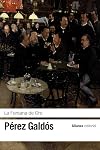
La Fontana de Oro is the first novel by Benito Pérez Galdós, published in 1870. The action takes place in the city of Madrid during the years of the Constitutional Triennium (1820 - 1823). It takes its title from the café located near the Puerta del Sol which, with the same name, served as a meeting place for artists and a public speaking platform for liberal politicians.Tags
Recommendations
























Member Reviews
La novela reconstruye vívidamente unos años marcados por las reuniones clandestinas de los conspiradores, las tertulias de los viejos cafés, las manifestaciones populares a los sones del trágala, el funcionamiento de las logias masónicas y de las sectas ultramontanas, y las ejecuciones infamantes de la Plaza de la Cebada.
Jan 13, 2023Spanish
Ratings
Members
- Recently Added By
Author Information

609+ Works 9,628 Members
Perez Galdos was Spain's outstanding nineteenth-century novelist. At a time when most Spanish novelists were limited by their regional backgrounds, Galdos possessed the intellect and vision to embrace the Spanish people as a nation. In 1873 he began the Episodios nacionales (National Episodes), a 46--volume series of historical novels in which he show more was concerned less with details and facts of history than with their impact on the lives of ordinary people. His works are sometimes divided into two periods: novels of the first period and contemporary Spanish novels. His early novels, Dona Perfecta (1876), Gloria (1877), Marianela (1878), and The Family of Leon Roch (1879), may be characterized as realistic with touches of romanticism. The novels are united by common characters and themes in the manner of Balzac's Human Comedy. Dona Perfecta is a denunciation of intolerance. Marianela explores the irony and tragedy of the destruction of love by scientific progress. Fortunata and Jacinta (1886-87), a four-volume masterpiece of the second period, contrasts two women - Jacinta, wife of the wealthy middle-class Juanito Santa Cruz, and Fortunata, his mistress. Both are admirable characters, but it is Fortunata who bears a son, demonstrating the vitality of the lower classes. The character of Maxi reveals Galdos's interest in mental illness and his naturalistic strain. Born and educated in the Canary Islands, Perez Galdos studied law briefly and spent most of his adult life in Madrid. His study of lower-class Spanish life and his attempts to improve it led him to the advocacy of more equal distribution of wealth and outspoken opposition to the Catholic church. While always popular with the people, he fared less well in literary circles. In 1889 he sought admission to the Royal Academy, an honor he was refused until 1897, and the Nobel Prize went to a contemporary, Jose Echegaray, a writer of considerably less talent. Galdos died poor and blind. Although the government refused him a state funeral, the entire Spanish nation mourned him. English translations of his novels now out of print are The Disinherited Lady (1881), Miau (1888), Compassion (1897), and Tristana. (Bowker Author Biography) show less
Series

Common Knowledge
- Original title
- La Fontana de Oro
- Original publication date
- 1870
- Important places
- Madrid, España
- First words
- Durante los seis inolvidables años que mediaron entre 1814 y 1820, la villa de Madrid presenció muchos festejos oficiales con motivo de ciertos sucesos declarados faustos en la Gaceta de entonces.
- Original language*
- Spaans
*Some information comes from Common Knowledge in other languages. Click "Edit" for more information.
Classifications
- Genres
- Fiction and Literature, General Fiction, Historical Fiction
- DDC/MDS
- 863.5 — Literature & rhetoric Spanish Literature Spanish fiction 19th century 1800–1900
- LCC
- PQ6555 .F6 — Language and Literature French, Italian, Spanish and Portuguese literatures Spanish literature Individual authors, 1700-ca. 1868
Statistics
- Members
- 92
- Popularity
- 350,380
- Reviews
- 1
- Rating
- (4.00)
- Languages
- English, Spanish
- Media
- Paper, Ebook
- ISBNs
- 18
- ASINs
- 4