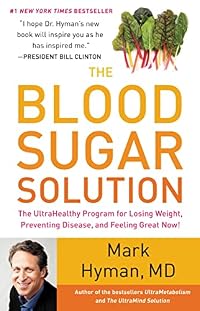
The Blood Sugar Solution: The UltraHealthy Program for Losing Weight, Preventing Disease, and Feeling Great Now!
by Mark Hyman
On This Page
Description
"In THE BLOOD SUGAR SOLUTION, Dr. Mark Hyman reveals that the secret solution to losing weight and preventing not just diabetes but also heart disease, stroke, dementia, and cancer is balanced insulin levels. Dr. Hyman describes the seven keys to achieving wellness-nutrition, hormones, inflammation, digestion, detoxification, energy metabolism, and a calm mind-and explains his revolutionary six-week healthy-living program. With advice on diet, green living, supplements and medication, show more exercise, and personalizing the plan for optimal results, the book also teaches readers how to maintain lifelong health. Groundbreaking and timely, THE BLOOD SUGAR SOLUTION is the fastest way to lose weight, prevent disease, and feel better than ever"-- show lessTags
Recommendations


Member Reviews
Somewhat resembles a gluten-free, dairy-free carob-chip cookie with no sweeteners. Looks appealing, potentially good for you, but by the end, potentially a little hard to swallow. I will say this for it: at the heart of the book is a truth we all need to hear: Our lifestyles are making us sick.
Divided into six somewhat disparate parts, book sections include: Understanding the Modern Plague, a section on the diabetics epidemic with a strong implication that most of us are pre-pre-diabetic; Seven Steps to Treating Diabesity, which includes a number of lifestyle surveys identifying one's own insulin resistance; The Blood Sugar Solution: Preparation, or steps to implementing a healthier lifestyle; The Six-Week Action Plan, which includes a show more basic and 'advanced' diet plan for those who are more sugar-dependent; Take Back Our Health,how to including community support in your changes; The Meal Plan and Recipes; and of course, references.
For those sensitive to it, a note on formatting. Structure is very much of the "Dummies" school of writing, which includes (overuse) of bullet points, sections broken down into 2-page easily digestible segments, action steps, sidebars and (repetitive) life-style quizzes. This truly isn't meant to be an educational tome so much as a motivational speech coupled with a plan for lifestyle change.
The first part inundates with statistics proving that the American diet is unhealthy, causing an epidemic of obesity. He attempts to link obesity to industry, government and pharmaceutical companies--certainly all implicated in problems with the modern food chain, as well as general individual confusion about nutrition. There's vital substance here--much like the almonds in your chocolate bar--but it feels a little media-spun and breezy, and I would have preferred something more substantial. For instance, his assertion that "The food industry has decided to preempt any food-labeling regulations that would given consumers real, credible information" (p.47) is some what misleading. While I'd agree that industry isn't/hasn't been helpful, food labels now are more readable than ever before. It's actually a voluntary front of package labeling that industry suggested that he has issue with. Certainly true, but spun in a way that diminishes consumer responsibility and government efforts to improve knowledge. Personally, I would have been interested to learn more factual information about the deliberate creation of (unhealthy) highly-processed food on the part of industry--after all, I'm a sucker for an big conspiracy, especially if I get to blame my weight on it. But for that, I plan on checking out the lauded [b:Salt Sugar Fat: How the Food Giants Hooked Us|15797397|Salt Sugar Fat How the Food Giants Hooked Us|Michael Moss|http://d202m5krfqbpi5.cloudfront.net/books/1361919312s/15797397.jpg|21520265].
Still, while every health care provider should already be aware of the current health crisis around poor diet and minimal exercise, some of this information might be new to the average American who may not have made the links between lifestyle and health (I don't know how they wouldn't have, but I'm trying to be generous here). Points he brings up include "low-fat" diets--there is now is strong evidence that defining healthy food strictly in terms of fat content is not enough. Likewise diet sodas--he cites a newer well-done study that links diabetes with higher diet soda consumption. I also like his assertion that too many medical practitioners--and their patients--accept the "pre-diabetic" label without actively fighting against further development of diabetes.
Other positives include linking inflammatory food choices with lifestyle stresses and inflammatory health conditions, although he often characterizes these as "toxins." There's a wide body of scientific research hoping to connect food, stress and inflammation, but as of right now, blanket statements are definitely out. Science is relatively certain inflammatory factors play a role in disease progression, specifically cardiovascular disease, breast cancer and autoimmune diseases (at least the ones that I know about off the top of my head). However, the link with inflammatory or "toxic" diets has been tenuous. A new European study on the Mediterranean diet was just released, and that seems to provide more conclusive proof. (However, contrary to Hymans' recommendations, that diet does contain alcohol, so it is sure to gain wider support).
There is a lot of good information here, spun in a way the average consumer might appreciate. However, because so much is referencing his website, it somewhat limits the extent to which it is accessible to everyone. My dad, for instance, should read this book; however, as he is computer illiterate, the online questionaires and resources would be useless. This issue perhaps hints at one of the hidden plagues of the food revolution--it usually requires significant economic or time resources to change.
Recipes and meal plans seem healthy, and no doubt would be part of a great balanced diet. He includes smoothies, breakfasts, snacks and solid meals. I also appreciate his checklists of kitchen supplies and spices, undoubtedly helpful for the kitchen impaired. It truly is a step-by-step recipe for change for those who are interested.
There is also a lot of selective information. Hyman would prefer that you don't drink alcohol at all. Not that I'm a fan, necessarily, but by not acknowledging the numerous studies that show a glass of red wine a day seems to be cardio-protective, he chips away at his own validity. And while I appreciate his emphasis on both 'real' food and food prepared by the consumer, I fail to understand how he doesn't consider it hypocritical that he would also recommend supplements.
Although I certainly believe in increasing environmental and pharmaceutical toxins, I think there aren't many studies that draw clear correlations with health, and those that do tend to center around asthma and cancer. Even then, connections are challenging to prove--if it was clearly provable, we'd have more success with EPA regulations. I feel his assertion of "increasing levels of toxins... are a significant cause of diabesity" (p.9) is seriously stretching the science. This truly is the section of the book that caused me the most skepticism. His self-analysis questions cover just about every symptom possible, so I think it would be hard to find someone that didn't merit his detox diet with supplements.
As a side note, for people into testing, he recommends a battery of blood work that is unlikely to be supported by many doctors and many more insurance companies. A full thyroid panel and insulin testing are two of the more esoteric ones that most practitioners--and clinical guidelines--would only recommend a screening thyroid and fasting glucose. Again, this speaks to well-financed readers, and I feel it is somewhat irresponsible to suggest someone with limited financial resources spend $800 on lab testing (just guessing off the top of my head as I don't have the book in hand--it's actually more like a couple thousand if it was market cost) that would need to be repeated in order to assess "improvement."
Well, it's not really, but a side-side note. I recently saw a paper talking about the wide difference in gut enzymes between dogs and wolves, even though they are related species. Genes that sequence certain starch-digesting enzymes are to twelve times more common in dogs (Nature, Jan. 2013). It speculated that the gut evolution enabled dogs to take advantage of human's more carb-heavy diets. Similarly, current human guts are built to digest carbs as well as proteins--a diet that immediately classifies all carbs as 'toxic' is problematic. His diet seems extreme and fails to acknowledge evolution with dietary change. Similarly, I remember a anthropological study that looked at how cereal grains enabled civilization to progress beyond the hunter-gatherer because it allowed for concentration of food and diminished fool-collection energy consumpton. So I'd be interested in knowing how Hyman connects his own dietary suggestions back to food industry. Where are all these lean meats coming from? Harvested nuts and beans? It's ingenuous to suggest his diet is the answer to agribusiness' "Frankenfoods" without recognizing it is a reciprocal relationship, and that demand for his type of foods will be no different.
At the end of the day, I'm not sure to what extent cause matters. Humans are hard-wired to select sweets and fats, so whether its because of capitalism or choice, we're gonna pick the unhealthy ones most of the time. I do buy into the 'addictive' component; again, whether it is from a dopamine cycle or habit is almost irrelevant. Almost, because knowing can help us with strategies. I do dispute Hyman's tendency to equate heroin with sugar. A little extreme, maybe? But that's where the addictive behavior figures in, and where behavior modification has to be an emphasized component of dietary and lifestyle change. I do like the way Hyman tries to connect that back to community, and how to enlist community support in ones' change. I don't know that the web community is the only option, but it is the one most strongly supported by this book.
I did chuckle at his Inflammation questionnaire: "At work, I am exposed to pesticides, toxic chemicals, loud noise, heavy metals, and/or toxic bosses and coworkers." Tell me that isn't funny stuff!
If only his prescription didn't also include his own brand of products. There was one line I found quite ironically funny where he complains that the solution isn't "diet and exercise" the way we've been hearing our doctors suggest for decades. Um, hypocritical much? Because that is, after all what he is recommending. Along with a healthy dose of his brand of supplements.
Summary: if it gets you to healthify your lifestyle--awesome. But don't waste your money on lab tests and supplements.
http://clsiewert.wordpress.com/2013/03/14/the-blood-sugar-solution-by-mark-hyman... show less
Divided into six somewhat disparate parts, book sections include: Understanding the Modern Plague, a section on the diabetics epidemic with a strong implication that most of us are pre-pre-diabetic; Seven Steps to Treating Diabesity, which includes a number of lifestyle surveys identifying one's own insulin resistance; The Blood Sugar Solution: Preparation, or steps to implementing a healthier lifestyle; The Six-Week Action Plan, which includes a show more basic and 'advanced' diet plan for those who are more sugar-dependent; Take Back Our Health,how to including community support in your changes; The Meal Plan and Recipes; and of course, references.
For those sensitive to it, a note on formatting. Structure is very much of the "Dummies" school of writing, which includes (overuse) of bullet points, sections broken down into 2-page easily digestible segments, action steps, sidebars and (repetitive) life-style quizzes. This truly isn't meant to be an educational tome so much as a motivational speech coupled with a plan for lifestyle change.
The first part inundates with statistics proving that the American diet is unhealthy, causing an epidemic of obesity. He attempts to link obesity to industry, government and pharmaceutical companies--certainly all implicated in problems with the modern food chain, as well as general individual confusion about nutrition. There's vital substance here--much like the almonds in your chocolate bar--but it feels a little media-spun and breezy, and I would have preferred something more substantial. For instance, his assertion that "The food industry has decided to preempt any food-labeling regulations that would given consumers real, credible information" (p.47) is some what misleading. While I'd agree that industry isn't/hasn't been helpful, food labels now are more readable than ever before. It's actually a voluntary front of package labeling that industry suggested that he has issue with. Certainly true, but spun in a way that diminishes consumer responsibility and government efforts to improve knowledge. Personally, I would have been interested to learn more factual information about the deliberate creation of (unhealthy) highly-processed food on the part of industry--after all, I'm a sucker for an big conspiracy, especially if I get to blame my weight on it. But for that, I plan on checking out the lauded [b:Salt Sugar Fat: How the Food Giants Hooked Us|15797397|Salt Sugar Fat How the Food Giants Hooked Us|Michael Moss|http://d202m5krfqbpi5.cloudfront.net/books/1361919312s/15797397.jpg|21520265].
Still, while every health care provider should already be aware of the current health crisis around poor diet and minimal exercise, some of this information might be new to the average American who may not have made the links between lifestyle and health (I don't know how they wouldn't have, but I'm trying to be generous here). Points he brings up include "low-fat" diets--there is now is strong evidence that defining healthy food strictly in terms of fat content is not enough. Likewise diet sodas--he cites a newer well-done study that links diabetes with higher diet soda consumption. I also like his assertion that too many medical practitioners--and their patients--accept the "pre-diabetic" label without actively fighting against further development of diabetes.
Other positives include linking inflammatory food choices with lifestyle stresses and inflammatory health conditions, although he often characterizes these as "toxins." There's a wide body of scientific research hoping to connect food, stress and inflammation, but as of right now, blanket statements are definitely out. Science is relatively certain inflammatory factors play a role in disease progression, specifically cardiovascular disease, breast cancer and autoimmune diseases (at least the ones that I know about off the top of my head). However, the link with inflammatory or "toxic" diets has been tenuous. A new European study on the Mediterranean diet was just released, and that seems to provide more conclusive proof. (However, contrary to Hymans' recommendations, that diet does contain alcohol, so it is sure to gain wider support).
There is a lot of good information here, spun in a way the average consumer might appreciate. However, because so much is referencing his website, it somewhat limits the extent to which it is accessible to everyone. My dad, for instance, should read this book; however, as he is computer illiterate, the online questionaires and resources would be useless. This issue perhaps hints at one of the hidden plagues of the food revolution--it usually requires significant economic or time resources to change.
Recipes and meal plans seem healthy, and no doubt would be part of a great balanced diet. He includes smoothies, breakfasts, snacks and solid meals. I also appreciate his checklists of kitchen supplies and spices, undoubtedly helpful for the kitchen impaired. It truly is a step-by-step recipe for change for those who are interested.
There is also a lot of selective information. Hyman would prefer that you don't drink alcohol at all. Not that I'm a fan, necessarily, but by not acknowledging the numerous studies that show a glass of red wine a day seems to be cardio-protective, he chips away at his own validity. And while I appreciate his emphasis on both 'real' food and food prepared by the consumer, I fail to understand how he doesn't consider it hypocritical that he would also recommend supplements.
Although I certainly believe in increasing environmental and pharmaceutical toxins, I think there aren't many studies that draw clear correlations with health, and those that do tend to center around asthma and cancer. Even then, connections are challenging to prove--if it was clearly provable, we'd have more success with EPA regulations. I feel his assertion of "increasing levels of toxins... are a significant cause of diabesity" (p.9) is seriously stretching the science. This truly is the section of the book that caused me the most skepticism. His self-analysis questions cover just about every symptom possible, so I think it would be hard to find someone that didn't merit his detox diet with supplements.
As a side note, for people into testing, he recommends a battery of blood work that is unlikely to be supported by many doctors and many more insurance companies. A full thyroid panel and insulin testing are two of the more esoteric ones that most practitioners--and clinical guidelines--would only recommend a screening thyroid and fasting glucose. Again, this speaks to well-financed readers, and I feel it is somewhat irresponsible to suggest someone with limited financial resources spend $800 on lab testing (just guessing off the top of my head as I don't have the book in hand--it's actually more like a couple thousand if it was market cost) that would need to be repeated in order to assess "improvement."
At the end of the day, I'm not sure to what extent cause matters. Humans are hard-wired to select sweets and fats, so whether its because of capitalism or choice, we're gonna pick the unhealthy ones most of the time. I do buy into the 'addictive' component; again, whether it is from a dopamine cycle or habit is almost irrelevant. Almost, because knowing can help us with strategies. I do dispute Hyman's tendency to equate heroin with sugar. A little extreme, maybe? But that's where the addictive behavior figures in, and where behavior modification has to be an emphasized component of dietary and lifestyle change. I do like the way Hyman tries to connect that back to community, and how to enlist community support in ones' change. I don't know that the web community is the only option, but it is the one most strongly supported by this book.
I did chuckle at his Inflammation questionnaire: "At work, I am exposed to pesticides, toxic chemicals, loud noise, heavy metals, and/or toxic bosses and coworkers." Tell me that isn't funny stuff!
If only his prescription didn't also include his own brand of products. There was one line I found quite ironically funny where he complains that the solution isn't "diet and exercise" the way we've been hearing our doctors suggest for decades. Um, hypocritical much? Because that is, after all what he is recommending. Along with a healthy dose of his brand of supplements.
Summary: if it gets you to healthify your lifestyle--awesome. But don't waste your money on lab tests and supplements.
http://clsiewert.wordpress.com/2013/03/14/the-blood-sugar-solution-by-mark-hyman... show less
Review:
According to Dr. Mark Hyman, Diabesity (diabetes + obesity) occurs when mild to severe cases of diabetes / insulin resistance are triggered by unhealthy eating habits, lack of exercise, and obesity; three out of four Americans are obese/overweight, and one out of two Americans is prediabetic or diabetic. These numbers should scare people, but the problem continues to grow exponentially, increasing along with America's waistline. I admit, I am far from being "in-shape" - I don't go out of my way to do thirty minutes of exercise a day, I indulge in the occasional calorie-filled treat, and although diabetes, heart disease, cancer, dementia, and Alzheimer's run rampant throughout my family history, I often ignore my better show more judgement's call to be more proactive. That being said, this book could not have come to me at a better time. At fist glance this book does seem imposing - 448 pages with leafy greens on the cover - ugh... but once I started reading, I was intrigued by the overall set-up and non-mechanical tone. The author does an excellent job setting the stage for the reader with an introduction concerning "the American diet" as well as the science behind it. I really enjoyed the more science-based sections, but I do think that they were more drawn out than they should have been, especially since not everyone has a science background. The self-diagnosing quizzes were kind of fun, and I liked how they solidified Hyman's main points and allowed me to delve deeper into my own health issues; though they did seem to get less interesting by quiz eleven. Some of the material was typical of modern diet books, but it was presented differently than most. The flow of the entire plan was nice, allowing for some "stretch", even though there were some aspects of the plan that required more energy, (and funds). By the time I made it through the book, I had a whole new grasp on a healthy relationship with food and exercise; one that wouldn't have me groaning about sit-ups and carrot sticks. I really liked the addition of the two weeks of recipes and the well-planned diet/exercise regimen, which I have started and hope to continue throughout the year. Starting a new "diet" can be tough, and motivation can deplete pretty quickly, but Mark Hyman makes sure that his readers feel supported. There are several websites, videos, chat-rooms, newsletters, and other forms of support detailed in the book that make it easier to stay on track. The author genuinely cares about the readers' health, and his knowledge of the subject is evident, but not perceived as overly superior. Very insightful and disciplined plan, full of strategies to reduce your health risks - and your waistline.
Rating: On the Run (4.5/5)
*** I received this book from the author in exchange for an honest and unbiased review. show less
According to Dr. Mark Hyman, Diabesity (diabetes + obesity) occurs when mild to severe cases of diabetes / insulin resistance are triggered by unhealthy eating habits, lack of exercise, and obesity; three out of four Americans are obese/overweight, and one out of two Americans is prediabetic or diabetic. These numbers should scare people, but the problem continues to grow exponentially, increasing along with America's waistline. I admit, I am far from being "in-shape" - I don't go out of my way to do thirty minutes of exercise a day, I indulge in the occasional calorie-filled treat, and although diabetes, heart disease, cancer, dementia, and Alzheimer's run rampant throughout my family history, I often ignore my better show more judgement's call to be more proactive. That being said, this book could not have come to me at a better time. At fist glance this book does seem imposing - 448 pages with leafy greens on the cover - ugh... but once I started reading, I was intrigued by the overall set-up and non-mechanical tone. The author does an excellent job setting the stage for the reader with an introduction concerning "the American diet" as well as the science behind it. I really enjoyed the more science-based sections, but I do think that they were more drawn out than they should have been, especially since not everyone has a science background. The self-diagnosing quizzes were kind of fun, and I liked how they solidified Hyman's main points and allowed me to delve deeper into my own health issues; though they did seem to get less interesting by quiz eleven. Some of the material was typical of modern diet books, but it was presented differently than most. The flow of the entire plan was nice, allowing for some "stretch", even though there were some aspects of the plan that required more energy, (and funds). By the time I made it through the book, I had a whole new grasp on a healthy relationship with food and exercise; one that wouldn't have me groaning about sit-ups and carrot sticks. I really liked the addition of the two weeks of recipes and the well-planned diet/exercise regimen, which I have started and hope to continue throughout the year. Starting a new "diet" can be tough, and motivation can deplete pretty quickly, but Mark Hyman makes sure that his readers feel supported. There are several websites, videos, chat-rooms, newsletters, and other forms of support detailed in the book that make it easier to stay on track. The author genuinely cares about the readers' health, and his knowledge of the subject is evident, but not perceived as overly superior. Very insightful and disciplined plan, full of strategies to reduce your health risks - and your waistline.
Rating: On the Run (4.5/5)
*** I received this book from the author in exchange for an honest and unbiased review. show less
I thought this guy seemed interesting when I saw him on Dr. Oz as I was channeling surfing. I should have known better. Glad I just checked it out from the library. Yes, yes, yes, our way of eating is killing us. Like we don't know that already. I am into Esselstyn and Ornish, but the husband doesn't want to go vegetarian, so I thought I would check this out. It was a lot of yackity, yack, and very few recipes. I already know why I want to eat healthier, I don't need proof. The book also seemed to always be leading back to his website. I hate that kind of blatant pushiness.
This book is not original enough, or well-presented enough, to justify looking at it instead of the rest of the bookshelf on nutrition. Pick the Jaminet books instead.
The quizzes (before/after) are so basic that they aren't useful.
Way too much preaching about the Evil Food Conglomerates.
A lot of scientism (talking in scientific-sounding terms) but not much science.
MY THOUGHTS
LOVED IT
The title of this book is a bit misleading since it covers more than just blood sugar. Once you get through the introduction and history of *diabesity* which runs about 70 pages, the information about eating and exercise are pretty spot on. My last two blood tests showed that my glucose levels were elevated and I needed to do something to avoid my own family history of diabetes. I am not overweight but I really wasn't eating properly. The book goes into detail about which foods actually reduce your blood sugar and relieve other problems like inflammation, head aches and fatigue. Even if you don't have issues with blood sugar, this book has great information just about living healthy.
So far, I have reduced my sugar show more count just by eating better food and exercise, so there really isn't much magic as far as accomplishing that. This book provides an excellent guide if you don't have access or the means to have clinical support in getting healthy. The plan is really simple and most of the foods are readily available. There is a handy recipe guide in the back with an index to help you find them easily. I can't tell you how many books like this don't include that simple thing. One thing I haven't read in a book like this is about chemical sweeteners, which it turns out can be pretty evil. I still crave my one diet soda a day, but maybe in the future I can start replacing it with a healthier drink like green tea. Overall, this is a great book to get started with if you want to change your life and make a committment to healthier living. show less
LOVED IT
The title of this book is a bit misleading since it covers more than just blood sugar. Once you get through the introduction and history of *diabesity* which runs about 70 pages, the information about eating and exercise are pretty spot on. My last two blood tests showed that my glucose levels were elevated and I needed to do something to avoid my own family history of diabetes. I am not overweight but I really wasn't eating properly. The book goes into detail about which foods actually reduce your blood sugar and relieve other problems like inflammation, head aches and fatigue. Even if you don't have issues with blood sugar, this book has great information just about living healthy.
So far, I have reduced my sugar show more count just by eating better food and exercise, so there really isn't much magic as far as accomplishing that. This book provides an excellent guide if you don't have access or the means to have clinical support in getting healthy. The plan is really simple and most of the foods are readily available. There is a handy recipe guide in the back with an index to help you find them easily. I can't tell you how many books like this don't include that simple thing. One thing I haven't read in a book like this is about chemical sweeteners, which it turns out can be pretty evil. I still crave my one diet soda a day, but maybe in the future I can start replacing it with a healthier drink like green tea. Overall, this is a great book to get started with if you want to change your life and make a committment to healthier living. show less
A great resource and wealth of information for anyone whatever their lifestyle.
First and foremost, don't let the title of this book fool you. You don't need to be a diabetic to benefit from the information Dr. Hyman provides in this book. Anyone who is looking to change their unhealthy eating habits will benefit from reading The Blood Sugar Solution.
Not sure if you have unhealthy eating habits? I can promise you will be surprised by all the eye opening information in this book. I thought I already knew everything there was to know about sustaining a healthy lifestyle, so I was really shocked by a lot of the information in this book.
This book was certainly an eye opening experience. Reading the chapter on inflammation alone, brought to show more mind certain family members and friends that would really benefit from knowing this information. I learned many things in this book that I have implemented in my own life which are helping me feel and look better.
I recommend this book to anyone, and not just those trying to lose weight. This book will change the way you look at your food. It gives you the tools and advice that are life changing. With this same information, Dr. Hyman has helped hundreds of people reverse their illness and get off of medication for good. It sounds hard to believe but Dr Hyman is a medical prodigy and one of just a few doctors in the medical field right now who are not following the norm and are actually out to truly help people get off of prescription drugs by implementing a system that truly works. show less
First and foremost, don't let the title of this book fool you. You don't need to be a diabetic to benefit from the information Dr. Hyman provides in this book. Anyone who is looking to change their unhealthy eating habits will benefit from reading The Blood Sugar Solution.
Not sure if you have unhealthy eating habits? I can promise you will be surprised by all the eye opening information in this book. I thought I already knew everything there was to know about sustaining a healthy lifestyle, so I was really shocked by a lot of the information in this book.
This book was certainly an eye opening experience. Reading the chapter on inflammation alone, brought to show more mind certain family members and friends that would really benefit from knowing this information. I learned many things in this book that I have implemented in my own life which are helping me feel and look better.
I recommend this book to anyone, and not just those trying to lose weight. This book will change the way you look at your food. It gives you the tools and advice that are life changing. With this same information, Dr. Hyman has helped hundreds of people reverse their illness and get off of medication for good. It sounds hard to believe but Dr Hyman is a medical prodigy and one of just a few doctors in the medical field right now who are not following the norm and are actually out to truly help people get off of prescription drugs by implementing a system that truly works. show less
This is a rather intensive book of how to lose weight by eliminating food groups as a whole. You would have to be both a very determined and organized person to put this approach into place. I do not doubt that it would work. However, as a mom of five, I do not have a desire to take out all sugar from my diet. I do restrict processed but I love agave and grow my own stevia - so I am not ready to take these out.
I do appreciate the approach of detox as a way to eliminate some weight and we could all use a good detox. I also appreciate the fact that after this diet you would have less of a desire to move back to the old eating habits that you had prior to the diet.
If you are disciplined enough to follow this diet I think you will find show more yourself very pleased.
Thanks to the publisher for this review copy. show less
I do appreciate the approach of detox as a way to eliminate some weight and we could all use a good detox. I also appreciate the fact that after this diet you would have less of a desire to move back to the old eating habits that you had prior to the diet.
If you are disciplined enough to follow this diet I think you will find show more yourself very pleased.
Thanks to the publisher for this review copy. show less
Members
- Recently Added By
Author Information

49+ Works 3,658 Members
Mark Hyman, MD is a physician, scholar and author. He is the founder and medical director of the UltraWellness Center and a columnist for The Huffington Post. Hyman graduated from Cornell University with a bachelor's in Asian Studies. He received his doctor of medicine from the University of Ottawa and completed his postgraduate training at the show more University of California, San Francisco. Hyman served as co-medical director at Canyon Ranch in Lenox, Massachusetts from 1996-2004. He opened the UltraWellness medical center in Lenox. In December 2013, The Daniel Plan a book Hyman co-authored with Pastor Rick Warren and Dr. Daniel Amen, became number 1 on the New York Times bestseller list. Hyman is also the author of The Blood Sugar Solution: The UltraHealthy Program for Losing Weight, Preventing Disease, and Feeling Great Now! which is a New York Times 2015 bestseller. (Bowker Author Biography) show less
Awards and Honors
Distinctions
Work Relationships
Common Knowledge
- Original publication date
- 2012
Classifications
Statistics
- Members
- 340
- Popularity
- 92,753
- Reviews
- 12
- Rating
- (3.35)
- Languages
- Czech, English, French
- Media
- Paper, Audiobook, Ebook
- ISBNs
- 20
- UPCs
- 1
- ASINs
- 5