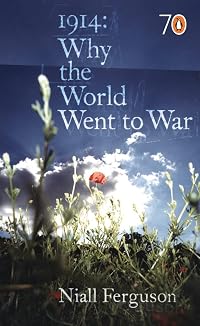
1914 : Why the World Went to War
by Niall Ferguson
On This Page
Description
Every book tells a story . . .And the 70 titles in the Pocket Penguins series are emblematic of the renowned breadth and quality that formed part of the original Penguin vision in 1935 and that continue to define our publishing today. Together, they tell one version of the unique story of Penguin Books. One of Penguin's bestselling non-fiction authors, Niall Ferguson has been hailed as the most brilliant historian of his generation for his fresh, provocative and controversial approach to show more subjects ranging from money to empires. 1914- Why the World Went to Warhas been specially adapted from Ferguson's bestselling The Pity of War (1998). It is a radical reassessment of how the world hurtled into catastrophe in 1914. show lessTags
Recommendations



























Member Reviews
A cut from Ferguson's larger The Pity of War, the book that really put him on the map. It is a sort of update to older works like A. J. P. Tyalor's War by Timetable and other seminal works on why the First World War began. Ferguson was boldly shocking and took flak for saying that the war WAS NOT inevitable, as so many of its participants and the later historians concluded. It was evitable. The cascading events needn't have cascaded. But, I think Ferguson goes a step too far when he concludes that Germany's aims—stated and unstated during the crises of July through September—were as rosy as he seems to want them to be. He says Germany just wanted a sort of European Union/Common Market for Europe, but he skips over the ominous intent show more of "German leadership" (p. 52) of such a union, or the scary sound of "German control" of Poland and the Baltic states (p. 49). And, you can always trust Germany when they say they would restore Belgium and France and have no North Sea ports? Right? Ferguson may, I wouldn't. (And, Ferguson blithely suggests that Luxembourg though may have been put under the Prussian jackboot, but not Belgium and France, no no no... and who cares about Luxembourg anyway [p. 51].) Food for thought, but it may give you a tummyache. show less
Ratings
Members
- Recently Added By
Lists

What A Year: Books titled with a particular year
147 works; 2 members
Author Information

60+ Works 18,066 Members
Niall Ferguson was born April 18, 1964, in Glasgow. He is a Scottish historian. He specializes in financial and economic history as well as the history of empire. He is the Laurence A. Tisch Professor of History at Harvard University and the William Ziegler Professor of Business Administration at Harvard Business School. His books include Paper show more and Iron: Hamburg Business and German Politics in the Era of Inflation 1897-1927 (1993), Virtual History: Alternatives and Counterfactuals (1997), The Pity of War: Explaining World War One (1998), The World's Banker: The History of the House of Rothschild (1998), The Cash Nexus: Money and Power in the Modern World, 1700-2000 (2001), Empire: The Rise and Demise of the British World Order and the Lessons for Global Power (2003), Colossus: The Rise and Fall of the American Empire (2004), The War of the World: Twentieth-Century Conflict and the Descent of the West (2006) and The Ascent of Money: A Financial History of the World (2008), Civilization: The West and the Rest (2011) , The Great Degeneration: How Institutions Decay and Economies Die, and The Square and the Tower: Networks and Power, from the Freemasons to Facebook. (Bowker Author Biography) show less
Series
Belongs to Publisher Series
Work Relationships
Is contained in
Common Knowledge
- Canonical title
- 1914 : Why the World Went to War
Classifications
Statistics
- Members
- 93
- Popularity
- 345,804
- Reviews
- 1
- Rating
- (3.22)
- Languages
- English
- Media
- Paper
- ISBNs
- 1
- ASINs
- 1