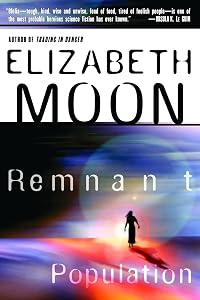
Remnant Population
by Elizabeth Moon
On This Page
Description
When her company relocates to another planet, Ofelia Falfurrias, 70, who expects to be downsized anyway, decides to remain behind. Thus she discovers the planet's population as it emerges from hiding, now that the humans have left. A meeting of cultures.Tags
Recommendations













Member Reviews
Although technically science fiction, this novel of first contact could have been set in any collision of extremely different cultures.
On a remote planet, a failing group of colonists is being removed to be resettled on another world. Ofelia, an elderly woman who has lived there for 40 years, decides she's tired of being ordered around and considered a nuisance, and she hides in the forest until the last ships leave. She has a chance to enjoy her isolation for some months, then listens, horrified, as her radio picks up the arrival of a new ship, thousands of kilometers away, and their destruction by some sort of previously unknown indigenous life form. Eventually they find her, leading to remarkable changes for her and for future show more arrivals.
The main character is testy and can be a bit of an acquired taste, but she also has curiosity and a willingness to think outside the box when confronted with the natives. I'm really glad I continued with the book after wondering if I could take a whole book about her. Recommended for fans of both sci fi and literary fiction. show less
On a remote planet, a failing group of colonists is being removed to be resettled on another world. Ofelia, an elderly woman who has lived there for 40 years, decides she's tired of being ordered around and considered a nuisance, and she hides in the forest until the last ships leave. She has a chance to enjoy her isolation for some months, then listens, horrified, as her radio picks up the arrival of a new ship, thousands of kilometers away, and their destruction by some sort of previously unknown indigenous life form. Eventually they find her, leading to remarkable changes for her and for future show more arrivals.
The main character is testy and can be a bit of an acquired taste, but she also has curiosity and a willingness to think outside the box when confronted with the natives. I'm really glad I continued with the book after wondering if I could take a whole book about her. Recommended for fans of both sci fi and literary fiction. show less
IN A NUTSHELL
This was wonderful. It was one of the best Science Fiction books I’ve ever read.
It is a beautifully imagined First Contact story, but it was the character of Ofelia that made it extraordinary. I was completely immersed in her view of the world. I admired her pragmatism, her self-knowledge, her willingness to take risks and, most of all, her enduring compassion.
Watching her choose to end her life in solitude as a means of achieving freedom and then seeing her bloom when she is pulled back into the world by her curiosity, her empathy and her realisation that she can be more if she chooses to be, was an uplifting experience.
'Remnant Population'. is a gentle, low-key story about a woman in her seventies who seizes an show more opportunity to live by herself, free from the expectations and demands of others, who then finds herself being the human first contact with an alien race.
I enjoyed everything about this book. It murmured rather than shouted, but it got under my skin all the same.
I loved the tone of the storytelling: unrushed, deeply observant, aware of things left unsaid. Despite, or perhaps because of, the unhurried pace of the storytelling, I found the plot compelling and propulsive.
Ofelia is a masterful creation. It was great to see a science fiction protagonist who is realistically old but far from helpless. It was even better to find that she was so deeply imagined. She anchored the story so that her humanity and her eccentricities provide a scale against which the aliens can be measured.
I empathised deeply with her decision to remain behind alone on the planet that had been her home for forty years. I understood her joy in finally being free to live her life the way she wants to live it, with no one telling her what to do, no male egos to soothe, no one preventing her from learning more about the things that matter to her.
Just when solitude might be turning into loneliness and freedom might have become detachment from life she encounters the aliens, or rather the indigenous people of the planet she and her fellow colonists were sent to occupy forty years earlier.
The details of Oelia’s life alone and her encounters with the aliens built into an immersive story that felt real and relatable. So much so that when more humans arrived, they were the ones who felt like a threat. Their presence was disquieting. They managed simultaneously to patronise and marginalise Ofelia while demonstrating to the indigenes that not all humans can live up to Ofelia's standards. I realised that, as soon as they arrived, I assumed everything would end badly. I couldn't see how things were going to end, but it seemed unlikely that any of the outcomes would be happy ones.
The actual ending surprised and pleased me. It’s how I wanted things to end, I just hadn’t been able to see a way to get there.
'Remnant Population' was beautifully written and flawlessly narrated. Suzanne Toren, was a joy to listen to. Click on the Youtube link below to hear a sample.
https://www.youtube.com/watch?v=WQJ0v3pV7e0 show less
This was wonderful. It was one of the best Science Fiction books I’ve ever read.
It is a beautifully imagined First Contact story, but it was the character of Ofelia that made it extraordinary. I was completely immersed in her view of the world. I admired her pragmatism, her self-knowledge, her willingness to take risks and, most of all, her enduring compassion.
Watching her choose to end her life in solitude as a means of achieving freedom and then seeing her bloom when she is pulled back into the world by her curiosity, her empathy and her realisation that she can be more if she chooses to be, was an uplifting experience.
'Remnant Population'. is a gentle, low-key story about a woman in her seventies who seizes an show more opportunity to live by herself, free from the expectations and demands of others, who then finds herself being the human first contact with an alien race.
I enjoyed everything about this book. It murmured rather than shouted, but it got under my skin all the same.
I loved the tone of the storytelling: unrushed, deeply observant, aware of things left unsaid. Despite, or perhaps because of, the unhurried pace of the storytelling, I found the plot compelling and propulsive.
Ofelia is a masterful creation. It was great to see a science fiction protagonist who is realistically old but far from helpless. It was even better to find that she was so deeply imagined. She anchored the story so that her humanity and her eccentricities provide a scale against which the aliens can be measured.
I empathised deeply with her decision to remain behind alone on the planet that had been her home for forty years. I understood her joy in finally being free to live her life the way she wants to live it, with no one telling her what to do, no male egos to soothe, no one preventing her from learning more about the things that matter to her.
Just when solitude might be turning into loneliness and freedom might have become detachment from life she encounters the aliens, or rather the indigenous people of the planet she and her fellow colonists were sent to occupy forty years earlier.
The details of Oelia’s life alone and her encounters with the aliens built into an immersive story that felt real and relatable. So much so that when more humans arrived, they were the ones who felt like a threat. Their presence was disquieting. They managed simultaneously to patronise and marginalise Ofelia while demonstrating to the indigenes that not all humans can live up to Ofelia's standards. I realised that, as soon as they arrived, I assumed everything would end badly. I couldn't see how things were going to end, but it seemed unlikely that any of the outcomes would be happy ones.
The actual ending surprised and pleased me. It’s how I wanted things to end, I just hadn’t been able to see a way to get there.
'Remnant Population' was beautifully written and flawlessly narrated. Suzanne Toren, was a joy to listen to. Click on the Youtube link below to hear a sample.
https://www.youtube.com/watch?v=WQJ0v3pV7e0 show less
Book club pick :)
What a great story this is… The best thing about the book is Ofelia, of course. I love the author for choosing the kind of person that is too often, too easily and unthinkingly dismissed, in so many societies (and not only in sci-fi books) – an elderly woman.
Ofelia, who has so many memories of grief and violence, who is used to surviving around people who walk all over her. Yet, there she is, finding new kinds of strength, a new inner voice, finding herself and freedom.
The writing has a flow that invites you along, and you immerse yourself in the story. I found myself caring more and more for Ofelia after just a few pages.
The aliens were wonderfully written – at first unknown and terrifying, and then hardly alien show more at all (to Ofelia, that is). I loved the scene where they made music together for the first time; I loved the process of learning about each other and forging a relationship, touches of humour, and the aliens’ POV.
I found the first contact team to be obnoxious and arrogant – grotesquely, perhaps, but not unbelievably so. Actually, I had to put the book away from time to time to calm down. Ofelia and her friends were wonderful in their courage and determination.
“It was impossible, it was all impossible, and she might as well get on with it. Impossible things didn’t get done by sitting around in the shade playing with children.”
The ending is lovely. show less
What a great story this is… The best thing about the book is Ofelia, of course. I love the author for choosing the kind of person that is too often, too easily and unthinkingly dismissed, in so many societies (and not only in sci-fi books) – an elderly woman.
Ofelia, who has so many memories of grief and violence, who is used to surviving around people who walk all over her. Yet, there she is, finding new kinds of strength, a new inner voice, finding herself and freedom.
The writing has a flow that invites you along, and you immerse yourself in the story. I found myself caring more and more for Ofelia after just a few pages.
The aliens were wonderfully written – at first unknown and terrifying, and then hardly alien show more at all (to Ofelia, that is). I loved the scene where they made music together for the first time; I loved the process of learning about each other and forging a relationship, touches of humour, and the aliens’ POV.
I found the first contact team to be obnoxious and arrogant – grotesquely, perhaps, but not unbelievably so. Actually, I had to put the book away from time to time to calm down. Ofelia and her friends were wonderful in their courage and determination.
“It was impossible, it was all impossible, and she might as well get on with it. Impossible things didn’t get done by sitting around in the shade playing with children.”
The ending is lovely. show less
I'm rounding up to 5 stars, because I almost never encounter sci-fi or fantasy stories with an older woman as the main character, and this was delightful. The pacing was a little slow and odd to start, it wasn't really "action-packed" but it didn't need to be, it defied expectations, and it was a great first contact story.
This review is more of a very personal rant about being a woman, aging as a woman and overall contains a lot of strong feelings of mine. This book definitely touched me and despite some things I didn't like, it's one of my favourite books I've read this year. Edit: rating it up to 4.5 because I can't stop thinking and talking about it.
"It was impossible, it was all impossible, and she might as well get on with it."
I am cursed with this seemingly outlandish thought that women, as all humans, get more interesting with age as opposed to what most of literature seems to think: Women somehow vanish somewhere between their 35th and 45th birthday. And most of our planets female population seems to be in their twenties, according to the amount show more of female protagonists in adult literature within that age range. A few years ago I got very aware of the fact that I'm aging. If I am lucky, I will be old someday. And to the shock and horror of every beauty company and every skin care youtube channel out there: It didn't make me panic. I am already quite ill and I am afraid of getting sicker, which is the unpleasant part of getting older or generally of being alive. So due to my experience with vanishing health I have a "bring it on" attitude regarding that part of aging. The other parts of it I actively embrace.
I think the vile hatred towards middle aged women and the disregard of old women (as cute little grandma npcs without their own agency) is an often times overlooked part of sexism. Women are already not seen as fully human by our society but practically vanish as soon as their value to a patriarchal value system disintegrates (birthing kids and looking attractive to men). Even authors I love, even literature I would award with my personal sign of approval, are much more often than not moving within that subconsciously societal conditioned age range, even as the authors themselves are aging. Not only do I think that this is sad from a feminist perspective, I mainly find this such a waste of potential. I am so bored of the familiar twenty-somethings with twenty-something problems and thoughts. Even though I am a twenty-something myself. There are so many fascinating women in my life and most of them are way past the age of 50. And I rarely see any stories with female protagonists like that, even rarer to see books where their age isn't the primary focus of the book.
So I had high hopes for "Remnant population". It almost sounded like the perfect book to me, even though the protagonist is heterosexual. A woman in her 70s who is tired of people, loves food and stays on a planet alone ? Count me in! The book is much more complicated than that, which has its good and bad sides.
The book starts with the extremely common trope of an aging woman (the protagonist Ofelia) hating her daughter in law, deeming her not pretty enough, judging her by her fertility, and calling her a bitch and a slut in her mind. Ofelias daughter in law also gets abused physically and verbally by her husband, Ofelias son. Ofelia doesn't think or say anything about it, probably because she had to endure the same with her late husband. She hates her son too but much less than the young woman guilty of the crime of being mildly annoying while not being pretty enough. When it's time to say goodbye, the young woman hugs Ofelia, quote "fiercly". It almost made me cry (mind you we are not even on page 30 by now).
I understand wanting to show the protagonist as an old woman who dislikes a lot of people for understandable to outrageous reasons and in understandable to outrageous ways. I understand that some women are internalized misogynistic in many ways. I don't need a protagonist to have my exact values or moral compass, I just want them to be interesting. Which the first impression of Ofelia wasn't to me. This baseless hatred of younger women by older women for those quite petty and sexist reasons is extremely normalized in media to a point where it's ridiculously over-represented and thus just really tired. I know women like this exist and it's realistic but other women exist too and are also realistic and less rare, even in patriarchal conservative societies, than Hollywood wants us to believe. My impression was that the initial misogyny towards her daughter in law was supposed to set the tone for Ofelias overall dislike of people and how much she was influenced by the patriarchal society around her. But I still didn't feel like it was adding something valuable.
I have to admit, at first this made me want to close the book again. Similar to Vellitt Boes (in "the dream quest of Vellitt Boe" by Kij Johnson) constant reminiscing of past male lovers and how much more attractive to men she was when she was younger it made me think... damn. The things I read for the sake of reading stories about old(er) female protagonists. But for that sake, I read on.
As the book progresses, Ofelias past and socialization in an extremely misogynistic society is revealed hint by hint. It makes these first pages more understandable but still gut wrenching. At first I thought the book wanted to be witty and shocking by using sexist slurs and painting the main character as extremely hateful against one quite innocent woman. And maybe that's the case. But as I read further and learned more about Ofelia it made me pause. Her actions can't be excused but that's not important to me because I do not care about "unproblematic" characters. I value characters with depth, complexity and nuance. And with more context those first pages of intense misogyny make perfect sense. Ofelia wouldn't say that she hates women but she is used to women, including herself, being hated and disregarded. Ofelia reacts to an annoying woman as her society does to annoying women: dehumanizing and sexist. Again, doesn't excuse anything but it showed me that these pages (hopefully) weren't just there to shock or provoke. Still don't know how good or necessary it was to start the book like that and make that the first impression of the main character but well. At least it makes sense.
Otherwise Ofelia seems like the kind of woman I want to see more of in books or media in general. She is tired from the horrible society she had to live in but she is still incredibly strong-willed. Going barefoot, not having time for bullshit, being genuinely kind when she means it, refusing to wear a hat against skin cancer (this made me laugh because it reminded me of my mom), making corporate men uncomfortable, desperately wanting to wear comfortable clothes or none at all, being incredibly stubborn... These parts of her reminded me so much of a lot of women I know in various stages of aging, myself included. There is such freedom of letting go of social rules and norms. Even just "little" things like ditching the bra and shoes. Which in the end isn't such a little thing at all.
As mentioned, the colonist company and society seems to be very patriarchal and disgusting. It is indicated that women don't have much to say or decide, while they are carrying a lot of the responsibility and workload. At one point in the past, a woman got murdered by the community for suggesting that marrying female children and beating them wasn't a good idea.
Ofelia has enough critical thinking skills to realize that a lot of the societies rules go against her own comfort, well being, self appreciation and humanity. It's something, even though that reflection doesn't seem to go any further or expand on other women around her. She reminds me a little bit of young adult women in my social bubble who realize that they are human but only apply that new found knowledge to themselves and think they are a unique phenomenon amongst women. It's a sad thought but probably a reality that many women grow old never going past that stage of awareness and socialization.
We are only alive once, you never know when your life is suddenly over, life is short and the amount of time where we are alive healthy is even shorter. This is true for everyone but it rings even heavier and more important to women, who often times spend their entire lifetime caring for others, putting others first and being the people a society relies on without any thanks or compensation. Statistics show that women who are in long time partnerships with men/live with men have shorter life expectancies, a higher risk of dying after surgeries, higher risk of heart attacks as well as strokes and a higher rate of depression (compared to women living alone). While married men have higher life expectancies, better quality of life and a higher survival rate after surgeries than unmarried men. Ofelia doesn't know all of this but you can feel this weight in her steps, her thoughts and actions. The tiredness at first, then the glimpse of a freedom never dreamed of and then the letting go. It's cathartic and beautiful in a sense. It felt good to read but also made me a bit sad.
"(...)she laughed aloud, then stopped abruptly, a hand to her mouth. Barto had not liked it when she laughed for no reason. She waited, listening; when no voice scolded, she felt her body relax, her hand drop from her mouth. She was safe, at least from that."
Ofelias newfound freedom as the only remaining person in a former space colony sounded like my ultimate dream. Surrounded by nature, animals, gardens and plants but still with a lot of comfort like warm showers and coolers for food. Sure, humans are social animals and I know that my hermit fantasies would probably not make me as happy as I think they would. But it's still such an intensely beautiful and calming thought. A thought I had much more often than I want to admit. And the way Moon describes these initial first days of being alone is as daring and wonderful as it gets. I immensely enjoyed her description of Ofelias routine, her discoveries and experiences. Including gardening, repairing equipment and buildings, walking naked through the streets, dangerous thunderstorms, sewing creative clothes , writing down the stories of the colony and cooking delicious food.
Ofelia spends much less time in solitude than I anticipated and overall that's a good thing. But to be honest, I could have read an entire book consisting of her gardening and repairing and living her life lol. These parts of the story were so much fun to read to me.
I also like how Ofelia is "just a normal woman". I mean, she is extraordinary and complex and smart and one of my favourite protagonist ever. But she isn't a scientist, she isn't a professional adventurer, survivalist, engineer or an expert on linguistics. Even though I am sure she could have been all of these things if she wasn't a woman and working class. She has some very practical skills and is overall an intelligent and very stubborn and tough person.
**Spoiler here! Other humans constantly underestimate her, even ridicule her. Again something all women have to endure but it gets worse with age, other social classes and a lower level of formal education. The experts seem much more foolish than her in the face of an unknown planet and culture, which drove me nuts but it seemed incredibly realistic. It reminded me of oblivious archeologists not knowing what a human could use a bone with 28 markings on. Or identifying a female warrior as male just because their sexism can't comprehend a woman not conforming to our gender roles. Some might say it's unrealistic that humans first "professional" contact with intelligent aliens would be that stupid and clumsy but I sadly find it entirely believable.
**
There are just a few chapters that do not follow Ofelia and those are pretty dull and unnecessary. I couldn't figure out why they had to be there. For me they didn't add anything of value and just inflated the amount of pages. But then again, I could have read an entire book just consisting of Ofelia doing whatever she feels like doing. She is the element that makes this book unique, fascinating and a joy to read. So every page spent with another human pov is slow and boring and made me wish they'd just vanish or die. I guess I can understand Ofelia quite well but to understand her I really didn't need to go through those agonizingly bad chapters! The last book I read was one of the rare instances were multiple povs actually worked for me. Here I am back to the usual skimming through pages that are uninteresting to me because they are quite obviously only a way for the author to implement some information she wasn't sure how to get across in another way.
But otherwise I really enjoyed this book. Ofelia is probably my favourite protagonist ever and I can't properly express how much she means to me. Ursula K. Le Guin finds some of the right words to describe her: "tough, kind, wise and unwise, fond of food, tired of foolish people - is one of the most probable heroines science fiction has ever known". This book and especially Ofelia are so unique and interesting that I can ignore that some parts of this book could have been a bit better. And oh I cried so much in the end, it's a bit embarrassing. show less
"It was impossible, it was all impossible, and she might as well get on with it."
I am cursed with this seemingly outlandish thought that women, as all humans, get more interesting with age as opposed to what most of literature seems to think: Women somehow vanish somewhere between their 35th and 45th birthday. And most of our planets female population seems to be in their twenties, according to the amount show more of female protagonists in adult literature within that age range. A few years ago I got very aware of the fact that I'm aging. If I am lucky, I will be old someday. And to the shock and horror of every beauty company and every skin care youtube channel out there: It didn't make me panic. I am already quite ill and I am afraid of getting sicker, which is the unpleasant part of getting older or generally of being alive. So due to my experience with vanishing health I have a "bring it on" attitude regarding that part of aging. The other parts of it I actively embrace.
I think the vile hatred towards middle aged women and the disregard of old women (as cute little grandma npcs without their own agency) is an often times overlooked part of sexism. Women are already not seen as fully human by our society but practically vanish as soon as their value to a patriarchal value system disintegrates (birthing kids and looking attractive to men). Even authors I love, even literature I would award with my personal sign of approval, are much more often than not moving within that subconsciously societal conditioned age range, even as the authors themselves are aging. Not only do I think that this is sad from a feminist perspective, I mainly find this such a waste of potential. I am so bored of the familiar twenty-somethings with twenty-something problems and thoughts. Even though I am a twenty-something myself. There are so many fascinating women in my life and most of them are way past the age of 50. And I rarely see any stories with female protagonists like that, even rarer to see books where their age isn't the primary focus of the book.
So I had high hopes for "Remnant population". It almost sounded like the perfect book to me, even though the protagonist is heterosexual. A woman in her 70s who is tired of people, loves food and stays on a planet alone ? Count me in! The book is much more complicated than that, which has its good and bad sides.
The book starts with the extremely common trope of an aging woman (the protagonist Ofelia) hating her daughter in law, deeming her not pretty enough, judging her by her fertility, and calling her a bitch and a slut in her mind. Ofelias daughter in law also gets abused physically and verbally by her husband, Ofelias son. Ofelia doesn't think or say anything about it, probably because she had to endure the same with her late husband. She hates her son too but much less than the young woman guilty of the crime of being mildly annoying while not being pretty enough. When it's time to say goodbye, the young woman hugs Ofelia, quote "fiercly". It almost made me cry (mind you we are not even on page 30 by now).
I understand wanting to show the protagonist as an old woman who dislikes a lot of people for understandable to outrageous reasons and in understandable to outrageous ways. I understand that some women are internalized misogynistic in many ways. I don't need a protagonist to have my exact values or moral compass, I just want them to be interesting. Which the first impression of Ofelia wasn't to me. This baseless hatred of younger women by older women for those quite petty and sexist reasons is extremely normalized in media to a point where it's ridiculously over-represented and thus just really tired. I know women like this exist and it's realistic but other women exist too and are also realistic and less rare, even in patriarchal conservative societies, than Hollywood wants us to believe. My impression was that the initial misogyny towards her daughter in law was supposed to set the tone for Ofelias overall dislike of people and how much she was influenced by the patriarchal society around her. But I still didn't feel like it was adding something valuable.
I have to admit, at first this made me want to close the book again. Similar to Vellitt Boes (in "the dream quest of Vellitt Boe" by Kij Johnson) constant reminiscing of past male lovers and how much more attractive to men she was when she was younger it made me think... damn. The things I read for the sake of reading stories about old(er) female protagonists. But for that sake, I read on.
As the book progresses, Ofelias past and socialization in an extremely misogynistic society is revealed hint by hint. It makes these first pages more understandable but still gut wrenching. At first I thought the book wanted to be witty and shocking by using sexist slurs and painting the main character as extremely hateful against one quite innocent woman. And maybe that's the case. But as I read further and learned more about Ofelia it made me pause. Her actions can't be excused but that's not important to me because I do not care about "unproblematic" characters. I value characters with depth, complexity and nuance. And with more context those first pages of intense misogyny make perfect sense. Ofelia wouldn't say that she hates women but she is used to women, including herself, being hated and disregarded. Ofelia reacts to an annoying woman as her society does to annoying women: dehumanizing and sexist. Again, doesn't excuse anything but it showed me that these pages (hopefully) weren't just there to shock or provoke. Still don't know how good or necessary it was to start the book like that and make that the first impression of the main character but well. At least it makes sense.
Otherwise Ofelia seems like the kind of woman I want to see more of in books or media in general. She is tired from the horrible society she had to live in but she is still incredibly strong-willed. Going barefoot, not having time for bullshit, being genuinely kind when she means it, refusing to wear a hat against skin cancer (this made me laugh because it reminded me of my mom), making corporate men uncomfortable, desperately wanting to wear comfortable clothes or none at all, being incredibly stubborn... These parts of her reminded me so much of a lot of women I know in various stages of aging, myself included. There is such freedom of letting go of social rules and norms. Even just "little" things like ditching the bra and shoes. Which in the end isn't such a little thing at all.
As mentioned, the colonist company and society seems to be very patriarchal and disgusting. It is indicated that women don't have much to say or decide, while they are carrying a lot of the responsibility and workload. At one point in the past, a woman got murdered by the community for suggesting that marrying female children and beating them wasn't a good idea.
Ofelia has enough critical thinking skills to realize that a lot of the societies rules go against her own comfort, well being, self appreciation and humanity. It's something, even though that reflection doesn't seem to go any further or expand on other women around her. She reminds me a little bit of young adult women in my social bubble who realize that they are human but only apply that new found knowledge to themselves and think they are a unique phenomenon amongst women. It's a sad thought but probably a reality that many women grow old never going past that stage of awareness and socialization.
We are only alive once, you never know when your life is suddenly over, life is short and the amount of time where we are alive healthy is even shorter. This is true for everyone but it rings even heavier and more important to women, who often times spend their entire lifetime caring for others, putting others first and being the people a society relies on without any thanks or compensation. Statistics show that women who are in long time partnerships with men/live with men have shorter life expectancies, a higher risk of dying after surgeries, higher risk of heart attacks as well as strokes and a higher rate of depression (compared to women living alone). While married men have higher life expectancies, better quality of life and a higher survival rate after surgeries than unmarried men. Ofelia doesn't know all of this but you can feel this weight in her steps, her thoughts and actions. The tiredness at first, then the glimpse of a freedom never dreamed of and then the letting go. It's cathartic and beautiful in a sense. It felt good to read but also made me a bit sad.
"(...)she laughed aloud, then stopped abruptly, a hand to her mouth. Barto had not liked it when she laughed for no reason. She waited, listening; when no voice scolded, she felt her body relax, her hand drop from her mouth. She was safe, at least from that."
Ofelias newfound freedom as the only remaining person in a former space colony sounded like my ultimate dream. Surrounded by nature, animals, gardens and plants but still with a lot of comfort like warm showers and coolers for food. Sure, humans are social animals and I know that my hermit fantasies would probably not make me as happy as I think they would. But it's still such an intensely beautiful and calming thought. A thought I had much more often than I want to admit. And the way Moon describes these initial first days of being alone is as daring and wonderful as it gets. I immensely enjoyed her description of Ofelias routine, her discoveries and experiences. Including gardening, repairing equipment and buildings, walking naked through the streets, dangerous thunderstorms, sewing creative clothes , writing down the stories of the colony and cooking delicious food.
Ofelia spends much less time in solitude than I anticipated and overall that's a good thing. But to be honest, I could have read an entire book consisting of her gardening and repairing and living her life lol. These parts of the story were so much fun to read to me.
I also like how Ofelia is "just a normal woman". I mean, she is extraordinary and complex and smart and one of my favourite protagonist ever. But she isn't a scientist, she isn't a professional adventurer, survivalist, engineer or an expert on linguistics. Even though I am sure she could have been all of these things if she wasn't a woman and working class. She has some very practical skills and is overall an intelligent and very stubborn and tough person.
**Spoiler here! Other humans constantly underestimate her, even ridicule her. Again something all women have to endure but it gets worse with age, other social classes and a lower level of formal education. The experts seem much more foolish than her in the face of an unknown planet and culture, which drove me nuts but it seemed incredibly realistic. It reminded me of oblivious archeologists not knowing what a human could use a bone with 28 markings on. Or identifying a female warrior as male just because their sexism can't comprehend a woman not conforming to our gender roles. Some might say it's unrealistic that humans first "professional" contact with intelligent aliens would be that stupid and clumsy but I sadly find it entirely believable.
**
There are just a few chapters that do not follow Ofelia and those are pretty dull and unnecessary. I couldn't figure out why they had to be there. For me they didn't add anything of value and just inflated the amount of pages. But then again, I could have read an entire book just consisting of Ofelia doing whatever she feels like doing. She is the element that makes this book unique, fascinating and a joy to read. So every page spent with another human pov is slow and boring and made me wish they'd just vanish or die. I guess I can understand Ofelia quite well but to understand her I really didn't need to go through those agonizingly bad chapters! The last book I read was one of the rare instances were multiple povs actually worked for me. Here I am back to the usual skimming through pages that are uninteresting to me because they are quite obviously only a way for the author to implement some information she wasn't sure how to get across in another way.
But otherwise I really enjoyed this book. Ofelia is probably my favourite protagonist ever and I can't properly express how much she means to me. Ursula K. Le Guin finds some of the right words to describe her: "tough, kind, wise and unwise, fond of food, tired of foolish people - is one of the most probable heroines science fiction has ever known". This book and especially Ofelia are so unique and interesting that I can ignore that some parts of this book could have been a bit better. And oh I cried so much in the end, it's a bit embarrassing. show less
Ofelia, an elderly woman, does not wish to leave her home of 40 years when Sims Bancorp decides to relocate the colony. She hides, and is left behind with live stock, a garden, and a power source, the sole human occupant of an entire planet. The first part of this book is an exquisite description of "living the simple life," albeit hundreds of years in the future on a distant planet. Despite the aches and pains of aging, Ofelia revels in this existence, and begins expressing her creativity and individuality in ways which were not possible under the constraints of colonial life.
Things change, however, when Ofelia learns that she is not alone on the planet: unbeknownst to the Sims Bancorp settlers, there has all along been intelligent show more indigenous life on the planet. The book then becomes a novel of first contact, as Ofelia makes contact with the indigenous creatures, and their two alien cultures begin exploring one another. Things are going well until the "experts" move in and try to take over.
I fully enjoyed this book with an elderly female protagonist whose wisdom and wits are in conflict with highly educated but basically foolish experts. I also enjoyed Moon's inventive portrayal of the culture and ethos of the native creatures. The novel is very character-driven--there are no super-powers, star wars, or robotics, just two species trying to understand each other.
Recommended, even if you don't think you're a sci-fi fan.
3 1/2 stars show less
Things change, however, when Ofelia learns that she is not alone on the planet: unbeknownst to the Sims Bancorp settlers, there has all along been intelligent show more indigenous life on the planet. The book then becomes a novel of first contact, as Ofelia makes contact with the indigenous creatures, and their two alien cultures begin exploring one another. Things are going well until the "experts" move in and try to take over.
I fully enjoyed this book with an elderly female protagonist whose wisdom and wits are in conflict with highly educated but basically foolish experts. I also enjoyed Moon's inventive portrayal of the culture and ethos of the native creatures. The novel is very character-driven--there are no super-powers, star wars, or robotics, just two species trying to understand each other.
Recommended, even if you don't think you're a sci-fi fan.
3 1/2 stars show less
Loved this affirmative story of an elder woman finally taking control of her life, being creative, enjoying nature, overcoming the inner voice that used to always tell her she was no good & has no power. Her sensitivity to body language enables her to develop ties with an indigenous intelligent species and confront bureaucrats who take a paternalistic attitude to that species.
I had previously read Haushofer's "The Wall" (cited by Moon as a literary antecedent). I can hear Moon thinking "I wouldn't be such a sad, rigid stick if I were left alone in the world" and going on to prove it. I'm glad she did.
Some good quotes: "Always something to overcome the body's momentary collapse, if you only gave it a chance. A color, a scent, a scrap of show more music." (p. 194) "What they [teachers] cared about, all they really cared about, was that she learned to do what she was told and not make messes...had not cared whether she understood the machines she was taught to tend and repair. Follow the instructions...It's no harder than making a dress from a pattern, one of them told her. Even homemakers like you can do that. She had clenched herself around the pain of his scorn and proved that she could..." (p.160) "The joy of creation, of play, had been the empty place unfilled by family and social duties. She would have loved her children better, she thought now, if she had realized how much she herself needed to play, to follow her own childish desire to handle beautiful things and make more beauty." (p 100) "It was the old guilt, which insisted that she be responsible for everything, that things must be conserved in case of later need." (p.101) show less
I had previously read Haushofer's "The Wall" (cited by Moon as a literary antecedent). I can hear Moon thinking "I wouldn't be such a sad, rigid stick if I were left alone in the world" and going on to prove it. I'm glad she did.
Some good quotes: "Always something to overcome the body's momentary collapse, if you only gave it a chance. A color, a scent, a scrap of show more music." (p. 194) "What they [teachers] cared about, all they really cared about, was that she learned to do what she was told and not make messes...had not cared whether she understood the machines she was taught to tend and repair. Follow the instructions...It's no harder than making a dress from a pattern, one of them told her. Even homemakers like you can do that. She had clenched herself around the pain of his scorn and proved that she could..." (p.160) "The joy of creation, of play, had been the empty place unfilled by family and social duties. She would have loved her children better, she thought now, if she had realized how much she herself needed to play, to follow her own childish desire to handle beautiful things and make more beauty." (p 100) "It was the old guilt, which insisted that she be responsible for everything, that things must be conserved in case of later need." (p.101) show less
Members
- Recently Added By
Published Reviews
ThingScore 75
In certain respects, Remnant Population is about as subtle as a herd of stampeding elephants. But although Elizabeth Moon's first hardcover novel wears its social agenda on its sleeve, it's also an intriguing first-contact yarn with dimensions that aren't at all obvious at first glance. The conventional logic of first contact says that it's a job best left to experts. [...] Moon, however show more suggests otherwise. show less
added by Nevov
Lists

Favorite Science Fiction by Women Authors
737 works; 202 members

Science fiction novels with a female protagonist
105 works; 30 members
Best Feminist Science Fiction
188 works; 34 members

Space Colonization
100 works; 26 members
Recommended Speculative Fiction by Women and People of Color
298 works; 45 members

Fiction Featuring Cranky, Eccentric Old Folks
80 works; 35 members

SF&F Book Chat options
15 works; 1 member

Literature About Women and Girls
394 works; 39 members

SciFi/Fantasy Without Romance!
37 works; 1 member
Author Information

119+ Works 37,057 Members
Elizabeth Moon was born March 7, 1945, and grew up in McAllen, Texas, graduating from McAllen High School in 1963. She has a B.A. in History from Rice University (1968) and another in Biology from the University of Texas at Austin (1975) with graduate work in Biology at the University of Texas, San Antonio. She served in the USMC from 1968 to show more 1971, first at MCB Quantico and then at HQMC. She married Richard Moon, a Rice classmate and Army officer, in 1969; they moved to the small central Texas town where they still live in 1979. They have one son, born in 1983. (Publisher Fact Sheets) Elizabeth Moon was born on March 7, 1945 in Texas. She received a B.A. in history from Rice University in 1968 and a B.S. in biology from the University of Texas at Austin in 1975 with graduate work in biology at the University of Texas, San Antonio. She served in the United States Marine Corps from 1968 to 1971. In the early 1980s, she wrote the Florence News column for the county weekly newspaper. She is a science fiction and fantasy author. In 1986, she published her first science fiction story in the monthly magazine Analog and the anthology series Sword and Sorceress. Her first novel, The Sheepfarmer's Daughter, was published in 1988 and won the Compton Crook Award in 1989. Her other works include Remnant Population, Oath of Fealty, Kings of the North, and Echoes of Betrayal. She has won several awards including the Nebula Award for Best Novel for The Speed of Dark in 2003 and the Heinlein Award in 2007. (Bowker Author Biography) show less
Some Editions
Awards and Honors
Awards
Work Relationships
Is contained in
Common Knowledge
- Original title
- Remnant Population
- Original publication date
- 1996
- People/Characters
- Ofelia Falfurrias
- Dedication
- To Betsy, who provided the spark,
And Mary, Ellen, and Carrie
who responded with warmth and light. - First words
- Between her toes the damp earth felt cool, but already sweat crept between the roots of her hair.
- Quotations
- Always something to overcome the body's momentary collapse, if you only gave it a chance. A color, a scent, a scrap of music. (p. 194)
What they [instructors] cared about, all they really cared about, was that she learned to do what she was told and not make messes...had not cared whether she understood the machines she was taught to tend and repair. Follow... (show all) the instructions...It's no harder than making a dress from a pattern, one of them told her. Even homemakers like you can do that. She had clenched herself around the pain of his scorn and proved that she could... (p.160)
The joy of creation, of play, had been the empty place unfilled by family and social duties. She would have loved her children better, she thought now, if she had realized how much she herself needed to play, to follow her o... (show all)wn childish desire to handle beautiful things and make more beauty. (p 100)
It was the old guilt, which insisted that she be responsible for everything, that things must be conserved in case of later need. (p.101) - Last words
- (Click to show. Warning: May contain spoilers.)It was a good joke either way, and while she did not, as she had once planned, die alone, she did die smiling.
- Blurbers
- LeGuin, Ursula K.; McCaffrey, Anne
Classifications
Statistics
- Members
- 1,408
- Popularity
- 16,774
- Reviews
- 61
- Rating
- (3.91)
- Languages
- English, French, German, Spanish
- Media
- Paper, Audiobook, Ebook
- ISBNs
- 16
- ASINs
- 7