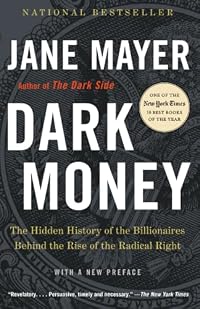
Dark Money: The Hidden History of the Billionaires Behind the Rise of the Radical Right
by Jane Mayer
On This Page
Description
History. Politics. Nonfiction. HTML:Why is America living in an age of profound economic inequality? Why, despite the desperate need to address climate change, have even modest environmental efforts been defeated again and again? Why have protections for employees been decimated? Why do hedge-fund billionaires pay a far lower tax rate than middle-class workers?The conventional answer is that a popular uprising against “big government” led to the ascendancy of a broad-based show more conservative movement. But as Jane Mayer shows in this powerful, meticulously reported history, a network of exceedingly wealthy people with extreme libertarian views bankrolled a systematic, step-by-step plan to fundamentally alter the American political system.
The network has brought together some of the richest people on the planet. Their core beliefs—that taxes are a form of tyranny; that government oversight of business is an assault on freedom—are sincerely held. But these beliefs also advance their personal and corporate interests: Many of their companies have run afoul of federal pollution, worker safety, securities, and tax laws.
The chief figures in the network are Charles and David Koch, whose father made his fortune in part by building oil refineries in Stalin’s Russia and Hitler’s Germany. The patriarch later was a founding member of the John Birch Society, whose politics were so radical it believed Dwight Eisenhower was a communist. The brothers were schooled in a political philosophy that asserted the only role of government is to provide security and to enforce property rights.
When libertarian ideas proved decidedly unpopular with voters, the Koch brothers and their allies chose another path. If they pooled their vast resources, they could fund an interlocking array of organizations that could work in tandem to influence and ultimately control academic institutions, think tanks, the courts, statehouses, Congress, and, they hoped, the presidency. Richard Mellon Scaife, the mercurial heir to banking and oil fortunes, had the brilliant insight that most of their political activities could be written off as tax-deductible “philanthropy.”
These organizations were given innocuous names such as Americans for Prosperity. Funding sources were hidden whenever possible. This process reached its apotheosis with the allegedly populist Tea Party movement, abetted mightily by the Citizens United decision—a case conceived of by legal advocates funded by the network.
The political operatives the network employs are disciplined, smart, and at times ruthless. Mayer documents instances in which people affiliated with these groups hired private detectives to impugn whistle-blowers, journalists, and even government investigators. And their efforts have been remarkably successful. Libertarian views on taxes and regulation, once far outside the mainstream and still rejected by most Americans, are ascendant in the majority of state governments, the Supreme Court, and Congress. Meaningful environmental, labor, finance, and tax reforms have been stymied.
Jane Mayer spent five years conducting hundreds of interviews-including with several sources within the network-and scoured public records, private papers, and court proceedings in reporting this book. In a taut and utterly convincing narrative, she traces the byzantine trail of the billions of dollars spent by the network and provides vivid portraits of the colorful figures behind the new American oligarchy.
... show less
Tags
Recommendations



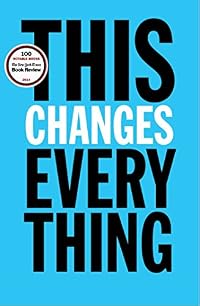
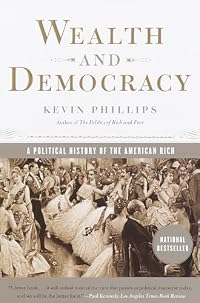
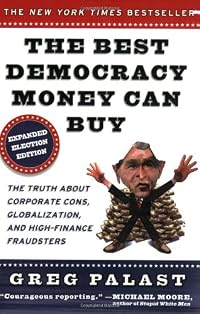
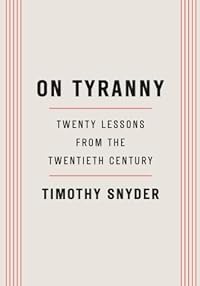





Member Recommendations
fulner Dark Money is the investigation to the
How the Koch's influence American politics. Jennifer Government is a dystopian fictional work about 21st century world if the Ko hs ideology rules the planet
Invisible Hands: The Making of the Conservative Movement from the New Deal to Reagan by Kim Phillips-Fein
M_Clark Invisible Hands covers much of the same territory as Dark Money but addresses more the philosophical developments of the movement.

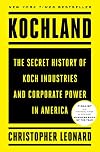
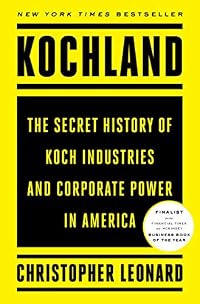
Kochland: The Secret History of Koch Industries and Corporate Power in America by Christopher Leonard
LamontCranston This book provides the full account of an event mentioned in passing in Dark Money. The oil stealing allegation and investigation from the 1980s.

M_Clark Mindf**k tells the story of the Mercer family investments in Cambridge Analytica like no other book.
Member Reviews
The Koch brothers have a plan, and it involves the creation of lots of different sources of conservative indoctrination, allowing them to serve their own political interests by giving to “charity” in the form of nonprofit policy shops and university centers committed to anti-regulatory postures. It’s a depressing story; Mayer finished the book before the big donation to GMU’s law school, which turns out to be exactly the kind of thing she’s talking about. Among other things, contrary to true academic freedom, the donor has the right to cut off the money if the donor doesn’t like who’s hired as the dean. Also, despite the claims about how big the donation was, it’s actually crony capitalism at its finest—the deal show more allowed them to rename the law school and claim to add a bunch of chaired professorships and scholarships, but by the ordinary rules for donations, the amount pledged would only have covered the professorships. When the money runs out, the taxpayers will have to pay for those new professors, but the donors still get the ideological influence and the tax credits. This is the kind of deal Mayer’s book exposes. show less
You already know this, but here the details are laid out in full: corporate plutocrats make tax-deductible donations to supposedly non-profit organizations, which in fact fund and organise think-tanks, university positions, political advertisements, and astroturfed protest groups to oppose policies that threaten their profits and freedom from regulation. They have proven able to spend enough to shut down sensible policy-making, fill the media with disinformation, and intimidate opponents, in order that their generally polluting businesses gain control over political debate and process. They dissemble, network and coordinate their way to turning private wealth into public power. Seeing this movement laid out in full like this highlights show more how naive Obama was to think he could lead America into a new age of bi-partisan, common-sense politics. The US has many fundamental political problems, including virtually unregulated political funding, lobbying, biased news, and gerrymandering, but this book helps you see that these are not merely unfortunate circumstances, but elements of deliberate strategy of a network of conservative groups funded by a small group of plutocrats for their own continuing enrichment. Trump, of course, was not the preferred candidate of the Kochs, the main players in these operations, but he has hired scores of people linked to them and their networks, not least multilevel sales heiress Betsy Devos at Education: Trump instantly sold out his populist schtick to his organised and influential corporate and plutocratic bedfellows. show less
I am utterly astounded.
Not surprised, mind you. But I am utterly astounded. It feels like there are no books written any more that rely on real investigative journalism.
But this is one, and it has meticulous, astounding scope.
It's one thing to point out the flaws in your opposition. Those kinds of books are commonplace and are always designed to sway you persuasively. And then there are books that give you a very, very big picture that shows you something so scary, so pervasive, that it boggles the imagination and is worse than any horror novel ever written.
This is about the Koch brothers. Two men in the 6th and 7th richest place in the world, who built an empire on oil money with the very worst record for ecological disasters, where show more ends always justify the means, turned all their money toward politics. How did they do this? Philanthropy. As in, pouring all their money into foundations and trusts that then poured all their money into other foundations and trusts in such a horribly convoluted shell-game that it takes full-time researchers to uncover where the money originated.
Why did they do this? To bypass political financing regulations.
Where did these foundations and trusts lead to?
Educational institutions in order to promote radical right wing agendas in all the biggest schools, tempting all students with ongoing stipends and opportunities as long as they tow the line.
Astroturfing. Creating hundreds of seemingly grass-roots organizations like the Tea Party and many like it, like the Heritage Foundation, etc., to provide ideological foot-troops against any target they pleased.
Fundraising campaigns that stagger the imagination, still using the shell-game premise, that led to nearly 300 billion dollars just to capture all the seats in congress and the senate. And the presidency. They used every trick in the book. Smear campaigns in advertising was only a small part of it. They bought and paid for several networks, tons of writers, and spread their right-wing agenda across so many fronts that it APPEARED to be THE only game in town. They even eventually strong-armed the Republican Campaign into giving over the reigns.
It started with the Koch brothers and their ideological obsession. Now it's a full network of the richest banding together to create what, in the parlance, can only be an Oligarchy. Rule by the rich.
What is the bottom line? The rich get richer. No one else matters.
Definitely not the middle class or the poor. If you're not in the upper 1%, you're nothing. They have bought the political system.
If you think this is a propaganda piece by the left, then try reading it and prove me wrong. Check https://www.politifact.com/
It is so much worse than you might imagine. They have lied through their teeth on practically anything and everything. They have done everything they can do to dismantle the EPA, health care systems, anti-trust laws, inheritance laws (That ONLY affect the upper 1%), brainwashing the intellectual elite (or at least giving them all monetary incentive to tow the line even if they don't BELIEVE), fund every group that nay-says global warming, blames every victim for the housing crisis, and, of course, the Obamacare act.
None of this is about the reality any of us regular people believe in. They say whatever they want in order to accomplish only ONE thing: their bottom line. If that means dismantling all government, all checks and balances, and the possibility of ever having an egalitarian society ever again, then it JUST DOESN'T MATTER.
Almost everyone in the government has a major financial hand in the Koch pie. Local, State, Nationwide. The regulators have either worked for or still work with the worst abusers.
If it sounds like some mob-run scheme, then you're right.
The fact that normal people can't untangle the web, or if they've gotten far enough in the tangle, they throw up their hands and cry for mercy, is exactly the point.
People ARE untangling the web and this book is a fantastic example of it.
Am I scared of what I've learned?
Oh hell yes. I was so scared back in the 2000's that I swore off political reading or watching tv ever again. If I couldn't trust anything I heard, then I would spend my time better by reading fiction.
I stopped being depressed and feeling helpless. And now that I feel a bit better, I decided to step back into the knowledge playground. I have strength I didn't have back then. This book doesn't make me spiral into desperation.
Rather, it makes me proud that there are still people willing to report the truth.
Maybe someday, this book will be required reading after we get over this crisis. Or perhaps it will be an underground book suppressed by the Oligarchy. Either way, we will have seen how we got here. show less
Not surprised, mind you. But I am utterly astounded. It feels like there are no books written any more that rely on real investigative journalism.
But this is one, and it has meticulous, astounding scope.
It's one thing to point out the flaws in your opposition. Those kinds of books are commonplace and are always designed to sway you persuasively. And then there are books that give you a very, very big picture that shows you something so scary, so pervasive, that it boggles the imagination and is worse than any horror novel ever written.
This is about the Koch brothers. Two men in the 6th and 7th richest place in the world, who built an empire on oil money with the very worst record for ecological disasters, where show more ends always justify the means, turned all their money toward politics. How did they do this? Philanthropy. As in, pouring all their money into foundations and trusts that then poured all their money into other foundations and trusts in such a horribly convoluted shell-game that it takes full-time researchers to uncover where the money originated.
Why did they do this? To bypass political financing regulations.
Where did these foundations and trusts lead to?
Educational institutions in order to promote radical right wing agendas in all the biggest schools, tempting all students with ongoing stipends and opportunities as long as they tow the line.
Astroturfing. Creating hundreds of seemingly grass-roots organizations like the Tea Party and many like it, like the Heritage Foundation, etc., to provide ideological foot-troops against any target they pleased.
Fundraising campaigns that stagger the imagination, still using the shell-game premise, that led to nearly 300 billion dollars just to capture all the seats in congress and the senate. And the presidency. They used every trick in the book. Smear campaigns in advertising was only a small part of it. They bought and paid for several networks, tons of writers, and spread their right-wing agenda across so many fronts that it APPEARED to be THE only game in town. They even eventually strong-armed the Republican Campaign into giving over the reigns.
It started with the Koch brothers and their ideological obsession. Now it's a full network of the richest banding together to create what, in the parlance, can only be an Oligarchy. Rule by the rich.
What is the bottom line? The rich get richer. No one else matters.
Definitely not the middle class or the poor. If you're not in the upper 1%, you're nothing. They have bought the political system.
If you think this is a propaganda piece by the left, then try reading it and prove me wrong. Check https://www.politifact.com/
It is so much worse than you might imagine. They have lied through their teeth on practically anything and everything. They have done everything they can do to dismantle the EPA, health care systems, anti-trust laws, inheritance laws (That ONLY affect the upper 1%), brainwashing the intellectual elite (or at least giving them all monetary incentive to tow the line even if they don't BELIEVE), fund every group that nay-says global warming, blames every victim for the housing crisis, and, of course, the Obamacare act.
None of this is about the reality any of us regular people believe in. They say whatever they want in order to accomplish only ONE thing: their bottom line. If that means dismantling all government, all checks and balances, and the possibility of ever having an egalitarian society ever again, then it JUST DOESN'T MATTER.
Almost everyone in the government has a major financial hand in the Koch pie. Local, State, Nationwide. The regulators have either worked for or still work with the worst abusers.
If it sounds like some mob-run scheme, then you're right.
The fact that normal people can't untangle the web, or if they've gotten far enough in the tangle, they throw up their hands and cry for mercy, is exactly the point.
People ARE untangling the web and this book is a fantastic example of it.
Am I scared of what I've learned?
Oh hell yes. I was so scared back in the 2000's that I swore off political reading or watching tv ever again. If I couldn't trust anything I heard, then I would spend my time better by reading fiction.
I stopped being depressed and feeling helpless. And now that I feel a bit better, I decided to step back into the knowledge playground. I have strength I didn't have back then. This book doesn't make me spiral into desperation.
Rather, it makes me proud that there are still people willing to report the truth.
Maybe someday, this book will be required reading after we get over this crisis. Or perhaps it will be an underground book suppressed by the Oligarchy. Either way, we will have seen how we got here. show less
Jane Mayer has written a very disturbing book about the influence of big money (and I mean very big money) on American politics and society. She details how a handful of billionaire families have utilized tax-exempt private foundations to influence legislation and regulation to benefit their personal financial interests, ostensibly in the interest of “social welfare.”
Section 501(c)(4) of the Internal Revenue Code authorizes the creation of tax exempt corporate entities devoted to “social welfare.” These entities are allowed to engage in electoral politics, and since the Supreme Court’s 2010 Citizens United decision, they have done so with a vengeance. Moreover, unlike other entities engaged in electoral politics, 501(c)(4) show more organizations do not have to disclose the identities of their contributors. Most prominent among the family foundations enjoying this tax largess is that owned by Charles and David Koch.
These two brothers control Koch Industries, the second-largest privately owned company in the United States (with 2013 revenues of $115 billion). The family business was started by their father Fred, who developed a new method for the refinement of heavy crude oil into gasoline. Fred Koch, a great influence on his sons, was one of the 11 founders of the John Birch Society, a far-right advocacy group supporting anti-communism and limited government. The brothers, with profits from their Kansas-based company, have become a major source of support for conservative candidates and causes in American politics that will benefit their financial operations.
In particular, Mayer describes how the Kochs have funded ostensibly “scientific” research to create the notion that climate change is a hoax. They claim they were driven by principle, “but their positions dovetailed seamlessly with their personal financial interests.” Of course, regulation of the emission of green house gases like carbon dioxide would greatly increase the cost of doing business for many of the Koch businesses.
But the Kochs have not confined their activities to sponsoring the publication of dubious scientific papers. Mayer reports that they have frequently used private detectives to dig up dirt on the private lives of their adversaries and legitimate climate scientists. Moreover, there appears to be plenty of evidence that the Koch’s businesses violated numerous environmental regulations and may have been criminally liable.
Mayer also documents the extent to which the Kochs have used their money and influence to transform the political system, especially at the state level, to one that would favor their antigovernment philosophy. As Alan Ehrenhalt writes in his review of this book for "The New York Times":
"What the Kochs and their allies have created, in her view, is a private political bank capable of bestowing unlimited amounts of money on favored candidates, and doing it with virtually no disclosure of its source. They have established a Republican Party in which donors, not elected officials, are in charge. In 2011, when House Speaker John Boehner was desperate for Republican votes to prevent the government from defaulting on its debt, he went to see David Koch in Manhattan to plead for help. 'It had taken years,' Mayer writes, but the brothers 'were becoming a rival center of power to the Republican establishment.'”
In some instances, Mayer overstates her case. She sees every conservative cause as intrinsically evil, and any funding of such causes as sinister. She does an injustice to the "Law and Economics Movement" because of support it received from the Olin Foundation, one of her bugbears. John M. Olin, who also made his fortune from the fossil fuel industry - in particular from the coal industry - believed universities were “brainwashing centers” for the liberal left, and dedicated his donations to countering this alleged influence.
Olin endowed the still-influential “Law and Economics” curriculum in law schools nationwide, which stresses the importance and “neutrality” of the free market, instead of giving equal or greater value to social considerations that might not be the most economically efficient. The Olin Foundation spent $68 million underwriting its growth. But this movement was already quite influential at the University of Chicago in the early 1960's without any help from John Olin. The Law and Economics philosophy influenced a whole generation of lawyers, leading to the junking of many anticompetitive regulations, a re-examination of antitrust law, a great reduction in the enforcement of the Robinson-Patman Act, and the abolition of the Interstate Commerce Commission.
This small criticism aside, Mayer’s writing had me cringing at the thought of the Kochs, Olins, and a host of even crazier right-wingers promulgating their nonsense, and in many cases, not being required to disclose their identities. In the 2016 election cycle, for example, "The New York Times" reported that the political network overseen by the Kochs planned to spend close to $900 million, “to influence legislation and campaigns across the country, leveraging Republican control of Congress and the party’s dominance of state capitols to push for deregulation, tax cuts and smaller government.”
As Bill McKibben characterized the influence of these conservative billionaires in "The New York Review of Books":
"…the Kochs, and the closely connected group of billionaires they’ve helped assemble, have . . . distorted American politics in devastating ways, impairing the chances that we’ll effectively respond to climate change, reducing voting rights in many states, paralyzing Congress, and radically ratcheting up inequality.”
It's not just inequality that has been affected by the Kochs. There is growing evidence that they are behind the obstructionism toward an investigation of the Trump-Russia connection. You can read about that here and here.
Evaluation: This well-researched and well-documented important book should be read by all citizens, even if it will probably raise your blood pressure.
(JAB) show less
Section 501(c)(4) of the Internal Revenue Code authorizes the creation of tax exempt corporate entities devoted to “social welfare.” These entities are allowed to engage in electoral politics, and since the Supreme Court’s 2010 Citizens United decision, they have done so with a vengeance. Moreover, unlike other entities engaged in electoral politics, 501(c)(4) show more organizations do not have to disclose the identities of their contributors. Most prominent among the family foundations enjoying this tax largess is that owned by Charles and David Koch.
These two brothers control Koch Industries, the second-largest privately owned company in the United States (with 2013 revenues of $115 billion). The family business was started by their father Fred, who developed a new method for the refinement of heavy crude oil into gasoline. Fred Koch, a great influence on his sons, was one of the 11 founders of the John Birch Society, a far-right advocacy group supporting anti-communism and limited government. The brothers, with profits from their Kansas-based company, have become a major source of support for conservative candidates and causes in American politics that will benefit their financial operations.
In particular, Mayer describes how the Kochs have funded ostensibly “scientific” research to create the notion that climate change is a hoax. They claim they were driven by principle, “but their positions dovetailed seamlessly with their personal financial interests.” Of course, regulation of the emission of green house gases like carbon dioxide would greatly increase the cost of doing business for many of the Koch businesses.
But the Kochs have not confined their activities to sponsoring the publication of dubious scientific papers. Mayer reports that they have frequently used private detectives to dig up dirt on the private lives of their adversaries and legitimate climate scientists. Moreover, there appears to be plenty of evidence that the Koch’s businesses violated numerous environmental regulations and may have been criminally liable.
Mayer also documents the extent to which the Kochs have used their money and influence to transform the political system, especially at the state level, to one that would favor their antigovernment philosophy. As Alan Ehrenhalt writes in his review of this book for "The New York Times":
"What the Kochs and their allies have created, in her view, is a private political bank capable of bestowing unlimited amounts of money on favored candidates, and doing it with virtually no disclosure of its source. They have established a Republican Party in which donors, not elected officials, are in charge. In 2011, when House Speaker John Boehner was desperate for Republican votes to prevent the government from defaulting on its debt, he went to see David Koch in Manhattan to plead for help. 'It had taken years,' Mayer writes, but the brothers 'were becoming a rival center of power to the Republican establishment.'”
In some instances, Mayer overstates her case. She sees every conservative cause as intrinsically evil, and any funding of such causes as sinister. She does an injustice to the "Law and Economics Movement" because of support it received from the Olin Foundation, one of her bugbears. John M. Olin, who also made his fortune from the fossil fuel industry - in particular from the coal industry - believed universities were “brainwashing centers” for the liberal left, and dedicated his donations to countering this alleged influence.
Olin endowed the still-influential “Law and Economics” curriculum in law schools nationwide, which stresses the importance and “neutrality” of the free market, instead of giving equal or greater value to social considerations that might not be the most economically efficient. The Olin Foundation spent $68 million underwriting its growth. But this movement was already quite influential at the University of Chicago in the early 1960's without any help from John Olin. The Law and Economics philosophy influenced a whole generation of lawyers, leading to the junking of many anticompetitive regulations, a re-examination of antitrust law, a great reduction in the enforcement of the Robinson-Patman Act, and the abolition of the Interstate Commerce Commission.
This small criticism aside, Mayer’s writing had me cringing at the thought of the Kochs, Olins, and a host of even crazier right-wingers promulgating their nonsense, and in many cases, not being required to disclose their identities. In the 2016 election cycle, for example, "The New York Times" reported that the political network overseen by the Kochs planned to spend close to $900 million, “to influence legislation and campaigns across the country, leveraging Republican control of Congress and the party’s dominance of state capitols to push for deregulation, tax cuts and smaller government.”
As Bill McKibben characterized the influence of these conservative billionaires in "The New York Review of Books":
"…the Kochs, and the closely connected group of billionaires they’ve helped assemble, have . . . distorted American politics in devastating ways, impairing the chances that we’ll effectively respond to climate change, reducing voting rights in many states, paralyzing Congress, and radically ratcheting up inequality.”
It's not just inequality that has been affected by the Kochs. There is growing evidence that they are behind the obstructionism toward an investigation of the Trump-Russia connection. You can read about that here and here.
Evaluation: This well-researched and well-documented important book should be read by all citizens, even if it will probably raise your blood pressure.
(JAB) show less
Why is America living in an age of profound economic inequality? Why, despite the desperate need to address climate change, have even modest environmental efforts been defeated again and again? Why have protections for employees been decimated? Why do hedge-fund billionaires pay a far lower tax rate than middle-class workers?The conventional answer is that a popular uprising against “big government” led to the rise of a broad-based conservative movement. But as Jane Mayer shows in this powerful, meticulously reported history, a network of exceedingly wealthy people with extreme libertarian views also played a key role by bankrolling a systematic, step-by-step plan to fundamentally alter the American political system.The network has show more brought together some of the richest people on the planet, foremost among them Charles and David Koch. Their core beliefs—that taxes are a form of tyranny; that government oversight of business is an assault on freedom—are sincerely held. But these beliefs also advance their personal and corporate interests: Many of their companies have run afoul of federal pollution, worker safety, securities, and tax laws.When libertarian ideas proved decidedly unpopular with voters, the Koch brothers and their allies decided on another path. If they pooled their vast resources, they could fund an interlocking array of organizations that could work in tandem to influence and ultimately control academic institutions, think tanks, the courts, statehouses, Congress, and, they hoped, the presidency.The political operatives the network employs are disciplined, smart, and at times ruthless. And their efforts have been remarkably successful. Libertarian views on taxes and regulation, once far outside the mainstream and still rejected by most Americans, are ascendant in the majority of state governments, the Supreme Court, and Congress. Meaningful environmental, labor, finance, and tax reform has been stymied.Jane Mayer spent five years conducting hundreds of interviews—including with several sources within the network—and scoured public records, private papers, and court proceedings in reporting this book. In a taut and utterly convincing narrative, she traces the byzantine trail of the billions of dollars spent by the network and provides vivid portraits of the colorful figures behind the new American oligarchy. Dark Money is a book that must be read by anyone who cares about the future of American democracy. show less
Everyone who cares about American politics should read this book. It's a hard slog, not because of any lapses on the author's part, but because the story itself is full of twists and turns and deliberate obfuscations (shell organizations that are only a PO box, etc). If you want to understand how Charles and David Koch, two unelected billionaire brothers, motivate, steer, and fund the radical right, attempting at every turn to buy politicians and votes and elections, this is your book. A shameful, dark chapter in our democracy, which, unfortunately is not only not over, but is instead in full, hideous flower. Congratulations to Jane Mayer--I don't know how she stood it.
I've been putting off reading this book because I knew it was going to be an incredibly stressful read, and I was right. But it was really great. By really great, I mean so bleak and scarier than any horror book because it is our reality, and I don't know how we'll ever get the country out from this control.
Members
- Recently Added By
Lists

True Color
16 works; 1 member

Books Read in 2019
4,052 works; 108 members

Books Read in 2017
4,248 works; 129 members

Club Read's Recommended Nonfiction Written by Women
618 works; 30 members
Author Information

5+ Works 3,591 Members
Some Editions
Awards and Honors
Awards
Distinctions
Common Knowledge
- Original title
- Dark Money: The Hidden History of the Billionaires Behind the Rise of the Radical Right
- Original publication date
- 2016-01-19
- People/Characters
- Fred Koch; David Koch; William Koch; Charles G. Koch; Frederick Koch; John M. Olin (show all 8); Richard Mellon Scaife; Lewis F. Powell, Jr.
- Important places
- Saltville, Virginia, USA; USA
- Epigraph
- We must make our choice. We may have democracy,
or we may have wealth concentrated in the hands of a few,
but we can't have both.
- Louis Brandeis - Dedication
- FOR BILL HAMILTON
Everyone needs an editor,
but not everyone is lucky enough to marry one.
Thank you for always being there with just the right words. - Quotations
- This faction hoped to use their wealth to advance a strain of conservative libertarian politics that was so far out on the political fringe as recently as 1980, when David Koch ran for Vice President on the Libertarian Party ... (show all)ticket, it received only 1 percent of the American vote. At the time, the conservative icon William F. Buckley, Jr. dismissed their views as "Anarcho-Totalitarianism."
In support of building their own youth movement, another speaker, the libertarian historian Leonard Liggio, cited the success of the Nazi model. In his paper titled "National Socialist Political Strategy: Social Change in a M... (show all)odern Industrial Society with an Authoritarian Tradition," Liggio, who was affiliated with the Koch-funded Institute for Humane Studies (IHS) from 1974 to 1998, described the Nazis' successful creation of a youth movement a key to their capture of the state. Like the Nazis, he suggested, libertarians should organise university students to create group identity. - Blurbers
- Klein, Naomi
- Canonical DDC/MDS
- 320.520973
- Canonical LCC
- JC599.U5
Classifications
- Genres
- General Nonfiction, Politics and Government, Nonfiction, Business, History
- DDC/MDS
- 320.520973 — Social sciences Political science Political science (Politics and government) Political ideologies Conservatism Standard subdivisions History, geographic treatment, biography North America United States
- LCC
- JC599 .U5 — Political Science Political theory Political theory. The state. Theories of the state Purpose, functions, and relations of the state
- BISAC
Statistics
- Members
- 2,039
- Popularity
- 10,169
- Reviews
- 78
- Rating
- (4.29)
- Languages
- English, Spanish
- Media
- Paper, Audiobook, Ebook
- ISBNs
- 17
- UPCs
- 1
- ASINs
- 9