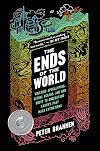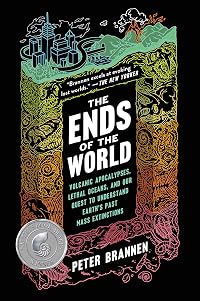
The Ends of the World: Volcanic Apocalypses, Lethal Oceans, and Our Quest to Understand Earth's Past Mass Extinctions
by Peter Brannen
On This Page
Description
Our world has ended five times: it has been broiled, frozen, poison-gassed, smothered, and pelted by asteroids. In The Ends of the World, Peter Brannen dives into deep time, exploring Earth's past dead ends, and in the process, offers us a glimpse of our possible future. Many scientists now believe that the climate shifts of the twenty-first century have analogs in these five extinctions. Using the visible clues these devastations have left behind in the fossil record, The Ends of the World show more takes us inside "scenes of the crime," from South Africa to the New York Palisades, to tell the story of each extinction. Brannen examines the fossil record-which is rife with creatures like dragonflies the size of sea gulls and guillotine-mouthed fish-and introduces us to the researchers on the front lines who, using the forensic tools of modern science, are piecing together what really happened at the crime scenes of the Earth's biggest whodunits. Part road trip, part history, and part cautionary tale, The Ends of the World takes us on a tour of the ways that our planet has clawed itself back from the grave, and casts our future in a completely new light. show lessTags
Recommendations










Member Reviews
A fantastic journey through worlds wonderful, strange -- and dead. Like the universe itself, deep geological time is vastly difficult to imagine so it's a gift when a writer can offer glimpses. Even when the focus is on mass extinctions. One is left with something of an existential crisis - what is the meaning of life? What is all for? We like to think of ourselves as the end product advancing forward the ultimate expression of consciousness standing on the shoulders of those who came before. Bur this is untrue. We are the product of an accidental disaster that happens ever couple hundred million years. Every mass extinction was largely caused by the same thing: CO2 released by super volcanoes. Even the asteroid dinosaur extinction was show more probably caused by the subsequent volcanoes not the immediate impact event. This is a really great book, detailed and accessible with the latest science, but be prepared to battle your inner nihilism. show less
Thoroughly researched yet very readable
Puts ancient events of impossible scale into context and makes them almost comprehensible. As an ironic effect of reading this book, I became comforted about my sense of powerlessness to affect the slide into cataclysm in which our foolish leaders have placed us. Our world has belched and burped and shaken off its riders a few times before, and will probably do so again. Its life is very long, and ours are very short.
Puts ancient events of impossible scale into context and makes them almost comprehensible. As an ironic effect of reading this book, I became comforted about my sense of powerlessness to affect the slide into cataclysm in which our foolish leaders have placed us. Our world has belched and burped and shaken off its riders a few times before, and will probably do so again. Its life is very long, and ours are very short.
In The Ends of the World: Volcanic Apocalypses, Lethal Oceans, and Our Quest to Understand Earth's Past Mass Extinctions, science journalist Peter Brannen examines the scientific community's understandings of and evidence for the five mass extinctions that characterize Earth's history. He notices that a common thread linking all of them is the Earth's carbon cycle and draws apt comparisons to events going on in the Industrial and Post-industrial Ages of the past couple hundred years.
Brannen travels to meet with geologists, paleontologists, oceanographers, and chemists to better recreate the truly bizarre worlds that preceded "our" Earth, explaining how water temperatures, continental arrangement, and even the air itself were different. show more He also explores the remnants of the upheavals that ended these ages, from the Palisades in New Jersey to the Chicxulub crater in Mexico's Yucatán Peninsula. He engages with the competing theories for some of these changes, such as the role basaltic eruptions in India may have played in the End-Cretaceous extinction, so that he can fairly report on the state of the academic community. One realizes that some of the disciplines have become so specialized that it takes an outsider like Brannen to connect some of the dots.
While the book does offer a word of caution about our current tampering with the carbon cycle, Brannen makes it clear that the planet and life won't disappear; only our current civilization, which developed in an oddly-prolonged interglacial period. He also explains how creationists and climate change deniers are actively harming not just individual sciences, but our ability to interpret the significance of that data. This is a must-read for those interested in geology, deep-time, and climate change. show less
Brannen travels to meet with geologists, paleontologists, oceanographers, and chemists to better recreate the truly bizarre worlds that preceded "our" Earth, explaining how water temperatures, continental arrangement, and even the air itself were different. show more He also explores the remnants of the upheavals that ended these ages, from the Palisades in New Jersey to the Chicxulub crater in Mexico's Yucatán Peninsula. He engages with the competing theories for some of these changes, such as the role basaltic eruptions in India may have played in the End-Cretaceous extinction, so that he can fairly report on the state of the academic community. One realizes that some of the disciplines have become so specialized that it takes an outsider like Brannen to connect some of the dots.
While the book does offer a word of caution about our current tampering with the carbon cycle, Brannen makes it clear that the planet and life won't disappear; only our current civilization, which developed in an oddly-prolonged interglacial period. He also explains how creationists and climate change deniers are actively harming not just individual sciences, but our ability to interpret the significance of that data. This is a must-read for those interested in geology, deep-time, and climate change. show less
If I were to describe this book in a word it would be "chastening," as the author does a fine job of linking our current environmental mega-crisis involving the excessive burning of fossil fuels with past mass extinctions, most of which involved carbon dioxide driven environmental disruption on a massive scale. This is a very personal book in which Brannen makes no bones of linking his sour outlook on the worth of humanity as being too stupid to live with the recent demise of his mother (I can so relate), and that personal anger contributes to the value of this piece of journalism as an exercise in witness.
I was going to skim this book not thinking I would want to read a book on the geological history of billions of years on earth, but I stopped skimming and became riveted. The ability of Brannen to make somewhat tangible the scale of the earth’s history and our rather insignificant part of that history is remarkable and depressing and it’s all going to end in 1.6 billion years no matter what. So, damn.
Vivid, stunning revelation
The five mass extinctions are such a cliché, we actually have no understanding of what really happened. Peter Brannen has written a remarkable and extremely readable book (his first) to fill in the voids. The result is thought-provoking, gripping, and more than a little worrisome.
There were different reasons for the extinctions. We all know about the asteroid hit, because it was only proven in the 1980s. But volcanic eruptions – the likes of which we have fortunately never seen – were the cause of another. As well, the planet keeps tipping in and out of ice ages as it wobbles its way along. When mass extinctions occur, they tend to be really fast – same day in the case of the asteroid hit, very few years show more in other cases. It’s not a gradual decline; it’s a vanishing. Few species make it to the next era; we start over every time.
The mechanics are remarkably similar. The level of carbon dioxide soars, crippling the oceans from doing their job, and they return the favor to the air, crippling everything else. The weather turns unimaginably violent. Everything gets wiped out. It takes the oceans a good hundred thousand years to regain balance, and then a hundred million years for a new world of plants and animals to evolve and populate the barren Earth. In the interim, Earth is Hell.
Brannen assembles the wisdom of renowned paleontologists to put the scenes together. There isn’t much disagreement on the mechanics or the major events. As CO2 rises, so do temperatures, and very few beings are capable of functioning in higher temperature bands. They falter and die. For survivors, there would be nothing to live on.
Today we are in remarkably pleasant pause between ice ages, in which the continents have very fortuitously aligned north-south. That allows for migration and survival as different climates take hold. It also keeps the oceans pumping. There is a nice, benign balance to the weather, and the horrific volcanic flows that can deposit literally miles thick lava over entire countries, have ceased.
Unfortunately, one species has seen fit to take command, and it is working to throw the balance the Earth has achieved into another era of chaos. We are imposing change at a rate “ten times faster” than the worst events in Earth’s history, say the paleontologists. When temperatures rise just one degree, the balance is upset. We are (laughably) attempting to hold it at another two. That will not support life as we know it. “The entire global economy depends on how quickly we can get carbon out of the ground and into the atmosphere,” says one. And we’re doing it bigger and better than our volcanoes. As for rising oceans, paleontologists snicker at estimates of .5 to 2m. Every time this happened before, it was more like 15-20m for this kind of temperature rise. Considering all the factors that make a mass extinction, “We are the perfect storm.”
One key takeaway is that we cannot learn from the events of the past. Every mass extinction was different. There are so many variables, life forms, different configurations of land and sea, there is no way of predicting numeric outcomes with certainty. Past performance does not guarantee future results. But the overall picture is grim and coming up fast, and Brannen found no paleontologists who say different.
The Ends of the World fills in huge gaps, put things in perspective and (cough) clears the air about how the Earth works. It is an extraordinary, valuable insight, colorfully written and also frightening. Maybe nothing is forever, but we’re not helping.
David Wineberg show less
The five mass extinctions are such a cliché, we actually have no understanding of what really happened. Peter Brannen has written a remarkable and extremely readable book (his first) to fill in the voids. The result is thought-provoking, gripping, and more than a little worrisome.
There were different reasons for the extinctions. We all know about the asteroid hit, because it was only proven in the 1980s. But volcanic eruptions – the likes of which we have fortunately never seen – were the cause of another. As well, the planet keeps tipping in and out of ice ages as it wobbles its way along. When mass extinctions occur, they tend to be really fast – same day in the case of the asteroid hit, very few years show more in other cases. It’s not a gradual decline; it’s a vanishing. Few species make it to the next era; we start over every time.
The mechanics are remarkably similar. The level of carbon dioxide soars, crippling the oceans from doing their job, and they return the favor to the air, crippling everything else. The weather turns unimaginably violent. Everything gets wiped out. It takes the oceans a good hundred thousand years to regain balance, and then a hundred million years for a new world of plants and animals to evolve and populate the barren Earth. In the interim, Earth is Hell.
Brannen assembles the wisdom of renowned paleontologists to put the scenes together. There isn’t much disagreement on the mechanics or the major events. As CO2 rises, so do temperatures, and very few beings are capable of functioning in higher temperature bands. They falter and die. For survivors, there would be nothing to live on.
Today we are in remarkably pleasant pause between ice ages, in which the continents have very fortuitously aligned north-south. That allows for migration and survival as different climates take hold. It also keeps the oceans pumping. There is a nice, benign balance to the weather, and the horrific volcanic flows that can deposit literally miles thick lava over entire countries, have ceased.
Unfortunately, one species has seen fit to take command, and it is working to throw the balance the Earth has achieved into another era of chaos. We are imposing change at a rate “ten times faster” than the worst events in Earth’s history, say the paleontologists. When temperatures rise just one degree, the balance is upset. We are (laughably) attempting to hold it at another two. That will not support life as we know it. “The entire global economy depends on how quickly we can get carbon out of the ground and into the atmosphere,” says one. And we’re doing it bigger and better than our volcanoes. As for rising oceans, paleontologists snicker at estimates of .5 to 2m. Every time this happened before, it was more like 15-20m for this kind of temperature rise. Considering all the factors that make a mass extinction, “We are the perfect storm.”
One key takeaway is that we cannot learn from the events of the past. Every mass extinction was different. There are so many variables, life forms, different configurations of land and sea, there is no way of predicting numeric outcomes with certainty. Past performance does not guarantee future results. But the overall picture is grim and coming up fast, and Brannen found no paleontologists who say different.
The Ends of the World fills in huge gaps, put things in perspective and (cough) clears the air about how the Earth works. It is an extraordinary, valuable insight, colorfully written and also frightening. Maybe nothing is forever, but we’re not helping.
David Wineberg show less
I finished half of this book when I borrowed it from the library and bought it to finish reading it. It's very information-dense and also can be a bit overwhelming at times because All. Those. Disasters.
The author is witty and at times, laugh-out-loud witty, but All. Those. Disasters.
If I had been the designer, I would expand the simple timeline in the front matter of the book and place it prominently on the front endpaper where it would be easily referred to as a reminder of geological eras, times, and extinctions that defined the periods. I would have perhaps noted chapter numbers and pages associated with each. I did photocopy and insert one of those colourful charts you used to see in natural history books in the 1950s and 1960s show more showing different plant and animal groups, when they arose and when they vanished. It's very interesting how it differs from the information presented in Ends of the World. A lot of information has been discovered in the last fifty years -- forty years even.
I am really glad I bought and read this book. I learned so much. And there's a useful index if I want to track down any specific piece of information again, although I might just reread it occasionally. It's that good. show less
The author is witty and at times, laugh-out-loud witty, but All. Those. Disasters.
If I had been the designer, I would expand the simple timeline in the front matter of the book and place it prominently on the front endpaper where it would be easily referred to as a reminder of geological eras, times, and extinctions that defined the periods. I would have perhaps noted chapter numbers and pages associated with each. I did photocopy and insert one of those colourful charts you used to see in natural history books in the 1950s and 1960s show more showing different plant and animal groups, when they arose and when they vanished. It's very interesting how it differs from the information presented in Ends of the World. A lot of information has been discovered in the last fifty years -- forty years even.
I am really glad I bought and read this book. I learned so much. And there's a useful index if I want to track down any specific piece of information again, although I might just reread it occasionally. It's that good. show less
Members
- Recently Added By
Lists

This, that, and the other titles
15 works; 2 members

Climate Change
39 works; 2 members

Geology
24 works; 2 members

In Our Time books
4,934 works; 2 members
Author Information

1+ Work 702 Members
Peter Brannen is an award-winning science journalist whose work has appeared in the New York Times, The Atlantic, Wired, the Washington Post, Slate, the Boston Globe, and Aeon, among other publication. This is his first book.
Some Editions
Awards and Honors
Awards
Common Knowledge
- Canonical title
- The Ends of the World; The Ends of the World: Volcanic Apocalypses, Lethal Oceans, and Our Quest to Understand Earth's Past Mass Extinctions
- Original title
- The Ends of the World: Volcanic Apocalypses, Lethal Oceans, and Our Quest to Understand Earth's Past Mass Extinctions
- Alternate titles*
- Los finales del mundo: Una historia de erupciones volcánicas, océanos letales y extinciones masivas. Los apocalipsis pasados y futuros de la Tierra (CIENCIA) (CIENCIA)
- Original publication date
- 2017
- Important events
- climate change
- Original language
- English
*Some information comes from Common Knowledge in other languages. Click "Edit" for more information.
Classifications
Statistics
- Members
- 713
- Popularity
- 39,865
- Reviews
- 21
- Rating
- (4.15)
- Languages
- English, Portuguese, Spanish
- Media
- Paper, Audiobook, Ebook
- ISBNs
- 17
- ASINs
- 5