
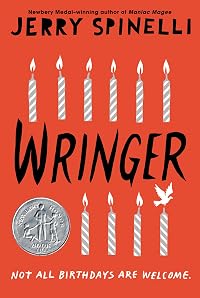
Wringer
by Jerry Spinelli
On This Page
Description
As Palmer comes of age, he must either accept the violence of being a wringer at his town's annual Pigeon Day or find the courage to oppose it.Tags
Recommendations





Member Reviews
This 1998 Newbery honor book is powerful, poignant and hauntingly beautiful. This is a remarkable story of peer and social pressure, the courage to sort through the quagmire of self doubt until the mud clears and what remains is a crystal clear reflection of self acceptance.
Sensitive, animal loving nine year old Palmer LaRue passionately dreads the arrival of his tenth birthday. The rite of passage in his small town is to become a wringer -- a wringer of the necks of pigeons still alive after being shot at by the local townsmen. The annual pigeon day is a huge event and Palmer has a decision to make -- should he become a "man," or should he stand alone and say no.
Wanting desperately to belong, Palmer abandons his long-term friendship of show more a neighborhood girl and initially finds a sense of belonging by becoming a member of the in crowd of male bullies where the rite of acceptance is a birthday brutal punch in the arm for every year. Like a medal of honor, Palmer proudly displays his horrific bruises obtained at the hands of a much larger, older boy.
Soon, Palmer realizes that he is uncomfortable with both the peers who emotionally and physically harm and the townspeople who once a year maim and kill 5,000 helpless birds.
Spinelli does a masterful job of weaving various emotions swirling inside Palmer, especially as Palmer discovers a pigeon on his windowsill and develops a loving relationship with the animal.
Returning to his neighborhood friend, he accepts the softer side of himself and once again embraces his friend Dorothy as together they feed and love the animal at the risk of discovery by the bullies and the townspeople.
Parker's mother and father are portrayed in a loving way, and his mother in particular shines like a beacon.
This book was particularly powerful because of the way the author used the softness of animals and females to guide Parker in his realization that while it is hard to risk non acceptance, it is harder still to say no to what is good, pure and right.
Highly recommended. Five Stars!!! show less
Sensitive, animal loving nine year old Palmer LaRue passionately dreads the arrival of his tenth birthday. The rite of passage in his small town is to become a wringer -- a wringer of the necks of pigeons still alive after being shot at by the local townsmen. The annual pigeon day is a huge event and Palmer has a decision to make -- should he become a "man," or should he stand alone and say no.
Wanting desperately to belong, Palmer abandons his long-term friendship of show more a neighborhood girl and initially finds a sense of belonging by becoming a member of the in crowd of male bullies where the rite of acceptance is a birthday brutal punch in the arm for every year. Like a medal of honor, Palmer proudly displays his horrific bruises obtained at the hands of a much larger, older boy.
Soon, Palmer realizes that he is uncomfortable with both the peers who emotionally and physically harm and the townspeople who once a year maim and kill 5,000 helpless birds.
Spinelli does a masterful job of weaving various emotions swirling inside Palmer, especially as Palmer discovers a pigeon on his windowsill and develops a loving relationship with the animal.
Returning to his neighborhood friend, he accepts the softer side of himself and once again embraces his friend Dorothy as together they feed and love the animal at the risk of discovery by the bullies and the townspeople.
Parker's mother and father are portrayed in a loving way, and his mother in particular shines like a beacon.
This book was particularly powerful because of the way the author used the softness of animals and females to guide Parker in his realization that while it is hard to risk non acceptance, it is harder still to say no to what is good, pure and right.
Highly recommended. Five Stars!!! show less
Once more, in his characteristic style, Jerry Spinelli shows why he is one of my favorite authors. This inspirational, heartbreaking novel uses a strange approach to celebrate the power of friendship, love, and respect for life.
Palmer is terrified of his tenth birthday. The fateful day when he will be old enough to become a wringer, one of the boys charged with helping out on the day of the city's great Pigeon Day Shoot, breaking the necks of the innocent birds.
Every other boy anticipates this milestone, but Palmer can hardly stand it. Then he picks up a very unlikely friend of his own; a charming, mischievous and intelligent pigeon he names Nipper. But for obvious reasons, Nipper must remain a complete secret, or someone will show more inevitably use him as just one more practice bird to kill. Meanwhile, Palmer navigates the hideous training of the wringer along with his peers, who are only too eager to accept the practice of violence with delight. He also befriends his outgoing neighbor Dorothy, who seems to understand his reluctance, and teaches him something about standing up for yourself.
But when the day of the Pigeon Shoot arrives...will Palmer be able to save Nipper?
I cry each time I read this book, from the scenes of ignorant brutality to the heartwarming moments of utter triumph. I felt for Palmer's character, and I loved the charming and unique personality of Nipper, who sometimes seemed just as human as the other characters. The ending isn't perfect, but the tears you'll shed will be of happiness, if you're anything like me. And most of all, the ending, like those of Spinelli's other books like "Stargirl" and "The Library Card," is bright with hope, the best thing a book can leave you with. show less
Palmer is terrified of his tenth birthday. The fateful day when he will be old enough to become a wringer, one of the boys charged with helping out on the day of the city's great Pigeon Day Shoot, breaking the necks of the innocent birds.
Every other boy anticipates this milestone, but Palmer can hardly stand it. Then he picks up a very unlikely friend of his own; a charming, mischievous and intelligent pigeon he names Nipper. But for obvious reasons, Nipper must remain a complete secret, or someone will show more inevitably use him as just one more practice bird to kill. Meanwhile, Palmer navigates the hideous training of the wringer along with his peers, who are only too eager to accept the practice of violence with delight. He also befriends his outgoing neighbor Dorothy, who seems to understand his reluctance, and teaches him something about standing up for yourself.
But when the day of the Pigeon Shoot arrives...will Palmer be able to save Nipper?
I cry each time I read this book, from the scenes of ignorant brutality to the heartwarming moments of utter triumph. I felt for Palmer's character, and I loved the charming and unique personality of Nipper, who sometimes seemed just as human as the other characters. The ending isn't perfect, but the tears you'll shed will be of happiness, if you're anything like me. And most of all, the ending, like those of Spinelli's other books like "Stargirl" and "The Library Card," is bright with hope, the best thing a book can leave you with. show less
Rings true to life, unfortunately. Spinelli illuminates the dark realities of American culture & standard childhood issues such as bullying, peer-pressure, and being afraid to be yourself when everyone else is so WRONG and normal. I could so identify with the protagonist that it was painful. The premise seems brutal & shocking, a whole town who enjoys the annual pigeon-killing festivities that includes having 10-year-olds gleefully putting the injured birds "out of their misery" in the coveted role of "wringer". Seems as horrendous as, say, Thanksgiving, fireworks, pig roasts, rodeos, bull fights, and other seemingly innocuous cultural celebrations that to some of us who are more sensitive seem like orgies of brutality and/or show more immorality.
While this was a little less uplifting and inspiring as every other Spinelli novel, there still is a glimmer of hope in the end. This is not a "feel-good" novel like Star Girl, Crash, or Maniac Magee, but an important one to be placed in the hands of the right child. Anyone who feels a bit out of place or is ultra-sensitive would be that right child and would find a hero in Palmer, but perhaps our "Beans & Muddow's" should take a read, too. show less
While this was a little less uplifting and inspiring as every other Spinelli novel, there still is a glimmer of hope in the end. This is not a "feel-good" novel like Star Girl, Crash, or Maniac Magee, but an important one to be placed in the hands of the right child. Anyone who feels a bit out of place or is ultra-sensitive would be that right child and would find a hero in Palmer, but perhaps our "Beans & Muddow's" should take a read, too. show less
The portrayal of bullying in this story rang true for me - it reminded me of the gangs of girls that plagued my schoolyard. But there was a vague air of unreality about the story - possibly because my rose-coloured eyeballs had trouble imagining a town that would so actively support the violence of the pigeon shooting day.
One thing that Jerry Spinelli really seems to capture well about children—their experience of a larger-than-life world. The ecstasy of a snow day. The stinging annoyance of a neighbor being called a 'friend. The blunt hungry yearning for acceptance.
In Maniac Magee, this hyper-reality took the form of the mythic. In Wringer it's visceral, our protagonist's dread of turning ten:
'In his dreams he looks down to find his hands around the neck of the pigeon. It feels silky. The pigeon's eye is like a polished shirt button. The pigeon's eye is orange with a smaller black button in the center. It looks up at him. It does not blink. It seems as if the bird is about to speak, but it does not. Only the voices speak: 'Wring it!' '
In Palmer's show more town, on the last day of Family Fest, thousands of pigeons are released from cages as live targets in a sharp shooting contest. At ten, he will join the ranks of the 'wringers', the boys responsible for snapping the necks of 'one-point' wounded pigeons. Palmer is turning nine. Palmer is out of birthdays.
As it's been well noted, but not nearly often enough, the Pigeon Day of Wringer is clearly modeled on the live pigeon shoot held in Hegins, Pennsylvania every Labor Day until protests shut it down in '99. (Live pigeon shoots are still legal in PA.)
On its own merit, Wringer is already a tightly suspenseful, claustrophobic novel: full of wonderful character moments and observational gems that build on its examination of peer pressure. But the truth behind the fiction sort of makes me wonder... maybe we do live in hyper-reality and as adults we've often just gotten too desensitized to see it.
Palmer's voice seems to warn us himself: "He would come to it without having to pedal or run or walk or even more a muscle. He would fall smack into the lap of it without doing anything but breathe. In the end he would get there simply by growing one day older." Maybe we need exaggeration —maybe we need fear— to remind us how important it is to not be resigned to the wrongs of the world. Rating: 4.5 stars show less
In Maniac Magee, this hyper-reality took the form of the mythic. In Wringer it's visceral, our protagonist's dread of turning ten:
'In his dreams he looks down to find his hands around the neck of the pigeon. It feels silky. The pigeon's eye is like a polished shirt button. The pigeon's eye is orange with a smaller black button in the center. It looks up at him. It does not blink. It seems as if the bird is about to speak, but it does not. Only the voices speak: 'Wring it!' '
In Palmer's show more town, on the last day of Family Fest, thousands of pigeons are released from cages as live targets in a sharp shooting contest. At ten, he will join the ranks of the 'wringers', the boys responsible for snapping the necks of 'one-point' wounded pigeons. Palmer is turning nine. Palmer is out of birthdays.
As it's been well noted, but not nearly often enough, the Pigeon Day of Wringer is clearly modeled on the live pigeon shoot held in Hegins, Pennsylvania every Labor Day until protests shut it down in '99. (Live pigeon shoots are still legal in PA.)
On its own merit, Wringer is already a tightly suspenseful, claustrophobic novel: full of wonderful character moments and observational gems that build on its examination of peer pressure. But the truth behind the fiction sort of makes me wonder... maybe we do live in hyper-reality and as adults we've often just gotten too desensitized to see it.
Palmer's voice seems to warn us himself: "He would come to it without having to pedal or run or walk or even more a muscle. He would fall smack into the lap of it without doing anything but breathe. In the end he would get there simply by growing one day older." Maybe we need exaggeration —maybe we need fear— to remind us how important it is to not be resigned to the wrongs of the world. Rating: 4.5 stars show less
I applaud the author's ability to weave a story around the moral points he wants to make. It really is done extremely well. Just know that it is ROUGH to read (CW: killing pigeons en masse, peer pressure, bullying, cultivating violence and hate in children ). I can definitely see parallels in the town's celebration of butchery/hate in other societal issues. Again, very well done, but won't leave you feeling happy or even satisfied at the end.
Most boys can't wait for their tenth birthday--Palmer is dreading his. In Palmer's town, ten-year-old boys become wringers, who break the necks of wounded pigeons at the town's annual Pigeon Day shoot. Spinelli's taut, gripping tale of a good-hearted boy in a violent town gives the fear of growing up a whole new meaning.
For Palmer, there are perks to being ten: acceptance by neighborhood bullies Beans, Mutto, and Henry, getting a nickname (Snots!), and showing off his bruise from the Treatment (one punch in the arm for every year of his life). But there is one perk Palmer dreads: becoming a wringer. His small town hosts the annual Pigeon Day shoot, where eager ten-year-old boys wring the necks of wounded birds. Palmer secretly finds show more the entire ritual repellent.
To make matters worse, like a guilty conscience a stray pigeon comes tapping at his window one day, takes up residence in his closet, and won't leave. In a town that murders pigeons, how can he keep it secret ... and safe? Palmer asks his friend, Dorothy, for help, but she unknowingly sets the bird free in a place where it is captured, Palmer struggles for awhile to try to fit in, but the wild pigeon changes all that. He makes pathetic attempts to rid himself of this bird, but soon gives him a name (Nipper) and a home. Though the prevailing mood is one of almost unbearable suspense and foreboding, Spinelli skillfully blends in bits of comic relief, like Palmer anxiously pacing back and forth as Nipper mimics and struts behind.
By brandon royal show less
For Palmer, there are perks to being ten: acceptance by neighborhood bullies Beans, Mutto, and Henry, getting a nickname (Snots!), and showing off his bruise from the Treatment (one punch in the arm for every year of his life). But there is one perk Palmer dreads: becoming a wringer. His small town hosts the annual Pigeon Day shoot, where eager ten-year-old boys wring the necks of wounded birds. Palmer secretly finds show more the entire ritual repellent.
To make matters worse, like a guilty conscience a stray pigeon comes tapping at his window one day, takes up residence in his closet, and won't leave. In a town that murders pigeons, how can he keep it secret ... and safe? Palmer asks his friend, Dorothy, for help, but she unknowingly sets the bird free in a place where it is captured, Palmer struggles for awhile to try to fit in, but the wild pigeon changes all that. He makes pathetic attempts to rid himself of this bird, but soon gives him a name (Nipper) and a home. Though the prevailing mood is one of almost unbearable suspense and foreboding, Spinelli skillfully blends in bits of comic relief, like Palmer anxiously pacing back and forth as Nipper mimics and struts behind.
By brandon royal show less
Members
- Recently Added By
Lists

Newbery Honor Books By year - II - 1981-2035
143 works; 4 members

6th Grade
68 works; 4 members

Books Read in 2024
4,623 works; 126 members

EGBERTINA's List of Newbery books that I hated or found unnecessary
58 works; 3 members

Books We Loved As Children
603 works; 252 members
Author Information

Jerry Spinelli was born in Norristown, Pennsylvania on February 1, 1941. He received a bachelor's degree from Gettysburg College and a master's degree from Johns Hopkins University. He worked as an editor with Chilton from 1966 to 1989. He launched his career in children's literature with Space Station 7th Grade in 1982. He has written over 30 show more books including The Bathwater Gang, Picklemania, Stargirl, Milkweed, and Mama Seeton's Whistle. In 1991, he won the Newbery Award for Maniac Magee. In 1998, Wringer was named a Newbery Honor book. (Bowker Author Biography) show less
Some Editions
Awards and Honors
Awards
Distinctions
Series
Belongs to Publisher Series
Common Knowledge
- Canonical title
- Wringer
- Original title
- Wringer
- Alternate titles
- Wringer: Not All Birthdays Are Welcome (cover) (cover)
- Original publication date
- 1997
- People/Characters
- Palmer LaRue; Beans; Mutto; Henry; Dorothy; Nipper
- Important places
- Waymer, USA (fictional place)
- Dedication
- To Jerry and Helen Weiss
- First words
- WAYMER—Hundreds of sharpshooters in and around this rural community are cleaning their shotguns as they look forward to Saturday's 63rd annual Pigeon Day.
- Last words
- (Click to show. Warning: May contain spoilers.)These babies, you never know which way . . .
- Publisher's editor
- Cotler, Joanna
- Original language
- English US
Classifications
- Genres
- Fiction and Literature, Kids, Children's Books
- DDC/MDS
- 813.54 — Literature & rhetoric American literature in English American fiction in English 1900-1999 1945-1999
- LCC
- PZ7 .S75663 .W — Language and Literature Fiction and juvenile belles lettres Fiction and juvenile belles lettres Juvenile belles lettres
- BISAC
Statistics
- Members
- 4,100
- Popularity
- 3,754
- Reviews
- 60
- Rating
- (3.64)
- Languages
- Chinese, English, German, Italian
- Media
- Paper, Audiobook, Ebook
- ISBNs
- 37
- UPCs
- 1
- ASINs
- 14