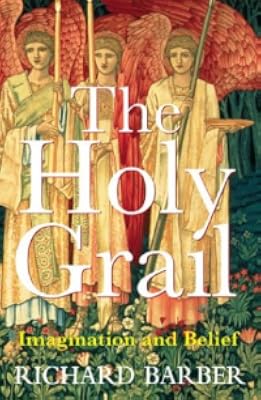
The Holy Grail: Imagination and Belief
by Richard Barber
On This Page
Description
"Barber traces the history of the stories surrounding the Holy Grail, beginning with Chretien de Troyes, who in the twelfth century first imagined the famous scene in which a mysterious golden vessel adorned with jewels was paraded before the eyes of an untested youth. The author died before he could complete his tale, and the unsolved mystery of the Grail has haunted us ever since. By a long series of imaginative transformations, the grail has moved from the sphere of romance to religion, show more and in twentieth-century popular culture has become an emblem of mysticism and man's highest aspirations, intimately linked with the central ritual of the Christian faith."--Jacket. show lessTags
Recommendations



















Member Reviews
This is not as rousing or exiting a history as I'd hoped for given what I thought I knew about the Holy Grail from the third Indiana Jones movie and popular culture in general. But I learned a lot and it certainly educated me as to the true history of the Grail (if you can define as "true history" the story of an imaginary object invented by an author who never even described what the object actually was or what it looked like). If you have any interest in the Grail, this is your book. I am very glad I stumbled across this book and I recommend it.
P.M. Matarasso, translator of THE QUEST OF THE HOLY GRAIL, Penguin, 2005, writes this about Richard Barber's incredibly erudite romp through Grail history:
"The book which serves as the best introduction and most reliable guide to the Grail myth in literature and literary consciousness from the twelfth century to the present day is Richard Barber's THE HOLY GRAIL: IMAGINATION AND BELIEF, Penguin, London, 2004. After giving full weight to the spectrum of medieval texts, it follows the Grail as symbol through to the wilder shores of New Age fantasy, covering a vast terrain with authority and grace. The thirty-page bibliography is up to date and comprehensive." (30)
From Barber's Introduction:
"The Grail is a mysterious and haunting image, show more which crosses the borders of fiction and spirituality, and which, for eight centuries, has been a recurrent ideal in
Western literature. What follows is an attempt to trace what we know about the Grail: it is, in all its forms, a construct of the creative imagination, but one which lays claim to the highest of religious ideals and experience. Even when it has been neglected for centuries, it has reappeared to appeal with renewed vigour to artists and writers; and from its first shape as a Christian symbol it has been recreated in a multitude of different forms.
"Such a topic exerts an extraordinary attraction for lovers of historical conundrums and enthusiasts for the esoteric and mysterious, particularly because we cannot give an answer to the question 'What is the Holy Grail?' The very first writer to mention it, who probably invented the idea, makes his story hinge on a similar question - 'What is the Grail for?' - and because he never provided the answer for his own riddle, the question continues to be asked. The initially mysterious and undefined 'Grail' had extraordinary repercussions: in a brief time span half a dozen major writers tried their hands at either completing the original stories or creating new ones, and in the process virtually invented a new art form, the prose romance, which many centuries later became the modern novel." (pg 1) show less
"The book which serves as the best introduction and most reliable guide to the Grail myth in literature and literary consciousness from the twelfth century to the present day is Richard Barber's THE HOLY GRAIL: IMAGINATION AND BELIEF, Penguin, London, 2004. After giving full weight to the spectrum of medieval texts, it follows the Grail as symbol through to the wilder shores of New Age fantasy, covering a vast terrain with authority and grace. The thirty-page bibliography is up to date and comprehensive." (30)
From Barber's Introduction:
"The Grail is a mysterious and haunting image, show more which crosses the borders of fiction and spirituality, and which, for eight centuries, has been a recurrent ideal in
Western literature. What follows is an attempt to trace what we know about the Grail: it is, in all its forms, a construct of the creative imagination, but one which lays claim to the highest of religious ideals and experience. Even when it has been neglected for centuries, it has reappeared to appeal with renewed vigour to artists and writers; and from its first shape as a Christian symbol it has been recreated in a multitude of different forms.
"Such a topic exerts an extraordinary attraction for lovers of historical conundrums and enthusiasts for the esoteric and mysterious, particularly because we cannot give an answer to the question 'What is the Holy Grail?' The very first writer to mention it, who probably invented the idea, makes his story hinge on a similar question - 'What is the Grail for?' - and because he never provided the answer for his own riddle, the question continues to be asked. The initially mysterious and undefined 'Grail' had extraordinary repercussions: in a brief time span half a dozen major writers tried their hands at either completing the original stories or creating new ones, and in the process virtually invented a new art form, the prose romance, which many centuries later became the modern novel." (pg 1) show less
Ratings
Members
- Recently Added By
Author Information

60+ Works 5,123 Members
Common Knowledge
- Canonical title
- The Holy Grail: Imagination and Belief
- Original publication date
- 2005-09-30
- Dedication
- For Helen
- First words
- This book is a journey that begins in territory that may seem strange and remote today.
- Last words
- (Click to show. Warning: May contain spoilers.)True, there have been moments of dullness and banality and there have been other times when it seemed that there was nothing to be found save shadows flickering against the flames of the imagination, but as a whole our journey has been set among the highest and most challenging ideas of the human spirit.
Classifications
- Genres
- Nonfiction, History, Religion & Spirituality, General Nonfiction, Literature Studies and Criticism
- DDC/MDS
- 398.4 — Society, government, & culture Customs, etiquette & folklore Folklore & Folktales Paranatural and legendary phenomena as subjects of folklore
- LCC
- PN686 .G7 .B27 — Language and Literature Literature (General) Literature (General) Literary history By period Medieval (to 1500) Legends
- BISAC
Statistics
- Members
- 268
- Popularity
- 120,050
- Reviews
- 2
- Rating
- (3.29)
- Languages
- English
- Media
- Paper
- ISBNs
- 3