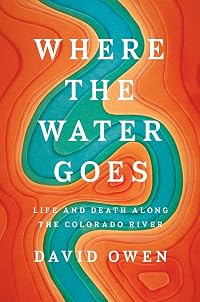
Where the Water Goes: Life and Death Along the Colorado River
by David Owen
On This Page
Description
The Colorado River is a crucial resource for a surprisingly large part of the United States, and every gallon that flows down it is owned or claimed by someone. David Owen traces all that water from the Colorado's headwaters to its parched terminus, once a verdant wetland but now a million-acre desert. He takes readers on an adventure downriver, along a labyrinth of waterways, reservoirs, power plants, farms, fracking sites, ghost towns, and RV parks, to the spot near the U.S.Mexico border show more where the river runs dry. Water problems in the western United States can seem tantalizingly easy to solve: just turn off the fountains at the Bellagio, stop selling hay to China, ban golf, cut down the almond trees, and kill all the lawyers. But a closer look reveals a vast man-made ecosystem that is far more complex and more interesting than the headlines let on. show lessTags
Recommendations







Member Reviews
Where The Water Goes is ostensibly a driving tour of the Colorado River, from its tributary headwaters to Baja in Mexico where it is supposed to end. Owen drives and describes the scenery and the various characters he meets (sometimes with his family), and fills in the history and significance of the location. But where it gets really interesting is in the legislatures and the courts, where the water has a completely different status.
There is real water and there is paper water. There are negotiated agreements and there is The Law Of The River, which seems to be whatever the legislator or lawyer talking wants it to be. And you don’t want to bring The Law Of The River to court. The book is most informative when paper water properties show more rear their heads. It’s not logical, intuitive, direct, simple, or efficient. And no one dares tamper with it lest the whole house of cards come tumbling down.
In Arizona, new developments can be built and sold without service or access to water. Owners have to go pick it up and bring it back as needed. In Colorado, the water that runs off your roof is not yours and you have no right to retain it. At the state level, there is a race to consume the allocation, lest it be reduced and grabbed by another state. And by the time the river gets to Mexico, there is literally nothing left. In the mean time, agriculture still flood-irrigates, and cities keep expanding. Deserts don’t mean no one can live or farm; they just have to divert more water. Incredibly, the locals argue about exporting agricultural products as if they were exporting the water in them. It’s all very Alice in Wonderland.
The whole arrangement was originally built on faulty data; the river system cannot produce what it says on paper. The big reservoirs are so low they constantly need to retain all the water they can, leaving little or nothing trickling down the system. Canals and other diversions pervert nature. Dams cause more problems than they solve. Worst of all is the first come first served arrangement, whereby those who have the oldest permits get all the water they’re allowed before newer participants can take any. In perpetuity. This is how the West was built.
None of this is news and Owen cites numerous predecessors in trying to explain it (but not rationalize it. No one can do that). Owen ends by making recommendations he knows full well no one will ever consider. It’s a remarkable trip.
David Wineberg show less
There is real water and there is paper water. There are negotiated agreements and there is The Law Of The River, which seems to be whatever the legislator or lawyer talking wants it to be. And you don’t want to bring The Law Of The River to court. The book is most informative when paper water properties show more rear their heads. It’s not logical, intuitive, direct, simple, or efficient. And no one dares tamper with it lest the whole house of cards come tumbling down.
In Arizona, new developments can be built and sold without service or access to water. Owners have to go pick it up and bring it back as needed. In Colorado, the water that runs off your roof is not yours and you have no right to retain it. At the state level, there is a race to consume the allocation, lest it be reduced and grabbed by another state. And by the time the river gets to Mexico, there is literally nothing left. In the mean time, agriculture still flood-irrigates, and cities keep expanding. Deserts don’t mean no one can live or farm; they just have to divert more water. Incredibly, the locals argue about exporting agricultural products as if they were exporting the water in them. It’s all very Alice in Wonderland.
The whole arrangement was originally built on faulty data; the river system cannot produce what it says on paper. The big reservoirs are so low they constantly need to retain all the water they can, leaving little or nothing trickling down the system. Canals and other diversions pervert nature. Dams cause more problems than they solve. Worst of all is the first come first served arrangement, whereby those who have the oldest permits get all the water they’re allowed before newer participants can take any. In perpetuity. This is how the West was built.
None of this is news and Owen cites numerous predecessors in trying to explain it (but not rationalize it. No one can do that). Owen ends by making recommendations he knows full well no one will ever consider. It’s a remarkable trip.
David Wineberg show less
I listened to this on audiobook. It was genuinely interesting to hear about the way the river is used, especially since I get my water from it. I just wish the author would have resisted the urge to push an agenda and become politically partisan. It is clear that water problems will have to be solved with bipartisan cooperation and the book would have been better had the author given detailed descriptions of the problems and discussed the various proposed solutions and their issues, but not been so blatantly obvious about his political opinions, since that made me less open to his ideas.
Wow what an amazing book.
If you live in the western United States this should be required reading.
Most of what people think and believe about water and it’s use in the west is wrong.
I love this book because the author didn’t just fill it with facts and lead the reader to incorrect conclusions as often happens, just to justify an agenda by the author.
In Where The Water Goes, the author traces the Colorado river from high atop the continental divide all the way to Mexico. Each chapter is dedicated to different sections of the river what other rivers feed into it and how the water is used.
The book tries to explain as clearly as possible
How water rights in the west are completely different than anywhere else.
The Law of The River what show more it is and what it means.
The Colorado River Compact, the upper and lower basins and states and what they are entitled to.
Where Mexico fits in.
How most of the water used in the Colorado front range originated in the other side of the continental divide and how it gets there.
One of the things I liked best is how the author broke down how there are no easy answers, to even what appear to be simple straight forward situations and questions.
This is a truly fascinating book! show less
If you live in the western United States this should be required reading.
Most of what people think and believe about water and it’s use in the west is wrong.
I love this book because the author didn’t just fill it with facts and lead the reader to incorrect conclusions as often happens, just to justify an agenda by the author.
In Where The Water Goes, the author traces the Colorado river from high atop the continental divide all the way to Mexico. Each chapter is dedicated to different sections of the river what other rivers feed into it and how the water is used.
The book tries to explain as clearly as possible
How water rights in the west are completely different than anywhere else.
The Law of The River what show more it is and what it means.
The Colorado River Compact, the upper and lower basins and states and what they are entitled to.
Where Mexico fits in.
How most of the water used in the Colorado front range originated in the other side of the continental divide and how it gets there.
One of the things I liked best is how the author broke down how there are no easy answers, to even what appear to be simple straight forward situations and questions.
This is a truly fascinating book! show less
Since I’m a resident of Tucson, this was more 'Where the Water Comes From' for me, at least through to the chapter about the Central Arizona Project, the canal that brings water from the Colorado to just south of here. And up to that point, it was fascinating, especially because of the history and anecdotes the author included in this overview of the Colorado River Basin. I have to admit it was dry reading after that until the last chapter, ‘What is to be Done?’, which points out the complexity of managing this very vital resource. 3 1/2 stars.
An interesting look at water issues, particularly as they relate to the Colorado River and the Southwest US. Most of the book feels like more of a travelogue than an in-depth look at the environment, science, or cultural history. And all those elements are combined with Owen's travels and stories of the people he met or places he saw while researching the book, although it sometimes felt a little tedious to me. The strongest part is probably the final chapter, "What is to be done?", where he looks at the various issues, such as the mind-boggling "Over-Allocation" of actual water, "Desalination," "Agriculture," etc. And I especially appreciated that Owen isn't blind to the many sides to every story or argument. He is especially good at show more pointing out the flaws in many seemingly simple and common-sense arguments, as well as illustrating the complexity of every idea or solution. Maybe not as focused on the river itself as I'd have liked it to be, but an interesting book nonetheless. (And I REALLY LOVE the cover, which reminded me of the Road Runner and Wiley Coyote cartoons that were my favorite as a child.) show less
A balanced and informative look at one of the most economically and ecologically critical rivers in the Western world. I'm not an engineer, hydrologist, or anyone of that sort, but Kohn managed to make infrastructure wildly interesting. An important, timely, scary, and surprisingly entertaining book about a complicated topic that impacts all of us in one way or another. I'd highly recommend it for everyone who drinks water, but especially to those living west of the Mississippi or those involved in water/property law, land development, agriculture, environmental nonprofits, and/or federal reclamation budgets and policy in the nation's capital.
Ratings
Members
- Recently Added By
Lists

Recommended Nature Writing
346 works; 180 members

Books Read in 2019
4,052 works; 110 members

Climate Change
39 works; 2 members
Author Information

19+ Works 1,613 Members
David Owen is on the staffs of both The New Yorker and Golf Digest. A frequent contributor to The Atlantic Monthly, and the author of nine previous books, he lives in Washington, Connecticut. (Bowker Author Biography)
Some Editions
Awards and Honors
Distinctions
Common Knowledge
- Dedication
- For Alice and Hugh O'Keefe
- First words
- Our pilot, David Kunkel, asked me to retrieve his oxygen bottle from under my seat, and when I handed it to him he gripped the plastic breathing tube with his teeth and opened the valve.
Classifications
- Genres
- Science & Nature, Nonfiction, Travel, General Nonfiction, Politics and Government
- DDC/MDS
- 917.91 — History & geography Geography & travel Geography of and travel in North America West Coast U.S. Arizona
- LCC
- F788 .O84 — Local History of the United States, Canada and Latin America United States local history New Southwest. Colorado River, Canyon, and Valley
- BISAC
Statistics
- Members
- 242
- Popularity
- 134,659
- Reviews
- 6
- Rating
- (3.80)
- Languages
- English
- Media
- Paper, Audiobook, Ebook
- ISBNs
- 5
- ASINs
- 2