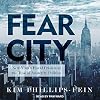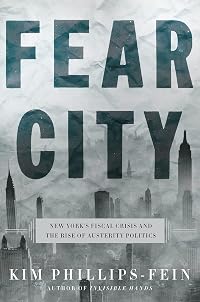
Fear City: New York's Fiscal Crisis and the Rise of Austerity Politics
by Kim Phillips-Fein
On This Page
Description
"An epic and riveting history of New York City on the edge of disaster--and an anatomy of the politics of austerity that continues to shape the world today. When the news broke in 1975 that New York City was on the brink of fiscal collapse, few believed it was possible: how could the capital of the financial world go bankrupt? And yet the city was billions of dollars--maybe twelve, maybe fourteen, no one even really knew how much--in the red. Bankers and politicians alike seized upon the show more situation as evidence that social liberalism, which New York famously exemplified, was doomed to failure--and promised apocalyptic scenarios if the city didn't fire thousands of workers, freeze wages, and slash social services. In this vivid, gripping account, historian Kim Phillips-Fein tells the remarkable story of the crisis that engulfed the city, forever transforming the largest metropolis in the United States and reshaping ideas about government throughout the country. In doing so, she brings to life a radically different New York, the legendarily decrepit city of the 1970s. Drawing on never-before-used archival sources as well as interviews with key players in the crisis, Phillips-Fein guides us through the hairpin turns and sudden reversals that brought New York City to the edge of bankruptcy--and kept it from going over. At once a sweeping history of some of the most tumultuous times in the city's past, a colorful portrait of the unwieldy mechanics of municipal government, and an origin story of the politics of austerity, Fear City is essential reading for anyone seeking to understand the resurgent fiscal conservatism of today."-- show lessTags
Recommendations








Member Reviews
Growing up in the NYC area, I have long been aware of the fiscal crisis of the 1970s, but never knew many details about it. Fear City gives a good education on the topic. It is well written, readable, and much less dry than you would expect of a 400-page book about fiscal policy. Phillips-Fein packs in a lot of information while making the story interesting and at times even suspenseful. She goes into great detail on both the political machinations at the city, state, and federal levels, as various factions tried to keep the city afloat and debated how it should solve its problems; and also covers how the austerity measures affected the city's people and communities and how some of them tried to fight back.
My main criticism relates to show more the author's biases. She pretty clearly is critical of the bankers and conservatives who insisted that the city cut back on services in order to be able to pay its debts, and it's not that I disagree with that opinion per se, but she sometimes indulged in sarcastic/snarky criticisms of conservative opinions, which I found tiresome. And there were times when I wished she would present her ideas of what other path the city could have possibly taken through the crisis, rather than just criticizing the decisions that beleaguered public servants made in an extremely difficult and unprecedented situation.
That said, Fear City is definitely a worthwhile read for anyone interested in New York history and urban fiscal policy. show less
My main criticism relates to show more the author's biases. She pretty clearly is critical of the bankers and conservatives who insisted that the city cut back on services in order to be able to pay its debts, and it's not that I disagree with that opinion per se, but she sometimes indulged in sarcastic/snarky criticisms of conservative opinions, which I found tiresome. And there were times when I wished she would present her ideas of what other path the city could have possibly taken through the crisis, rather than just criticizing the decisions that beleaguered public servants made in an extremely difficult and unprecedented situation.
That said, Fear City is definitely a worthwhile read for anyone interested in New York history and urban fiscal policy. show less
 This review was written for LibraryThing Early Reviewers.
The book's first sentence: "On October 30,1975, the New York Daily News printed the most famous headline in its history: FORD TO CITY: DROP DEAD."
Indeed, one of the themes of the book is the interplay of the Federal government and the city/state governments in the management of New York City's debt crisis in the 1970s. That crisis came about, the book lucidly demonstrates, by generous city spending on social services and city workers at a time when the city's revenue base was shrinking. Politicians and city employee unions agreed on only one solution to the gap between revenue and spending - borrow. The bills finally came due in 1975. The market stopped buying New York City bonds.
The author, a history professor living in New York City, show more writes extremely well, and what could have been a dry, number crunching story is, instead, a great human drama. For the most part she sets out the well-sourced facts chronologically and without bias. She does, however, at the end of the narrative, offer her views about the price that was paid for the debt 'fix'.
"[New York City's debt crisis] . . . marked the beginning of a new age. A corporate and financial elite, along with technocratic politicians responsive to that group, gained control over New York. They could be counted on to prioritize the interests of business and the wealthy; indeed, they often regarded that as the only way to help the city. This new perspective closed off an older vision of New York, shutting down debate over whether city government should seek to guarantee a set of social rights for all. New York City still has not transcended this constriction of its politics. Neither has the nation as a whole."
The fix was the creation, in 1976, of the Municipal Assistance Corporation (MAC). That was a state agency that sold bonds and used the proceeds to pay the city's debts and at the same time to force the city drastically to reduce spending on, for example, subsidized subway fares, multiple fire houses and companies, free tuition at City College, a massive police force, health clinics and outdated city hospitals, and excessive numbers of city employees (in 1970 eleven out of every 100 people employed in New York City worked for the municipal government).
The changes forced by MAC took decision making out of the hands of old-time ward healing pols, and from well intentioned, but free spending, liberal politicians like John Lindsay and Abe Beame, and gave it to businessmen and technocrats. Mayors Giuliani and Bloomberg reflected the new ethos.
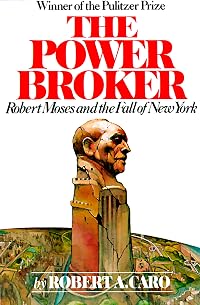
The book makes city governance as interesting and page turning as Robert Caro did in THE POWER BROKER (1975). show less
Indeed, one of the themes of the book is the interplay of the Federal government and the city/state governments in the management of New York City's debt crisis in the 1970s. That crisis came about, the book lucidly demonstrates, by generous city spending on social services and city workers at a time when the city's revenue base was shrinking. Politicians and city employee unions agreed on only one solution to the gap between revenue and spending - borrow. The bills finally came due in 1975. The market stopped buying New York City bonds.
The author, a history professor living in New York City, show more writes extremely well, and what could have been a dry, number crunching story is, instead, a great human drama. For the most part she sets out the well-sourced facts chronologically and without bias. She does, however, at the end of the narrative, offer her views about the price that was paid for the debt 'fix'.
"[New York City's debt crisis] . . . marked the beginning of a new age. A corporate and financial elite, along with technocratic politicians responsive to that group, gained control over New York. They could be counted on to prioritize the interests of business and the wealthy; indeed, they often regarded that as the only way to help the city. This new perspective closed off an older vision of New York, shutting down debate over whether city government should seek to guarantee a set of social rights for all. New York City still has not transcended this constriction of its politics. Neither has the nation as a whole."
The fix was the creation, in 1976, of the Municipal Assistance Corporation (MAC). That was a state agency that sold bonds and used the proceeds to pay the city's debts and at the same time to force the city drastically to reduce spending on, for example, subsidized subway fares, multiple fire houses and companies, free tuition at City College, a massive police force, health clinics and outdated city hospitals, and excessive numbers of city employees (in 1970 eleven out of every 100 people employed in New York City worked for the municipal government).
The changes forced by MAC took decision making out of the hands of old-time ward healing pols, and from well intentioned, but free spending, liberal politicians like John Lindsay and Abe Beame, and gave it to businessmen and technocrats. Mayors Giuliani and Bloomberg reflected the new ethos.
The book makes city governance as interesting and page turning as Robert Caro did in THE POWER BROKER (1975). show less
This review was written for LibraryThing Early Reviewers.Not long before seeing “Fear City” on LT’s Early Reviewers list, I had watched Adam Curtis’s 2016 film “Hypernormalisation,” which starts with two local but globally significant moments in 1975, one in Damascus and one in New York City. The latter was in deep debt and on the brink of collapse, and the film presents footage of the city issuing bonds in return for loans – a meeting where no banks showed up. Curtis saw this as the moment when financial institutions took power away from politicians and started to run society themselves. The film veers from there to analyze the effects of this “experiment” in the ensuing decades, but it had me wondering about the details of NYC’s fiscal crisis.
Kim Phillips-Fein’s show more “Fear City” details “New York’s fiscal crisis and the rise of austerity politics” (the book’s subtitle) so thoroughly that often I found my eyes glazing over, lost in the economic and political minutia. Even though the material throughout was not ideally suited to this reader, I applaud Phillips-Fein for dismantling some myths (in regards to the causes of the crisis as well as how the city navigated it and rose out of it) and painting as thorough and clear a picture as is possible all these decades later. It is an important history at an appropriate time, as conservative politicians and the corporations they appear to represent more than the public push toward even greater austerity in the wider American government.
Both Curtis and Phillips-Fein correctly assert that we – in NYC and elsewhere – are dealing with the effects of the mid-1970s crisis: income inequality and reduced government spending in social services, to name but two areas. Yet New York remains an island of sorts in the United States, with its relatively strong public sector and social welfare. Paradoxically, the city is home to some of the richest people in the world and is a place for billionaires from around the world to park their money via real estate. As such, the city is a living, breathing symbol of the struggles that started, in part, 42 years ago. show less
Kim Phillips-Fein’s show more “Fear City” details “New York’s fiscal crisis and the rise of austerity politics” (the book’s subtitle) so thoroughly that often I found my eyes glazing over, lost in the economic and political minutia. Even though the material throughout was not ideally suited to this reader, I applaud Phillips-Fein for dismantling some myths (in regards to the causes of the crisis as well as how the city navigated it and rose out of it) and painting as thorough and clear a picture as is possible all these decades later. It is an important history at an appropriate time, as conservative politicians and the corporations they appear to represent more than the public push toward even greater austerity in the wider American government.
Both Curtis and Phillips-Fein correctly assert that we – in NYC and elsewhere – are dealing with the effects of the mid-1970s crisis: income inequality and reduced government spending in social services, to name but two areas. Yet New York remains an island of sorts in the United States, with its relatively strong public sector and social welfare. Paradoxically, the city is home to some of the richest people in the world and is a place for billionaires from around the world to park their money via real estate. As such, the city is a living, breathing symbol of the struggles that started, in part, 42 years ago. show less
This review was written for LibraryThing Early Reviewers.New York's debt crisis of the mid to late 1970s is ably depicted by Kim Phillips-Fein. She thoroughly traces the origins of New Deal liberalism on the finances and social policies of New York City and the ramifications of New York's inability to pay for those programs. Phillips-Fein's research is impressive, demonstrated by her narrative that weaves a transfixing story of the plight of New York and the ideological battle that reverberates around the notion of the role of federal, state, and local governments and bankruptcy. Most impressive in her work is the method by which she strove to connect various political, economic, and social issues as viewed by New York City, Albany, and Washington, DC. This book is well worth reading as we as show more a nation continue to debate the role of wealth and social equality in modern America. show less
This review was written for LibraryThing Early Reviewers.Many readers, including this particular reader, would not think of a book on business history to be a page turner. This book, focusing on the fiscal crisis facing New York City in the 1970s, is certainly that.
It's very informative and it discusses complex matters in easy to understand language.
I'd certainly recommend this book. In fact, I think I'll track down some of her other books. They're bound to be interesting.
It's very informative and it discusses complex matters in easy to understand language.
I'd certainly recommend this book. In fact, I think I'll track down some of her other books. They're bound to be interesting.
This review was written for LibraryThing Early Reviewers.A very detailed and interesting presentation of the facts, figures and people behind and/or involved in the days of New York City's financial crises in the late 60s and 70s. A Midwesterner and a teenager at the beginning of troubles for New York, I have vague recollections of stories in the news about garbage piling up because of reduced services, but troubles in a faraway and psychologically remote place did not concern me then. It is good to have the historical background from an almost-but-not-quite unbiased perspective. Evidence of Ms. Phillips-Fein's liberal political views first caught my attention by her remarks about Arthur Laffer's "erroneous notion" about low taxes and higher government revenues. Even John F. Kennedy show more disagreed, and proved it by his economic policies. She referred to liberals 'sad resignation' about limited resources compared to the 'punitive savagery' of conservatives. She refers to Donald Trump's restoration of the Commodore Hotel as an 'exploitation,' and to 'insurgent conservative movements' to eliminate Social Security, minimum wage and unions. She makes some reasonable points about the costs to the poor and uneducated under austerity programs that brought New York's books back into balance. At the same time, her longing for the days of government (i.e., taxpayers) provision of all material things makes me wonder in what style and price-range home she lives in and what she does personally to help the tired, poor and hungry. The fact that she adopts the class and racial dividing terms and concepts of her political party do not make void the value of the information in the book. In fact, in some ways it helps me to clarify my own thinking. show less
This review was written for LibraryThing Early Reviewers.As a factual depiction of the events of the fiscal crisis facing New York City, this book seems largely correct, but the author's ultra-liberal interpretation of those events is just absolutely off the wall. She almost willfully ignores the lessons she herself writes about in the story of the crisis, turning a crystal-clear case of 'you can't provide what you can't pay for' into some sort of conflict between fat-cat bankers / elites who ensure their own gains at the expense of the poor. There is no such thing as free college, there is no free medical care, no free food for the hungry. Everything must be paid for by someone. To make the city's self-inflicted troubles into class warfare is willfully stupid. Kim, you've done a great deal show more of research and a lot of good writing in the narration of what happened, but in your interpretations, you are suffering from cranio-rectal inversion. show less
This review was written for LibraryThing Early Reviewers.Members
- Recently Added By
Lists

Brooklyn Public Library Literary Prize 2017
16 works; 1 member
Author Information

5+ Works 446 Members
Awards and Honors
Awards
Distinctions
Common Knowledge
- Important places
- New York, New York, USA
Classifications
- Genres
- Economics, Nonfiction, History, General Nonfiction, Business, Politics and Government
- DDC/MDS
- 330.9747 — Society, government, & culture Economics Jobs & Careers Economic geography and history North America Northeastern U.S. New York
- LCC
- HB3722 .P497 — Social sciences Economic theory. Demography Economic theory. Demography Business cycles. Economic fluctuations
- BISAC
Statistics
- Members
- 183
- Popularity
- 178,997
- Reviews
- 16
- Rating
- (4.17)
- Languages
- English
- Media
- Paper, Audiobook, Ebook
- ISBNs
- 7
- ASINs
- 2